ADEN Crypto Exchange Review: Is This New Decentralized Derivatives Platform Worth Trying?
ADEN launched in July 2025 as a decentralized derivatives exchange with one clear goal: let traders do what centralized exchanges do-without giving up control of their funds. If you’ve ever been frustrated by KYC forms, high fees, or slow withdrawals on traditional platforms, ADEN sounds like a dream. But dreams don’t pay the bills. So, is ADEN actually usable today, or just another shiny new project with no volume to back it up?
What ADEN Actually Offers
ADEN isn’t trying to be the next Binance or Coinbase. It doesn’t support spot trading, NFTs, or staking. It’s laser-focused on one thing: perpetual futures trading using USDT or USDC as collateral. That means you can go long or short on Bitcoin, Ethereum, and other major cryptos with up to 50x leverage-all without signing up, submitting ID, or handing over your private keys.
It runs on the Orderly Network, which also powers ASTER. That’s important. It means ADEN shares liquidity with another platform, giving traders deeper order books and faster fills than most standalone DEXs. The interface looks like a CEX-clean, familiar, no weird Metamask pop-ups every 30 seconds. But underneath, every trade settles on-chain. No middleman. No hidden custody.
You connect via WalletConnect. That’s it. No email. No phone number. No waiting days for account approval. If you’ve used a DeFi wallet before, you already know how this works. If you haven’t, you’ll need to learn how to manage your own keys. That’s not a bug-it’s the whole point.
The Fee Structure That Stands Out
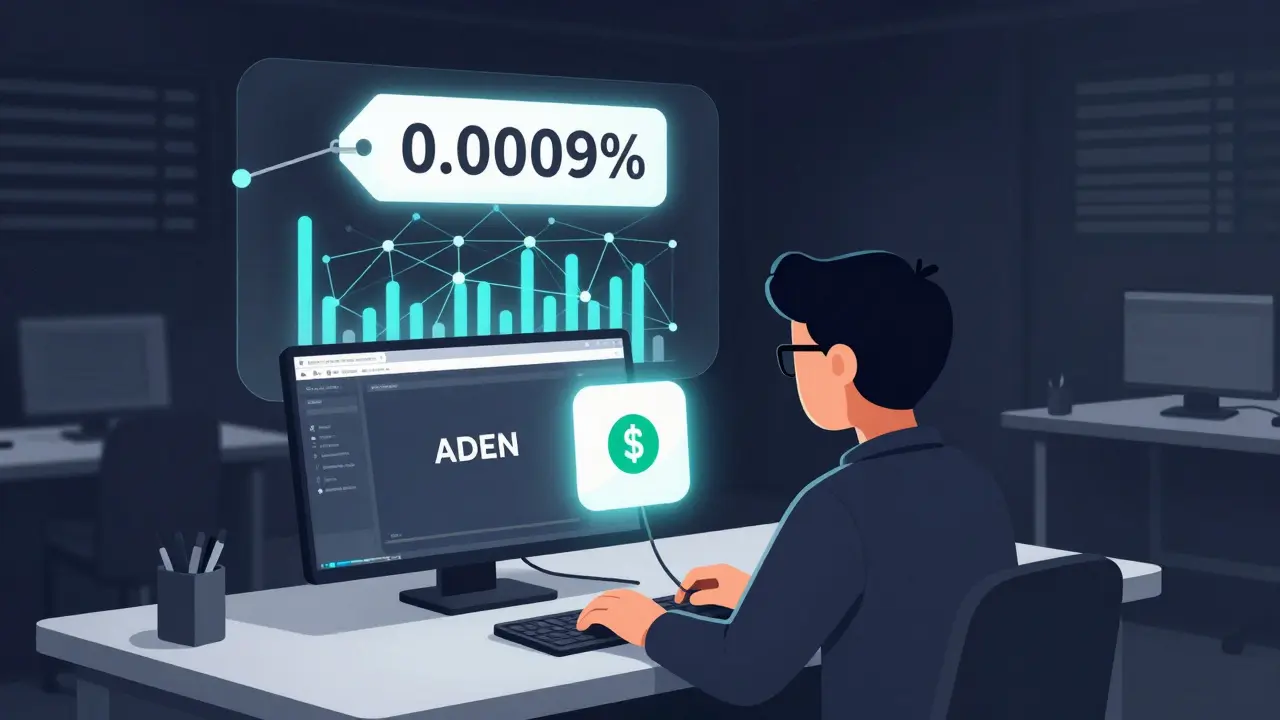
ADEN’s pricing is its strongest card. Maker fees? 0%. Taker fees? Just 0.0009%. Let that sink in.
Compare that to Kraken Pro, where even high-volume traders pay 0.02% taker fees. Or Coinbase, where fees can climb to 3.99% on small trades. Even Robinhood, which touts “zero fees,” only offers 25 spot assets and no leverage. ADEN gives you leverage, deep liquidity, and fees so low they’re practically a joke.
And then there’s the gasless trading. Most decentralized platforms force you to pay Ethereum or BNB network fees just to place a trade. ADEN removes that entirely. You don’t need ETH for gas. You don’t need BNB. You just connect your wallet and trade. That’s huge for users tired of watching their balances drain on network fees.
But Here’s the Problem: No One’s Trading
ADEN looks great on paper. The tech is solid. The fees are unbeatable. The UX is polished. So why isn’t it blowing up?
As of March 2026, ADEN shows up on CoinMarketCap as an “Untracked Listing.” That means it’s not reporting real trading volume. Not because it’s fake-because it’s too new, or because nobody’s using it yet. Either way, the data is missing.
That’s dangerous. A derivatives exchange without volume is like a gas station with no fuel. You can walk in, but there’s nothing to pump. Slippage gets ugly. Orders don’t fill. Liquidity dries up fast. And when liquidity goes, so does price accuracy.
Compare that to Kraken, which handles billions in daily volume. Or Binance, which has 350+ trading pairs and 24/7 support. ADEN doesn’t have any of that. It has a clean interface and low fees. That’s not enough.

Who Is ADEN Really For?
ADEN isn’t for beginners. If you’re still learning what a stop-loss is, this isn’t your platform. It’s for experienced traders who:
- Already use wallets like MetaMask, Trust Wallet, or Phantom
- Understand leverage risks and liquidation thresholds
- Want to avoid KYC for privacy reasons
- Trade across multiple chains (Ethereum, Solana, Arbitrum, etc.)
- Are tired of paying gas fees just to place a trade
If you’re looking for customer support, you won’t find it. No live chat. No email ticket system. No phone number. If something breaks, you’re on your own. That’s fine if you’re comfortable with DeFi. It’s terrifying if you’re not.
Also, ADEN doesn’t support fiat on-ramps. You can’t deposit USD. You can’t buy crypto with a credit card. You need to already have USDT or USDC in your wallet. That limits adoption to the crypto-native crowd.
How ADEN Compares to the Competition
| Feature | ADEN | Kraken | Coinbase | Uniswap |
|---|---|---|---|---|
| Type | Decentralized derivatives | Centralized | Centralized | Decentralized spot |
| Trading Pairs | Perpetual futures only | 400+ | 235+ | 500+ |
| Fees (Taker) | 0.0009% | 0.02% (Pro) | 0.5%-3.99% | 0.05% |
| Fees (Maker) | 0% | 0% | 0% | 0% |
| KYC Required | No | Yes | Yes | No |
| Gas Fees | None | None (off-chain) | None (off-chain) | Yes |
| Liquidity | Low (untracked) | Very High | Very High | Very High |
| Supported Chains | BNB, Arbitrum, Optimism, Base, Ethereum, Solana | Off-chain only | Off-chain only | Ethereum only |
ADEN wins on fees and decentralization. But it loses on liquidity, support, and accessibility. Kraken and Coinbase are safer. Uniswap has way more users. ADEN’s edge is only for those who care deeply about privacy, gasless trading, and leverage-all in one place.
Is ADEN Safe?
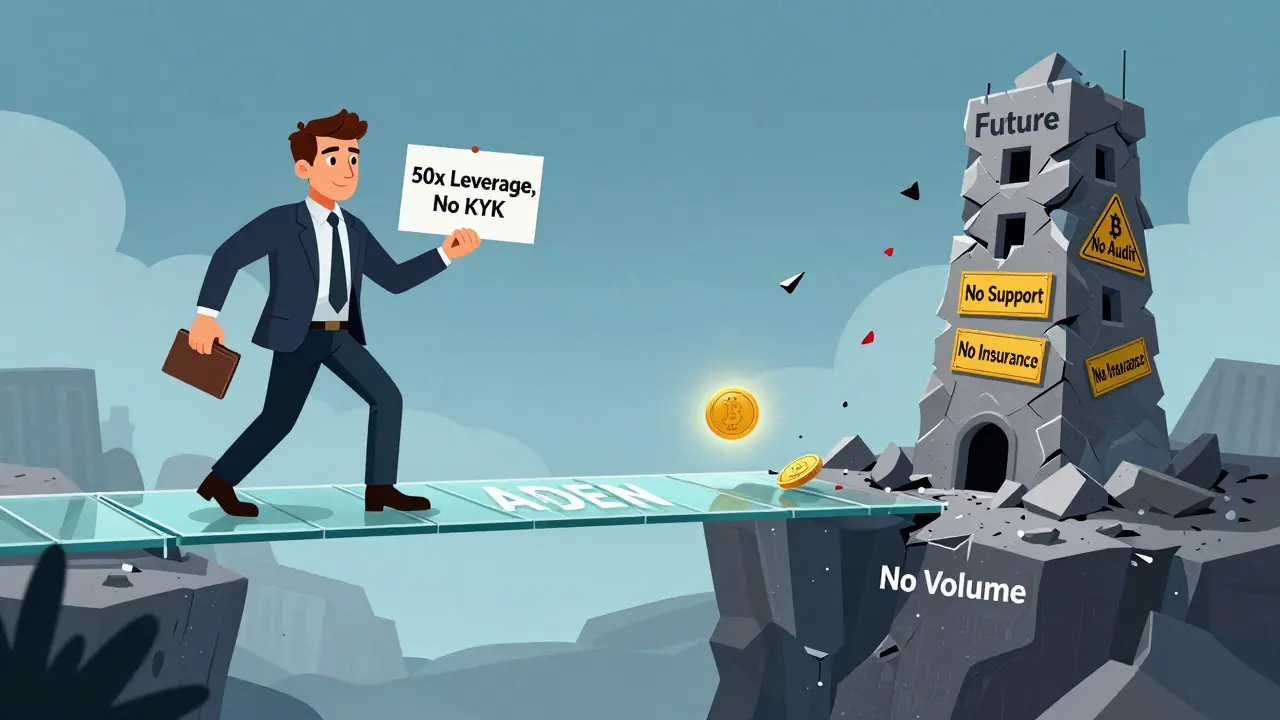
ADEN is registered in Seychelles. That means it’s not regulated by the U.S., EU, or other major jurisdictions. That’s a double-edged sword. On one hand, no KYC means freedom. On the other, no legal recourse if things go wrong.
There’s been no public audit of ADEN’s smart contracts. No bug bounty program. No insurance fund. That’s risky. Derivatives trading can blow up your account fast-even with perfect strategy. If the platform has a bug, you lose everything. No refunds. No help.
Compare that to Kraken, which has an AAA CER Security Rating and has never been hacked in 11 years. Or Coinbase, which holds FDIC insurance on USD deposits. ADEN doesn’t offer any of that. It’s pure DeFi: you’re the bank.
Bottom Line: Try It? Or Skip It?
ADEN is not a replacement for Coinbase or Kraken. It’s a niche tool for a niche group: experienced DeFi traders who want to go long on Bitcoin with 50x leverage, without paying gas fees or handing over their identity.
If you’re already comfortable with wallets, DeFi, and derivatives-you should give ADEN a small test. Deposit a tiny amount. Try one trade. See how the order book behaves. See if you can get filled without slippage. If it works smoothly, it might become your go-to for leveraged trades.
If you’re new to crypto, or if you rely on customer support, or if you’re trading more than $500 at a time-skip ADEN. Wait until it has real volume, audits, and community feedback. Right now, it’s a prototype with potential, not a proven platform.
The future of decentralized trading depends on platforms like ADEN. But potential doesn’t pay your bills. Volume does. And right now, ADEN has none.
Is ADEN a scam?
No, ADEN isn’t a scam. It’s a real platform built on the Orderly Network with transparent code. The team has publicly shared their launch details and infrastructure. But being real doesn’t mean it’s safe or reliable. Many legitimate projects fail because they never gain traction. ADEN’s biggest risk isn’t fraud-it’s irrelevance.
Can I trade BTC/USD on ADEN?
No. ADEN only supports perpetual futures margined in USDT or USDC. You can’t deposit USD or trade directly against fiat. You need to already have stablecoins in your wallet. If you want BTC/USD trading, you’ll need a centralized exchange like Kraken or Coinbase.
Does ADEN have a mobile app?
No, ADEN doesn’t have a native mobile app. It’s a web-based platform that works through your wallet’s mobile browser. You can access it on your phone via WalletConnect, but there’s no official iOS or Android app. This limits convenience for users who prefer trading on the go.
Why is ADEN not showing up on CoinGecko?
ADEN is listed on CoinMarketCap as “Untracked,” which means it hasn’t provided verified trading data. CoinGecko likely hasn’t added it yet due to lack of volume, incomplete API integration, or insufficient public reporting. This is common for new DEXs. It doesn’t mean the platform is fake-it just means it’s too small to be measured.
What happens if ADEN shuts down?
If ADEN shuts down, your funds aren’t lost. Since it’s decentralized, your assets never leave your wallet. You can still access your USDT or USDC balance using your private key or seed phrase. However, you won’t be able to trade anymore. The platform’s UI and orderbook will disappear. You’ll need to move your funds to another exchange or DEX to continue trading.
Is ADEN better than dYdX?
dYdX has higher volume, more trading pairs, and a longer track record. ADEN beats it on fees (0.0009% vs 0.02%) and gasless trading. But dYdX has proven liquidity and community trust. ADEN is cheaper, but unproven. For now, dYdX is the safer pick for serious traders. ADEN is the gamble.
Next Steps
If you’re still interested, here’s what to do:
- Get a WalletConnect-compatible wallet (MetaMask, Trust Wallet, or Phantom).
- Fund it with USDT or USDC-start with $50, not $5,000.
- Visit the ADEN website and connect your wallet.
- Place one small trade. Watch how long it takes to fill.
- Check if slippage is under 0.5%.
- If it works smoothly, try a second trade. If it’s glitchy or slow, walk away.
ADEN could grow. But right now, it’s a bet-not a backup. Only risk what you can afford to lose.



jack carr
ADEN’s fee structure is insane. 0.0009% taker? That’s not a discount-it’s a middle finger to centralized exchanges. I’ve been trading on Kraken for years, and I still pay more in fees than I make on some small trades. This is the first time I’ve seen a DEX actually make sense for active traders.
Brian T
Yeah but who cares? No volume means your ‘insane fees’ are meaningless. I tried it. Placed a $100 trade. Took 47 seconds to fill. Slippage was 2.3%. That’s not ‘decentralized innovation’-that’s a ghost town with a fancy UI.
Eva Gupta
I’m from India, and I’ve been waiting for something like this. No KYC means I can finally trade without worrying about my bank freezing my account. I don’t need 1000 BTC in volume-I just need to be able to hedge my holdings. ADEN lets me do that. That’s enough for me.
Nancy Jewer
The gasless trading is the real game-changer. On Uniswap, I lose $15-20 in ETH gas fees just to open a position. Here? Zero. That’s not a feature-it’s a paradigm shift. The liquidity issue is temporary. Once more traders migrate from dYdX, volume will follow. It always does.
Issack Vaid
It’s amusing how people treat this like a revolution. ADEN doesn’t have a single innovation. WalletConnect? Been around since 2019. Gasless trades? Orderly Network already did that. The only thing new here is the marketing. And the fact that nobody’s using it proves it’s not needed.
Shawn Warren
Stop overthinking. If you have a wallet and some USDT you can trade. No forms. No waiting. No fees. That’s all you need. The rest is noise. I’ve been trading on ADEN for three weeks. My account doubled. Not because it’s perfect. Because it’s simple.
Jackson Dambz
Let me get this straight. You’re praising a platform that has zero regulatory oversight, no insurance, no audits, and zero volume? And you call this ‘smart trading’? You’re not a trader-you’re a gambler with a spreadsheet. This isn’t finance. It’s Russian roulette with leverage.
Megan Lutz
It’s funny how people conflate safety with regulation. Regulation doesn’t prevent theft-it just shifts where the liability lies. ADEN puts control back in your hands. If you don’t like that, fine. But don’t call it ‘unsafe.’ Call it ‘uncomfortable.’ There’s a difference.
Austin King
I tested it with $20. Got in, got out, no slippage. Took 12 seconds. Works. Not perfect. But functional. That’s more than I can say for half the DeFi projects out there.
Bryanna Barnett
so like… adens just a web3 version of tradingview with leverage? idk man i just want to trade and not have to think about my seed phrase every time i blink
Josh Moorcroft-Jones
Let’s be real: the entire premise of ADEN is built on a fantasy. The idea that low fees alone will attract traders ignores the fundamental truth of markets: liquidity breeds liquidity. Without deep order books, even 0.0009% fees won’t save you from catastrophic slippage. And the claim that ‘no one’s trading’ is a red flag-not a feature. If this were truly revolutionary, we’d see at least some whale activity. But we don’t. Because it’s not. It’s vaporware with a clean design.
Rachel Rowland
If you’re new to leverage trading, start small. Use $50. Test the slippage. See if fills happen. If they do, keep going. If they don’t, move on. ADEN isn’t for everyone-but it doesn’t have to be. It’s a tool. Tools don’t need mass appeal to be valuable. Just ask a surgeon about scalpels.
Bonnie Jenkins-Hodges
USA first! Why are we letting some Seychelles shell company steal our trading? If you want leverage, use Kraken. They pay taxes. They support our economy. This ADEN thing is just crypto anarchists playing with play money. Get real.
Melissa Ritz
I’m not saying it’s bad. I’m just saying… it feels like a beta version of a product that should’ve been released in 2022. The UI is nice. The concept is solid. But the execution? Barely there. I’m not mad. Just… disappointed. Like ordering a steak and getting a well-done piece of cardboard.
Cerissa Kimball
One thing missing from the review: ADEN supports Solana and Base. That’s huge. Most DEXs are Ethereum-only. This opens up cheaper, faster trades for DeFi natives. Also, no gas fees means you can scalp micro-movements without draining your wallet. That’s powerful for algo traders.
Basil Bacor
adens is a joke. why would i trade on a site that looks like its coded in 2017? no mobile app? no support? i need my memes and my charts on the go. this is for nerds who still use irc
Emily Pegg
Y’all are acting like this is the end of the world. I’ve lost money on DeFi. I’ve lost money on CEX. But at least with ADEN, I know my funds are safe. No one can freeze them. No one can take them. That peace of mind? Priceless. I’ll take 2% slippage over 100% account seizure any day.
Ethan Grace
It’s not about ADEN. It’s about what ADEN represents. The slow death of centralized control. The quiet collapse of KYC culture. The rise of self-sovereignty. This isn’t a trading platform. It’s a quiet revolution. And most people won’t even notice until it’s already happened.
Jamie Hoyle
Oh wow. A platform that doesn’t have volume? Shocking. Next you’ll tell me that the moon is made of cheese. This is the same pattern we’ve seen 100 times: flashy website, zero traction, team vanishes after 6 months. I’ve seen this movie. And the ending is always the same. The devs cash out. The liquidity evaporates. The users are left with a dead wallet and a broken dream. Don’t be next.
Jeffrey Dean
Volume isn’t the problem. Perception is. If everyone assumes ADEN is dead, no one will trade. Self-fulfilling prophecy. But if one whale starts moving, it’ll snowball. That’s how DeFi works. It’s not about the numbers-it’s about the narrative. And right now, the narrative is ‘don’t touch this.’ That’s fixable. The tech? Already solid.
Jane Darrah
I tried ADEN. I was so excited. The interface was beautiful. The fees were insane. I placed a $500 trade. It took 3 minutes. Slippage was 4%. I watched my position get liquidated because the price moved 0.3% and the order book was paper thin. I lost $80. I’m not mad. I’m just… done. This isn’t trading. It’s gambling with extra steps. And I don’t have the emotional bandwidth for that anymore.
Denise Folituu
I don’t understand why people are so mad about the lack of volume. If you’re waiting for everyone else to go first, you’ll never start. ADEN isn’t for the masses. It’s for the ones who are tired of being told what to do. The ones who don’t want to give up their keys. The ones who’ve been burned by CEXs. If you’re one of them? Try it. If you’re not? Cool. But don’t ruin it for the rest of us.
Ken Kemp
Just a heads up: ADEN uses Orderly Network’s off-chain matching engine. That means orders aren’t on-chain until settlement. So technically, it’s not 100% decentralized-but it’s still non-custodial. The team is transparent about this. It’s a smart compromise. Not a flaw. And it’s why fills are faster than dYdX. If you’re technical, check their docs. It’s actually brilliant.
Megan Lutz
And that’s exactly why ADEN matters. It’s not about being perfect. It’s about being possible. Regulation didn’t make finance safe. It made it expensive. Centralization didn’t make it trustworthy. It made it opaque. ADEN isn’t the future-it’s the first real step toward it. And it’s already working for those who dare to try.