Benefits of Holding Governance Tokens: Power, Profit, and Pitfalls
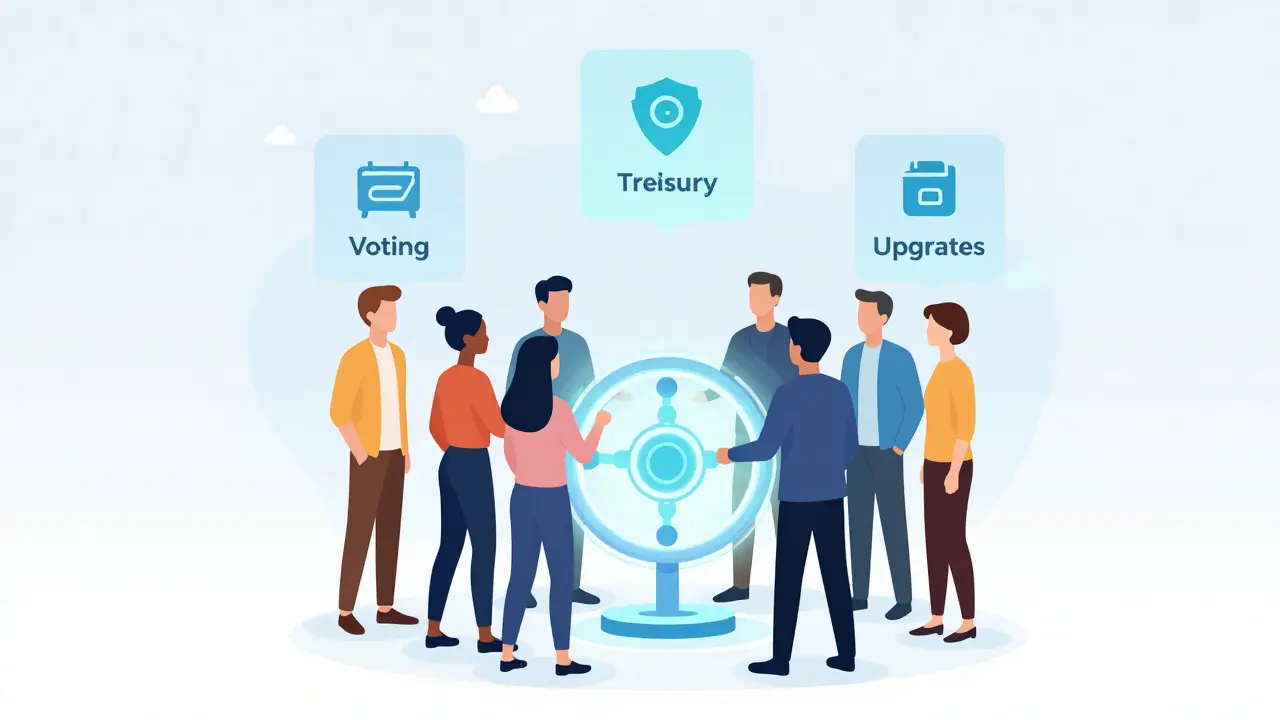
Imagine owning a share in a company but having actual say over its daily operations, not just hoping the board of directors makes good choices. That is the core promise of holding governance tokens. In the world of decentralized finance (DeFi), these digital assets are more than just speculative investments; they are keys to power. They allow holders to vote on protocol upgrades, fee structures, and treasury allocations. But does holding them actually pay off? Or is it just another buzzword in the crypto space?
Key Takeaways
- Governance tokens grant voting rights on critical protocol decisions, shifting control from centralized teams to the community.
- Holders can earn passive income through staking rewards and liquidity provision incentives tied to their governance status.
- Token value often correlates with protocol success, as active governance drives adoption and ecosystem growth.
- Risks include low voter turnout, plutocracy (wealth concentration), and evolving regulatory scrutiny regarding security classification.
What Are Governance Tokens Really?
To understand the benefits, we first need to define what we are talking about. A governance token is a cryptocurrency that grants its holder voting power within a specific decentralized protocol or Decentralized Autonomous Organization (DAO). Unlike utility tokens, which might just give you access to a service, or security tokens, which represent equity in a traditional sense, governance tokens are about control.
Think of protocols like Uniswap or Aave. These are not companies with CEOs. They are code running on blockchains. Who decides if the code gets updated? Who decides how fees are distributed? The token holders do. When you hold UNI or AAVE, you are essentially a shareholder with a direct line to the steering wheel. This model emerged prominently around 2019-2020, with MakerDAO's MKR token often cited as one of the earliest implementations of this concept.
The Power of Voting: Shaping Protocol Direction
The most immediate benefit of holding governance tokens is the ability to influence the future of the project. This isn't symbolic; it's operational. Holders vote on proposals that determine:
- Protocol Upgrades: Should the platform integrate a new blockchain network? Should interest rate models be adjusted?
- Treasury Management: How should the protocol's reserve funds be invested? Should grants be given to developers building tools for the ecosystem?
- Fee Structures: What percentage of transaction fees goes to liquidity providers versus being burned or added to the treasury?
- New Partnerships: Which external projects should the protocol collaborate with?
For example, in March 2022, Uniswap token holders voted to allocate $160 million from the protocol's treasury to the Uniswap Community Growth Fund. This wasn't a decision made by executives in a boardroom. It was a collective decision by the community. If you held UNI at that time, your vote helped shape that outcome. This level of transparency and agency is impossible in traditional corporate structures.
Economic Incentives: Staking and Rewards
Beyond political power, there are tangible financial benefits. Many protocols incentivize holding and locking up governance tokens to prevent short-term speculation and encourage long-term commitment. This is often done through staking mechanisms.
When you stake your governance tokens, you lock them in a smart contract. In return, you might receive:
- Staking Rewards: Protocols may distribute newly minted tokens or a portion of protocol revenue to stakers. For instance, some platforms reward users who stake their tokens to secure the network or participate in governance with additional yield.
- Liquidity Mining Bonuses: Holding governance tokens can qualify you for higher yields when providing liquidity on decentralized exchanges (DEXs). Some pools offer boosted APY (Annual Percentage Yield) to those who also hold the native governance token.
- Revenue Sharing: Certain DAOs distribute a cut of their profits directly to token holders. This turns the token into a cash-flow-generating asset, similar to a dividend-paying stock, but without the middleman.
This creates a powerful alignment of incentives. You want the protocol to succeed because its success increases the value of your token and the size of your rewards. It’s a flywheel effect: better governance leads to better products, which attracts more users, which generates more fees, which rewards holders.
Value Appreciation Through Ecosystem Growth
Governance tokens are not static assets. Their value is intrinsically linked to the health and adoption of the underlying protocol. As a protocol grows, the demand for its governance token often rises. Why? Because more people want a say in the growing pie.
Consider the relationship between Total Value Locked (TVL) and token price. When a DeFi protocol like Aave sees an increase in TVL, it means more capital is trusting and using the platform. This increased usage often leads to higher trading volumes and fees. If the governance structure allows for fee sharing or buybacks, the token becomes more valuable. Even if it doesn’t, the market perceives the token as more valuable because it represents ownership in a thriving ecosystem.
Furthermore, successful governance signals stability. Investors prefer protocols where decisions are made transparently and democratically over those controlled by a single entity that could rug-pull or make unilateral mistakes. Therefore, effective governance can drive institutional adoption, further boosting token value.
Comparison: Governance Tokens vs. Traditional Assets
How do governance tokens stack up against other investment vehicles? Let’s break it down.
| Feature | Governance Tokens (e.g., UNI, AAVE) | Traditional Stocks | Utility Tokens (e.g., Filecoin) |
|---|---|---|---|
| Voting Rights | Direct on-chain voting on protocol changes | Voting at annual shareholder meetings (limited impact) | Usually none or limited to feature access |
| Ownership Structure | Decentralized, community-led | Centralized corporate hierarchy | Centralized development team |
| Liquidity | High (24/7 trading on DEXs/CEXs) | Moderate (market hours only) | High (if listed on major exchanges) |
| Regulatory Status | Evolving, potential security risks | Well-defined, regulated | Generally considered commodities |
| Barrier to Entry | Low (buy on any exchange) | Medium (brokerage account required) | Low |

Pitfalls and Risks: It’s Not All Sunshine
While the benefits are compelling, you cannot ignore the risks. Governance tokens are volatile and experimental. Here is what you need to watch out for.
Plutocracy and Whale Dominance
In many DAOs, voting power is proportional to token holdings. This means "one token, one vote." Large holders, known as whales, can dominate decisions. If a few entities hold a significant percentage of the supply, they can push through proposals that benefit them at the expense of smaller holders. This undermines the democratic ideal and can lead to centralization despite the decentralized appearance.
Low Voter Turnout
Even if you want to vote, will anyone else? Low participation rates are common in many DAOs. Often, less than 5% of eligible voters participate in proposals. This means a small, unrepresentative group effectively controls the protocol. Your vote matters less if the quorum is tiny. This apathy can stem from complexity, lack of awareness, or simply not caring enough to spend gas fees on voting.
Regulatory Uncertainty
The legal landscape for governance tokens is murky. In 2025, regulators like the U.S. Securities and Exchange Commission (SEC) have indicated that tokens marketed for profit or tied to central management may be classified as securities. If a governance token is deemed a security, it could face strict compliance requirements, delisting from exchanges, or even bans in certain jurisdictions. This adds a layer of risk that traditional stocks do not have.
Smart Contract Risk
Governance tokens exist on blockchains and rely on smart contracts. If the code governing the token or the voting mechanism has bugs, it can be exploited. Hacks and exploits in DeFi protocols have resulted in millions of dollars lost. Always research the security audits of the protocol before investing.
How to Start Participating in Governance
If you decide the benefits outweigh the risks, here is how to get started.
- Choose a Protocol: Research established projects with active communities. Look for high TVL, regular proposal activity, and transparent communication. Uniswap, Aave, and MakerDAO are good starting points.
- Acquire Tokens: Buy the governance token on a reputable exchange. Ensure you are buying the correct token version (e.g., ERC-20 standard).
- Set Up a Wallet: Use a non-custodial wallet like MetaMask or Ledger. Connect it to the protocol’s governance dashboard.
- Delegate or Vote: If you don’t have time to read every proposal, consider delegating your voting power to a trusted representative. Alternatively, review proposals on forums like Discourse or Snapshot and cast your vote directly on-chain.
- Stay Informed: Follow the protocol’s social channels, read governance reports, and engage with the community. Knowledge is power in governance.
Future Outlook: Evolution of Governance
The space is evolving rapidly. We are seeing innovations like quadratic voting (where voting power increases logarithmically with token holdings to reduce whale dominance) and reputation-based systems (where past contributions weight votes). There is also a trend toward integrating governance tokens with traditional finance, potentially bridging DeFi and legacy banking systems. As these models mature, the benefits of holding governance tokens could become even more pronounced, offering a hybrid of financial return and civic engagement.
What is the difference between a governance token and a utility token?
A utility token primarily grants access to a product or service, such as paying for storage on a network. A governance token grants voting rights and decision-making power over the protocol's future direction, upgrades, and treasury management.
Can I lose money holding governance tokens?
Yes. Like all cryptocurrencies, governance tokens are highly volatile. Their value can drop due to market sentiment, poor protocol performance, regulatory crackdowns, or smart contract hacks. Additionally, if you stake tokens, they may be locked for a period during which their value could decrease.
Do I need a large amount of tokens to vote?
It depends on the protocol. Most allow any token holder to vote, though some require a minimum threshold to submit proposals. However, your voting weight is usually proportional to your holdings, so larger holders have more influence.
Are governance tokens considered securities?
The regulatory status is unclear and varies by jurisdiction. Regulators like the SEC may classify some governance tokens as securities if they are seen as investments relying on the efforts of others. This carries legal risks for holders and issuers.
How do I delegate my voting power?
Most governance dashboards have a "Delegate" tab. You enter the address of a trusted representative, and they will vote on your behalf according to their stated preferences. You can change or revoke delegation at any time.