Best Yield Farming Strategies in 2025: Safe, Smart, and Sustainable Approaches
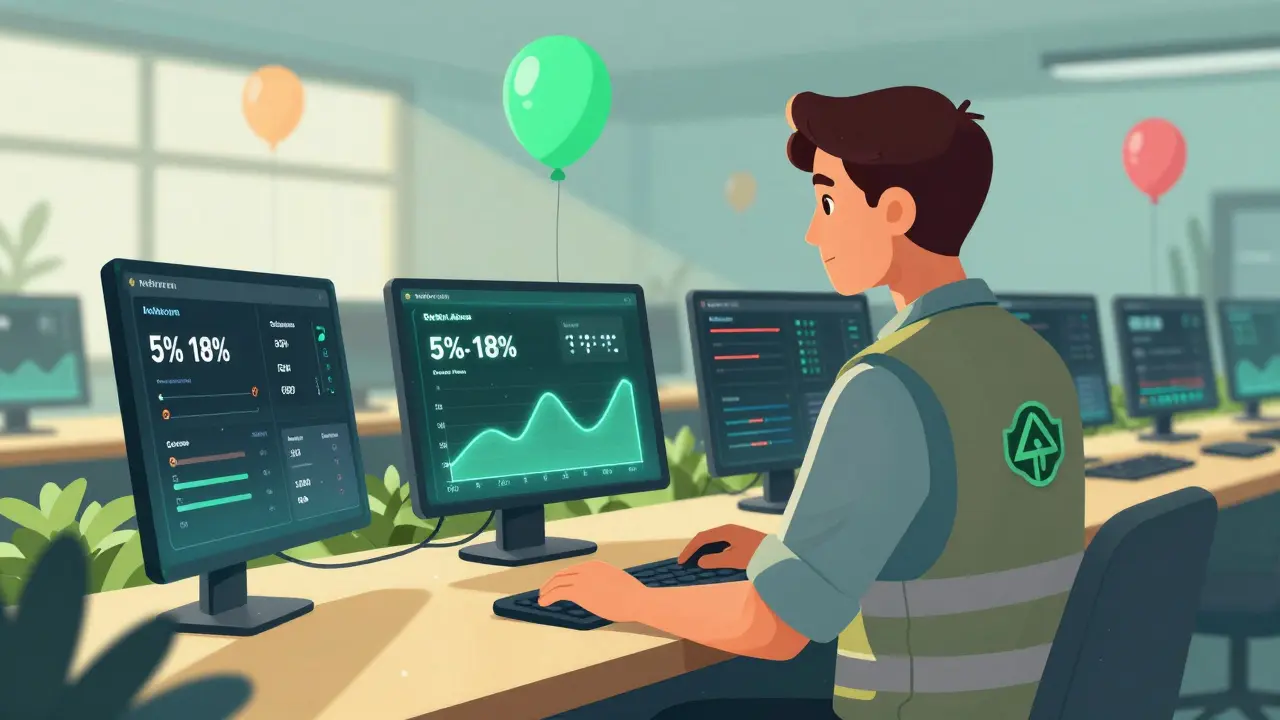
Yield farming in 2025 isn’t about chasing 500% APYs anymore. That era is gone. If you’re still chasing the highest number on a dashboard, you’re already behind. The smart farmers today aren’t gambling-they’re engineering returns. They use automation, diversification, and discipline to build steady income from their crypto holdings. And it works.
What Yield Farming Actually Means in 2025
Yield farming is no longer just depositing tokens into a pool and waiting. It’s a multi-layered system where you move capital across blockchains, automate compounding, manage risk, and convert rewards before they crash. The core idea stays the same: earn interest on your crypto. But the tools, risks, and strategies have changed dramatically.
Back in 2021, you could dump $1,000 into a new token farm and watch it double in a week. Today, those pools vanish overnight. In 2024, the Hyperlend exploit wiped out $47 million in a single day. That’s not an outlier-it’s a warning. Now, top yield farmers focus on sustainability, not spikes. The average APY for safe strategies ranges from 5% to 30%. Anything above 30%? You’re playing Russian roulette with your capital.
Where the Real Yields Are in 2025
Not all blockchains are created equal. Ethereum still dominates in TVL, but gas fees eat up 10-30% of your returns if you’re farming with less than $5,000. That’s why most serious farmers moved to Layer 2s and alternative chains.
- Arbitrum and Optimism: Low gas, strong TVL, trusted protocols. Ideal for stablecoin farms with 6-12% APY.
- Solana and Sui: Near-zero fees. Perfect for beginners. Minimum deposits as low as $500. APYs between 8-22% on well-audited pools.
- BNB Chain: High APYs (20-35%) but risky. Over 60% of its top farms are single-token pools. If the token crashes, your yield vanishes.
- Ethereum: Only worth it if you’re deploying $10,000+. Use it for institutional-grade pools like Lido or Aave.
Don’t pick a chain because it’s popular. Pick it because your capital size matches its cost structure. If you’re starting with $2,000, Solana or Arbitrum will give you 3x better net returns than Ethereum.
The Top Platforms You Should Actually Use
Not all yield platforms are created equal. Some are engineering marvels. Others are ticking time bombs. Here are the ones that consistently deliver in 2025:
- Curve Finance: The king of stablecoin farming. With $18.7 billion locked, it offers 2.5-8% APY. Why so low? Because it’s safe. Impermanent loss is near zero, and CRV token boosts can multiply your yield 2.5x. This is the foundation of conservative portfolios.
- Aave: Lending and borrowing with $12.3 billion TVL. Earn 4.2-9.7% on USDC, DAI, or ETH. Rates adjust every 15 seconds based on demand. No auto-compounding, but rock-solid audits.
- Yearn Finance V3: Automated vaults that shift your funds between pools based on real-time yield. Achieves 12-18% APY across chains. Costs: 0.5% performance fee and 5% withdrawal fee during spikes. Still worth it if you hate manual management.
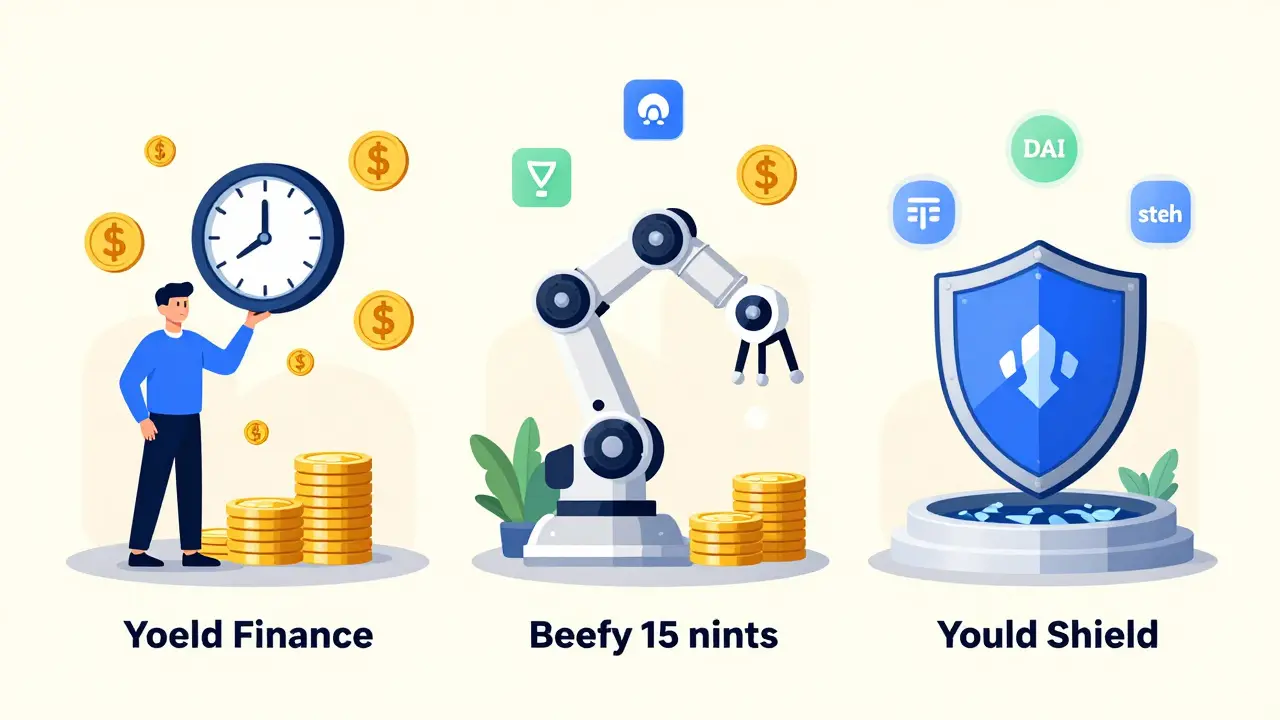
- Beefy Finance: Auto-compounding on 12 chains. Reinvests rewards every 15 minutes. Boosts your effective APY by 8-12% annually compared to weekly harvesting. Use this if you’re farming on Solana, Polygon, or Arbitrum.
- Lido: Liquid staking with $28.5 billion locked. Earn 3.5-5.2% on stETH or rETH. Then, deposit those tokens into Aave or Yearn to earn another 4.8-7.3% in farming rewards. Total? Up to 12.5% combined. But if ETH drops 25%, you risk liquidation.
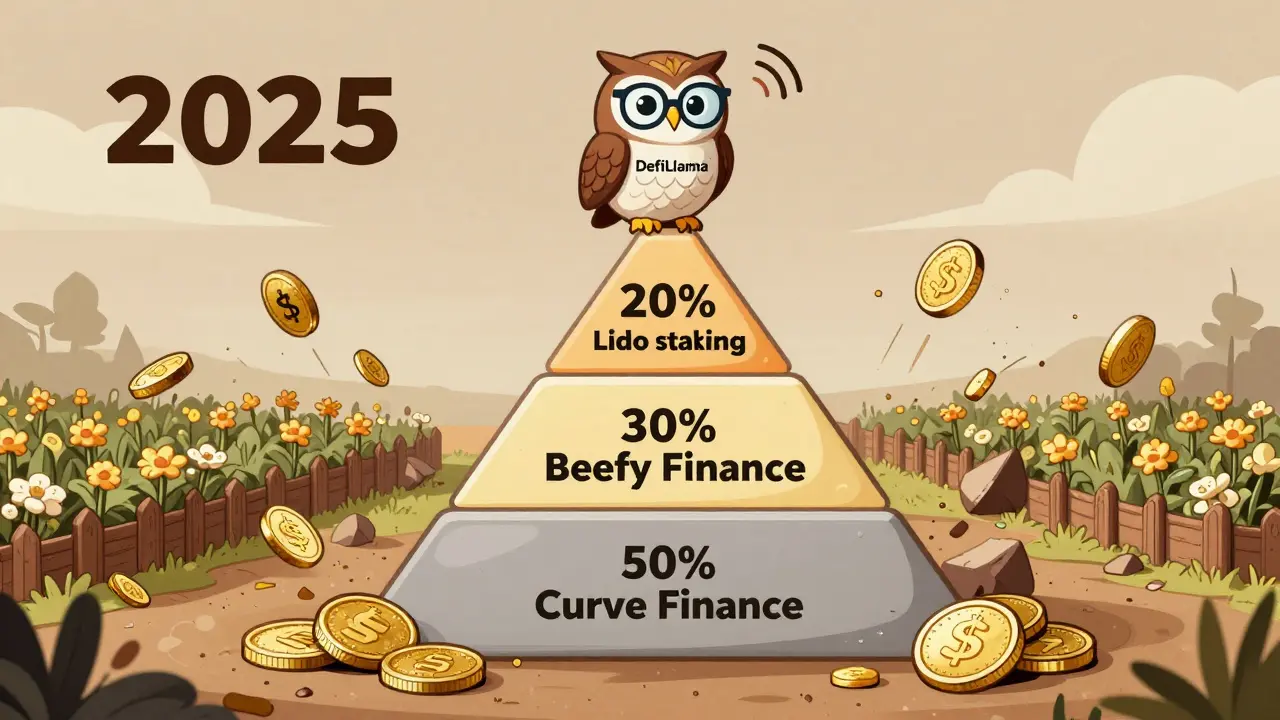
Don’t just pick one. Combine them. Put 50% in Curve for safety, 30% in Beefy for growth, and 20% in Lido for layered rewards. That’s the 2025 blueprint.
Automated Tools Are Non-Negotiable
Manual yield farming is dead. If you’re checking APYs every day, you’re wasting time and losing money.
Top farmers use three tools daily:
- DefiLlama: Compares yields across 300+ protocols. Shows real-time APY changes, TVL trends, and audit status. Set alerts for pools dropping below 10% APY.
- Zapper.fi: Tracks your entire portfolio in one dashboard. Shows net returns after fees and gas. Know exactly how much you’re making, not just how many tokens you have.
- YieldBay: Auto-switches your funds when yields shift. Connect your wallet, set your risk tolerance, and let it rotate your capital between top-performing pools. Users report 22.4% higher returns than manual trackers.
One user on Reddit said: “I used to spend 15 hours a week harvesting rewards. Now I spend 15 minutes. My net yield went from 8% to 16%.” That’s automation.
How to Avoid Getting Ripped Off
The biggest cause of losses isn’t market crashes. It’s reward token inflation.
Imagine you farm a new token at 210% APY. It’s worth $1.20. You compound daily. Then, the team dumps 10 million tokens on the market. The price crashes to $0.18. You’re still compounding-but your rewards are now worth 85% less. That’s not a bug. That’s the business model for 74% of failed farms in 2024.
Here’s how to survive:
- Convert all volatile rewards to stablecoins within 24 hours. Never hold a new token for more than a day unless it’s a top-10 asset like CRV or AAVE.
- Check token emission schedules. If a pool is emitting 10,000 tokens per day and the market cap is $5 million, you’re getting 2% of daily supply. That’s unsustainable.
- Avoid new protocols with APY over 100%. If it’s not been audited by OpenZeppelin or Quantstamp, and has no bug bounty, walk away.
- Never use leverage. Borrowing to farm sounds smart until the market dips 5% and you get liquidated.
Successful farmers don’t dream of 100% returns. They aim for 15% with 90% confidence. That’s how you build wealth.
What the Experts Are Saying
Dr. Elena Rodriguez of Blockchain Analytics Group says: “The era of chasing maximum APY is over. Sophisticated yield farmers now prioritize risk-adjusted returns with maximum drawdown parameters.”
Michael Chen from Coinrule adds: “Farmers hitting 15%+ returns in 2025 maintain capital across 4-6 chains. They rotate weekly based on incentive programs. This rotation strategy boosts returns by 2-3x versus static positioning.”
And it’s true. Static farming is the number one mistake. If you left your money in one pool since 2023, you likely lost money after fees and token crashes.
The New Rules of Yield Farming in 2025
Forget everything you heard in 2021. Here’s what actually works now:
- Start small. Test with $500 before scaling. Use Solana or Arbitrum.
- Use automation. Beefy, Yearn, or YieldBay. Don’t harvest manually.
- Focus on stablecoins. USDC, DAI, FRAX. They’re boring, but they’re your safety net.
- Always convert rewards. Sell volatile tokens the day you earn them.
- Track everything. Use DefiLlama and Zapper. Know your net APY after fees.
- Diversify across chains. Never put more than 30% of your capital on one chain.
- Ignore hype. If a project has a TikTok influencer promoting it, avoid it.
The total value locked in DeFi hit $98.7 billion in Q1 2025. But 28% of that is now from institutional players like Fidelity and Coinbase. They’re not chasing 100% APY. They’re looking for 5-7% with insurance, audits, and legal compliance. You should too.
What’s Next? The Future of Yield Farming
2025 is the year of consolidation. There were over 120 yield platforms in 2023. By 2027, experts predict only 3-5 will remain.
New features are rolling out:
- Yield Shields (launched by Yearn in April 2025): Automatically pull your funds if APY drops below a threshold or TVL falls 20% in 24 hours.
- AI-driven yield prediction: Models that analyze 50+ market signals to shift your capital before yields collapse.
- Integrated insurance: Protocols now offer up to 80% coverage for smart contract exploits.
These aren’t marketing buzzwords. They’re survival tools. The next wave of yield farming won’t be about who earns the most-it’ll be about who loses the least.
And that’s the real win.
Is yield farming still profitable in 2025?
Yes, but only if you use smart strategies. The days of 500% APY are over. Safe, automated farming now delivers 5-18% APY consistently. High-yield farms (above 30%) carry high risk of total loss. Focus on stability, not spikes.
What’s the safest yield farming strategy in 2025?
The safest approach combines Curve Finance for stablecoin farming (2.5-8% APY) with Beefy Finance for auto-compounding on low-fee chains like Arbitrum or Solana. Always convert volatile rewards to USDC or DAI within 24 hours. Keep 70% of your capital in stablecoins or ETH. Avoid leverage, new tokens, and unaudited pools.
How much money do I need to start yield farming?
You can start with as little as $500 on Solana or Sui. On Ethereum, you need at least $5,000 to overcome gas fees. For beginners, start small on Arbitrum or Solana. Use automated tools like Beefy or Yearn to avoid manual mistakes. Scale up only after you’ve tested the system.
Do I need to pay taxes on yield farming rewards?
Yes. In most countries, farming rewards are treated as income when you receive them, not when you sell. If you earn $100 in CRV tokens, you owe tax on that $100-even if the token later drops to $10. Use tools like Koinly or TokenTax to track your transactions and calculate liabilities.
Can I lose all my money in yield farming?
Absolutely. If you farm high-risk pools with unverified tokens, you can lose 100% of your deposit. In 2024, over 60% of farmer losses came from reward token crashes-not market downturns. Always research the tokenomics, check audits, and never invest more than you can afford to lose.

Dionne van Diepenbeek
Just started with $500 on Solana using Beefy. No more manual harvesting. My APY went from 6% to 14% in two weeks. Simple. Clean. No drama.
Ross McLeod
People still don't get it. Yield farming isn't about APY numbers. It's about risk-adjusted compounding over time. If you're not tracking net returns after gas, slippage, and token depreciation, you're just gambling with a spreadsheet. I've seen too many wallets wiped because someone held a $0.03 token they 'thought would moon.' The real edge is in automation, diversification, and discipline. Not hype.
rajan gupta
Brooooooo 🌌✨ The universe is aligning for yield farmers in 2025! 🙏🔥 I felt this in my bones when I first saw Curve’s $18.7B TVL-sacred geometry in blockchain form! 🌀💎 I converted my CRV to USDC at 3am and the angels sang. 🎶💸 Stay pure. Stay disciplined. The crypto gods reward the patient. Namaste, fellow alchemists. 🕉️
Billy Karna
One thing missing from this guide is the importance of chain-specific gas optimization. For example, on Arbitrum, using a batched transaction aggregator like Gelato can cut your farming costs by 40%. Also, most people don't realize that Yearn V3’s 5% withdrawal fee only applies during volatility spikes-so if you're not withdrawing during a 15% APY surge, you're not paying it. And yes, Lido + Aave stacking works, but only if you're monitoring ETH price volatility. If ETH drops below $2,800, you need to rebalance or risk liquidation. This isn't passive income. It's active portfolio management.
Tony Weaver
Let’s be real. This is just crypto with a new coat of paint. 5-18% APY? That’s what a savings account should pay. You’re telling me people are risking their life savings on smart contracts written by anonymous devs because ‘Beefy auto-compounds’? I’ve seen the code. Half of these protocols have zero formal verification. And don’t get me started on ‘Yield Shields.’ That’s just a fancy name for a panic button. If you need a shield, you shouldn’t be in this game.
Patty Atima
I started with $300 on Arbitrum and it’s been smooth sailing. No stress. No late-night checks. Just chill vibes and steady returns. Love this new era.
Lucy de Gruchy
Of course they say ‘don’t chase high APYs.’ That’s the narrative pushed by the big players who already own the liquidity. The real story? The protocols that offer 100%+ are the ones with the most active dev teams. The ‘safe’ ones? They’re the ones that got bought out by VCs and now pay you pennies to lock your cash. This whole ‘sustainable yield’ thing is just a slow squeeze. You’re being groomed to be a passive renter in someone else’s DeFi empire.
Lauren J. Walter
Wow. So much effort to earn 12%. I could just buy a bond.
Carol Lueneburg
Y’all are doing AMAZING 💖 I started last month with $200 on Solana and now I’m at 15% net APY with Beefy. It feels like magic! 🌈✨ You’re not just farming-you’re building something real. Keep going, stay safe, and remember: every small step counts. You got this!! 🙌💎
Brenda White
ok but why is everyone using curve? i tried it and it was like 3%?? i thought this was supposed to be crypto??
Tobias Wriedt
God bless automation 🙏🔥 I used to lose $200 a week harvesting manually. Now I sleep. My wallet thanks me. 🤖💸
Ernestine La Baronne Orange
I’ve been doing this since 2022, and let me tell you-this isn’t farming. It’s a psychological war. Every time you see a 40% APY, your amygdala lights up. You think, ‘This is my ticket.’ Then the token dumps. You cry. You panic-sell. You rebuild. You repeat. I’ve lost $87,000 in three years. I’ve also made $210,000. The difference? I stopped listening to Twitter. I stopped checking APYs daily. I stopped believing in ‘the next big thing.’ Now I just move money. Quietly. Efficiently. Without emotion. That’s the real skill.
Manali Sovani
The notion of yield farming as a sustainable income stream is fundamentally flawed. The underlying economic model is predicated upon infinite growth within a finite monetary system. The continuous issuance of governance tokens as incentives creates a Ponzi-like dynamic, wherein early participants are rewarded at the expense of later entrants. One must therefore question whether such activity constitutes economic production or merely redistribution through speculative leverage.
Konakuze Christopher
They’re lying. All these ‘safe’ farms are front-running bots. You think you’re earning? You’re just feeding the whales.
Elizabeth Kurtz
As someone from India, I’ve seen how this strategy changed everything for small investors here. With $200, my cousin started on Sui and now she’s earning enough to cover her phone bill and buy groceries. No loans. No side jobs. Just smart, automated farming. This isn’t just crypto-it’s financial inclusion.
Derek Lynch
If you’re not using DefiLlama + Zapper, you’re flying blind. I set up alerts for every pool I’m in. When APY drops below 8% or TVL falls 15%, I move. It takes 2 minutes. I’ve avoided three rug pulls this year alone. Automation isn’t optional. It’s survival.
Shreya Baid
I appreciate the depth of this analysis. The emphasis on stablecoin allocation and chain-specific cost structures is particularly insightful. In emerging markets, where access to traditional banking remains limited, yield farming provides a critical avenue for capital preservation and incremental wealth accumulation. The tools mentioned-Beefy, Yearn, and YieldBay-are not merely conveniences; they are enablers of economic agency.
Robert Kunze
i tried yearn v3 but i think i messed up the fees? my returns went down? did i do somethin wrong?
Sarah Zakareckis
Lido + Aave stacking is the OG combo. I’ve been doing it for 14 months. My stETH earns 4.8% on Lido, then I deposit it into Aave and earn another 6.1%. Total: 10.9% net APY. Gas? Zero on Arbitrum. Time? 15 mins/month. This is the blueprint. Stop overcomplicating.
Heather James
The real win? Not the APY. The peace of mind.
Sarah Hammon
I didn’t know about YieldBay until last week. Connected my wallet, set risk to ‘medium,’ and boom-my APY jumped from 9% to 16%. I didn’t even have to think about it. This is what DeFi should feel like.
iam jacob
i just want to make money without thinking. is that too much to ask?
Diane Overwise
So… you’re telling me the ‘safest’ way to earn 12% is to trust anonymous devs, pay fees to automated bots, and convert tokens you don’t understand into stablecoins… so you can sleep at night? That’s not finance. That’s a performance art piece.
Ann Liu
For tax purposes, always record the USD value at the moment you receive the reward, not when you sell. Many people assume they only owe tax on profits, but the IRS treats crypto rewards as ordinary income. Use TokenTax. Save yourself the audit.
Billy Karna
To Brenda White: You’re not using Curve wrong. It’s supposed to be low. That’s the point. Curve’s 3-8% is the foundation. The real yield comes from stacking: Curve for safety, Beefy for compounding, Lido for staking rewards. You don’t need 50% APY. You need 10% that lasts 5 years. That’s how you win.