Bitcoin ETF History in Canada: First Approvals and How They Changed Global Investing

Bitcoin ETF Comparison Tool
Spot vs Futures Bitcoin ETFs
Choose the type of Bitcoin ETF you want to learn about:
On February 18, 2021, something huge happened in finance - not in New York, not in London, but in Toronto. The Bitcoin ETF became real for everyday investors. The Ontario Securities Commission approved the Purpose Bitcoin ETF (ticker: BTCC), and for the first time ever, anyone with a brokerage account could buy Bitcoin like they would buy Apple or Tesla shares. No wallets. No private keys. No worrying about getting hacked. Just click, buy, and hold.
Why Canada Got There First
The U.S. had been talking about a Bitcoin ETF for nearly a decade. Regulators kept saying no - citing market manipulation, lack of custody, and unregulated exchanges. Meanwhile, Canada took a different approach. The OSC didn’t wait for perfect conditions. They looked at what investors actually needed: simple, regulated, secure access to Bitcoin. Purpose Investments, a Toronto-based asset manager led by Som Seif, built a product that met every regulatory requirement. It held real Bitcoin, not futures. It used trusted custodians. It reported daily net asset values. It was transparent. That’s what made the difference. The OSC didn’t block innovation - they shaped it. And that’s why, when Purpose launched BTCC, it didn’t just get approved. It exploded.The Launch That Shook the World
The first day of trading, BTCC moved over $200 million in volume. By day two, it hit $400 million. Within 30 days, the fund had over $1 billion in assets under management. That’s faster than any ETF in history. Even more impressive? It kept growing. By early 2024, it held more than $2 billion in Bitcoin. That’s not a fluke. That’s demand. Retail investors rushed in. So did institutions. Pension funds, family offices, even banks started using BTCC as a way to get Bitcoin exposure without dealing with crypto exchanges. And because it was eligible for RRSPs and TFSAs, Canadians could hold Bitcoin in their retirement accounts - tax-free or tax-deferred. That was a game-changer.How It Worked (And Why It Mattered)
Most crypto products before this were either unregulated exchanges or futures-based ETFs. Futures are complicated. They’re bets on Bitcoin’s price, not actual ownership. The Purpose ETF was different. Every share you bought meant the fund bought a real Bitcoin and locked it away in cold storage. It was like buying gold in an ETF - except it was Bitcoin. The structure was simple: when demand went up, authorized participants bought Bitcoin and swapped it for new ETF shares. When people sold, the shares were redeemed for Bitcoin and sold back into the market. This kept the price tightly aligned with Bitcoin’s actual value. By day three, the premium to net asset value was just 0.2%. That’s near-perfect tracking. No wild swings from speculation. Just clean exposure.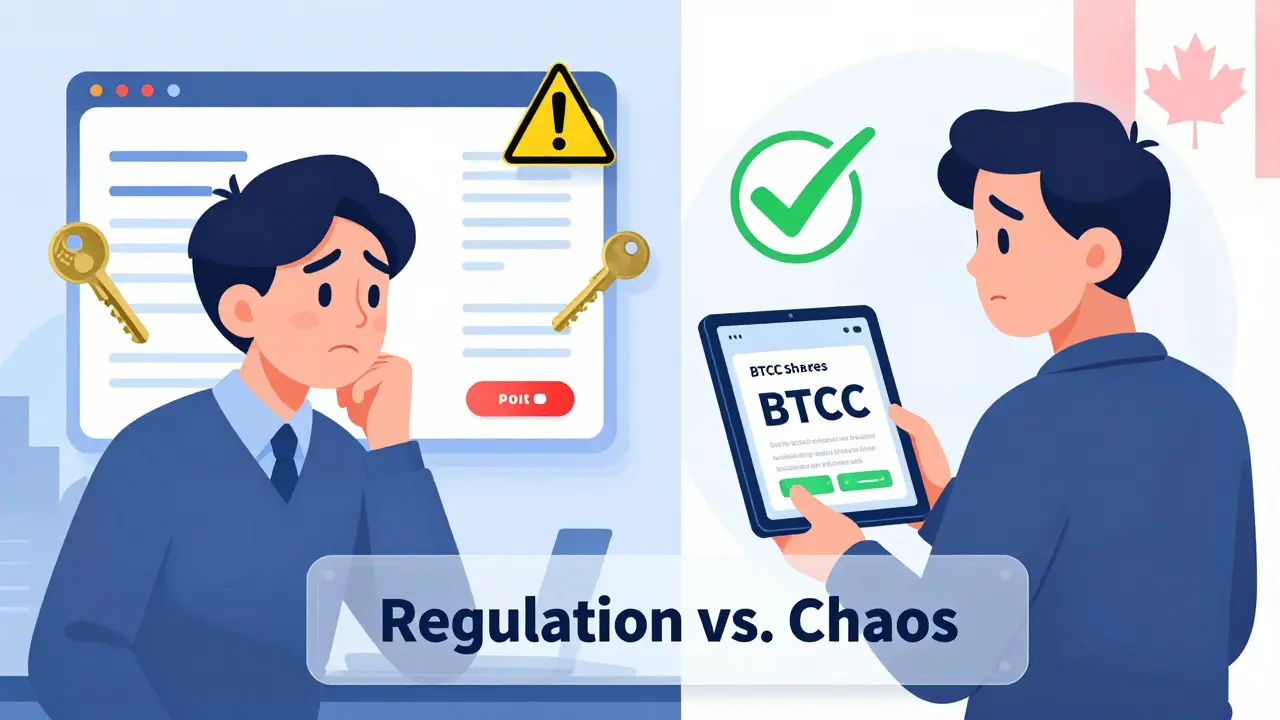
What Happened Next - And Why It Mattered Everywhere
One day after Purpose launched BTCC, Evolve ETFs rolled out its own Bitcoin ETF. Canada now had two. The market didn’t split - it doubled. Trading volume kept climbing. By the end of the first week, Canadian Bitcoin ETFs had traded nearly $1 billion in shares. That’s more than any other country had ever seen in a single week for crypto products. But the real impact wasn’t in Canada. It was in the U.S. For years, the SEC refused to approve a spot Bitcoin ETF. They kept saying, "We need better custody. We need more transparency. We need proof it can’t be manipulated." Then they looked at Canada. Purpose had already done it. The OSC had signed off. The market had embraced it. The structure worked. By October 2021, the U.S. finally approved its first Bitcoin ETF - but it was futures-based. ProShares BITO didn’t hold Bitcoin. It held futures contracts. That meant higher fees, tracking errors, and no direct ownership. Canada’s ETF became the blueprint. When the U.S. finally approved spot Bitcoin ETFs in January 2024, every single one copied the Canadian model: direct custody, daily NAV, redemption mechanism, regulated custodians. Purpose didn’t just launch a fund. They built the standard.Why This Still Matters Today
Three years later, BTCC is still one of the largest spot Bitcoin ETFs in the world. It’s not just a Canadian product - it’s a global reference point. Investors from Europe, Asia, and Latin America look at Canada’s success and ask: "Why didn’t we do this sooner?" The regulatory path Canada took is now the gold standard. It showed that you don’t need to choose between innovation and safety. You can have both. You just need regulators who are willing to understand the technology - not fear it. For everyday people, it meant something even bigger: access. No more learning how to use a wallet. No more worrying about seed phrases. No more choosing between a sketchy exchange and missing out. You could buy Bitcoin through your regular brokerage. Same app. Same security. Same rules as any other stock.
What’s Different Now?
Back in 2021, Bitcoin was trading around $40,000. Today, it’s over $70,000. The Purpose ETF didn’t just survive the volatility - it thrived. Its structure held up. Liquidity stayed strong. Tracking accuracy stayed tight. Even during the 2022 crash, when crypto markets dropped 70%, BTCC didn’t break. It tracked Bitcoin - exactly as designed. Other countries have followed. Australia, Switzerland, and Hong Kong now have their own spot Bitcoin ETFs. But they all point back to Canada. Purpose didn’t just get lucky. They solved a real problem: how to bring Bitcoin into the mainstream financial system without breaking the rules.What You Can Learn From This
If you’re thinking about investing in Bitcoin, the Canadian ETF model shows you what to look for:- Does it hold actual Bitcoin - or just futures?
- Is it eligible for tax-advantaged accounts?
- Does it have daily liquidity and low tracking error?
- Is it regulated by a credible securities authority?
Final Thought
Canada didn’t invent Bitcoin. But it did invent a way for the world to invest in it - safely, simply, and at scale. The Purpose Bitcoin ETF wasn’t just the first. It became the template. And that’s not something you see every day in finance.What was the first Bitcoin ETF in Canada?
The first Bitcoin ETF in Canada was the Purpose Bitcoin ETF (BTCC), launched on February 18, 2021, by Purpose Investments. It was the world’s first spot Bitcoin ETF available to retail investors, meaning it held actual Bitcoin, not futures or derivatives.
Why did Canada approve Bitcoin ETFs before the U.S.?
Canada’s regulator, the Ontario Securities Commission, focused on practical investor protection rather than waiting for perfect conditions. Purpose Investments built a product with direct custody, daily transparency, and compliance with securities laws. The OSC approved it because it worked - and the U.S. later followed the same model when they finally approved spot Bitcoin ETFs in 2024.
Can you hold a Bitcoin ETF in an RRSP or TFSA in Canada?
Yes. Canadian Bitcoin ETFs like BTCC are eligible for registered accounts such as RRSPs and TFSAs. This means you can buy Bitcoin inside these accounts and benefit from tax-free growth (TFSA) or tax-deferred gains (RRSP), just like you would with stocks or mutual funds.
What’s the difference between a spot Bitcoin ETF and a futures Bitcoin ETF?
A spot Bitcoin ETF, like Canada’s BTCC, holds actual Bitcoin in custody. A futures Bitcoin ETF, like the U.S.’s BITO, holds contracts that bet on Bitcoin’s future price. Spot ETFs track Bitcoin more accurately and give you direct exposure. Futures ETFs can have tracking errors, higher fees, and don’t give you ownership of Bitcoin.
Is the Purpose Bitcoin ETF still active?
Yes. As of early 2025, the Purpose Bitcoin ETF (BTCC) remains one of the largest and most actively traded spot Bitcoin ETFs globally, with over $2 billion in assets under management. It continues to be a benchmark for Bitcoin investment products worldwide.


Tiffany M
Canada just did what the US was too scared to do - and now everyone’s copying them? Classic. I mean, come on, we had the tech, the capital, the brainpower - but no guts. Meanwhile, Toronto just rolled out Bitcoin like it was a new cereal brand. 🤷♀️
Eunice Chook
Spot ETFs are a gimmick. Bitcoin’s not an asset. It’s a social experiment. You’re buying a meme with custody.
Lois Glavin
I bought BTCC in 2021 and just checked my TFSA last week - it’s doubled since then. No stress, no wallet headaches. Just buy and forget. Best decision I ever made.
Scot Sorenson
Oh wow, Canada got there first? Shocking. Next you’ll tell me they invented the wheel. The SEC wasn’t slow - they were smart. Canada’s ETF is just a glorified brokerage product. Real investors know the difference.
Patricia Whitaker
So let me get this straight - you’re praising Canada because they let people buy Bitcoin like a stock? What’s next? ETFs for NFTs? Crypto toilet paper? This is financial delusion.
Toni Marucco
The Canadian model represents a profound epistemological shift in asset custody - not merely regulatory pragmatism, but a reification of decentralized value within the fiduciary framework. It is not an ETF. It is a covenant between capital and consensus.
Claire Zapanta
Canada? Really? The same country that thinks maple syrup is a currency? This is why the world laughs at our financial institutions - they’re too eager to be first at everything, even if it’s nonsense.
Ian Norton
BTCC’s tracking error was 0.2% on day three? That’s statistically insignificant. But ask yourself - who’s auditing the custodians? Who’s checking if those Bitcoins even exist? I’ve seen this movie before. It ends with a rug pull.
Sue Gallaher
Canada got lucky. That’s all. They had low regulation and a bunch of rich Canadians who wanted to gamble. Don’t act like this was genius. It was chaos with a compliance stamp.
Kurt Chambers
the us is just jealous. canada did it first. again. like hockey. like poutine. now bitcoin. we dont need your rules. we made our own.
Kelly Burn
BTCC is the OG spot ETF 🚀💎. No futures, no leverage, just pure HODL vibes. The custodians are top-tier, NAV is tight, and it’s TFSA-eligible? That’s the trifecta. DeFi can’t touch this.
John Sebastian
This is exactly why I don’t invest in crypto. You’re letting regulators decide what’s safe. That’s not freedom. That’s just another gatekeeper.
Jessica Eacker
If you’re new to crypto, start with a spot ETF like BTCC. No stress. No panic. Just buy a little, hold it, and learn. You don’t need to be a tech wizard to win here.
Candace Murangi
I’m from the US but I bought BTCC last year. Honestly? It’s smoother than my brokerage’s stock trades. No weird delays. No weird fees. Just… works.
Albert Chau
Everyone’s acting like this was some revolutionary moment. It’s just a fund. Bitcoin’s still volatile. This doesn’t change anything.
Taylor Fallon
Canada didn’t just approve a product - they gave people dignity. No more begging for access. No more sketchy exchanges. Just… buy. Like you would with your pension. That’s not finance. That’s justice.
Heath OBrien
Canada? LOL. They still think Tim Hortons is a global brand. Now they think they invented Bitcoin? Wake up. This is just a marketing stunt.
Alex Warren
The structure of BTCC is textbook perfect: direct custody, daily NAV, redemption mechanism, regulated custodian. No other ETF model comes close in transparency.
Steven Ellis
Let’s not overlook the quiet genius here: Purpose Investments didn’t lobby for approval. They built a product so airtight, the OSC had no choice but to say yes. That’s institutional integrity - rare in finance.
Jeremy Eugene
The regulatory clarity demonstrated by the OSC provides a model for global markets. The structure of the Purpose Bitcoin ETF is a masterclass in fiduciary innovation, aligning technological advancement with institutional accountability.
Abhishek Bansal
Canada approved it? So what? You think that makes Bitcoin real? It’s still just digital numbers. You’re all delusional. I bought Dogecoin instead. It’s more fun.
Madison Surface
Can we just take a moment to honor Som Seif? He didn’t wait for permission. He built the bridge while everyone else was arguing over the blueprint. And now? Millions of people - grandparents, teachers, nurses - can finally hold Bitcoin without needing a PhD in cryptography. That’s not finance. That’s human progress.
When I think about my mom buying BTCC through her RRSP, I get emotional. She doesn’t know what a blockchain is. She just knows it’s safe, it’s simple, and it’s hers. That’s the real win.
This isn’t about Bitcoin being the future. It’s about making the future accessible. No gatekeepers. No jargon. No fear. Just a checkbox on your brokerage app that says ‘Buy Bitcoin’ - and you can click it like you would your morning coffee.
And yeah, the U.S. took three years to catch up. But they didn’t just copy the structure - they copied the *ethos*. The idea that innovation doesn’t have to mean chaos. That safety and progress can live in the same room.
Every spot ETF since then - in Switzerland, Australia, Hong Kong - they all look like BTCC. Not because they had to. But because it’s the right way.
I used to think crypto was for tech bros. Now I think it’s for everyone who just wants to own something real in a world full of fake money. And Canada? They didn’t just lead the way.
They made it kind.