Burn Mechanisms and Implementation in Cryptocurrency: How Token Burning Works and Why It Matters
What Is Token Burning, Really?
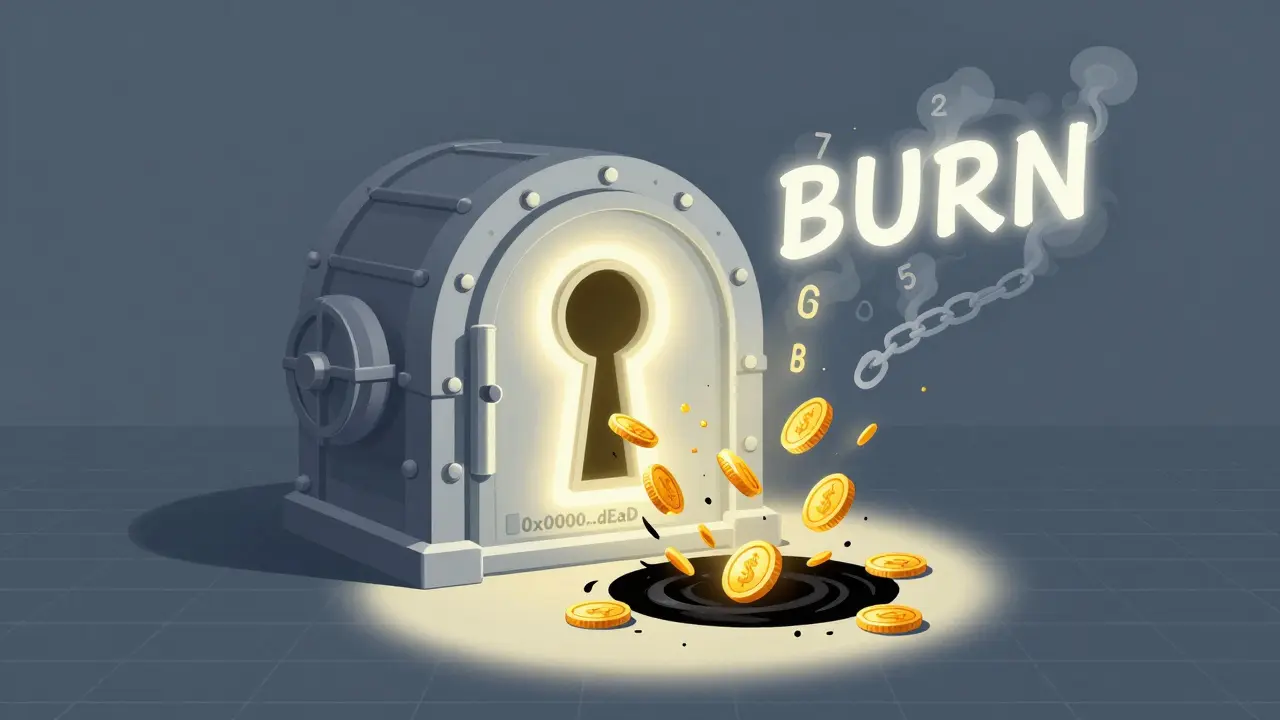
Token burning isn’t magic. It’s not a trick to make prices go up overnight. It’s a simple, deliberate act: tokens are sent to a wallet that no one can access. That wallet? Usually something like 0x000000000000000000000000000000000000dEaD - a known, irreversible address with no private key. Once tokens land there, they’re gone forever. No one can spend them. No one can recover them. They’re just... gone.
This isn’t just a technical detail. It’s a core part of tokenomics - how a cryptocurrency’s supply is managed. Projects use burning to reduce the total number of tokens in circulation. Less supply, in theory, means more value per token. But it’s not that simple. Burning only works if the project has real utility, demand, and trust behind it. Otherwise, it’s just deleting numbers from a ledger.
Why Do Projects Burn Tokens?
There are four main reasons projects burn tokens:
- Create scarcity: If you own 1% of 1 billion tokens, you own 10 million. If 300 million get burned, you now own 1% of 700 million - that’s 7 million tokens, but the *percentage* stayed the same. The *value per token* might rise if demand stays steady.
- Reduce inflation: Many tokens are minted over time as rewards. Burning offsets that new supply. Think of it like printing less money while also destroying some existing cash.
- Signal commitment: When a project burns millions of dollars’ worth of tokens, it shows they’re not just collecting funds and running. They’re locking value into the system.
- Improve token utility: Some newer models let you burn tokens to unlock features - like paying to access premium tools or voting rights. This turns burning into an active choice, not just a passive reduction.
Take Binance Coin (BNB). Since 2017, they’ve burned 20% of their quarterly profits in BNB. That’s over 40% of the total supply gone. That’s not luck. It’s a long-term strategy to shrink supply while growing usage. And it works - because BNB isn’t just a speculative asset. It’s used to pay trading fees, enter lotteries, and access DeFi tools on Binance Chain.
How Is It Actually Done? The Technical Side
Token burning happens through smart contracts. If you’re building a token on Ethereum, you’re likely using the ERC-20 standard. To burn, you call a function like burn(address, amount) - but instead of sending tokens to another user, you send them to the burn address.
Here’s how most implementations work:
- Define the burn address: Use a known, public, non-recoverable address. Ethereum’s null address is
0x0000...0000. Some use0x0000...dEaD- it’s the same idea. - Set triggers: Will burns happen automatically? After every transaction? Quarterly? After a milestone? This is coded into the contract.
- Control access: Only the project owner? A multisig wallet? A DAO vote? Bad access controls led to $2.3 million being accidentally burned in 2022 because a user clicked the wrong button.
- Update the supply: The contract must reduce the total supply variable. If you don’t do this, the blockchain still shows the old number - even though the tokens are gone. That’s misleading.
- Test and audit: Smart contracts are code. Code has bugs. A single typo can let anyone burn all tokens. Always test on a private network first. Always hire an auditor. OpenZeppelin’s burn templates are widely trusted because they’ve been battle-tested.
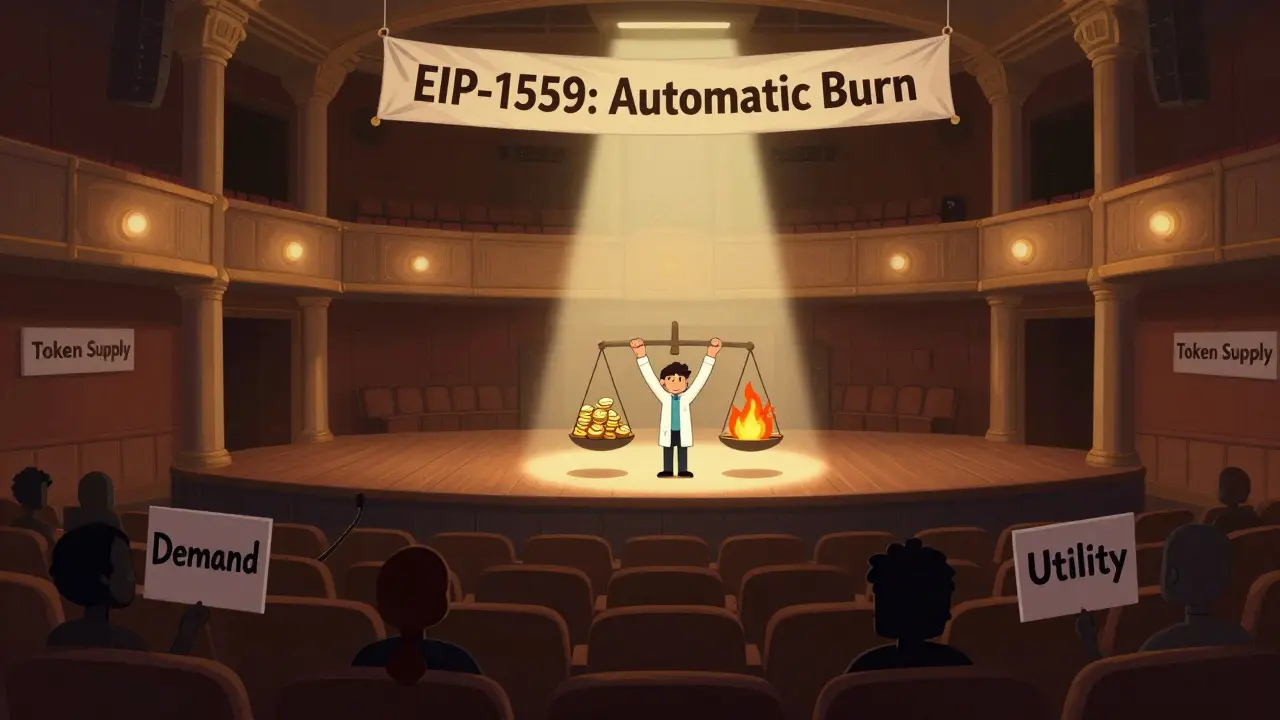
Not all burns are manual. Ethereum’s EIP-1559, launched in August 2021, automated burning. Every time you send ETH, part of the fee gets destroyed. As of late 2023, over 2.5 million ETH - worth roughly $4.5 billion - had been burned this way. That’s not a marketing stunt. It’s protocol-level deflation.
Types of Burn Mechanisms - Which One Works Best?
There are five common approaches, each with trade-offs:
| Method | How It Works | Pros | Cons |
|---|---|---|---|
| Scheduled Burns | Fixed intervals (e.g., Binance burns BNB quarterly) | Predictable, builds trust, easy to communicate | Markets anticipate it - price may drop before, rise after, then flatline |
| Transaction Fee Burns | Fees from network transactions are destroyed (EIP-1559) | Automatic, aligns incentives, reduces inflation | Complex to implement, affects miner/validator economics |
| Buyback and Burn | Project buys tokens on open market, then burns them | Directly reduces supply, signals confidence | Expensive, risky in bear markets, can be seen as market manipulation |
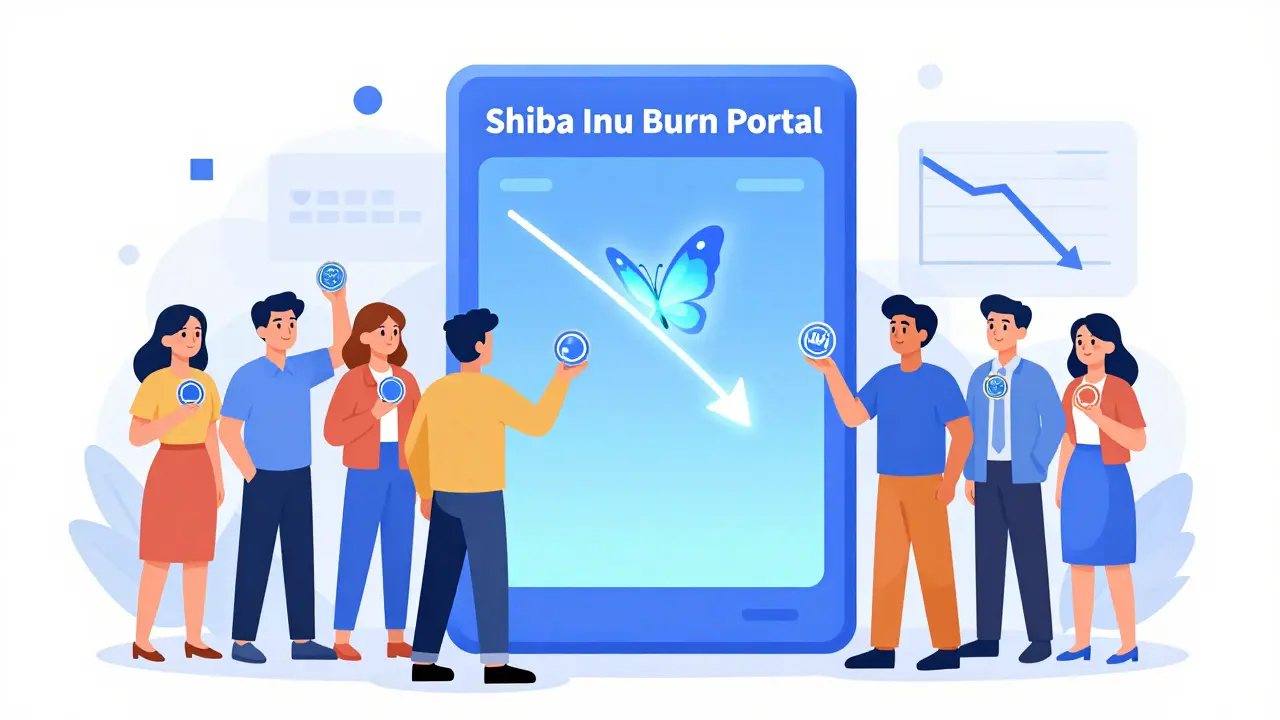
| Community-Driven Burns | Users voluntarily burn tokens via portal (e.g., Shiba Inu) | Engages community, decentralized, transparent | Low participation, hard to scale, inconsistent results |
| Protocol-Level Burns | Burns tied to network usage (e.g., Chainlink’s proposed model) | Dynamic, responsive, aligns with growth | Very complex, requires deep tokenomics design |
Shiba Inu’s burn portal is a great example of community-driven burning. As of 2023, over 410 trillion SHIB tokens - more than 40% of the original supply - were burned by users. Many got NFTs as rewards. It wasn’t about price manipulation. It was about ownership.
Does Burning Actually Make Prices Go Up?
Here’s the hard truth: no, not reliably.
A 2021 University of Cambridge study looked at 127 burn events across major coins. Only 32% showed a statistically significant price increase within seven days. That means in nearly 7 out of 10 cases, burning had no measurable impact.
Why? Because price isn’t just about supply. It’s about demand. If no one wants your token, burning 90% of it won’t help. Look at Safemoon. They burned 2% of every transaction. The price collapsed anyway. Why? Because the token had no real use. People bought it hoping to flip it. When the hype died, the burn couldn’t save it.
Dr. Garrick Hileman from Blockchain.com put it simply: “Token burns can theoretically increase scarcity, but their actual market impact depends on token velocity, utility, and market conditions.”
Think of it like this: Burning is like removing seats from a theater. If no one’s buying tickets, removing seats doesn’t make the show more valuable. But if the show is popular, fewer seats mean higher ticket prices.
When Burning Goes Wrong
Token burning sounds safe. It’s not.
In 2022, a popular DeFi wallet had a bug in its burn interface. Users thought they were approving a transaction. Instead, they accidentally burned over $2.3 million in tokens. No one could undo it. No one could recover it. Just gone.
Then there’s TerraUSD (UST). It burned tokens aggressively to try to stabilize its peg. But it didn’t fix the broken algorithm. The burn didn’t save it. UST crashed, taking $40 billion with it. Burning wasn’t the problem. The lack of real backing was.
And then there’s regulation. The U.S. SEC warned in early 2023 that burns could be seen as “unregistered securities transactions” if done to manipulate prices. Ripple changed its burn strategy after that. Projects now need legal advice, not just devs.
What’s Next for Token Burning?
The future isn’t just about burning more. It’s about burning smarter.
Projects are starting to tie burns to real utility. STEPN, for example, lets you burn tokens to unlock higher-tier sneakers in their move-to-earn game. That’s not speculation. That’s consumption.
Chainlink is testing a burn-and-mint equilibrium model - burn tokens when network usage is low, mint them when it’s high. That’s dynamic supply management.
Polygon’s upcoming EIP-1559 upgrade will burn more fees for high-priority transactions. That rewards users who pay more - and makes the network more efficient.
By 2025, Messari predicts 68% of new tokens will use multi-dimensional burn strategies - combining scheduled, fee-based, and utility-based burns in one system.
Should You Care About Token Burning?
If you’re holding a token, yes - but not because you think it’ll make you rich.
Look at the burn mechanism like this:
- Is it transparent? Can you see the burns on-chain?
- Is it automated or manual? Automated is harder to manipulate.
- Is it tied to real usage? Or just a marketing gimmick?
- Has the team burned their own tokens? That’s a strong signal.
Don’t buy a token because it burns. Buy it because it solves a problem - and the burn is just a side effect of good design.
Token burning isn’t a silver bullet. It’s a tool. Used well, it can help. Used poorly, it’s just noise. The best projects don’t talk about burns. They talk about what their token does. The burn? That’s just the quiet math behind it.
What is a burn address in cryptocurrency?
A burn address is a public wallet address that has no private key, meaning no one can access or spend any tokens sent there. Common examples include Ethereum’s null address (0x0000...0000) and the widely adopted 0x0000...dEaD. Once tokens are sent to this address, they are permanently removed from circulation and cannot be recovered.
Can token burning increase a coin’s price?
It can, but not always. Burning reduces supply, which may increase scarcity and drive up price - but only if demand stays the same or grows. Studies show only about one-third of burns lead to measurable price increases. Without real utility, adoption, or trust, burning alone won’t create value.
How do I know if a burn is legitimate?
Check the blockchain explorer (like Etherscan or BscScan) for transactions sent to known burn addresses. Legitimate burns are public, transparent, and verifiable. If the project claims a burn but you can’t find the transaction, it’s likely fake. Also, look for audits, multi-sig controls, and whether the burn is automated or tied to usage.
Is Ethereum’s EIP-1559 a form of token burning?
Yes. EIP-1559 burns the base fee portion of every Ethereum transaction. This means a portion of ETH is permanently destroyed with each block, reducing the total supply over time. As of late 2023, over 2.5 million ETH have been burned through this mechanism, making it the largest and most consistent burn in crypto history.
Can I burn my own tokens?
If the project provides a burn function - like Shiba Inu’s portal or Binance’s burn tool - then yes. You can send your tokens to the burn address yourself. But be extremely careful: once sent, you cannot reverse it. Never burn tokens unless you fully understand the process and trust the interface.
Are token burns regulated?
Yes. Regulators like the U.S. SEC and ESMA have warned that token burns could be considered market manipulation if used to artificially inflate prices. Projects must now be transparent about why they’re burning - whether it’s for supply management, utility, or something else. In some cases, regulators have forced changes to burn strategies to avoid legal risk.

Brandon Vaidyanathan
Okay but let’s be real - most of these burns are just crypto bros playing pretend with their wallets. Binance burns? Cool. But if your token’s only use is to get a free NFT after burning 10k of it, you’re not building utility, you’re running a digital bingo hall. 🤡
Gareth Fitzjohn
Token burning is a straightforward concept. Remove supply, hope demand holds. Simple economics. The problem is when projects treat it like a magic wand instead of a tool. Not all burns are equal.
Katie Teresi
USA invented blockchain. Europe’s still arguing over coffee while we’re burning tokens and building real value. If you don’t get it, you’re just jealous.
Moray Wallace
I appreciate the breakdown, especially on EIP-1559. It’s one of the few genuinely deflationary mechanisms that doesn’t rely on marketing. The fact that it’s automated and protocol-level makes it trustworthy.
Dylan Morrison
Burning tokens is like lighting a candle in a dark room - it doesn’t change the house, but it helps you see what’s actually there. If the house is falling apart, no amount of candles will fix it. 🕯️
Lori Quarles
STOP pretending burns are a strategy. They’re a distraction. If your project needs to burn tokens to look valuable, you’re already dead. Go build something useful, not math tricks.
Steven Dilla
I’ve burned over 200k SHIB just to feel like I’m part of something. It’s not about ROI - it’s about belonging. The community gave me that. That’s worth more than any chart. 🙏🔥
Akhil Mathew
Interesting how India’s crypto community is quietly becoming one of the biggest contributors to community-driven burns. We don’t shout about it, but we show up. Shiba’s burn portal? We’ve sent over 10% of all burned tokens from here. Quiet power.
Ramona Langthaler
burns are just a scam to make dumb people think their trash coin is scarce when its literally worthless and the devs are all offshore and the whitepaper was written by a chatbot and nobody even uses it and why are you still reading this
Kevin Thomas
If you’re thinking about burning your own tokens, here’s the real advice: check the contract first. OpenZeppelin’s burn function is solid. If the project didn’t use it, or if the burn address isn’t on Etherscan, you’re playing Russian roulette. Don’t be the guy who lost $5k because he clicked ‘approve’ without reading.
Andrea Demontis
The philosophical question isn’t whether burning increases value - it’s whether scarcity, in a digital realm where copying is free, even has meaning. If a token is burned in the blockchain and no one cares, does it still have value? Or are we just ritualizing deletion as a substitute for utility? We’re not reducing supply - we’re performing a digital exorcism on our own greed.
Raju Bhagat
Bro i burned 500k SHIB and got a free NFT and now my whole family is in crypto and my cousin just bought a house with his crypto profits so burns are the future and dont even try to hat on this
Jack Petty
EIP-1559? More like EIP-1559: The Fed’s Secret Crypto Weapon. They’re quietly killing ETH supply to prep for CBDC. You think this is about deflation? Nah. It’s about control. They want you dependent on a token that’s disappearing - so you’ll beg for the digital dollar next.
Brianne Hurley
I mean, if you’re still holding Safemoon after the burn fiasco, you’re not an investor - you’re a hostage. And if you think Shiba Inu’s burn portal is ‘community-driven,’ you’ve never seen the 10k bots running auto-burn scripts from a single IP. It’s theater.
Gary Gately
i think burns are cool but like why do people act like its a cure all? its just one part of the puzzle like you gotta have use case too like duh
Joshua Clark
I’ve been studying tokenomics for six years now, and I can tell you this: the most successful burns are the ones nobody talks about. The quiet, automated, contract-bound ones - like Ethereum’s EIP-1559 - that happen in the background, day after day, without fanfare. It’s not about the headline. It’s about the cumulative effect. Over 2.5 million ETH burned? That’s not marketing. That’s a silent revolution. And the people who get it? They’re not shouting on Twitter. They’re just holding.
William Hanson
Burns are for losers who can’t build real products. If you need to delete tokens to make people feel good, you’re not a founder. You’re a magician with a deck of cards.
josh gander
Hey everyone - if you’re new to this, just remember: burns are like pruning a tree. Cut the dead branches, the healthy ones grow stronger. But if you chop the whole trunk? You’re not helping. You’re killing it. Always ask: is this burn helping the ecosystem… or just the dev’s wallet? 🌳💡
Tom Sheppard
man i just burned my last 10k tokens and felt kinda sad but then i remembered im part of something bigger like we’re not just investors we’re builders and yeah maybe the price dont go up but at least i know i helped make the supply leaner and that feels good 😊