CAKEBANK Airdrop: Details, Risks, and What You Need to Know in 2026
You’ve heard the buzz. Maybe you saw it on Twitter, Telegram, or a Discord server that promises free money. The CAKEBANK airdrop by Cake Bank sounds like your next big win in the crypto world. But before you connect your wallet or click any links, we need to talk about what is actually happening here. In May 2026, the landscape of cryptocurrency distributions has changed drastically. Scams are smarter, regulations are tighter, and legitimate projects have very clear documentation.
The hard truth? There is almost zero verifiable information about an official "CAKEBANK" airdrop from a reputable entity called "Cake Bank." If you are looking for a step-by-step guide to claim tokens right now, I’m going to save you time and potential losses: this specific opportunity looks highly suspicious or non-existent. Let’s break down why, compare it to real airdrops, and teach you how to spot the difference between a genuine reward and a wallet drainer.
What Is CAKEBANK?
To understand the risk, we first need to define the entity. CAKEBANK is a cryptocurrency token with extremely low market capitalization and minimal public presence. As of early 2026 data points, the token trades at approximately $0.00000207 USD. That is less than one ten-thousandth of a cent. For context, you would need millions of these tokens just to buy a cup of coffee.
This pricing structure usually indicates one of three things:
- A brand new project that hasn’t gained traction.
- A micro-cap token with no liquidity (meaning you can’t sell it even if you get it).
- A speculative asset often associated with high-risk meme coins or scam projects.
There is no major exchange listing, no whitepaper from a recognized team, and no audit reports from firms like CertiK or Hacken. In the world of decentralized finance (DeFi), silence is rarely golden-it’s usually dangerous.
The Confusion: CAKEBANK vs. PancakeSwap (CAKE)
A lot of confusion stems from the name. Many users see "Cake" and immediately think of PancakeSwap, which is one of the largest decentralized exchanges on the BNB Chain.
PancakeSwap uses the CAKE token. It is a legitimate, top-tier DeFi protocol. In 2025 and into 2026, PancakeSwap ran verified airdrop campaigns. For example, they offered rewards worth thousands of dollars in CAKE tokens to Coinbase One members who maintained trading volume on networks like Arbitrum or Base. These were transparent, had clear rules, and were announced on official channels.
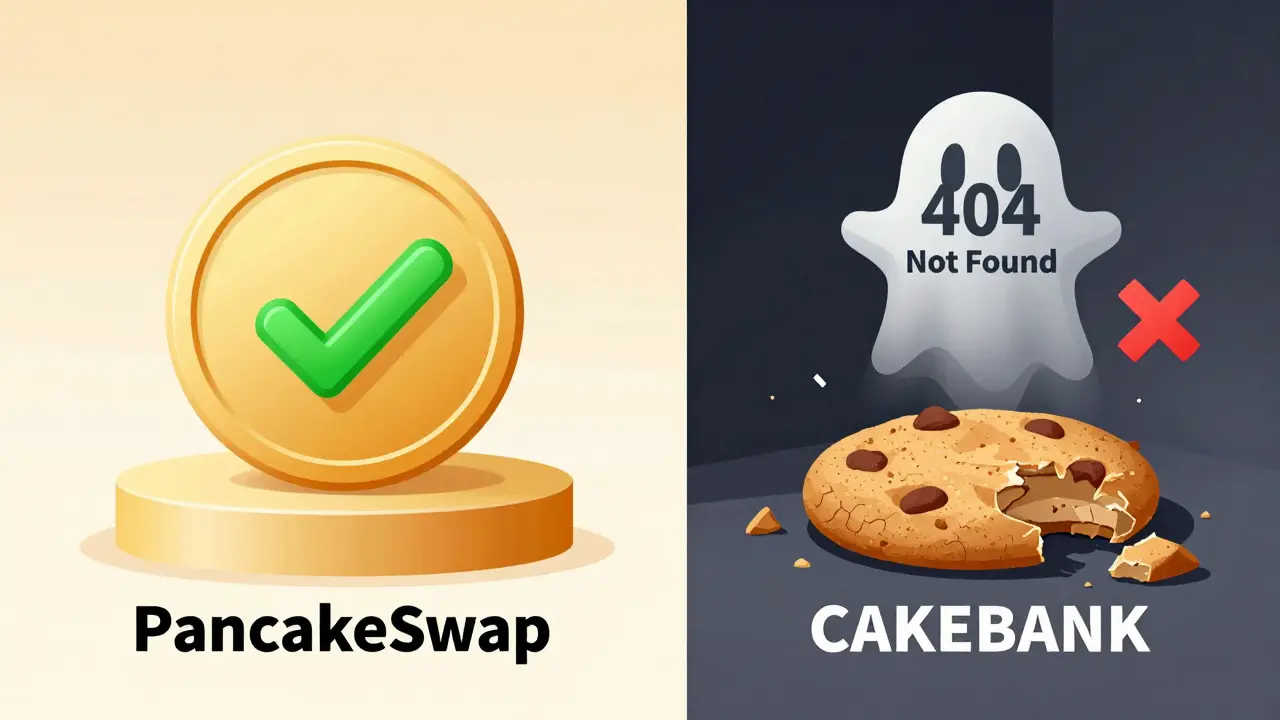
CAKEBANK is not CAKE. They are completely different entities. Do not let the similar names trick you into thinking you are participating in a PancakeSwap event. This is a classic tactic used by scammers: create a token with a name that mimics a famous brand to steal attention and funds.
| Feature | PancakeSwap (CAKE) | CAKEBANK (Cake Bank) |
|---|---|---|
| Market Cap | Billions of USD | Micro-cap / Negligible |
| Official Website | pancakeswap.finance | Unverified / Missing |
| Audit Status | Multiple Audits Passed | No Public Audit Found |
| Airdrop Transparency | Clear Rules & Smart Contracts | Vague Promises / No Docs |
| Risk Level | Low to Medium (Standard DeFi Risk) | Extremely High (Potential Scam) |
Why Is There No Information?
In 2026, legitimate crypto projects do not operate in the shadows. If a project is launching an airdrop, you will find:
- Official Announcements: Posts on their verified Twitter/X account, Discord, and website.
- Community Engagement: Active discussions on Reddit, Bitcointalk, or specialized forums.
- Third-Party Tracking: Listings on sites like Airdrop.io, CoinMarketCap, or DexScreener with historical data.
For CAKEBANK, none of this exists. The absence of information is a red flag. It suggests the project may be in very early planning stages, limited to a small private group, or-most likely-it is a fraudulent scheme designed to harvest personal data or drain wallets.
How Crypto Scams Use Fake Airdrops
If you encounter a site claiming to distribute CAKEBANK tokens, here is exactly what happens behind the scenes:
1. The Hook
They promise "free" tokens. Greed overrides caution. You visit a link provided in a DM or an unverified comment.
2. The Connection
The site asks you to connect your MetaMask, Trust Wallet, or Phantom wallet. They might say it’s needed to "verify eligibility."
3. The Approval Trap
This is the critical moment. The site will ask for an "Approval" transaction. This gives the smart contract permission to spend your tokens. Scammers often ask for approval to spend an unlimited amount of your USDT, ETH, or BNB.
4. The Drain
Once approved, the attacker triggers a transfer. Your wallet is emptied instantly. The "CAKEBANK" tokens you thought you received are either worthless or never existed.
Regulatory Context in 2026
The regulatory environment has tightened significantly since 2024. In the United States and parts of Europe, airdrops are scrutinized under securities laws. Projects must clearly state eligibility criteria. Unregistered distributions can lead to legal issues for both the issuer and, in some cases, the receiver.
Furthermore, tax authorities now view unsolicited crypto transfers as taxable events in many jurisdictions. If you receive tokens you didn’t earn through legitimate participation, you may still owe taxes on them when you try to sell. With a token priced at $0.00000207, you won’t make money-but you could still face compliance headaches.

How to Verify Any Airdrop Safely
Don’t take my word for it. Use this checklist for every future airdrop opportunity:
- Check the Contract Address: Never trust a name alone. Look up the token contract address on Etherscan, BscScan, or Solscan. Does it have verified source code? Who holds the majority of the supply? If one wallet holds 90%, it’s a rug pull waiting to happen.
- Verify Social Channels: Go directly to the project’s official website. Copy the social media links from there. Do NOT follow links from Twitter bios or Telegram messages unless you have double-checked them.
- Use a Burner Wallet: Never connect your main wallet holding significant funds to an unverified dApp. Use a secondary wallet with minimal assets.
- Search for Reviews: Search "[Project Name] scam" or "[Project Name] review" on Google. If the only results are promotional articles written by the project itself, stay away.
Alternatives: Legitimate Airdrops to Watch
If you want to participate in airdrops safely, focus on established ecosystems. In 2026, look for opportunities within:
- Layer 2 Networks: Projects like Arbitrum, Optimism, and Base often reward early users who provide liquidity or bridge funds.
- Major Exchanges: Binance Launchpad and Coinbase Earn offer vetted projects. While not always "free," they are safe.
- DeFi Protocols: Interact with well-known protocols like Aave, Uniswap, or PancakeSwap. Sometimes, simply using the platform qualifies you for future governance token distributions.
These paths require work-bridging, swapping, providing liquidity-but they carry a fraction of the risk compared to chasing unknown tokens like CAKEBANK.
Final Verdict on CAKEBANK
Based on available data, the CAKEBANK airdrop lacks legitimacy. The token’s negligible value, the absence of official documentation, and the confusing naming convention all point to a high-risk scenario. Protect your capital. Do not connect your wallet. Do not share your seed phrase. And remember: if it sounds too good to be true, especially with a token worth fractions of a penny, it almost certainly is.
Is the CAKEBANK airdrop legit?
There is no credible evidence that the CAKEBANK airdrop is legitimate. The token has extremely low value, no official documentation, and no presence on major exchanges. It is highly likely to be a scam or a worthless micro-cap token.
What is the difference between CAKE and CAKEBANK?
CAKE is the native token of PancakeSwap, a major decentralized exchange with billions in market cap. CAKEBANK is a separate, obscure token with negligible value and no verifiable backing. They are not related.
How can I tell if a crypto airdrop is a scam?
Red flags include: requests to approve unlimited spending of your tokens, lack of official website/social media verification, anonymous teams, and promises of huge returns for minimal effort. Always verify contract addresses on block explorers.
Can I lose money participating in a fake airdrop?
Yes. While you don't pay to enter, scammers can drain your connected wallet if you sign malicious transactions. Always use a burner wallet with minimal funds for unverified interactions.
Where should I look for legitimate airdrops in 2026?
Focus on established ecosystems like Layer 2 networks (Arbitrum, Base), major DeFi protocols (Uniswap, Aave), and verified exchange programs (Binance Launchpad). These platforms have transparent rules and audited smart contracts.