CEX vs DEX: How Geographic Restrictions Shape Your Crypto Access
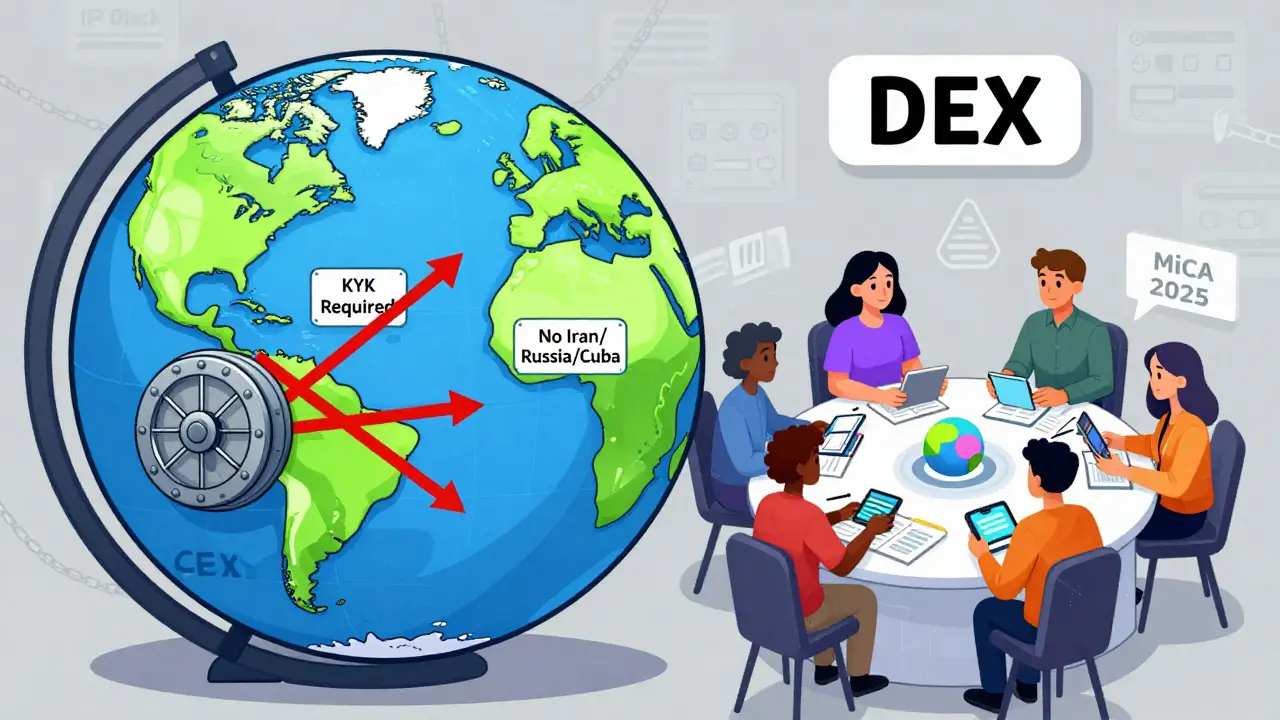
If you’ve ever tried to trade crypto and got blocked by a message like "This service isn’t available in your country," you’ve hit one of the biggest real-world barriers in crypto: geographic restrictions. It’s not just about internet speed or language-it’s about where you live determining what you can buy, sell, or even hold. And the difference between centralized exchanges (CEX) and decentralized exchanges (DEX) when it comes to these blocks is night and day.
CEXs: Built to Be Restricted
Centralized exchanges like Binance, Coinbase, or Kraken don’t just operate like websites-they operate like banks. They need licenses. They need to follow local laws. And if a government says, "No derivatives trading here," or "No US citizens," they comply. No debate.That’s why you’ll find Binance.US separate from Binance.com. Why Coinbase doesn’t offer staking in New York. Why you can’t deposit euros on a CEX if the exchange doesn’t have a banking partner in the Eurozone. These aren’t technical glitches-they’re legal requirements.
Every CEX uses KYC (Know Your Customer) to verify your identity. That means uploading a passport, a selfie, sometimes even proof of address. Once they have that, they know exactly where you are. And if you’re in Iran, Russia, Cuba, or Syria? You’re locked out. Not because the tech can’t reach you, but because the company can’t risk fines, blacklisting, or criminal charges.
Even within countries that allow crypto, restrictions vary. In Germany, you can trade Bitcoin freely. In France, you need to report holdings over €10,000. In India, exchanges must collect tax details. These rules don’t just affect what you trade-they affect whether you can even open an account.
DEXs: Theoretically Open, Practically Getting Closer
Decentralized exchanges like Uniswap, SushiSwap, or PancakeSwap don’t ask for your ID. You connect your wallet-MetaMask, Phantom, Trust Wallet-and trade. No sign-up. No paperwork. No location check.That’s why someone in Nigeria can trade ETH for a token no CEX lists. Why a user in Venezuela can swap USDT for a stablecoin without a bank. DEXs don’t control your funds. They don’t hold your keys. And they don’t know where you are-unless you tell them.
But here’s the twist: regulators are catching up. In 2025, the EU’s MiCA regulation started pushing for DEXs to implement geolocation tools. The U.S. SEC has signaled that DEXs facilitating trades of unregistered securities could be held liable. Even though the code runs on blockchain, the people building and promoting these platforms are still subject to law.
Some DEXs now quietly block IP addresses from sanctioned countries. Others use wallet analytics to detect if a user is linked to a known exchange account in a restricted region. It’s not perfect-but it’s growing. You can still trade on a DEX from most places, but the door is slowly closing.
Fiat On-Ramps: The Real Gatekeepers
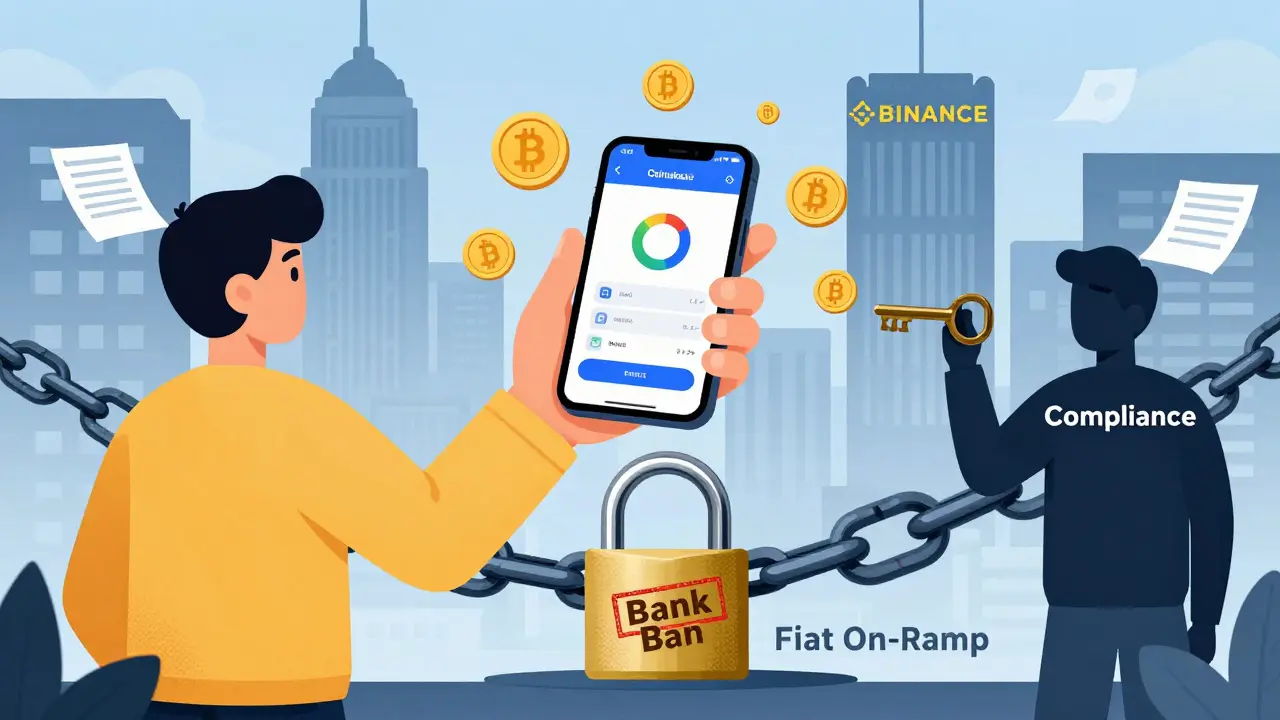
Here’s the hidden truth: CEXs control the front door to crypto. Most people don’t start with Bitcoin. They start with dollars, euros, or yen. And only CEXs let you deposit those directly.On a DEX, you need crypto already. So if you’re in a country where buying crypto with a bank card is banned-like Egypt, Algeria, or parts of Southeast Asia-you’re stuck. You can’t even get to the DEX unless you find a peer-to-peer seller, a crypto ATM, or a friend abroad to send you ETH.
That’s why CEXs are the gatekeepers. They’re the ones with banking licenses, payment processors, and compliance teams. If your country doesn’t have a deal with Coinbase or Kraken, you can’t get in. DEXs don’t solve that problem-they just let you trade once you’re already inside.
Security Trade-Offs: Control vs. Autonomy
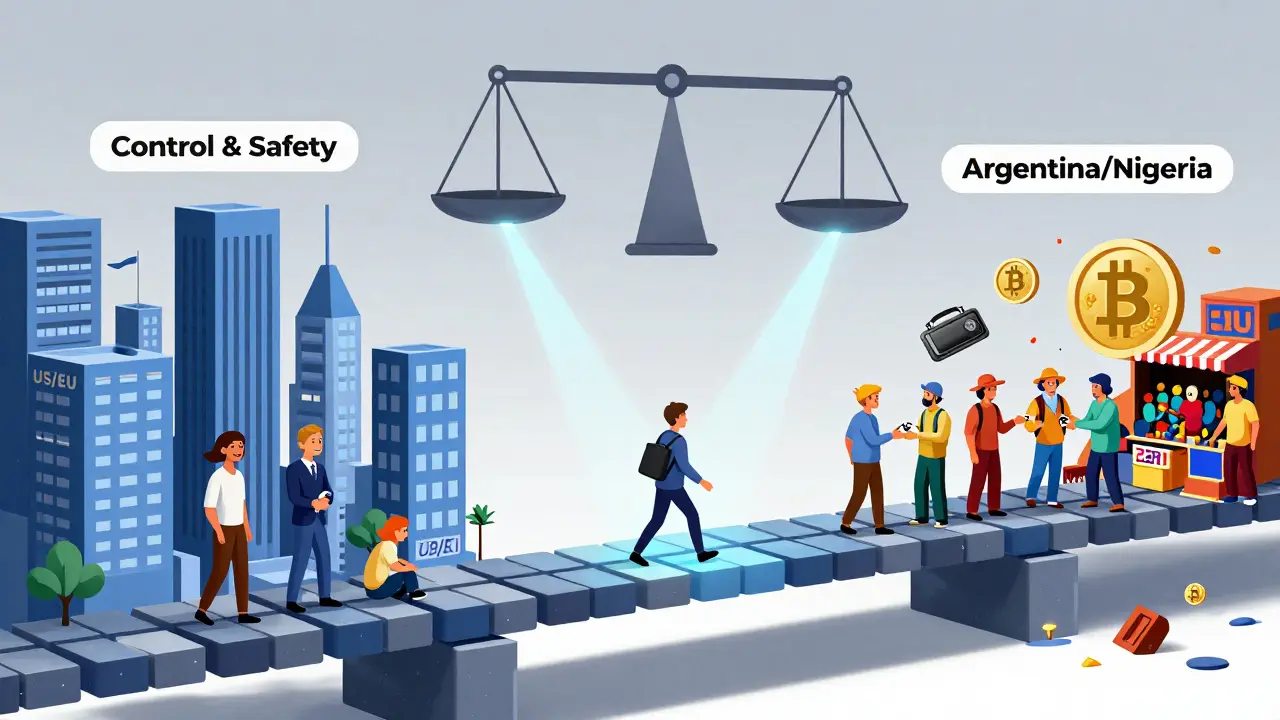
CEXs promise safety. They store your coins in cold wallets. They freeze accounts if they detect fraud. They can reverse transactions (sometimes). But that same control makes them easy targets for regulators. If the government orders them to freeze accounts in Turkey, they do it. No appeal.DEXs give you total control. If you lose your private key, your coins are gone forever. If you send funds to a scam contract, there’s no customer service to call. But you also can’t be frozen. No one can shut down your wallet. No regulator can demand you stop trading.
That’s the trade-off: convenience and protection vs. freedom and risk. In countries with unstable governments or weak property rights, DEXs are a lifeline. In countries with strong legal systems, CEXs offer peace of mind.
Who Gets Left Behind?
The people most affected aren’t tech-savvy traders. They’re everyday people trying to protect their savings from inflation. In Argentina, where the peso lost 200% of its value in 2024, many turned to crypto. But CEXs like Binance blocked them from withdrawing pesos. So they used P2P platforms to buy USDT, then swapped it on DEXs.In Nigeria, where the central bank banned banks from handling crypto in 2021, DEXs became the only way to trade. But without fiat access, users had to rely on informal networks-WhatsApp groups, cash deliveries, or friends overseas. The DEX didn’t block them. The system around it did.
Even in the U.S., restrictions exist. Some states ban certain tokens. Some CEXs don’t offer margin trading in California. DEXs let you trade those tokens-but only if you already own them. So the restriction shifts from the platform to the on-ramp.
What’s Next? The Regulatory Tightrope
By 2026, we’re seeing a new trend: regulators aren’t trying to shut down DEXs anymore. They’re trying to make them comply.Projects like Uniswap are being asked to add geofencing to their front-end interfaces. Some DEX aggregators now show warnings: "Trading this token may violate your local laws." Others partner with compliance tools that scan wallet histories for links to sanctioned addresses.
It’s not about stopping crypto. It’s about controlling it. The goal isn’t to ban DEXs-it’s to make them traceable, accountable, and tied to real identities.
That means the days of "completely unregulated" DEXs are ending. The next generation of decentralized platforms will likely include optional KYC, regional token lists, and IP-based access controls-not because they want to, but because they have to.
Which One Should You Use?
If you’re in the U.S., Canada, UK, Australia, or most of Western Europe: Use a CEX. They’re safe, regulated, and easy. You can deposit fiat, trade hundreds of coins, and get help if something goes wrong.If you’re in a country with strict controls, high inflation, or unstable banking: Use a DEX-but only after you’ve gotten your first crypto through P2P, a local exchange, or a friend. DEXs won’t solve your on-ramp problem, but they’ll give you freedom once you’re in.
If you’re anywhere and care about privacy: Use a DEX with a hardware wallet. Don’t connect your exchange wallet. Don’t reuse addresses. Your freedom comes with responsibility.
There’s no perfect solution. But understanding where the walls are-and who built them-helps you navigate around them.
Can I use a DEX if my country bans crypto?
Technically, yes. DEXs don’t require registration or location checks. But if your country bans crypto entirely, using a DEX could still break the law. Enforcement varies-some governments monitor blockchain activity, others don’t. The risk isn’t technical-it’s legal.
Why can’t DEXs just block users by country like CEXs do?
The core code of a DEX runs on blockchain and can’t be easily changed. But the front-end website you use to access it (like Uniswap’s interface) can block IPs. Many DEX aggregators already do this. The protocol itself doesn’t enforce location rules-but the tools you use to interact with it can.
Do I need KYC to use a DEX?
No, DEXs themselves don’t require KYC. You only need a crypto wallet. But if you buy crypto on a CEX first-and most people do-you’ll have already gone through KYC. Some DEX interfaces now suggest or require identity checks to comply with local laws, but it’s not built into the protocol.
Can I move from a CEX to a DEX without getting blocked?
Yes. Once you withdraw crypto from a CEX to your own wallet, you’re no longer under the CEX’s control. You can then use that crypto on any DEX. The restriction only applies while your funds are on the CEX. Once they’re off, you’re free to trade-unless your country bans crypto entirely.
Are there any DEXs that are completely free from geographic restrictions?
No platform is truly free anymore. Even if the blockchain code allows global access, the websites, apps, and wallet integrations that connect you to DEXs are increasingly adding geo-blocks. The era of fully borderless DEXs is ending as regulators demand accountability. What remains is a gray zone where access depends on how hard you look-and how much risk you’re willing to take.

Tom Sheppard
bro i just tried to buy crypto on binance from canada and got blocked like wtf 😭 i mean i get the regs but why can’t i trade usdt? it’s not even a derivative lol. why does my country get treated like a criminal just because we’re not the usa? 🤦♂️
Richard Kemp
so dexs arent really free if they start blocking ips… kinda defeats the whole point huh
Gurpreet Singh
in india we cant even open a binance account anymore. had to use p2p for months just to get eth. now i use uniswap but its a pain to cash out. the real problem isnt the tech its the banks.
Will Pimblett
oh so now dexes are gonna be regulated like banks? brilliant. next they’ll make you fill out a form before swapping weth for dai. can we please just let people trade without the nanny state breathing down their necks?
Gustavo Gonzalez
you’re all delusional. dexes are already being monitored by chainalysis. every transaction you make is tracked. you think you’re anonymous? you’re not. the only people who think dexes are free are the ones who haven’t read the fine print. also stop romanticizing crypto as some kind of rebellion-it’s just another asset class now.
Jeremy Dayde
look i get that cexs are locked down but dexe arent the solution either because even if you bypass the ip block you still need to get the crypto in the first place and that’s the whole problem the on ramp is the real gatekeeper and nobody talks about that like yeah you can trade on uniswap but how did you get the usdt in the first place did you steal it from your neighbor or what
Elizabeth Jones
the real tragedy isn’t the restrictions-it’s how we’ve normalized them. we accept that where you’re born determines your financial freedom. if this were about education or healthcare we’d be in the streets. but crypto? oh no, let’s just blame the user for not being tech-savvy enough.
Pamela Mainama
in india we use p2p and dexe. no kyc. no drama. just trade. the system is broken but we make it work.
Rachel Stone
so you’re saying the revolution was always just a vpn away?
Nickole Fennell
THEY’RE COMING FOR OUR DEFI!! THEY’RE TURNING DEXES INTO BANKS!! THEY’RE USING WALLET ANALYTICS!! I’M LOSING MY SOUL TO THE ALGORITHM!!
Edward Drawde
if you’re using dexe in a banned country you’re asking for jail time. stop being a dumbass.
christal Rodriguez
actually the whole premise is flawed. crypto was never meant to be accessible. it was designed as a hedge for the elite. the fact that you think it’s for everyone is the real illusion.
Tressie Trezza
i think the most beautiful thing about dexe is that even if they add geo-blocks, someone will always find a way around it. that’s the spirit of it, right? not the tools, but the will to keep trying.
Calvin Tucker
the regulatory push on dexe is inevitable and logical. blockchain is public, identities are traceable, and financial systems cannot exist in a vacuum. decentralization does not equate to lawlessness. it’s time to evolve beyond the libertarian fantasy.
Mark Ganim
can we just acknowledge that the entire crypto world is built on a lie? that the "decentralized" part is just a marketing term? the front-end interfaces? the wallet providers? the liquidity providers? the influencers? they’re all centralized. the blockchain is just the ledger. the real power is still in the hands of a few companies with servers in silicon valley.