Crypto Borrowing and Collateral: A Practical Guide for 2026

You own Bitcoin. You need cash. Do you sell your coins? For years, that was the only option if you wanted liquidity without touching a bank loan application. But in 2026, the landscape has shifted dramatically. Crypto borrowing is a financial mechanism where users lock up digital assets as collateral to borrow fiat or stablecoins without selling their holdings. This simple shift changes everything about how investors manage taxes, exposure, and capital efficiency.
The core promise is straightforward: keep your upside potential while accessing immediate liquidity. If you believe Bitcoin will hit $150,000 next year, selling it today to pay off a credit card debt feels like throwing away free money. Crypto-backed loans let you bridge that gap. However, this isn't just a "no questions asked" ATM. It involves complex mechanics, significant risks, and a rapidly evolving regulatory environment. Understanding these dynamics is the difference between smart leverage and total loss.
How Crypto-Backed Loans Actually Work
At its heart, a crypto loan is a secured transaction. Unlike traditional banks that check your credit score and income history, crypto lenders care about one thing: the value of the asset you pledge. This is called collateral. When you deposit cryptocurrency into a lending platform, you are essentially creating a security interest in those tokens.
The process follows a specific logical flow:
- Deposit: You transfer your chosen crypto (like Bitcoin or Ethereum) to the platform’s wallet or smart contract.
- Valuation: The system calculates the current market value of your deposit.
- Borrowing Limit: Based on the Loan-to-Value (LTV) ratio, the platform determines how much you can borrow. Most platforms allow 50% to 70% LTV for volatile assets.
- Disbursement: You receive the loan amount, usually in stablecoins (USDC, USDT) or fiat currency (USD, EUR).
- Repayment: You pay back the principal plus interest over time. Once repaid, your collateral is released.
The key metric here is the Loan-to-Value (LTV) ratio. If you have $10,000 worth of Ethereum and the platform offers a 50% LTV, you can borrow up to $5,000. If the price of Ethereum drops, your collateral value decreases, but your debt remains fixed. This imbalance triggers risk mechanisms designed to protect the lender, not you.
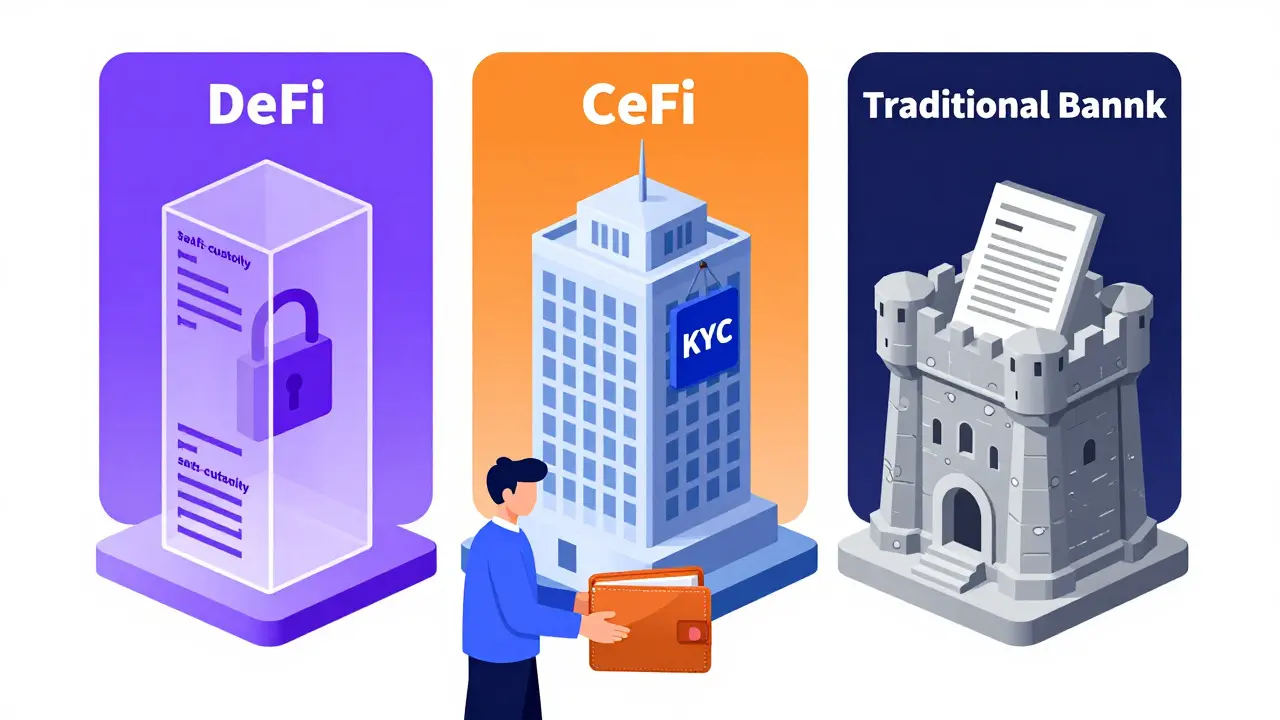
The Three Models: DeFi, CeFi, and Traditional Banking
Not all crypto loans are created equal. In 2026, borrowers face three distinct ecosystems, each with different trade-offs regarding control, convenience, and safety.
| Feature | DeFi Protocols | CeFi Platforms | Traditional Banks |
|---|---|---|---|
| Examples | Aave, Compound | Nexo, Ledn | Sygnum Bank, UBS |
| KYC Required? | No | Yes | Strictly Yes |
| LTV Ratio | 50% - 75% | 50% - 90% | 30% - 60% |
| Risk Profile | Smart Contract Risk | Counterparty/Bankruptcy Risk | Regulatory/Low Default Risk |
| Speed | Minutes (on-chain) | Hours to Days | Days to Weeks |
Decentralized Finance (DeFi) protocols operate entirely on blockchains using smart contracts. There is no middleman. You connect your wallet, approve the transaction, and the code handles the rest. The benefit is full transparency and self-custody-you never hand over private keys to a company. The downside is complexity. One wrong click, or a bug in the code, can lead to irreversible losses. Additionally, because there is no customer support team, you are on your own if things go wrong.
Centralized Finance (CeFi) platforms act more like traditional banks. You create an account, verify your identity (KYC), and send funds to their custody wallets. They offer user-friendly interfaces and often higher LTV ratios. However, you take on counterparty risk. Remember the collapses of Celsius, BlockFi, and Voyager in 2022? Users lost access to billions in assets because these companies mismanaged or lent out the collateral they were supposed to be holding. In 2026, reputable CeFi firms are more conservative, but the risk of insolvency remains.
Traditional Banking Solutions have entered the space via "Lombard loans." Swiss and European banks like Sygnum and Solaris now accept crypto as collateral. These loans come with strict regulations, lower LTVs, and slower processing times. But they offer legal protection under established banking laws. If the bank fails, deposit insurance schemes may apply. This model suits high-net-worth individuals who prioritize regulatory certainty over speed.
The Danger Zone: Liquidation Explained
This is the part most beginners ignore until it’s too late. Because crypto prices are volatile, your collateral value can drop rapidly. To prevent owing more than the collateral is worth, lenders use automated liquidation mechanisms.
Here is how it works in practice. Let’s say you borrow $5,000 against $10,000 of Ethereum (50% LTV). The platform sets a maintenance threshold at 110%. This means your collateral must always be worth at least 110% of your debt. If Ethereum crashes by 40%, your collateral is now worth $6,000. Your debt is still $5,000. The ratio is 120%, which is safe. But if ETH drops another 10%, your collateral is $5,400. The ratio hits 108%. You are below the threshold.
The system automatically sells your Ethereum to repay the loan. This is called liquidation. You lose your position, often at a penalty fee. In DeFi, this happens instantly via bots scanning the blockchain. In CeFi, it might happen within hours. During the market crashes of May 2021 and June 2022, thousands of users saw their portfolios wiped out not because they disagreed with the long-term thesis, but because they got caught in short-term volatility spikes.
To avoid this, experts recommend maintaining a buffer. Keep your LTV well below the maximum allowed limit. If the max is 70%, aim to stay at 40-50%. Use alerts to monitor price movements. Some platforms offer "auto-repay" features or insurance products, but these add cost and complexity.
Tax Implications and Regulatory Shifts
One major advantage of crypto borrowing is tax efficiency. In many jurisdictions, including the United States, borrowing against an asset is not a taxable event. Selling Bitcoin triggers capital gains tax. Borrowing against it does not. You can use the borrowed funds for investments, business expenses, or personal needs without triggering a tax bill on your crypto holdings.
However, this comes with caveats. If you are liquidated, that sale *is* a taxable event. You will owe taxes on any capital gains realized at the moment of liquidation. Furthermore, the IRS views crypto loans as potentially reportable income if the terms are ambiguous, though clear documentation helps mitigate this.
Regulation is tightening globally. The EU’s MiCA regulation, effective in 2024, provides clearer guidelines for crypto asset service providers. This has forced many CeFi platforms to adopt stricter compliance measures. In the US, the SEC has taken enforcement actions against unregistered lending products, pushing innovation toward registered entities or decentralized structures. For borrowers, this means fewer "wild west" platforms offering unsustainable rates, but also more reliable institutions entering the market.

Who Should Use Crypto Borrowing?
Crypto borrowing isn’t for everyone. It makes sense for specific profiles:
- The Long-Term Holder: You believe in the asset’s future growth and don’t want to sell during a dip to cover expenses.
- The Business Owner: You need working capital quickly and have crypto assets sitting idle. Speed matters more than lowest interest rates.
- The Tax Optimizer: You want to access liquidity without triggering capital gains tax on appreciated assets.
- The Arbitrageur: You borrow low-yield assets to invest in higher-yield opportunities (though this carries high risk).
It is generally a bad idea for:
- The Speculative Trader: If you’re unsure about the asset’s direction, leveraging it amplifies both gains and losses.
- The Unprepared: If you don’t understand liquidation thresholds or cannot monitor your positions regularly.
- The Debt-Ridden: Using crypto loans to pay off high-interest consumer debt can work, but only if the underlying collateral is stable. Volatile assets make this dangerous.
Practical Steps to Get Started Safely
If you decide to proceed, follow these steps to minimize risk:
- Choose Your Platform Carefully: Research the track record. For DeFi, look at audit reports and total value locked (TVL). For CeFi, check proof of reserves and regulatory licenses.
- Start Small: Don’t put your entire portfolio at risk. Test the process with a small amount first.
- Calculate Your Liquidation Price: Use online calculators to determine exactly at what price your collateral will be sold. Set price alerts above this level.
- Diversify Collateral: Don’t rely solely on one volatile asset. Stablecoins or blue-chip cryptos like Bitcoin offer more stability.
- Understand the Fees: Look beyond the APR. Check for origination fees, withdrawal fees, and liquidation penalties.
- Keep Records: Document every transaction for tax purposes. Track the date, amount, and purpose of each loan.
The market has matured since the chaos of 2022. Average LTVs have decreased from 80% to around 65%, reflecting a more cautious industry. Interest rates vary widely: stablecoin loans might carry 5-12% APR, while volatile asset loans can exceed 20%. Always compare rates across multiple platforms before committing.
Is crypto borrowing safer than taking a personal loan?
It depends on your risk tolerance. Crypto borrowing avoids credit checks and can be faster, but it exposes you to market volatility and liquidation risk. Personal loans have fixed payments but require good credit and may have higher interest rates. If your collateral is highly volatile, a personal loan is often safer.
What happens if I forget to repay my crypto loan?
In DeFi, you must repay manually; otherwise, you risk liquidation if the collateral value drops. In CeFi, missed payments may lead to penalties, reduced credit limits, or eventual liquidation of your collateral. Unlike traditional loans, there is usually no collection agency chasing you personally-your collateral is the guarantee.
Can I use any cryptocurrency as collateral?
Most platforms accept major assets like Bitcoin (BTC) and Ethereum (ETH). Some also support stablecoins (USDC, USDT) and select altcoins (SOL, ADA). Niche or low-liquidity tokens are rarely accepted due to valuation difficulties and slippage risks during liquidation.
Are crypto loans taxable?
Taking out a loan is generally not a taxable event. However, if your collateral is liquidated, that sale is taxable. Additionally, if you earn interest on the borrowed funds (e.g., through yield farming), that income is taxable. Consult a tax professional for jurisdiction-specific advice.
Which is better: DeFi or CeFi for borrowing?
DeFi offers greater privacy, speed, and control but requires technical knowledge and carries smart contract risk. CeFi offers ease of use and customer support but introduces counterparty risk and requires KYC. Choose DeFi if you are tech-savvy and prioritize decentralization; choose CeFi if you prefer a familiar banking interface and can trust the platform’s solvency.