Crypto Exchange Restrictions for Chinese Citizens in 2025: What’s Banned and Why
Crypto Ban Risk Assessment Tool
Risk Assessment Tool
This tool calculates your potential legal risk under China's June 1, 2025 cryptocurrency ban based on your current situation. Results are based on the article content provided.
Your Risk Assessment
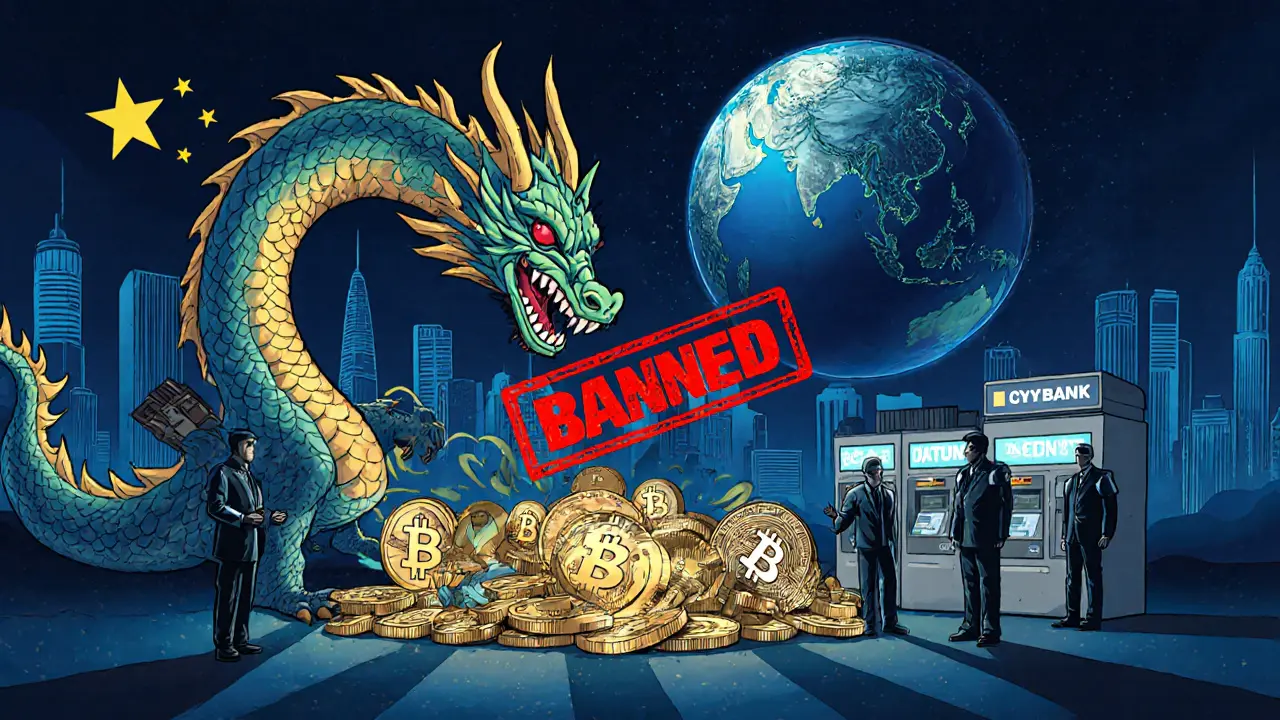
As of June 1, 2025, Chinese citizens can no longer legally buy, sell, trade, or even hold any cryptocurrency. This isn’t a warning or a gray area-it’s a total ban enforced by the People’s Bank of China (PBOC). If you’re a resident of mainland China, owning Bitcoin, Ethereum, or even Tether (USDT) is now illegal. The government didn’t just shut down exchanges. It cut off every possible path to crypto, including the ones people used to sneak around earlier rules.
How China Got to a Complete Crypto Ban
China’s crackdown on cryptocurrency didn’t happen overnight. It was a 12-year buildup. Back in 2013, the PBOC warned banks not to handle Bitcoin transactions. By 2017, they shut down all local crypto exchanges and banned initial coin offerings (ICOs). In 2021, mining was outlawed because of energy use. By 2023, even using VPNs to access foreign exchanges was under scrutiny. Each step tightened the noose. Then, on May 30, 2025, Circular No. 237 dropped: all crypto activity, personal or business, was declared illegal.Before this, China was the world’s biggest crypto market. In 2013, Bitcoin prices swung wildly based on news from Beijing. Chinese miners once powered over 70% of Bitcoin’s network. But the government saw decentralized money as a threat-not just to financial control, but to the yuan’s dominance. The rise of stablecoins like USDT became especially worrying. They were being used to move money out of China, bypassing strict capital controls. That’s why the July 2025 crackdown targeted OTC brokers and crypto-to-yuan traders who helped people convert digital assets into cash abroad.
What Exactly Is Illegal Now?
The 2025 ban isn’t vague. It covers every single action related to cryptocurrency:- Buying or selling crypto with yuan or foreign currency
- Holding crypto in personal wallets (even if bought overseas)
- Using crypto as payment for goods or services
- Operating or promoting crypto exchanges, even from outside China
- Providing price data, trading tools, or wallet services for crypto
- Running mining rigs, even if you’re just powering them at home
- Accepting crypto as payment for business services
It doesn’t matter if you’re an individual or a company. Even if you own crypto through a Hong Kong account or an offshore exchange, the PBOC considers it a violation if you’re a Chinese resident. Financial institutions like Bank of China, ICBC, and Alipay are legally required to freeze any account linked to crypto activity. Their systems now flag transfers to known crypto wallet addresses, foreign exchange platforms, or OTC dealers.
How Enforcement Works in Practice
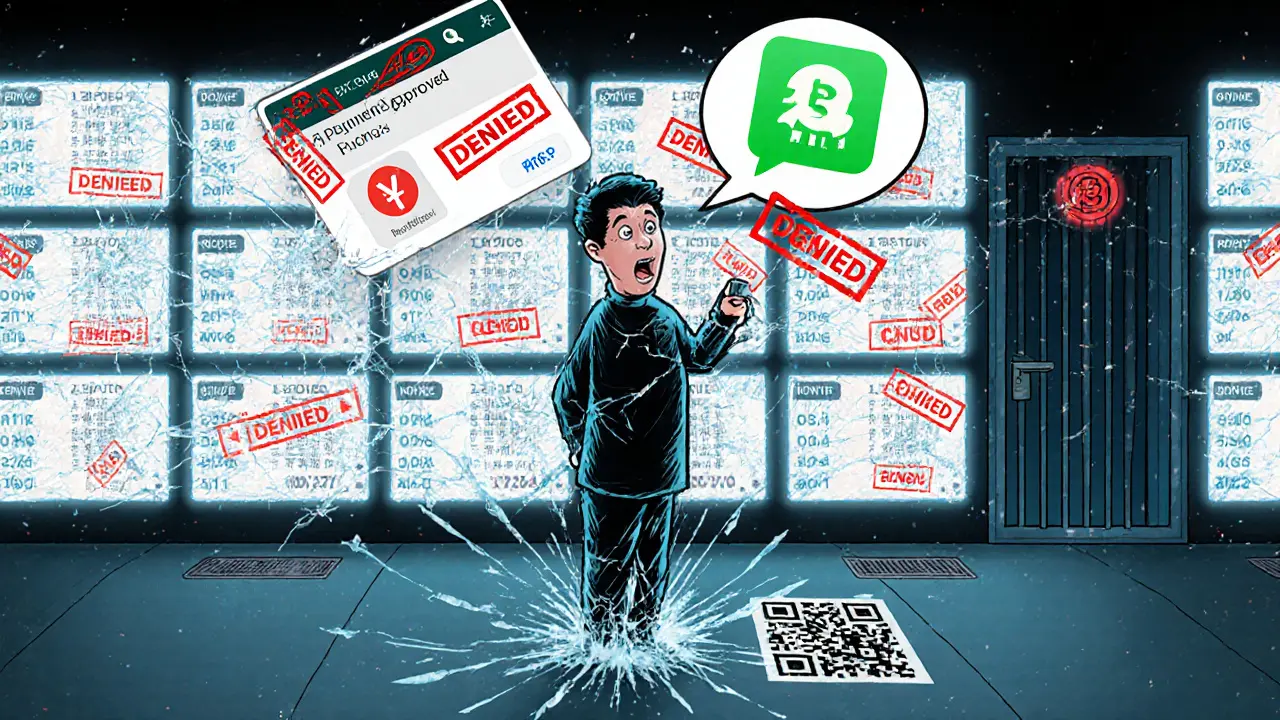
China doesn’t rely on luck to catch violators. Its enforcement is technical, coordinated, and relentless. Banks use AI-driven monitoring tools to detect patterns tied to crypto trading-like sudden large transfers to overseas wallets, repeated small payments to known crypto platforms, or transactions matching the timing of global market spikes.In July 2025, police in Guangdong and Shanghai arrested over 200 people running underground crypto-to-yuan exchanges. Many of these were small businesses that accepted USDT in exchange for cash. The authorities traced transactions through telecom data, bank records, and even mobile app usage logs. Some suspects were charged with illegal business operations and money laundering.
Even social media is monitored. Posts promoting crypto investment, tutorials on using Phantom Wallet, or guides on bypassing firewalls are removed within hours. Platforms like WeChat and Douyin now automatically flag keywords like “BTC,” “ETH,” or “USDT.”
Why China Won’t Reverse This
Some people wonder if China will soften its stance. The answer is no-at least not for the foreseeable future. The government has two clear priorities: control and stability. Crypto undermines both. A decentralized currency can’t be tracked, taxed, or frozen by the state. That’s the opposite of what China wants.The real alternative is the digital yuan, or e-CNY. Launched in pilot form in 2020, it’s now fully integrated into daily life in cities like Beijing, Shanghai, and Shenzhen. Unlike Bitcoin, the digital yuan is fully traceable. The government can set expiration dates on funds, restrict spending to certain merchants, or even freeze payments to individuals. It’s not just a digital version of cash-it’s a tool for social and economic control.
Experts agree: China’s goal isn’t to ban crypto because it’s dangerous. It’s to ban crypto because it’s uncontrollable. And the digital yuan gives them everything crypto promises-speed, efficiency, global reach-but with total oversight.
What About Hong Kong?
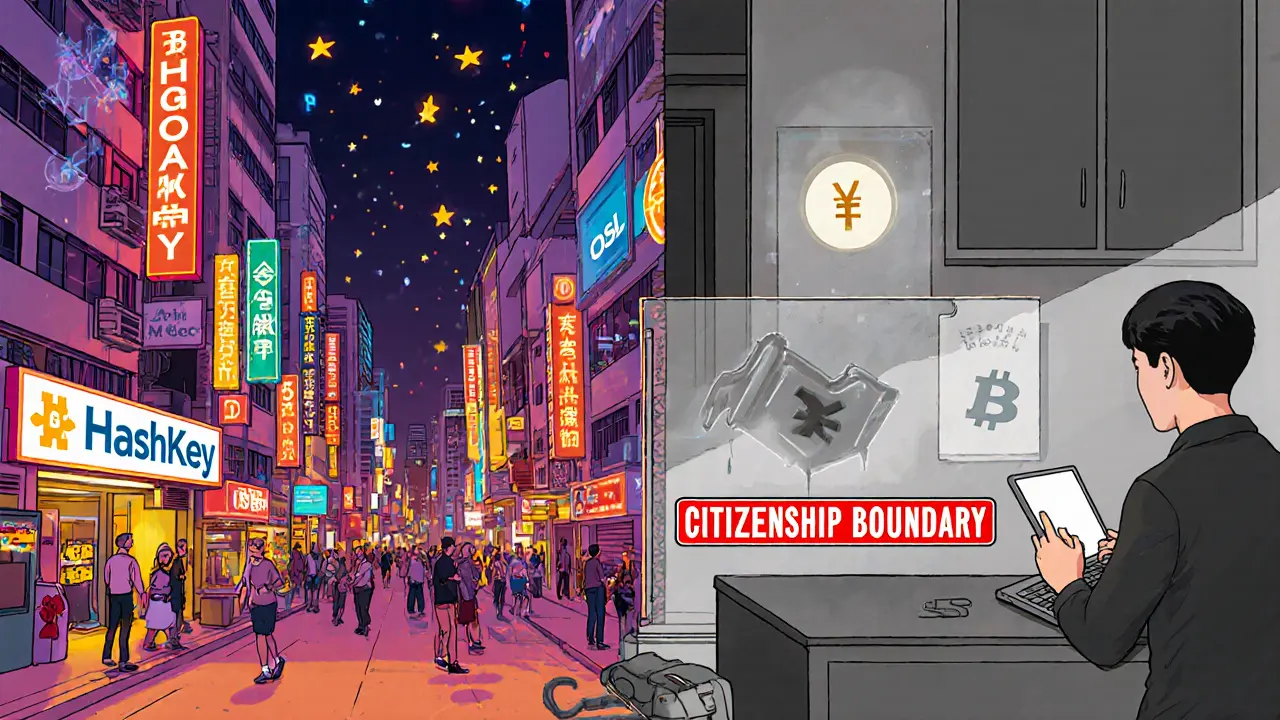
Hong Kong is the exception. While mainland China shuts down crypto, Hong Kong has become Asia’s most open digital asset hub. Exchanges like HashKey and OSL are licensed by Hong Kong’s Securities and Futures Commission. Institutional investors can trade crypto futures. Tokenized bonds and real estate are being issued on blockchain platforms.But here’s the catch: Hong Kong residents are not Chinese citizens under mainland law. If you’re a mainland Chinese citizen living in Hong Kong, you’re still bound by the 2025 ban. The PBOC doesn’t recognize jurisdictional borders when it comes to its citizens’ financial behavior. Many mainlanders with Hong Kong bank accounts have been investigated for crypto trades-even if the transactions happened entirely in Hong Kong.
What Happens If You Get Caught?
The penalties aren’t just fines. They’re criminal. In 2025, courts in Zhejiang and Jiangsu sentenced individuals to up to three years in prison for running crypto OTC services. Others received heavy fines-sometimes equal to the value of the crypto they held. Banks can freeze personal accounts indefinitely. Credit scores can be damaged. Some people have been barred from applying for loans, mortgages, or even government jobs.Even holding crypto without trading it can be grounds for investigation. If your wallet has a balance of 10 Bitcoin or more, and you’re a Chinese resident, authorities can demand proof of how you acquired it. If you can’t prove it came from before June 2025, you’re assumed to be in violation.
What’s the Future for Crypto in China?
There’s no sign the ban will loosen. The PBOC has invested billions in surveillance tech, AI monitoring, and cross-border financial tracking. The digital yuan is expanding rapidly-over 500 million users as of late 2025. State media regularly frames crypto as a “financial risk” and “a tool for capital flight.”Some companies still find loopholes. A few use offshore subsidiaries to hold crypto assets, but these are risky and legally murky. Any profits brought back into China could be seized. Even discussing crypto in corporate meetings can trigger internal audits.
The only real path forward for Chinese citizens is to accept the digital yuan. It’s already used for public transit, utility bills, and government subsidies. The government is pushing it harder than ever-offering cash bonuses to users who adopt it. In 2026, the PBOC plans to tie e-CNY to social credit scores, making it harder to access services if you don’t use it.
Final Reality Check
If you’re a Chinese citizen, crypto is gone-not just from exchanges, but from your life. The days of buying Bitcoin on Binance via a VPN are over. The tools to evade detection are being hunted down. The legal risks are real and severe.This isn’t about ideology. It’s about control. China has chosen a path where money is not just digital-it’s monitored, managed, and mandatory. For those outside China, this is a warning: when a government decides to eliminate an asset class, it doesn’t just regulate it. It erases it.

Tina Detelj
So let me get this straight-China just turned money into a state-controlled surveillance tool, and people are acting like this is normal?? 🤯 We built blockchain to escape exactly this kind of control, and now the most powerful nation on earth is weaponizing digital cash to monitor every coffee purchase?? I’m not even mad-I’m just… fascinated by how fast we’re all becoming characters in a dystopian novel written by bureaucrats with Excel sheets.
stephen bullard
It’s sad, really. The digital yuan isn’t about innovation-it’s about obedience. People forget that money was never just about transactions; it’s about freedom. When you can’t own something without the state knowing where it is, when you can’t move it without permission-you don’t have money, you have tokens. And tokens can be revoked.
SHASHI SHEKHAR
Bro, I live in India and I’ve seen this movie before-remember when the government demonetized 500 and 1000 rupee notes in 2016? Chaos everywhere, small businesses collapsed, elderly people cried in lines for hours… and what did we get? A push for digital payments. Now here we are again, but this time it’s global, it’s blockchain, and it’s *worse*. China isn’t just banning crypto-they’re erasing financial autonomy. And honestly? I’m scared for what comes next. The digital yuan isn’t progress-it’s a leash with a GPS tracker. 🚨💸
Abby cant tell ya
Wow. So the Chinese government just made owning Bitcoin a crime. And you’re all acting like this is a surprise?? 🙄 You people thought crypto was about freedom but you still used it to buy weed and NFT monkeys. Now you’re shocked when the state says ‘nope’? Get over it. You wanted anarchy? You got a prison with Wi-Fi.
Janice Jose
I get why China did this. I really do. But I also feel for the people who just wanted to invest, or send money home, or protect their savings from inflation. It’s not about ideology-it’s about survival. And now they’re criminalizing that. That’s the real tragedy here.
Michael Labelle
Kinda reminds me of how the US treated marijuana in the 90s. One day it’s a crime, next decade it’s a tax revenue stream. Maybe in 20 years, China will realize crypto isn’t the enemy-the lack of regulation is. But until then, they’re just building a digital police state with better UX.
jeff aza
Let’s be clear: this isn’t a ‘ban’-it’s a monetary coup d’état. The PBOC is deploying sovereign digital currency infrastructure to achieve full capital control, eliminate shadow financial systems, and neutralize any decentralized monetary competition. The digital yuan is a programmable fiat instrument with embedded compliance logic-think: FedNow on steroids, with AI-driven behavioral enforcement. This is the future of central bank dominance, and China just shipped v1.0.
Vijay Kumar
China banned crypto because they’re scared. Scared of people thinking for themselves. Scared of money they can’t control. Sad.
Vance Ashby
So… if I own BTC in a wallet I bought before 2025, and I never touch it, am I still guilty? 😅
Brian Bernfeld
Look-I’ve lived in three countries. I’ve seen authoritarian regimes try to control information. I’ve seen them crush dissent. But this? This is next-level. They’re not just censoring speech-they’re censoring *ownership*. You can’t own something that can’t be traced, taxed, or frozen. That’s the entire point of crypto. And China just proved that if a state wants to kill a technology, it doesn’t need to outlaw the code-it just needs to outlaw the people who use it. Brutal. Brilliant. Terrifying.
Christina Oneviane
Oh my god. So now the Chinese government can track your coffee purchase and say ‘you spent 10 yuan on a latte-where did the other 5 yuan come from? You must be laundering crypto.’ I’m not even joking. This is worse than the Red Scare. At least McCarthy didn’t have AI.
fanny adam
It is imperative to recognize that the People’s Republic of China’s implementation of a comprehensive cryptocurrency prohibition constitutes a systemic assertion of monetary sovereignty, predicated upon the foundational tenets of state-controlled economic stability, anti-capital-flight protocol, and the eradication of unregulated financial intermediation. The digital yuan, as a centrally programmable instrument, enables granular fiscal oversight unattainable via decentralized ledgers. This is not suppression-it is governance.
Eddy Lust
i mean… i get it. people want to be free with their money. but what if the money you’re trying to be free with is just… kinda useless? like, i dont know, maybe crypto was a big party and china just decided to turn off the lights and say ‘time to go home.’ i’m not mad. just… tired. 💤
Casey Meehan
China banned crypto? Cool. I’m just glad I didn’t buy any. 🤷♂️😂
Martin Doyle
You’re all overreacting. This is just capitalism meeting socialism. The digital yuan is better. It’s faster. It’s cleaner. If you’re crying about losing your Bitcoin, you were never serious about money-you were serious about gambling.
SARE Homes
OMG. I KNEW IT. I KNEW CHINA WOULD DO THIS. THEY’RE TRYING TO CONTROL EVERYTHING. NEXT THEY’LL BAN THE INTERNET. OR SMILES. OR SUNSET. 😭😭😭
Grace Zelda
It’s wild how fast we went from ‘crypto is the future’ to ‘crypto is a crime’ in one country. But here’s the thing-this isn’t just about China. It’s about what happens when governments realize they can replace freedom with convenience. And people? They’ll trade liberty for a smoother app experience every time. We’re not losing crypto-we’re losing the will to fight for it.
Kristi Malicsi
they banned it so they can have their own version which they can spy on and control and limit and track and freeze and punish people for using it and everyone just shrugs and says oh well
Rachel Thomas
Wait so if I buy Bitcoin in Hong Kong and then move to the mainland, am I a criminal? That’s not a ban, that’s a trap.
Sierra Myers
China’s digital yuan is just a fancy PayPal with a police badge. No big deal.
SHIVA SHANKAR PAMUNDALAR
They banned crypto because they’re scared of what happens when people stop trusting the state. But they don’t realize-by banning it, they’re proving the point. If you have to outlaw something to keep people from using it… maybe it’s because you’re the problem.