Crypto Payment Speed Comparison: TPS & Confirmation Times 2025

Crypto Payment Speed Comparison Tool
Performance Metrics
TPS
0
Transactions per secondAvg. Conf.
0
SecondsSecurity
-
LevelReliability
-
Uptime %Network Comparison
| Network | TPS | Confirmation Time | Best For |
|---|
Recommendation Engine
When you try to pay for a coffee or settle an invoice with crypto, the clock starts ticking the moment you hit send. If the network needs minutes-or even ten minutes-to confirm, the experience feels clunky compared to a swipe of a card. That’s why cryptocurrency transaction speed has become the litmus test for any blockchain that wants to be taken seriously as a payment method.
Key Takeaways
- Solana boasts the fastest real‑world average confirmation at 0.4seconds, but it only reaches about 1.6% of its 65,000TPS theoretical limit.
- Bitcoin remains the slowest with 5‑7TPS and ~10‑minute blocks, yet it offers unmatched security and liquidity.
- Layer‑2 solutions like Polygon can lift Ethereum’s throughput to7,000TPS while keeping fees low.
- Choosing a network for payments means balancing speed, cost, reliability, and ecosystem maturity.
- Future upgrades (e.g., Solana’s congestion fixes, Ethereum’s roll‑ups) aim to push practical TPS into the thousands.
How Transaction Speed Is Measured
Two metrics dominate the conversation:
- Transactions per second (TPS) - the number of transfers a blockchain can seal in one second. High TPS reduces queue length during peak demand.
- Confirmation time - the delay between broadcasting a transaction and seeing it finalized. For retail payments, sub‑second confirmation is the sweet spot.
Both numbers are tied to a network’s consensus design, block size, and data propagation methods. Theoretical TPS shows what a protocol could achieve under ideal conditions; real‑world peak TPS tells the story of everyday usage.

Major Networks: Speed, Consensus, and Typical Use Cases
Below are the most relevant blockchains for payment scenarios, each introduced with Schema.org microdata so search engines can identify the entities.
Bitcoin is the original proof‑of‑work cryptocurrency, processing about 5‑7TPS with roughly a ten‑minute block time. Its security comes from the largest hashed power in the world, making it the go‑to choice for high‑value, low‑frequency payments.
Ethereum is a proof‑of‑stake platform that handles up to 25TPS and averages 12‑second block confirmations after its 2022 Merge. It powers most DeFi and NFT apps, but its gas fees can spike during congestion.
Solana is a high‑throughput blockchain that combines Proof of History with Proof of Stake, achieving a theoretical 65,000TPS and an average 0.4‑second confirmation time. It’s favored for fast‑moving DeFi and gaming, though it has faced occasional network stalls.
Algorand is a pure proof‑of‑stake network designed for predictable performance, delivering 1,000theoretical TPS and about 4.5‑second confirmations. Its stability makes it attractive for cross‑border remittances.
Avalanche is a consensus protocol that can process roughly 4,500TPS with sub‑second finality, suitable for complex finance and NFT marketplaces. It supports multiple virtual machines, letting developers choose between Ethereum‑compatible and native code.
Polygon is a layer‑2 scaling solution for Ethereum, extending capacity to about 7,000TPS while keeping fees low and retaining Ethereum’s security guarantees. It’s a popular bridge for merchants who need faster settlements than base‑layer Ethereum can provide.
Sui is a novel blockchain that uses a Move‑based execution engine and a Narwhal‑based data availability layer, recording around 854TPS in its July2023 peak. It targets high‑volume, low‑latency applications.
Fantom is a DAG‑based network delivering roughly 4,000TPS with confirmation times under two seconds, optimized for DeFi and real‑time gaming. Its Lachesis consensus offers fast finality with modest hardware requirements.
Speed Comparison Table
| Network | Theoretical TPS | Peak Real‑World TPS | Avg. Confirmation Time | Consensus Model |
|---|---|---|---|---|
| Solana | 65,000 | 1,504 (April62025) | 0.4seconds | Proof of History + PoS |
| Avalanche | 4,500 | 4,500 (steady) | ≈1second | Avalanche Consensus |
| Polygon (Layer‑2) | 7,000 | ~5,800 (2025 avg.) | ≈2seconds | Optimistic Rollup |
| Algorand | 1,000 | ~950 | 4.5seconds | Pure PoS |
| Fantom | 4,000 | ~3,800 | ≈2seconds | DAG‑Lachesis |
| Sui | ~10,000 (est.) | 854 | ≈1second | Proof of Stake + Narwhal |
| Ethereum | 25 | 24‑25 | 12seconds | Proof of Stake (Post‑Merge) |
| Bitcoin | 7 | ~5‑7 | ≈10minutes | Proof of Work |
Beyond Speed: Cost, Security, and Reliability
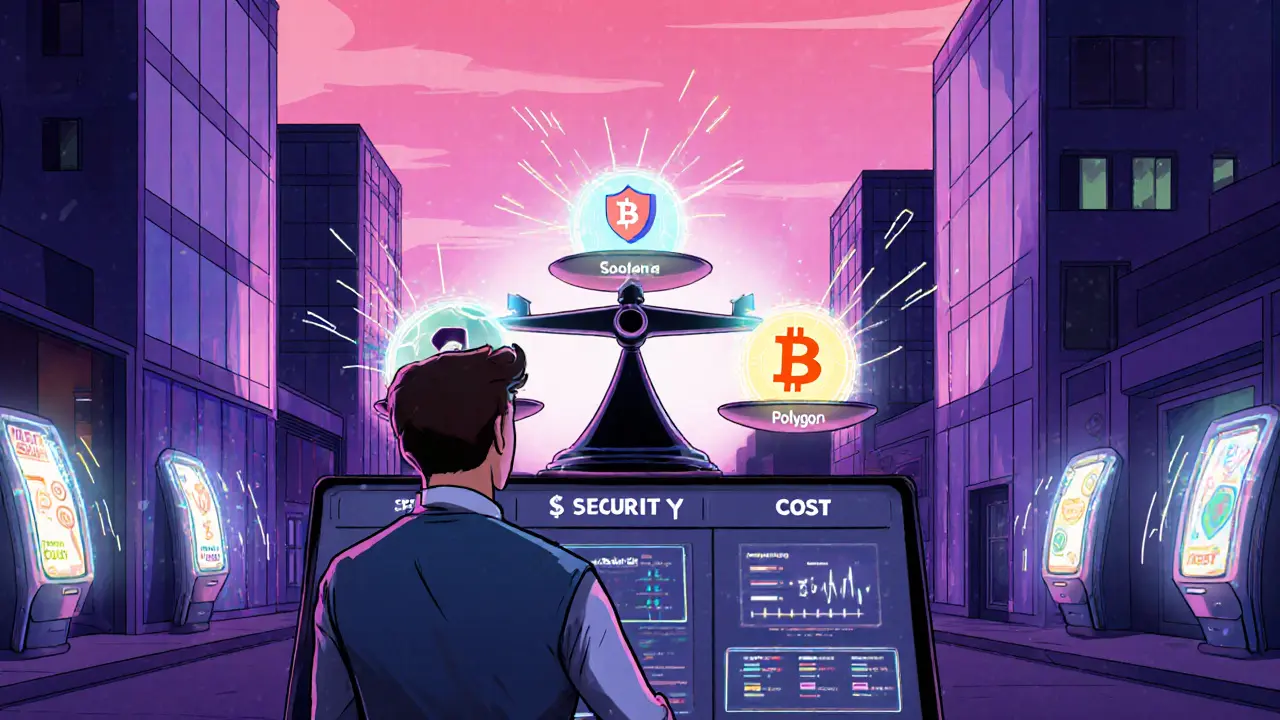
Speed alone doesn’t decide whether a crypto payment solution works in the real world. Here’s how the other factors stack up:
- Fees: Networks that rush transactions can spike fees when demand spikes. Solana’s fees stay sub‑cent, but congestion periods have forced users to over‑pay to beat the mempool.
- Security: Bitcoin’s proof‑of‑work chain has withstood a decade of attacks, giving merchants confidence for large settlements. Faster PoS chains rely on economic staking and can be vulnerable if a few validators control a large share.
- Reliability: Outages on Solana (e.g., the 2025 memecoin surge) caused temporary transaction failures. Algorand and Polygon report higher uptime percentages, making them safer for everyday point‑of‑sale use.
Choosing the Right Crypto for Your Payment App
Match the network to three core business questions:
- What transaction value range am I handling? High‑value, low‑frequency transfers benefit from Bitcoin’s security; micro‑payments thrive on sub‑second chains like Solana or Polygon.
- How important is fee predictability? If you need a stable fee model, consider Algorand (flat fees) or Polygon’s roll‑ups.
- Do I need fast finality for a seamless UX? For instant checkout, aim for under‑2‑second confirmation-Solana, Avalanche, or a well‑tuned Layer‑2 solution.
Implementation tips:
- Start with testnets: Solana’s devnet and Polygon’s Mumbai testnet give you a sandbox for fee estimation.
- Use SDKs that abstract confirmation logic-most libraries hide the difference between “pending” and “finalized”.
- Design fallback flows: if the primary fast network stalls, automatically route to a slower but more reliable chain like Bitcoin.
Future Outlook: Speed Gains on the Horizon
Roadmaps from 2025 onward indicate three major trends:
- Layer‑2 proliferation: New roll‑ups on Ethereum (e.g., ZK‑Rollups) promise sub‑millisecond finality while preserving security.
- Hybrid consensus: Projects like Sui blend PoS with data availability layers to squeeze more TPS without sacrificing decentralization.
- Hardware‑accelerated validation: Some validators are experimenting with ASIC‑based PoS signatures, potentially raising real‑world TPS by 2‑3×.
Even if a network hits its theoretical ceiling, practical adoption depends on ecosystem depth-wallets, exchanges, and regulators need to support the chosen chain. Expect the next wave of payment‑grade crypto to be a mix of fast base layers and robust roll‑ups, delivering thousands of TPS with fees comparable to traditional card processing.
Frequently Asked Questions
Which cryptocurrency is the fastest for everyday payments?
In real‑world tests, Solana delivers the lowest average confirmation time at around 0.4seconds, but its network can become congested. For a more consistent experience, Polygon’s Layer‑2 solution offers sub‑2‑second confirmations with steadier uptime.
Can I use Bitcoin for point‑of‑sale transactions?
Technically you can, but the ten‑minute block time makes it impractical for instant checkout. Some merchants mitigate this by accepting zero‑confirmation payments or using Lightning Network channels, which settle instantly off‑chain.
How do transaction fees compare across fast networks?
Solana and Polygon typically charge less than $0.01 per transaction. Algorand has a flat fee of about $0.001. Ethereum’s base layer can exceed $5 during spikes, which is why most payment apps rely on roll‑ups or sidechains to keep costs low.
What’s the biggest downside of choosing a high‑TPS network?
Speed often comes with trade‑offs in decentralization and network stability. Fast chains may have fewer validators, making them more susceptible to outages or centralization concerns, and they can experience sudden fee spikes when demand outpaces capacity.
Will Ethereum ever match the speed of Solana?
Ethereum’s base layer is unlikely to hit Solana’s raw TPS without compromising security. However, widespread adoption of Layer‑2 solutions (Optimistic and ZK roll‑ups) is expected to push effective throughput into the thousands, narrowing the gap for payment use cases.

Jack Stiles
Yo, this crypto speed thing is pretty wild. Solana’s sub‑second vibes are sick, but you gotta watch the network jams. If you’re just trying to buy a coffee, going for Polygon or Algorand might save you the headache.
Ritu Srivastava
Honestly, many of these “fast” chains are built on shaky foundations. You’re trading security for speed like it’s a harmless gamble, but the moral cost of that shortcut is huge. People keep shouting about TPS while ignoring the massive centralization risks.
Liam Wells
While the author presents a comprehensive tabulation of throughput metrics, it must be noted-with utmost precision-that the declared "theoretical TPS" values often lack empirical verification; consequently, reliance upon such figures may engender unwarranted optimism.
Furthermore, the variance between on‑chain and off‑chain confirmations, especially within hybrid consensus models, warrants deeper scrutiny.
Caleb Shepherd
Look, the thing they don’t tell you is how the validators are funded. Most of these high‑TPS networks are backed by a handful of VC‑heavy entities that could pull the rug anytime. Keep an eye on the governance tokens-they’re the real power play.
Don Price
When we dissect the narrative that the crypto sphere has finally cracked the speed barrier, we must first acknowledge that the majority of these figures are cherry‑picked from peak‑load experiments that are rarely replicated in sustained, real‑world usage.
Take Solana, for instance: the headline 0.4‑second confirmation time is derived from optimal network conditions, where the mempool is relatively empty and the validator set is cooperating without any malicious intent.
In practice, during periods of high demand-particularly when meme‑coins surge-its confirmation latency can balloon dramatically, leading to transaction failures and exorbitant fees.
Contrast this with Bitcoin, which, despite its sloth‑like ten‑minute block time, offers a predictable security model rooted in an enormous hash‑rate, making it the default choice for high‑value, low‑frequency transfers.
The emergence of the Lightning Network attempts to bridge that gap, providing near‑instant settlements while preserving Bitcoin’s security guarantees; however, it introduces custodial complexities and liquidity constraints that many merchants are not prepared to manage.
Ethereum’s transition to proof‑of‑stake has indeed reduced block times to around 12 seconds, yet it remains vulnerable to gas price volatility, especially during DeFi spikes.
Layer‑2 solutions such as Optimistic and ZK‑Rollups promise sub‑second finality, but they inherit Ethereum’s security assumptions and rely on aggressive fraud proofs that can, in worst‑case scenarios, delay withdrawals for days.
Algorand’s pure proof‑of‑stake architecture delivers a steady 4.5‑second finality, but its ecosystem is comparatively nascent, limiting merchant adoption and integration tooling.
Polygon, as an optimistic roll‑up, offers sub‑2‑second confirmations and low fees, yet it remains tethered to Ethereum’s security model; any vulnerability in the underlying base layer propagates upward.
Fantom’s DAG‑based consensus provides impressive throughput, but its validator distribution is less decentralized than Bitcoin’s, raising concerns about potential collusion.
Sui’s novel data availability layer showcases promising throughput, yet it is still in early phases, with limited mainnet usage data to substantiate its claims.
When evaluating a payment network, one must balance three axes: speed, security, and reliability; ignoring any one of these renders the solution either impractical or unsafe.
Furthermore, regulatory scrutiny is intensifying globally, with authorities focusing on transaction monitoring and anti‑money‑laundering compliance, which may impact high‑throughput chains more heavily due to their transaction volume.
In sum, no single blockchain currently satisfies all merchant requirements; a hybrid approach-leveraging fast Layer‑2 solutions for micro‑payments while falling back to Bitcoin or Ethereum for high‑value settlements-remains the most prudent strategy.
Adopting such a dual‑stack architecture also future‑proofs businesses against upcoming upgrades, such as Ethereum’s upcoming sharding roadmap and potential Layer‑2 standardizations.
Dawn van der Helm
👍 Great rundown! If you’re just starting out, I’d try Polygon for cheap micro‑payments and keep a Bitcoin fallback for big orders. 🚀
Monafo Janssen
Hey folks, love the depth here. From a cultural perspective, it’s fascinating how different regions gravitate toward different chains. In Southeast Asia, you’ll see a lot of Solana in gaming, while Africa is leaning more toward Algorand for remittances because of its stable fees.
Michael Phillips
One philosophical angle: the quest for speed mirrors our modern desire for instant gratification. Yet, we must ask whether sacrificing decentralization for speed erodes the core values that made crypto revolutionary.
Jason Duke
Let’s be real-if you’re not paying under $0.01 per txn, you’re basically paying for the privilege of using crypto. That’s insane, especially when traditional card processors charge less than a cent for bulk volume.
Bryan Alexander
Whoa! Imagine a world where you can buy a coffee with a transaction that finalizes before you even finish ordering. That’s the kind of drama we need in everyday life!
Patrick Gullion
Honestly, most of these “fast” chains are just marketing hype. I’d rather trust a slower, proven network than jump on the newest speed bandwagon.
Darren Belisle
I see both sides. Speed is great, but if a network goes down you’ll lose sales. A balanced approach with fallback options is the way forward.
Mark Bosky
From a technical standpoint, it’s essential to consider the underlying consensus mechanism when selecting a payment chain. Proof‑of‑Stake systems like Algorand offer rapid finality with relatively low energy consumption, whereas Proof‑of‑Work chains such as Bitcoin prioritize security at the expense of speed. When integrating a crypto payment gateway, developers should also account for SDK support, API latency, and the availability of testnets for thorough QA. Additionally, transaction fee predictability is a key metric; spikes during network congestion can erode user experience and increase operational costs. It’s advisable to implement dynamic fee estimation and, where possible, route payments through Layer‑2 solutions to mitigate these issues.
Brian Lisk
In looking at the presented data, one cannot help but appreciate the nuanced trade‑offs that each blockchain presents. Solana’s near‑instant confirmation time is undeniably attractive for retail environments, yet its occasional network instability should give merchants pause. Avalanche, with its respectable TPS and sub‑second finality, offers a compelling middle ground, balancing speed and reliability, particularly for complex DeFi applications that demand rapid settlement. Polygon’s Layer‑2 architecture stands out for its cost‑effectiveness; users enjoy low transaction fees while benefiting from Ethereum’s security guarantees, making it a suitable choice for high‑volume micro‑transactions. Algorand’s pure proof‑of‑stake consensus delivers consistent performance and straightforward fee structures, which can simplify accounting for enterprises operating across diverse jurisdictions. Meanwhile, Bitcoin, though lagging in speed, remains the benchmark for security and liquidity, especially when leveraged alongside Lightning Network channels for near‑instant payments without compromising its robust trust model. The overarching theme is clear: no single network universally dominates; instead, the optimal solution is contingent upon the specific use‑case, transaction value, and risk tolerance of the merchant. By employing a hybrid approach-such as utilizing Polygon for everyday purchases while reserving Bitcoin for high‑value transfers-businesses can maximize both user experience and capital preservation. Moreover, as upcoming upgrades like Ethereum’s sharding and further Layer‑2 innovations materialize, the landscape will continue to evolve, potentially narrowing the performance gaps currently observed. In conclusion, strategic diversification across multiple blockchains, coupled with vigilant monitoring of network health and fee dynamics, will empower vendors to deliver seamless, secure, and cost‑effective crypto payments well into the future.
Mark Fewster
I appreciate the thoroughness of the analysis. It helps businesses make informed decisions without getting lost in hype.
Ken Pritchard
Mentoring tip: start with a sandbox on Polygon’s Mumbai testnet, then gradually integrate a Bitcoin Lightning node for larger settlements. This staged approach reduces risk while giving you hands‑on experience.
manika nathaemploy
i think its important to look at the community support too. some chainz have good docs and forums which help newbies a lot.
Richard Bocchinfuso
People need to stop glorifying speed when it means compromising on decentralisation. Fast isn’t always better.
EDWARD SAKTI PUTRA
From an operational perspective, having consistent fee models across chains simplifies accounting and reduces surprise expenses for merchants.
Moses Yeo
One might argue that the relentless pursuit of higher TPS is merely a reflection of our capitalist obsession with speed, overlooking the philosophical implications of decentralizing trust.