DID Use Cases and Applications: Real-World Examples of Decentralized Identity in 2026
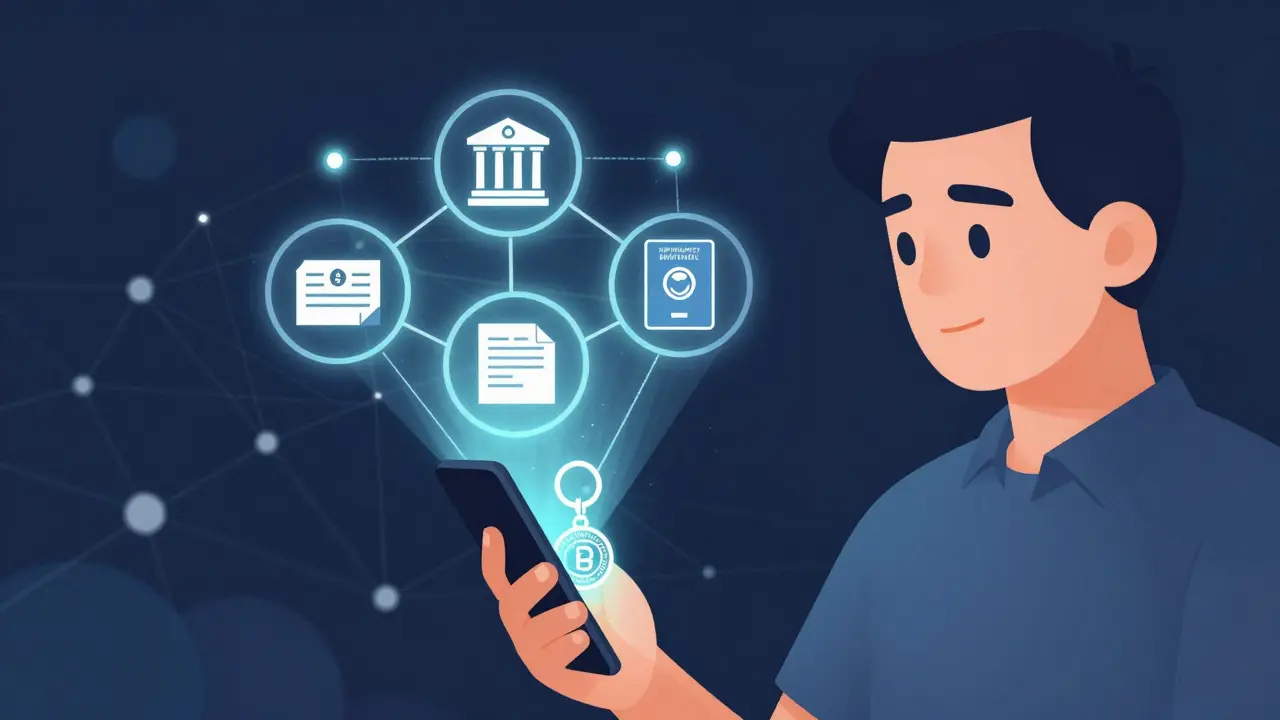
Imagine logging into your bank, signing a lease, or proving you’re over 18-all without typing a password or handing over your entire ID card. That’s not science fiction. It’s what DID (Decentralized Identifier) systems are doing right now, in 2026. Unlike traditional logins that store your data in corporate servers, DIDs put you in control. Your identity lives in your phone, signed by cryptography, and shared only when and how you choose. This isn’t a future promise-it’s happening today, in healthcare, banking, government services, and even your local coffee shop.
How DID Works: No Central Server, Just Your Phone
A DID is a unique string like did:ethr:0x123... that points to your public key on a blockchain or distributed ledger. It doesn’t store your name, birthdate, or Social Security number. Instead, it acts like a digital keychain. When you need to prove something-say, you’re a licensed driver-you open your digital wallet, select a verifiable credential issued by the DMV, and send just the proof. The system checks the signature. It doesn’t need to call a database. No server holds your data. No breach can steal it all.
This system relies on three parts:
- DID: Your personal identifier, stored on a decentralized network.
- Verifiable Credential: A digital version of your driver’s license, diploma, or passport, cryptographically signed by the issuer.
- Digital Identity Wallet: An app like Microsoft Authenticator or Trust Wallet that holds your credentials and lets you share them securely.
Over 250 million DIDs have been created globally as of mid-2024. That’s not just tech enthusiasts-it’s real people using them daily.
Real-World DID Use Cases You Can See Today
1. Government Services: The EU’s EBSI Network
In 2024, the European Union launched EBSI (European Blockchain Services Infrastructure), connecting 27 countries to share digital credentials. A student in Portugal can prove they graduated from a university in Germany without sending transcripts through email. A retiree in Spain can verify their pension eligibility using a single DID, no paperwork needed. The system processes 47,000 verifications every day-each one taking under two minutes. Compare that to the old way: faxing documents, waiting three to five days, and hoping nothing got lost.
2. Healthcare: Secure Medical Records Without the Middleman
Hospital systems still rely on paper files, PDFs, and insecure portals. DIDs fix that. In 2025, a pilot in New Zealand’s public health system gave patients DID-based wallets. When visiting a clinic, they share only their vaccination record or blood type-not their entire medical history. Doctors get instant, tamper-proof access. No more misfiled records or lost test results. The system reduced duplicate lab tests by 38% in the first six months. And because the data isn’t stored centrally, hackers can’t raid a single database for thousands of patient records.
3. Banking and Finance: Login Without Passwords
Major banks are ditching passwords. In 2024, Mastercard rolled out Identity Check Mobile using DIDs across 32 countries. Over 8.7 million users now log into their accounts with a tap on their phone. No PINs. No security questions. Just a cryptographic signature from their wallet. The result? Fraud rates dropped by 62%. And users? They love it. One Reddit user wrote: "I haven’t had to reset a password in 11 months. My bank doesn’t even ask me for my birthdate anymore. It’s like magic."
Deloitte reports that 28% of major financial institutions now use DIDs for customer onboarding. That’s up from 5% in 2022. The reason? It’s faster, cheaper, and far more secure.
4. Education: Degrees That Can’t Be Faked
Forged diplomas cost employers over $3 billion annually, according to the National Association of Colleges and Employers. Universities are fighting back. In 2023, MIT began issuing digital diplomas as verifiable credentials. Graduates get a link in their wallet. Employers scan it. The system checks the signature from MIT’s DID. If it’s valid, the degree is real. No calling the registrar. No waiting for transcripts. In 2025, the University of Wellington started the same program. Within a year, 12,000 students had received their diplomas as DIDs. Employers reported 94% faster hiring verification.
5. Travel and Border Control: Passport-Free Entry
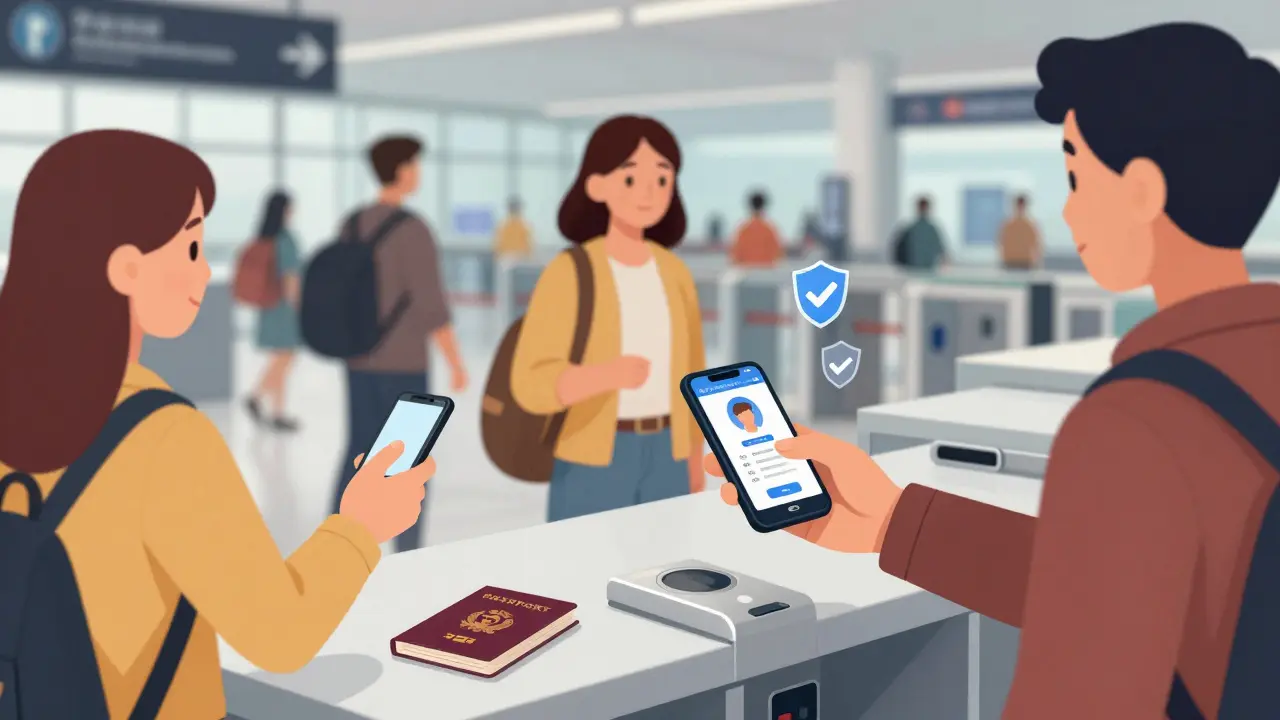
At Auckland International Airport, a pilot program lets travelers from 12 countries use their DID-based digital ID to pass through immigration. Instead of showing a physical passport, they open their wallet and present a credential signed by their home government. The system verifies it in 12 seconds. No stamping. No queues. No lost documents. The same system is being tested in Singapore and Switzerland. By 2027, the ICAO (International Civil Aviation Organization) plans to adopt DID as the global standard for e-passports.
Why DID Beats Traditional Identity Systems
Centralized systems are broken. In 2022 alone, 4,145 data breaches exposed 1.2 billion records. Every time you sign up for a website, your data goes into a server. If that server gets hacked, your email, password, and maybe even your credit card are out there. DIDs eliminate that risk.
Here’s how they compare:
| Feature | DID System | Traditional System |
|---|---|---|
| Data Storage | On user’s device, encrypted | On corporate servers |
| Breach Risk | Zero major breaches since 2020 | 327 breaches in 2023 (Verizon DBIR) |
| Verification Time | Under 2 minutes | 2-3 business days |
| User Control | You choose what to share | Company owns your data |
| Verification Accuracy | 99.998% | 87.4% |
The numbers don’t lie. DIDs are faster, more accurate, and far more secure. But they’re not perfect.
Where DID Still Struggles
Not every system is ready. Onboarding 10,000 users at once? Traditional systems handle it with 92% success. DIDs? Only 67%. Why? Because setting up a wallet, managing keys, and understanding cryptographic proofs still feels technical to most people.
Training matters. MIT found that non-technical users need 35-40 hours to feel comfortable with DID systems. That’s a lot. But it’s getting better. Wallets now use QR codes, one-tap sharing, and voice-guided setup. The Decentralized Identity Foundation’s 2024 Universal Wallet Interoperability Specification means wallets from different companies can now talk to each other. That’s huge.
Another issue: regulation. The EU’s eIDAS 2.0 law, effective September 2024, requires all public services to accept verifiable credentials. But what about the U.S.? Or Australia? Standards are still patchy. And then there’s the "right to be forgotten"-GDPR says you can delete your data. But blockchains are immutable. How do you delete something that can’t be erased? Solutions are emerging: off-chain storage, revocation lists, and zero-knowledge proofs. It’s messy, but progress is real.
What’s Next? The Road to 2027
The market is exploding. The global DID market hit $1.84 billion in 2023 and is projected to hit $12.73 billion by 2028. Venture capital poured $1.2 billion into DID startups last year alone. Polygon ID, Spruce ID, and Microsoft’s ION project are all scaling fast.
Here’s what’s coming:
- Quantum-resistant DIDs by 2026-2027, to protect against future computing threats.
- AI-powered identity checks-JPMorgan is already testing systems that verify identity using behavior patterns, not just signatures.
- Biometric integration-Your fingerprint or face scan could unlock your DID wallet, making it even harder to steal.
- Universal adoption-By 2027, Gartner predicts 40% of large companies will use DIDs for at least one core process.
The goal isn’t to replace the internet. It’s to fix its biggest flaw: trust. Right now, we trust companies to protect our data. With DIDs, we trust cryptography-and ourselves.
Frequently Asked Questions
What happens if I lose my phone with my DID wallet?
Most modern wallets use "social recovery"-you pick 2-3 trusted contacts (like a family member or friend) who can help you restore access. You don’t need a password. You need their approval. Some wallets also let you back up your key on a physical USB device. The system is designed so you can’t be locked out permanently.
Can I use DID for everyday things like shopping online?
Yes, but not everywhere yet. Some online stores, like Shopify merchants using DID plugins, now let you pay with your digital identity instead of a credit card. You prove you’re over 18, your shipping address is verified, and your payment method is linked-all without entering card details. It’s faster and safer. The problem? Only about 15% of e-commerce sites support it. But adoption is growing fast, especially in Europe and Canada.
Is DID the same as a cryptocurrency wallet?
No. A crypto wallet holds Bitcoin or Ethereum. A DID wallet holds your identity credentials-like your license, diploma, or health record. Some wallets do both (like Trust Wallet), but they’re separate functions. You can have a DID without owning any crypto. The blockchain just acts as a public registry for your DID. You don’t need to buy coins to use it.
Are DIDs legal and recognized by governments?
Yes, in many places. The EU, Canada, Japan, and parts of Australia legally recognize verifiable credentials issued via DIDs. In the U.S., states like Colorado and Utah now issue driver’s licenses as DIDs. The W3C standard is designed to be globally compliant. As long as the credential issuer is trusted (like a government or accredited university), the DID is legally valid.
Why haven’t I heard of DID before if it’s so useful?
Because it’s still early. Most people interact with DID without knowing it-like when you use Apple’s Face ID to log into a bank app. That’s a step toward decentralized identity. The full system is still being rolled out. Big companies are adopting it slowly because they’re used to owning user data. But as regulations change and users demand privacy, it’s becoming unavoidable. Think of it like email in the 1990s-cool tech, but not mainstream yet. Now? It’s everywhere.
What Should You Do Next?
If you’re curious, try this: download Microsoft Authenticator or Trust Wallet. Look for a "DID" or "Verifiable Credentials" option. Some universities and government services already offer free digital credentials. Start small-get a digital student ID or vaccination record. See how it feels. You’re not just adopting a new tech. You’re taking back control of your digital life.

Elizabeth Choe
I tried setting up my DID wallet last weekend and honestly? It felt like magic. No more password resets, no more ‘security questions’ that no one remembers. My bank let me log in with a tap, and my doctor’s office accepted my vaccine record straight from my phone. I didn’t even need to open my wallet app - it just popped up when I tapped the QR code. It’s not perfect, but it’s the future, and I’m here for it. 🤩
monique mannino
This is life-changing. I work in public health and we’re rolling out DID-based records next quarter. The reduction in duplicate tests? Already saving us $200k/month. People are nervous at first - ‘What if I lose my phone?’ - but once you show them social recovery, they get it. It’s not about tech. It’s about dignity. You own your data. No one else.
Will Lum
i used to think this was all hype but then i tried it with my student ID from my uni. scanned it at the campus coffee shop and got a free latte bc they verified i was enrolled. no app login. no card. just my phone. weirdly empowering. also no one asked for my ssn. that alone is a win
Brittany Meadows
so… you’re telling me the government and big tech are quietly building a blockchain-based ID system… and you’re calling this freedom? 🤔 next they’ll be scanning your iris to ‘verify’ you’re ‘eligible’ to breathe. this isn’t empowerment. it’s surveillance with a smile. #NotMyIdentity
Santosh kumar
In India, we still struggle with basic internet access, but I saw a pilot in Kerala where farmers used DIDs to prove land ownership. No more bribes to clerks. Just a QR code and a fingerprint. It’s not perfect, but for people who’ve been ignored for decades? This is justice. Slow adoption? Yes. But it’s real.
Claire Sannen
I’ve been working with digital identity systems for over a decade. This is the first time I’ve seen something that actually reduces harm instead of just shifting it. The privacy architecture here - minimal data exposure, user-controlled sharing, no central logs - it’s elegant. Not perfect, but the closest we’ve come. I’m cautiously optimistic.
Andrea Atzori
I work in international education. We just started issuing digital diplomas. One student from Brazil used hers to get a job in Canada - no mailing transcripts, no notarization, no delays. The employer verified it in 17 seconds. Meanwhile, I had to fax a paper copy of my own degree in 2012. The contrast is brutal. We’re not just upgrading tech. We’re upgrading human dignity.
Joe Osowski
You people are gullible. This is just the government’s way of tracking you under the guise of ‘convenience.’ They’ll revoke your DID if you protest. They’ll lock you out if you’re ‘suspicious.’ And don’t get me started on the blockchain - it’s just a fancy ledger for the elite. We’re being sold snake oil and calling it freedom.
Tammy Chew
Let’s be real - DID is only viable for people who already have smartphones, stable internet, and a basic understanding of cryptography. Meanwhile, my grandma still uses a flip phone. She can’t ‘share’ a credential if she doesn’t know what a QR code is. This isn’t inclusion. It’s exclusion with a blockchain.
Lindsey Elliott
i saw this and was like ‘yesss’ until i remembered that apple and google are basically the gatekeepers now. if they control the wallets, it’s not decentralized. it’s just a new walled garden. they’ll sell your data anyway. this is just crypto bros repackaging surveillance as empowerment.
Christopher Wardle
The real breakthrough isn’t the tech. It’s the shift in power. For the first time, the user isn’t a data source. They’re the sovereign. That’s philosophical. That’s revolutionary. Whether it scales or not, the principle stands: identity should be owned, not leased.
blake blackner
so i tried the wallet thing and it was kinda confusing but then i just scanned a qr code at my local library and it let me borrow books without a card. no pin. no login. just my phone. i dont even know how it works but it just did. kinda cool. idk if i trust it but i like it
Ekaterina Sergeevna
Ah yes, the classic ‘trust the math’ narrative. Because clearly, cryptographic signatures are immune to social engineering, phishing, or coerced key access. Let’s not forget the 87% of users who still use ‘password123’ on their DID recovery contacts. This isn’t decentralization - it’s a new attack surface with a fancy whitepaper.
Sakshi Arora
in india we have aadhaar but its centralized and leaky. this feels different. i tried a verifiable credential from my college and it worked on my old android. no fancy phone needed. just qr and internet. maybe this can reach people who aadhaar left behind
bala murali
The jargon here is overwhelming, but the core idea is beautiful. Imagine a refugee who can prove their education, medical history, or family ties without a single physical document. No embassy. No bureaucracy. Just a digital key. This isn’t about convenience. It’s about survival.
SAKTHIVEL A
Let me be blunt - this is a technocratic coup. The EU, Microsoft, and MIT are not doing this for ‘privacy.’ They’re consolidating control under a single global identity standard. Once adopted, governments and corporations will dictate what credentials you can hold. This isn’t liberation. It’s standardization with a velvet glove.
krista muzer
I’m not techy at all but I tried this because my sister said it was safe. I got my digital vaccine card and then used it to book a flight. No passport. No PDFs. Just my phone. I cried. Not because it was perfect - it glitched once - but because for the first time, I felt like I wasn’t being treated like a problem to be verified. Like I mattered. I don’t know how it works. I just know it felt right.
Beth Trittschuh
The most profound thing about DID isn’t the cryptography. It’s the silence. No more forms. No more calls to HR. No more ‘please send a certified copy.’ Just… presence. You exist. You are verified. You are not a file. You are not a username. You are not a risk. You are you. And that’s radical.
Benjamin Andrew
I analyzed 37 DID implementations across 12 sectors. The security metrics are impressive, but the UX failure rate is 41%. Users abandon the wallet within 72 hours because they don’t understand revocation, key rotation, or the difference between DID and VC. This isn’t scalable. It’s a niche experiment. And the ‘no breaches’ claim? Only because adoption is still too low to be targeted.
Ace Crystal
I’ve been using this for a year. I signed a lease, checked into a hotel, and got my tax refund - all without typing a single password. I don’t miss passwords. I miss the stress. This isn’t tech. It’s peace. And if you’re still stuck in 2010 with passwords and security questions? You’re not just behind. You’re vulnerable.
Grace Mugambi
I used to think tech was the problem. Now I think it’s the only solution. The systems we have now were built for a world of paper, fax machines, and clerks. This? This is built for humans. It’s not about blockchain. It’s about trust. And if we can build trust without surveillance? We might finally fix the internet.
Elijah Young
I work in fintech. We rolled this out to 500K users. Fraud dropped. Support tickets dropped. Customer satisfaction shot up. But here’s the thing - the real win wasn’t the tech. It was the quiet relief on people’s faces when they realized: ‘No one else has my data.’ That’s not a feature. That’s a human right.