Different Hash Algorithms Used in Cryptocurrencies: SHA-256, Keccak, BLAKE2, and More
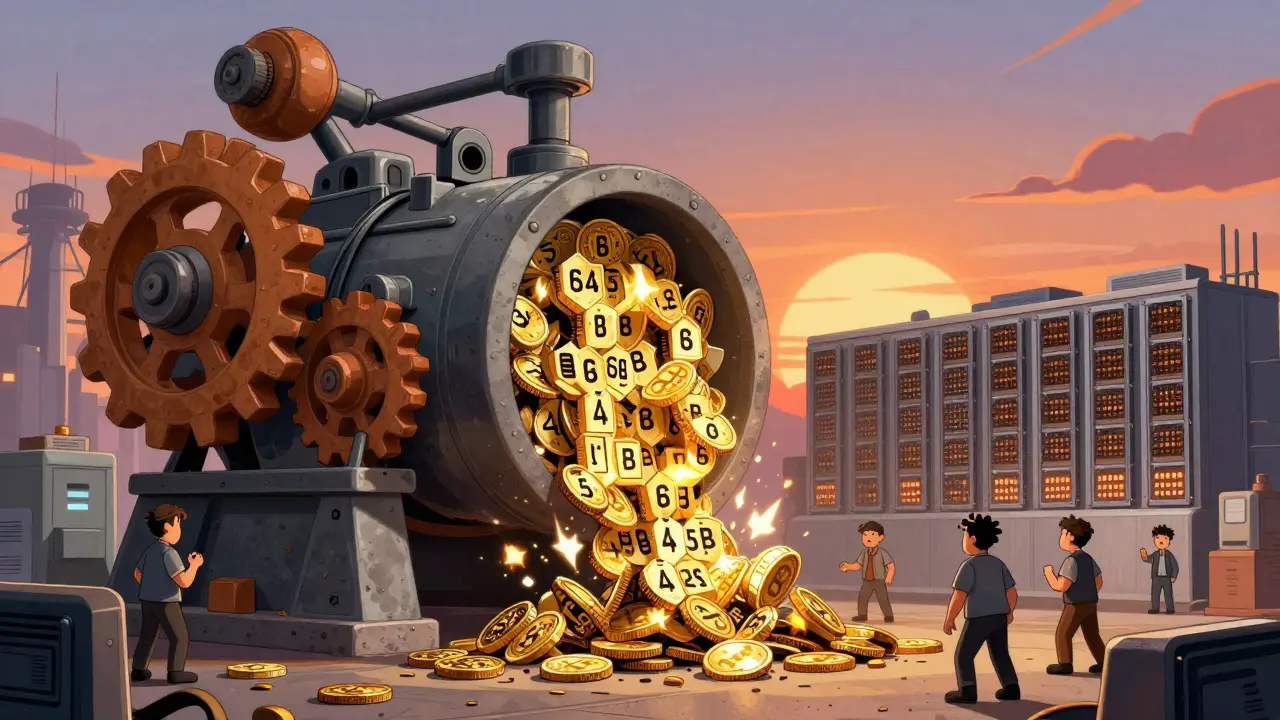
When you send Bitcoin or Ethereum, you're not just moving coins-you're relying on a hidden layer of math that makes the whole system secure. At the heart of every transaction, block, and wallet address is a hash algorithm. These aren't just fancy math functions. They're the digital fingerprints that keep cryptocurrencies from being forged, tampered with, or hacked. But not all hash algorithms are the same. Some are old, some are fast, some are built to resist powerful mining hardware, and others are designed for the future. Understanding which ones power the blockchains you use can help you see why Bitcoin behaves differently from Litecoin, or why Ethereum chose a different path entirely.
SHA-256: The Original Workhorse of Bitcoin
SHA-256 is the algorithm that made Bitcoin possible. When Satoshi Nakamoto launched the network in January 2009, he chose SHA-256 because it was well-tested, standardized by NIST, and had no known practical attacks. It takes any input-whether it's a single word or a gigabyte of data-and turns it into a fixed 256-bit hash, shown as a 64-character hexadecimal string. For miners, this means solving a puzzle: find a number that, when hashed with the block data, produces a result starting with a certain number of zeros. The more zeros required, the harder the puzzle. SHA-256 does this reliably, but it's also incredibly fast on specialized hardware. Today, ASIC miners like the Bitmain Antminer S19 can crunch over 300 terahashes per second. That speed is great for security, but it also means regular GPUs and CPUs can't compete. As a result, Bitcoin mining is dominated by a few large companies, which some see as a centralization risk.
SHA-256 isn't just used for mining. It's also part of how Bitcoin addresses are created. First, your public key is hashed with SHA-256, then the result is hashed again with RIPEMD-160. This double-layered approach reduces the address size and adds a small extra layer of security. Even though SHA-256 is old, it's still considered secure. NIST and cryptographers agree: no one has found a practical way to reverse it or find two different inputs that produce the same output. But that doesn't mean it's perfect. Experts like Matthew Green warn that the cost of attacking SHA-256 is dropping. What once took $2^63 in computing power now costs closer to $2^55. Nation-states could crack it within five years. For now, it's safe-but not forever.
Keccak-256: Ethereum's Customized Security
Ethereum didn't use SHA-256. Instead, it went with Keccak-256, a variant of the SHA-3 standard. The difference might seem small, but it's critical. Keccak uses a completely different design called a "sponge construction," which absorbs data and then squeezes out the hash. This makes it resistant to certain types of attacks that can affect SHA-2 algorithms, like length extension attacks. Ethereum's developers chose Keccak specifically because it offered better theoretical security for smart contracts-where a single flaw can cost millions.
But here's the twist: Ethereum doesn't use the official NIST SHA3-256 standard. It uses Keccak-256 with different padding rules. This was a deliberate choice to avoid compatibility issues with other systems. The Ethereum Foundation confirmed in 2023 that this custom version prevents cross-chain hash collisions-meaning a hash from Bitcoin can't accidentally match one from Ethereum. Performance-wise, Keccak-256 is slower than SHA-256 on ASICs, which helped Ethereum stay more accessible to GPU miners for years. Even after the Merge in 2022, when Ethereum switched to proof-of-stake, Keccak-256 remained the standard for transaction hashing and smart contract execution. It's now used in over 22% of the top 100 cryptocurrencies, and Ethereum's influence keeps it growing. NIST has approved SHA3-256 as a standard, and Ethereum plans to switch to it by 2025, but for now, Keccak-256 is its own thing-and it works.

BLAKE2b: Speed for High-Throughput Chains
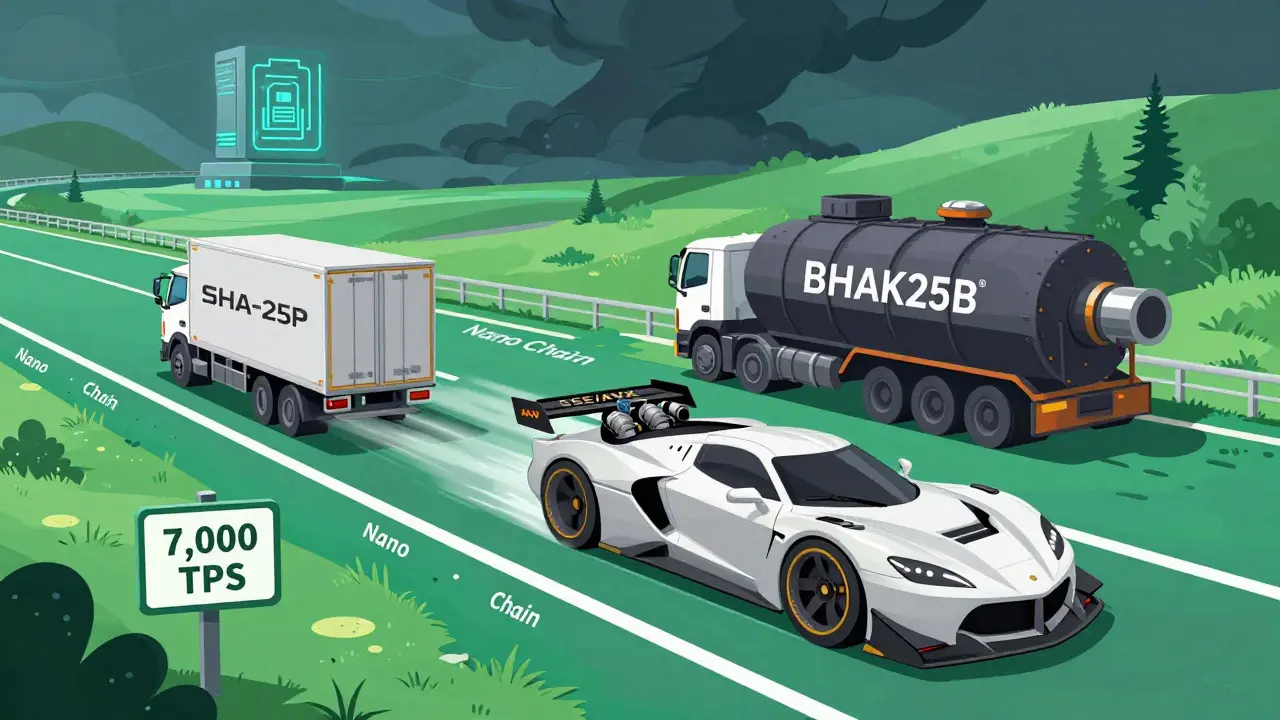
If you want speed, BLAKE2b is the algorithm to beat. Designed in 2012 by cryptographers including Jean-Philippe Aumasson, it's faster than SHA-256 and even Keccak on regular CPUs. Benchmarks show it can hash over 1,200 megabytes per second on modern processors, while SHA-256 maxes out around 600 MB/s. That’s why Nano, a cryptocurrency focused on instant, feeless transactions, chose BLAKE2b. Nano processes over 7,000 transactions per second with confirmation times under a second. SHA-256 can’t come close to that. BLAKE2b’s speed comes from its optimized design: fewer rounds, simpler operations, and better use of modern CPU instructions like SSE and AVX.
It’s not just fast-it’s also secure. BLAKE2b has no known collisions or practical attacks. It’s used in Zcash, Monero (in some variants), and even in some enterprise blockchain solutions because it balances speed and security better than older algorithms. One downside? It’s less widely supported. While SHA-256 has libraries in every programming language, BLAKE2b support is patchy. Developers working with it often need to compile custom code or rely on niche libraries. Still, for projects that prioritize performance over legacy compatibility, BLAKE2b is the clear winner. And with energy use as low as 0.05 kWh per 1,000 transactions-compared to Bitcoin’s 950 kWh-it’s also one of the greenest options available.
Memory-Hard Algorithms: Scrypt, Equihash, and ASIC Resistance
Not everyone wants mining to be dominated by billion-dollar ASIC factories. That’s where memory-hard algorithms come in. These are designed to make mining expensive on specialized hardware by forcing miners to use large amounts of RAM instead of raw processing power.
Litecoin, launched in 2011, was the first to use Scrypt. Unlike SHA-256, which needs mostly CPU cycles, Scrypt demands 32 times more memory. This made it possible for regular users to mine with GPUs instead of buying expensive ASICs. For a while, it worked. But by 2015, ASICs for Scrypt were developed, and Litecoin mining became just as centralized as Bitcoin’s.
Zcash took it further with Equihash. Created in 2016, it requires about 140MB of RAM per hash calculation. The idea was to make ASICs too expensive to build because they’d need massive memory bandwidth. For a few years, it held up. But by late 2022, Innosilicon released the Z15 ASIC miner, capable of 1,500 sol/s. Suddenly, GPU miners were out of the game. Equihash didn’t fail because it was weak-it failed because the economics of ASIC manufacturing caught up. Still, memory-hard algorithms remain important. They prove that blockchain design isn’t just about math-it’s about economics, incentives, and who gets to control the network.
Why It Matters: Security, Speed, and Centralization
The choice of hash algorithm isn’t just technical-it shapes the entire ecosystem. SHA-256 gives Bitcoin unmatched security and battle-testing, but it also locks mining into the hands of a few manufacturers. Keccak-256 gives Ethereum flexibility and better resistance to certain attacks, but it’s slower and more complex to implement. BLAKE2b enables high-speed, low-energy networks like Nano, but it’s not yet mainstream. Memory-hard algorithms tried to democratize mining, but ASICs always find a way.
What’s clear is that no single algorithm is best for everything. Bitcoin needs long-term security, so it sticks with SHA-256. Ethereum needs smart contract safety, so it uses Keccak. Nano needs speed and efficiency, so it chose BLAKE2b. The future of cryptocurrency may not be about picking one winner, but about building systems that can switch algorithms when needed. That’s called "algorithm agility," and it’s becoming a key design principle in new blockchains. If a hash function is ever broken, the network should be able to upgrade without a hard fork.
What’s Next? Quantum Threats and Algorithm Evolution
The biggest looming threat isn’t a cracked hash function-it’s quantum computing. A powerful enough quantum computer could break SHA-256 and other classical algorithms using Shor’s algorithm. Google’s 70-qubit processor in 2023 showed progress, and experts estimate practical attacks could emerge in 10-15 years. That’s why NIST is already standardizing quantum-resistant algorithms like CRYSTALS-Kyber. While these aren’t hash functions, they’ll change how blockchains store keys and sign transactions.
For now, SHA-3 variants like Keccak are seen as more future-proof than SHA-2. They’re newer, better designed, and less likely to be vulnerable to unforeseen attacks. Ethereum’s plan to switch to standard SHA3-256 by 2025 is a sign of things to come. Meanwhile, Bitcoin’s developers remain cautious. Pieter Wuille, a core Bitcoin contributor, argues that SHA-256’s 15 years of real-world use make it more trustworthy than theoretical improvements. But even he admits: if quantum threats become real, Bitcoin will need to change.
The lesson? Cryptocurrency security isn’t static. The hash algorithms you rely on today will evolve-or be replaced. The best networks aren’t the ones that picked the strongest algorithm in 2009. They’re the ones built to adapt.