Famous Genesis Blocks in Cryptocurrency History

Imagine waking up on a cold January morning in 2009 to find that the global financial system had just been handed a digital escape hatch. Most people were still reeling from the banking crisis, but deep in the code of an obscure new software project, something historic happened. This wasn't just a line of code; it was a declaration of war against centralized control. At the heart of this revolution sits the Genesis Block, the foundational layer of every major cryptocurrency network. It’s the point where the chain begins, the anchor that holds up billions of dollars in value today.
You might think all genesis blocks are created equal, but they aren’t. While many cryptocurrencies copy-paste their starting parameters, the stories behind them vary wildly. Some are born from political protest, others from technical necessity, and a few from pure accident. Understanding these origin points helps you grasp why certain coins command trust while others fade into obscurity. Let’s look at the most famous ones and what makes them tick.
The Bitcoin Genesis Block: The Original Protest
No discussion of blockchain history starts anywhere other than Bitcoin. On January 3, 2009, at 18:15:05 GMT, Satoshi Nakamoto mined the first block of the Bitcoin network. This isn't just a technical milestone; it's a cultural artifact. Embedded within the coinbase transaction of this block is a headline from The Times: "The Times 03/Jan/2009 Chancellor on brink of second bailout for banks."
Why does this matter? Because it proves intent. Nakamoto didn't just build a payment system; he built a critique of the existing one. By embedding a news headline, he timestamped the creation of Bitcoin against a specific moment of institutional failure. This message remains permanently etched in the ledger. You can’t change it, delete it, or rewrite it without breaking the entire chain. It serves as a permanent reminder that Bitcoin was designed as a hedge against central bank mismanagement.
Technically, the Bitcoin Genesis Block is unique because it has no parent. Every other block references the hash of the block before it. But since there was nothing before Block 0, Nakamoto hard-coded it into the client software. It’s not mined in the traditional sense; it’s baked in. Also, the 50 BTC reward for mining this block is unspendable. Why? Because the script requires a coinbase maturity check that effectively locks those coins forever. They sit there, untouched, a digital monument to the start of the experiment.
Ethereum’s Frontier: Where Code Became Law
If Bitcoin is a calculator, Ethereum is a computer. Its Genesis Block, known as the Frontier release, launched on July 30, 2015. Unlike Bitcoin’s simple transfer of value, Ethereum’s genesis block initialized a world state capable of executing complex smart contracts.
The technical setup here was far more intricate. The genesis block didn't just create coins; it allocated balances to early contributors who participated in the 2014 crowdsale. These addresses hold millions of ETH today, representing some of the largest single-holder positions in the network. If you look at the genesis block data, you see a pre-mined supply distributed among thousands of wallets. This contrasts sharply with Bitcoin, where every satoshi was earned through work (mining) after the launch.
This difference shapes the culture of each chain. Bitcoin purists often criticize Ethereum’s pre-mine as a lack of fair launch principles. However, this initial distribution funded the development team and allowed the ecosystem to grow rapidly. Without that seed capital, we likely wouldn’t have the decentralized finance (DeFi) explosion we saw in 2020 and beyond. The Ethereum genesis block set the stage for programmable money, turning the blockchain from a ledger into a platform.
Ripple’s XRP Ledger: A Different Kind of Origin
Ripple operates differently from Bitcoin and Ethereum. Its XRP Ledger genesis block was established in June 2012 by David Schwartz, Jed McCaleb, and Arthur Britto. The key distinction? There was no mining. The entire supply of 100 billion XRP was created at once in the genesis block. None of it was mined; it was simply issued.
This design choice reflects Ripple’s goal: speed and efficiency for cross-border payments. Mining consumes energy and time, which slows down settlement. By pre-creating the supply, Ripple could focus on consensus algorithms that validate transactions in seconds rather than minutes. The genesis block here defines the rules of the game immediately: fixed supply, no inflation from mining rewards, and a validator-based security model.
Critics argue this centralizes power, as the founders controlled the majority of the supply initially. Supporters counter that decentralization comes from the network effect and validator diversity, not just token distribution. Regardless of your stance, the XRP Ledger’s genesis block demonstrates that "blockchain" doesn't always mean "mined." It highlights the trade-off between decentralized issuance and operational efficiency.

Litecoin: The Silver to Bitcoin’s Gold
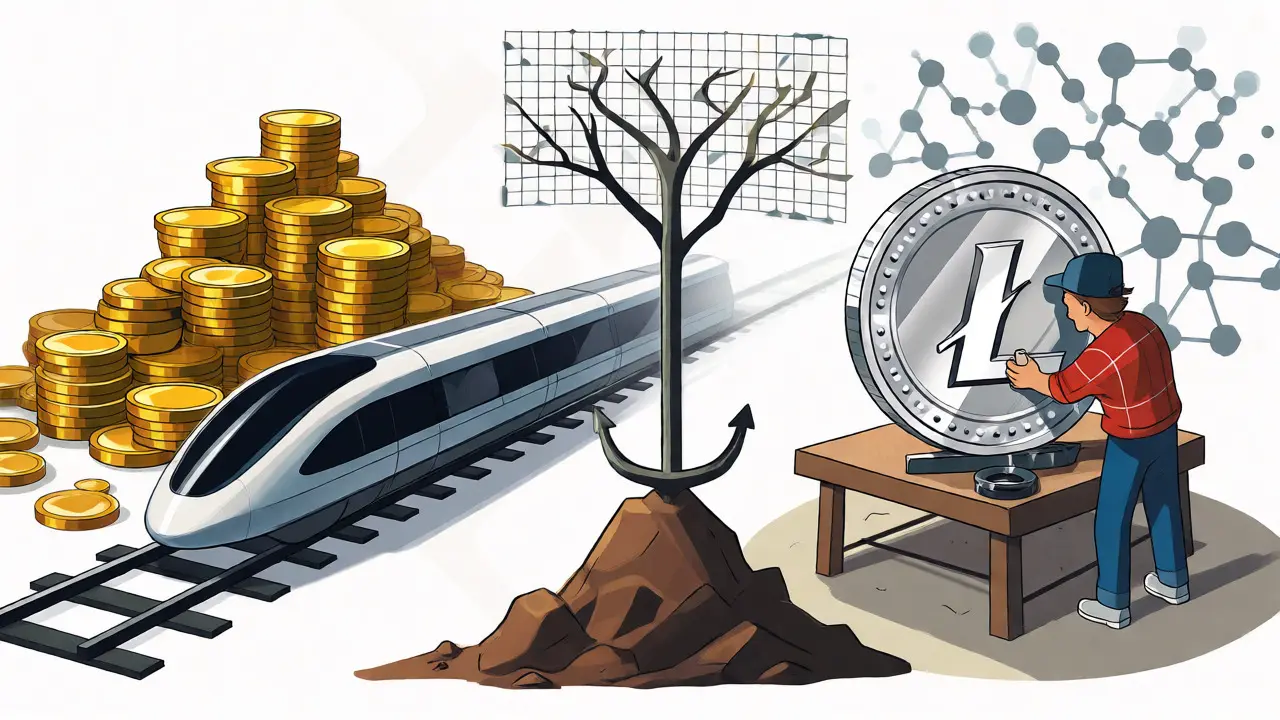
Charlie Lee launched Litecoin in October 2011, explicitly aiming to be the "silver to Bitcoin's gold." Its genesis block mirrored Bitcoin’s structure closely but changed critical parameters like block time and hashing algorithm. Instead of SHA-256, Litecoin used Scrypt, making it accessible to home miners without specialized hardware.
The genesis block of Litecoin contains a similar spirit of accessibility. It was mined by Charlie Lee himself, marking the start of a network designed for faster, cheaper transactions. While it lacks the poetic newspaper headline of Bitcoin, its significance lies in proving that Bitcoin’s code could be forked and improved. It paved the way for countless altcoins, showing that innovation could happen by modifying the base protocol.
Today, Litecoin remains one of the longest-running cryptocurrencies, surviving multiple market cycles. Its longevity validates the decision to prioritize user experience over ideological purity. The genesis block here represents pragmatism-taking a working model and tweaking it for real-world utility.
Comparing the Giants: Key Differences
Seeing these blocks side-by-side reveals how different philosophies shape technology. Here’s a quick breakdown of the core attributes:
| Feature | Bitcoin | Ethereum | XRP Ledger |
|---|---|---|---|
| Launch Date | Jan 3, 2009 | Jul 30, 2015 | Jun 2012 |
| Creation Method | Mined (Hard-coded) | Pre-mined (Crowdsale) | Pre-created (Fixed Supply) |
| Initial Reward | 50 BTC (Unspendable) | N/A (Balances assigned) | 100 Billion XRP (All created) |
| Key Innovation | Proof-of-Work Consensus | Smart Contracts | Fast Settlement Consensus |
| Embedded Message | Newspaper Headline | None | None |
Notice how Bitcoin focuses on symbolic resistance, Ethereum on functional capability, and XRP on operational speed. Each genesis block sets the DNA for the network’s future behavior. You can’t separate the tech from the intent.
Why the Genesis Block Still Matters Today
You might wonder why anyone cares about a block from 2009 or 2015. Isn’t the current price and adoption what matters? Not entirely. The genesis block establishes trust. When you run a full node, you verify the entire chain back to Block 0. If the genesis block doesn’t match the hard-coded standard in your software, your node rejects the whole chain.
This immutability is crucial for audits and transparency. Investors and developers can trace any transaction back to its origin. For Bitcoin, seeing that unspendable 50 BTC reward confirms that the rules haven’t been tampered with. For Ethereum, checking the genesis allocations ensures that early backers haven’t manipulated the initial supply.
Moreover, the story behind the block influences community sentiment. Bitcoin holders often cite the embedded headline as proof of its anti-establishment roots. This narrative drives adoption during times of economic uncertainty. It’s not just code; it’s a manifesto. New projects trying to launch today struggle to replicate this organic storytelling. Many fail because their genesis blocks feel sterile, lacking the historical weight that Bitcoin carries.
Lessons for New Blockchain Projects
If you’re building a new blockchain, what can you learn from these examples? First, clarity of purpose matters. Bitcoin knew exactly what it opposed. Ethereum knew exactly what it enabled. Second, distribution strategy defines decentralization. Pre-mines allow for faster growth but invite criticism. Fair launches build stronger communities but move slower.
Third, don’t underestimate the power of a good story. The Times headline wasn’t necessary for the code to run. It was added for humans. In a market saturated with thousands of tokens, a compelling origin story helps users remember why your project exists. Don’t just write a whitepaper; embed meaning into your genesis block.
Can the Genesis Block be changed?
No, the Genesis Block cannot be changed without creating a completely new blockchain. Since it is hard-coded into the client software and has no previous block reference, altering it would break the hash link to Block 1, causing all subsequent nodes to reject the chain. It is immutable by design.
Why is the Bitcoin Genesis Block reward unspendable?
The 50 BTC reward in Bitcoin's Genesis Block is unspendable due to a bug in the original implementation regarding coinbase maturity. The script requires the output to be spent only after 100 blocks, but because it is the first block, the logic fails to recognize it as valid for spending under normal conditions. Satoshi acknowledged this as a minor issue that didn't warrant a hard fork to fix.
What is the significance of the embedded text in Bitcoin's Genesis Block?
The text "The Times 03/Jan/2009 Chancellor on brink of second bailout for banks" serves two purposes. First, it proves the block wasn't mined before January 3, 2009, as the newspaper hadn't printed that headline earlier. Second, it acts as a political statement, criticizing the central banking system and signaling Bitcoin's role as an alternative to traditional finance.
Do all cryptocurrencies have a Genesis Block?
Yes, virtually all blockchain networks have a genesis block. It is the starting point of the ledger. Even if a network uses a different consensus mechanism or pre-mines its supply, it must define an initial state or first block to establish the chain's history and validity rules.
How does Ethereum's Genesis Block differ from Bitcoin's?
Ethereum's Genesis Block included a pre-mined allocation of ETH to participants of its 2014 crowdsale, whereas Bitcoin's Genesis Block awarded a standard mining reward to the miner (Satoshi). Additionally, Ethereum's genesis block initialized the world state for smart contract execution, while Bitcoin's primarily established the initial balance and consensus parameters.