Future of Modular Blockchain Architecture: Scalability, Layers, and What Comes Next
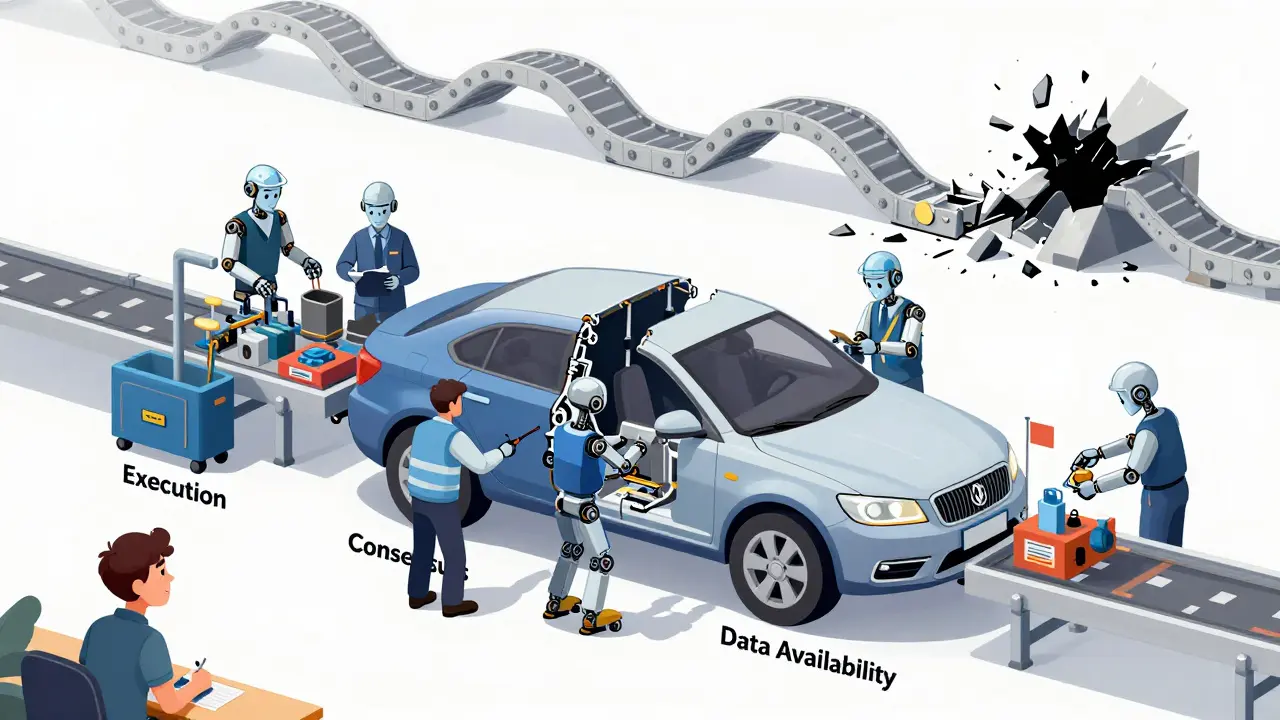
Monolithic blockchains used to be the norm. Every node had to do everything: verify transactions, agree on order, store all the data, and finalize everything. That worked fine when Bitcoin handled a few transactions per minute. But as soon as DeFi, NFTs, and dApps exploded, that model cracked under pressure. Gas fees spiked. Transactions stalled. Users got frustrated. The answer wasn’t to make the chain bigger-it was to break it apart.
Why Modular Blockchains Are the New Standard
Modular blockchain architecture doesn’t try to do everything in one place. Instead, it splits the core functions into separate layers, each optimized for one job. Think of it like building a car: you don’t make the engine, transmission, and tires from scratch every time. You pick the best engine, pair it with the right transmission, and choose tires suited for the road. That’s what modular blockchains do.The four key layers are:
- Execution Layer: Where transactions happen. Smart contracts run, tokens move, and apps respond. This is the "workhorse" layer.
- Consensus Layer: Decides which transactions are valid and in what order. It’s the referee that keeps everyone honest.
- Data Availability Layer: Securely stores all transaction data so anyone can verify it later. If this layer fails, the whole chain becomes untrustworthy.
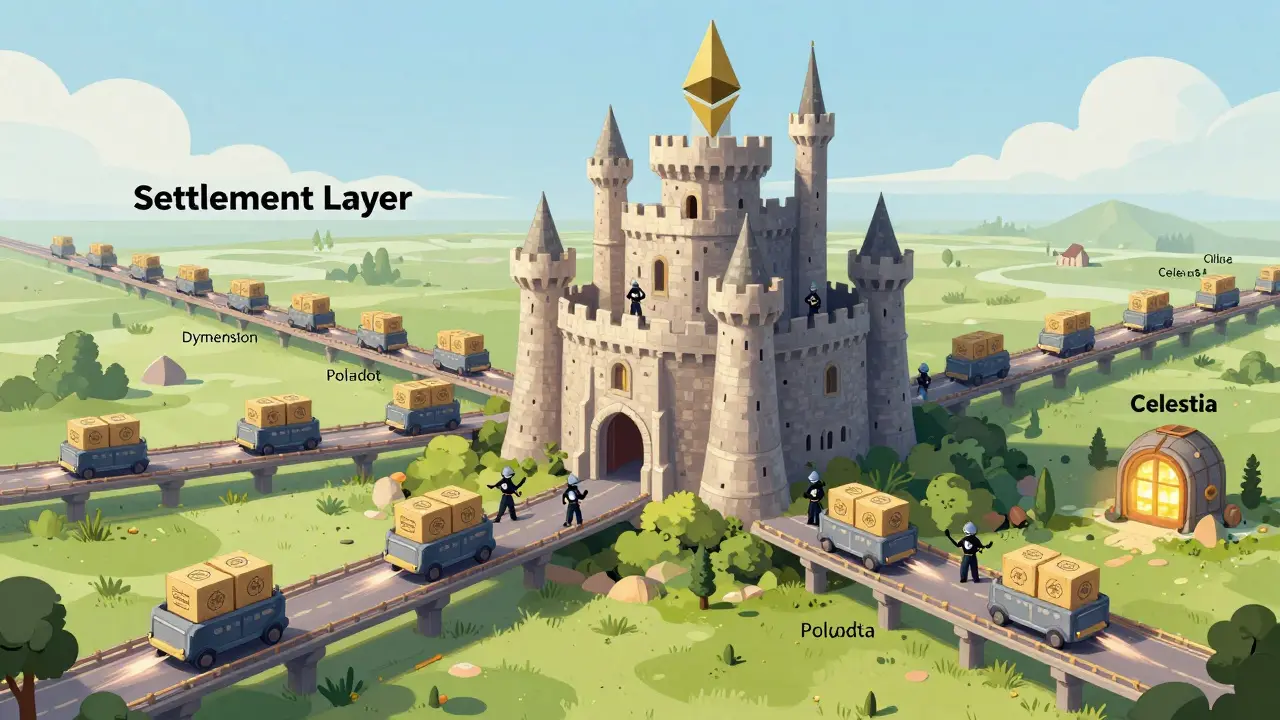
- Settlement Layer: The final authority. It confirms transactions and resolves disputes, often acting as a trust anchor for other chains.
Before modular, every blockchain tried to handle all four layers itself. Ethereum, for example, ran execution, consensus, and data storage on the same chain. That meant every single transaction slowed down the whole network. Modular blockchains break that bottleneck. Each layer can scale independently. Need more speed? Upgrade the execution layer. Need more security? Strengthen the consensus layer. No need to rebuild the whole system.
How Leading Platforms Are Doing It
Several major players have already built or are transitioning to modular designs-and they’re showing real results.Polkadot was one of the first to go all-in on modularity. It doesn’t just support one chain. It connects dozens through its Relay Chain, which handles consensus and security. Individual parachains handle execution. The upcoming JAM architecture takes this further by letting developers build custom chains with tailored execution environments, all secured by Polkadot’s shared infrastructure.
Ethereum, once the poster child for monolithic blockchains, is now becoming modular. The Dencun upgrade in 2024 was a major step. It introduced proto-danksharding, which offloads transaction data to specialized data availability layers. This lets Ethereum’s L2 rollups process thousands of transactions per second without overloading the main chain. Ethereum is no longer a single chain-it’s a settlement layer for hundreds of execution environments.
Dymension flips the script. It lets developers deploy custom blockchains called RollApps that handle their own execution. Dymension takes care of consensus and settlement, while delegating data availability to Celestia. Celestia, in turn, is a pure data availability layer. It doesn’t process transactions or run smart contracts. It just stores data securely and proves it’s available. This specialization makes it incredibly cheap and efficient.
Here’s how these platforms compare:
| Platform | Primary Role | Execution Layer | Consensus Layer | Data Availability | Settlement Layer |
|---|---|---|---|---|---|
| Polkadot | Shared Security Network | Parachains | Relay Chain | Parachains | Relay Chain |
| Ethereum | Settlement Layer | L2 Rollups | Proof-of-Stake | Proto-danksharding (Data Availability Rollups) | Ethereum Mainnet |
| Dymension | Consensus & Settlement | RollApps | Rollchain | Celestia | Dymension Hub |
| Celestia | Data Availability Only | None | DA-specific consensus | Self-hosted | None |
Each platform has its niche. Polkadot is a full-stack modular network. Ethereum is becoming the settlement backbone. Dymension is a turnkey system for launching custom chains. Celestia is the data warehouse no one else wants to build.
The Trade-Offs: Complexity and Interoperability
Modular doesn’t mean easier. It means more choices-and more things that can go wrong.One big risk is interoperability. If your app runs on Dymension, uses Celestia for data, and needs to talk to Ethereum for settlement, you’re relying on three different protocols to work together. If one fails, your app breaks. Bridges between chains have been hacked before. Modular systems multiply those attack surfaces.
Another issue is developer complexity. Building on a monolithic chain like early Ethereum meant learning one stack. Now, you need to understand how execution environments interact with consensus protocols, how data availability proofs work, and how to verify cross-chain messages. The learning curve is steep. New developers often get lost in the layers.
And then there’s the user experience. Most people don’t care about layers. They just want their transaction to go through fast and cheap. If they have to choose between a "RollApp on Dymension" and "Ethereum L2," they’ll pick the one that feels simpler. That’s why user-friendly wallets and abstracted interfaces are now just as important as the underlying tech.
What’s Next? Shards, Recursive Rollups, and Dynamic Chains
The next phase isn’t just about splitting layers-it’s about making them smarter.Sharded monolithic chains are coming. Ethereum’s long-term vision includes splitting its main chain into 64 shards, each handling its own execution. This blurs the line between monolithic and modular. It’s modular in structure, but still feels like one chain.
Recursive rollups are even wilder. Imagine a rollup that builds on top of another rollup. That rollup builds on a third. Each layer compresses data and proof, making verification cheaper and faster. This creates a chain of trust that can scale exponentially. It’s like nesting Russian dolls-but for blockchain efficiency.
And then there’s dynamic role-switching. A chain might start as a monolith. When traffic spikes, it auto-splits into modular layers. When traffic drops, it merges back. This isn’t science fiction. Projects like Polkadot’s JAM are already building tools that let chains change their architecture on the fly based on demand.
The Bigger Picture: A Layered Ecosystem, Not a Single Chain
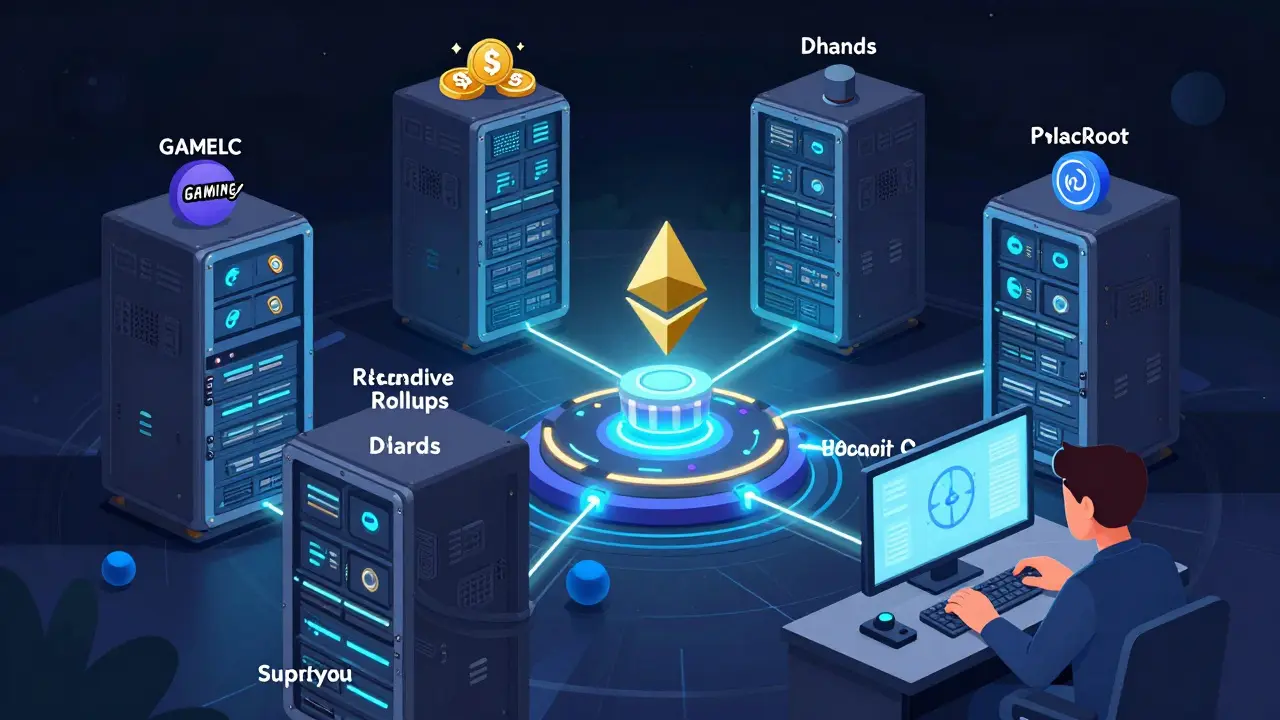
The future isn’t one blockchain to rule them all. It’s a layered ecosystem.Think of it like the internet. No one uses one server for everything. You have DNS servers, email servers, web servers, databases-all talking to each other. Modular blockchains are doing the same thing.
Large, secure chains like Ethereum or Polkadot will act as settlement layers. They’ll be the "banks" of the crypto world-slow, reliable, and trusted. Meanwhile, thousands of specialized execution chains will handle everything else: high-frequency trading, social media tokens, gaming economies, supply chain logs. Each optimized for its job. Each connected through interoperability protocols.
That’s why modular architecture isn’t just a technical upgrade. It’s a cultural shift. It moves us from "one-size-fits-all" blockchains to a world where developers can pick the right tools for the job. Where users get faster, cheaper transactions. Where innovation isn’t stuck waiting for a single chain to upgrade.
Who Benefits?
- Developers: Build custom chains without starting from scratch. Launch dApps that scale without worrying about Ethereum’s congestion.
- Users: Pay less in fees. Get transactions confirmed in seconds, not minutes.
- Enterprises: Deploy private, permissioned chains that settle on public ones for trust-without exposing sensitive data.
- Investors: Back platforms that solve real problems, not just hype.
The biggest winners? Those who understand the layers. Not just the tech-but how they fit together. The next big app won’t be built on Ethereum. It’ll be built on a custom execution layer, secured by Polkadot, with data stored on Celestia, and final settlement on Ethereum. And it’ll work because the layers talk to each other.
What’s the difference between monolithic and modular blockchains?
Monolithic blockchains handle execution, consensus, data availability, and settlement all on one chain. Every node does everything, which slows things down. Modular blockchains split these functions into separate layers. Each layer can be optimized independently-so execution can be fast, consensus can be secure, and data can be stored cheaply. This separation solves scalability issues that monolithic chains can’t.
Is Ethereum now a modular blockchain?
Yes, but not fully. Ethereum’s main chain still handles execution and consensus. But with the Dencun upgrade, it now offloads transaction data to specialized data availability layers. This makes it the first major blockchain to become partially modular. Its long-term goal is to become a settlement layer for rollups, with execution handled by external chains. That’s the full modular model.
Why is Celestia important in modular blockchains?
Celestia is a dedicated data availability layer. Most blockchains store all transaction data themselves, which is expensive and slow. Celestia only stores data and proves it’s available-nothing else. This lets other chains (like Dymension or rollups) focus on execution and consensus while using Celestia’s cheap, secure storage. It’s like renting a vault instead of building one.
Can I build my own modular blockchain?
Yes, but it’s complex. Platforms like Polkadot’s Substrate SDK and Cosmos SDK let you build custom blockchains. Dymension even lets you launch a RollApp with just a few commands. But you still need to understand how consensus, data availability, and settlement interact. If you’re new, start by building on an existing execution layer like Arbitrum or Optimism before trying to design your own chain.
Will modular blockchains replace Bitcoin and Ethereum?
No-they’ll complement them. Bitcoin will likely stay as a simple, secure store of value. Ethereum will become the settlement layer for most decentralized apps. Modular chains will handle the heavy lifting: high-speed transactions, complex apps, and niche use cases. The future isn’t one winner. It’s a network of specialized chains working together.

Carol Lueneburg
This is SO refreshing to see! 🌈 Modular blockchains are like finally letting developers use LEGOs instead of building everything from clay. I’ve been waiting for this shift for years. The way Ethereum’s turning into a settlement layer? Chef’s kiss. 👌
Brenda White
celestial is the real MVP here. no one talks about how insane it is that you can just rent data availability instead of building your own data center. like why are we still reinventing the wheel? 🤦♀️
Tobias Wriedt
Modular? More like messy. This is just fragmentation dressed up as innovation. We used to have ONE chain that everyone trusted. Now? You need a PhD just to send a transaction. This isn’t progress - it’s chaos. 🙄
Ernestine La Baronne Orange
I’m so tired of people acting like this is some revolutionary breakthrough. Modular? Please. We’ve had this architecture in enterprise systems since the 90s. And guess what? It created more complexity, more points of failure, more expensive middleware, more vendor lock-in. Blockchain is just repeating the same mistakes - and now we’re supposed to cheer? I’m not buying it. The user experience is a nightmare. Who wants to choose between "RollApp on Dymension" and "Ethereum L2"? It’s like ordering a sandwich and having to pick your bread, meat, cheese, and condiments from three different continents. I just want to eat. Not engineer. 😩
Manali Sovani
The conceptual framework presented is theoretically sound. However, the practical implementation remains fraught with systemic inefficiencies. The notion of layer specialization, while elegant in abstraction, fails to account for latency introduced by cross-layer verification protocols. Furthermore, the economic incentives for data availability providers are not sufficiently robust to ensure long-term decentralization.
Konakuze Christopher
They’re lying. This isn’t innovation. It’s a distraction. Ethereum’s going modular because they’re losing. They’re scared. And now they’re selling you a broken puzzle. Don’t fall for it.
S F
America built the internet. China’s building the next blockchain. This modular nonsense? It’s just Europe and Silicon Valley trying to rebrand failure as philosophy. We need real infrastructure. Not more layers.
Angelica Stovall
Every single one of these "solutions" is just a Ponzi scheme with better marketing. Celestia? Dymension? They’re all just rebranded ICOs. The only thing modular here is the scam. You think this is the future? It’s the graveyard.
Taylor Holloman.
Honestly? I’m just here for the quiet wins. 🌿 No hype. No drama. Just seeing how people are quietly building stuff that actually works. Like Celestia doing one thing and doing it well. Or devs using Substrate to spin up a chain without needing 12 engineers. It’s not flashy. But it’s real. And that’s beautiful.
Bryan Roth
I love how this is turning into a global symphony of specialized chains. Think about it - a gaming dApp on a custom execution layer, secured by Polkadot, data stored on Celestia, final settlement on Ethereum. That’s not complexity. That’s freedom. Developers aren’t trapped anymore. Users aren’t paying $50 to send $5. And yeah, it’s messy - but so was the early web. We didn’t give up then. We shouldn’t now. This is the internet’s next chapter. Let’s build it together.
sai nikhil
The architecture is well-structured. However, the emphasis on decentralization without addressing regulatory compliance may lead to adoption challenges in emerging markets. Practical utility should not be sacrificed for ideological purity.
Sahithi Reddy
Celestia is the future
George Hutchings
This reminds me of how Japan handles public transit. No one system does everything. Trains, buses, subways - each optimized. People don’t care about the engineering. They just want to get there. That’s what modular blockchains are doing. Quietly. Efficiently. Beautifully.
Henrique Lyma
The entire premise is built on a fantasy of infinite scalability. You can’t just offload data and expect trust to emerge from thin air. The settlement layer still needs to verify everything. And if Celestia goes down? The whole house of cards collapses. This isn’t innovation. It’s a gamble with global financial infrastructure.
Steph Andrews
I’ve been watching this space for years and honestly I’m just happy we’re finally moving away from the "one chain to rule them all" mindset. It was never sustainable. Modular doesn’t mean harder - it means more choices. And choices are good. Let people build what they need. I’m not a dev. I just want my crypto to work. And now? It finally does.