German Crypto Exchange Regulations: A 2026 Compliance Guide

Germany’s crypto exchange regulations have moved from uncertainty to clarity, creating one of Europe’s most structured frameworks for digital assets. As of early 2026, businesses must navigate detailed requirements set by BaFin and the EU’s MiCAR regulation. This guide breaks down exactly what you need to know to operate legally.
The Regulatory Framework Overview
BaFin is Germany’s primary regulator for financial markets, including cryptocurrency. Formally known as the Federal Financial Supervisory Authority, this agency oversees crypto operations. Since December 30, 2024, BaFin has been implementing the MiCAR (Markets in Crypto-Assets Regulation), an EU-wide framework standardizing rules for crypto assets across member states.
Germany treats cryptocurrency as fully legal but under strict oversight. Unlike some countries where crypto exists in a gray area, Germany’s approach combines national laws with EU directives. This creates a multi-layered system where exchanges must comply with both German-specific rules and broader European regulations.
Key Laws Shaping Crypto Operations
In 2025, Germany passed two major laws: the Finanzmarktdigitalisierungsgesetz (FinmadiG) and the Kryptomärkte-Aufsichtsgesetz (KMAG). These acts created transitional provisions for crypto service providers and aligned German law with MiCAR. The FinmadiG focuses on digitalizing financial markets, while KMAG specifically oversees crypto asset markets.
On March 6, 2025, the Federal Ministry of Finance updated its guidance. It replaced terms like "virtual currencies" with "crypto assets" and introduced clear rules for tax reporting. This circular now requires daily market rates for valuing assets and differentiates between active and passive staking for tax purposes. It also addresses decentralized finance (DeFi) implications for the first time.
Licensing Requirements Step-by-Step
Obtaining BaFin licensing is mandatory for any entity providing crypto services like custody, trading, or exchange functions. The process starts with submitting a detailed application to BaFin. You’ll need to prove your IT infrastructure meets cybersecurity standards, including encryption and regular audits. Your anti-money laundering procedures must also be documented and tested.
Under MiCAR, businesses offering new crypto-assets to the public must prepare white papers detailing technical specifications and risks. BaFin reviews these before any public offering. Existing license holders under German law had until December 31, 2025, to transition to MiCAR-compliant licenses. This grandfathering period ensures continuity while updating compliance standards.
AML/KYC Compliance Essentials
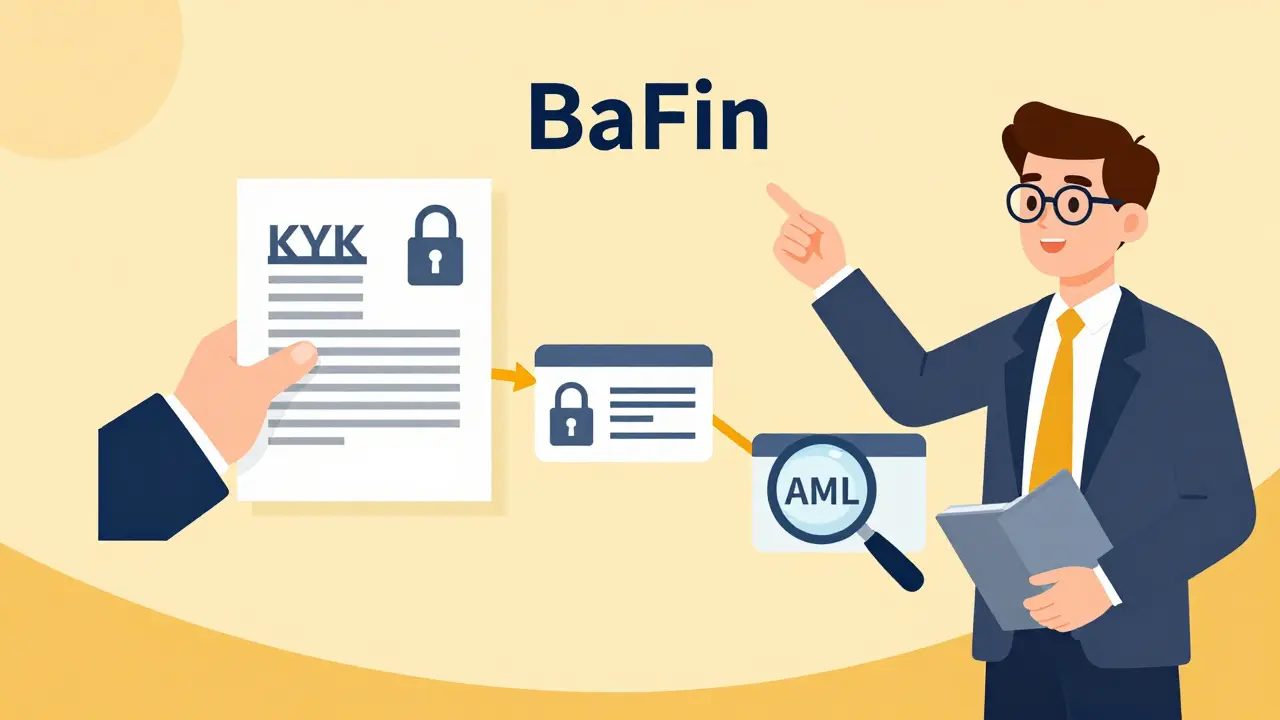
Germany’s KryptoWTransferV (Crypto Asset Transfer Regulation) implements the Financial Action Task Force’s "travel rule." This requires crypto exchanges to collect and transmit originator and beneficiary information for all transactions. Alongside KYC checks, this prevents money laundering and ensures transaction traceability.
Every user must undergo identity verification before trading. Exchanges must monitor transactions for suspicious activity and report it to BaFin. Failure to comply can lead to fines or license revocation. BaFin President Mark Branson emphasized this in December 2022, calling for global crypto regulation to protect consumers and financial stability.
Crypto Asset Classification Framework
| Type | Governing Regulation | Key Requirements |
|---|---|---|
| Financial instrument tokens | Securities Trading Act and MiFID II | Licensing under MiFID II, investor protection rules |
| Security-like tokens | Securities Prospectus Act | Prospectus approval required for public offerings |
| Capital investment tokens | Capital Investment Act | Specialized investment fund regulations apply |
This classification system determines which regulations apply to each asset. For example, tokens resembling stocks fall under the Securities Trading Act, while those acting like investment funds trigger Capital Investment Act rules. Exchanges must carefully categorize assets to avoid compliance gaps.
Real-World Enforcement Examples
BaFin demonstrated active enforcement in June 2025 when it ordered Ethena GmbH to wind up operations related to USDe stablecoins. Holders were given until August 6, 2025, to redeem tokens through a BaFin-appointed representative. This case shows regulators won’t tolerate non-compliant operations, even for established projects.
Enforcement actions focus on three areas: failure to obtain proper licenses, inadequate AML controls, and misleading marketing. BaFin publishes enforcement reports quarterly, listing violations and penalties. This transparency helps businesses understand common pitfalls.
Compliance Challenges and Best Practices
The multi-layered regulatory structure creates complexity. For instance, a single exchange might need to comply with MiFID II for some tokens and the Capital Investment Act for others. Legal analysis is crucial before launching new services. Many businesses hire compliance specialists familiar with German and EU crypto rules.
Best practices include: conducting regular internal audits, maintaining detailed transaction records for tax and regulatory audits, and using BaFin’s published guidance to stay updated. The March 2025 tax circular explicitly states that documentation must cover all DeFi activities, even if they’re decentralized. This means exchanges must track on-chain transactions and report them accurately.
Tax Reporting Changes in 2025
The March 2025 tax circular introduced major changes. Crypto assets are now valued using daily market rates, not average prices. Staking rewards are classified differently based on whether they’re active (requiring work) or passive (automated). Active staking is taxed as income, while passive staking may qualify for capital gains treatment.
DeFi protocols now have specific tax rules. For example, liquidity pool rewards are treated as income, and swaps between tokens are taxable events. Transitional rules apply for 2024 tax years to help businesses adapt. All exchanges must provide transaction overviews showing dates, amounts, and values for tax authorities.
Conclusion: Balancing Innovation and Regulation
Germany’s crypto regulatory landscape offers clear benefits. It provides international trust through stability, access to the EU market, and tax incentives like R&D grants. However, the complexity demands careful navigation. Businesses that invest in compliance infrastructure-like robust IT systems and legal expertise-can thrive in this environment.
As of 2026, BaFin continues to refine MiCAR implementation. Future updates will likely address emerging technologies like decentralized autonomous organizations (DAOs) and more complex DeFi structures. Staying informed through BaFin’s official channels is essential for long-term success.
Do I need a BaFin license to operate a crypto exchange in Germany?
Yes. Any entity providing crypto-asset services like custody, trading, or exchange functions must obtain authorization from BaFin. This applies to all businesses operating within Germany’s market, regardless of location. Existing license holders have until December 31, 2025, to transition to MiCAR-compliant licenses.
How does MiCAR affect existing crypto exchanges?
MiCAR created a grandfathering period allowing existing license holders to continue operations until December 31, 2025. During this time, they must apply for new licenses under MiCAR rules. Businesses that operated without German authorization before MiCAR’s December 29, 2024 implementation must notify BaFin of their activities immediately.
What are the tax implications for staking rewards?
Staking rewards are taxed differently based on activity. Active staking (where you validate transactions manually) is taxed as income. Passive staking (automated through smart contracts) may qualify for capital gains treatment. The March 2025 tax circular requires exchanges to clearly differentiate these types in transaction reports.
Does DeFi fall under German regulations?
Yes. The March 2025 tax circular explicitly covers DeFi protocols for the first time. Liquidity pool rewards are taxed as income, and token swaps are taxable events. Exchanges must track on-chain transactions and report them to tax authorities. BaFin also monitors DeFi projects for AML compliance under KryptoWTransferV.
What happens if I fail AML compliance checks?
Failure to meet AML requirements can lead to fines, license suspension, or revocation. BaFin’s June 2025 enforcement action against Ethena GmbH shows severe consequences. Exchanges must maintain detailed transaction logs, conduct regular KYC checks, and report suspicious activity within 24 hours.
How long does the BaFin licensing process take?
The process typically takes 6-12 months. It includes document review, IT infrastructure audits, and compliance testing. BaFin prioritizes applications with strong cybersecurity measures and clear AML procedures. Starting early and using BaFin’s official guidance can reduce delays.
Can I operate a crypto exchange in Germany without a license?
No. Operating without BaFin authorization is illegal and risks criminal charges. The Ethena GmbH case demonstrates BaFin’s strict enforcement. Even if your business is based outside Germany, you must comply if you serve German customers. Always verify licensing status with BaFin before launching services.
What’s the difference between financial instrument tokens and security-like tokens?
Financial instrument tokens resemble traditional securities like stocks and fall under MiFID II. They require licensing for trading and investor protection rules. Security-like tokens are more specific to asset-backed claims and require a prospectus approval before public offering. The classification depends on the token’s economic function, not its technical design.


David Bain
The regulatory framework presented here is a testament to Germany's strategic alignment with EU directives. MiCAR's implementation necessitates a nuanced understanding of both national and supranational obligations, particularly regarding token classification under MiFID II and Capital Investment Act provisions. This multi-layered system demands meticulous attention to detail, as non-compliance can lead to severe penalties. It's fascinating how the EU is harmonizing crypto regulations across member states while allowing national adaptations. However, the complexity may stifle innovation for smaller players. The balance between security and growth remains delicate.
Matt Smith
MiCAR is just another EU power grab. Crypto should be free from all regulation! This is why people are moving to more crypto-friendly countries. 😡🔥
laura mundy
Germany's regulations are overcomplicating things. Other countries do it simpler. This is why crypto is moving elsewhere.
Ajay Singh
Licensing takes too long. Compliance is key. Period.
Paul Gariepy
This is excellent! The licensing process is tough, but necessary. I've seen companies succeed by focusing on IT infrastructre and AML procedures. Just need to stay organized.
Josh Flohre
The regulatory framework is clear. Any business failing to comply is incompetent. BaFin's enforcement actions are justified. This guide is necessary. Period.
sachin bunny
This is all a setup. The government wants to control crypto. They'll never let it thrive. 🤡
Mendy H
The MiCAR framework is laughable. All this regulation just creates more bureaucracy. No wonder people are leaving Europe for crypto.
Katie Haywood
Wow, this is a lot to unpack. BaFin's rules are tough, but hey, at least they're not as bad as some other countries. Still, the licensing process is a nightmare. My friend's company took 10 months. 😒
Jim Laurie
This guide is a lifesaver! The tax rules for staking are tricky, but breaking it down like this helps. Gotta get that right 😅
sabeer ibrahim
MiCAR is a joke. The EU is trying to control everything. Crypto should be free. 🤷♂️
Reda Adaou
This is a solid guide. The key is to stay updated with BaFin's guidance. Compliance can be manageable with the right support.
orville matibag
Germany's approach is interesting. They're trying to balance innovation with regulation. DeFi tax rules are messy, but they're making progress.
Freddie Palmer
This guide is really helpful. The MiCAR transition period for pre-December 2024 operations is a key point. Tax implications for DeFi protocols are particularly complex, especially with the March 2025 circular. Need to ensure all transactions are tracked accurately.
Olivette Petersen
This is great info! Germany's approach is setting a standard for Europe. With proper compliance, crypto businesses can thrive. Let's stay positive and work together!
Alex Garnett
Only the most elite firms can navigate this complexity. Small businesses will fail. Germany's regulations are too strict for the average entrepreneur. This is why America is better for crypto.