How Bitcoin Halving Impacts Price: History, Patterns, and What Comes Next
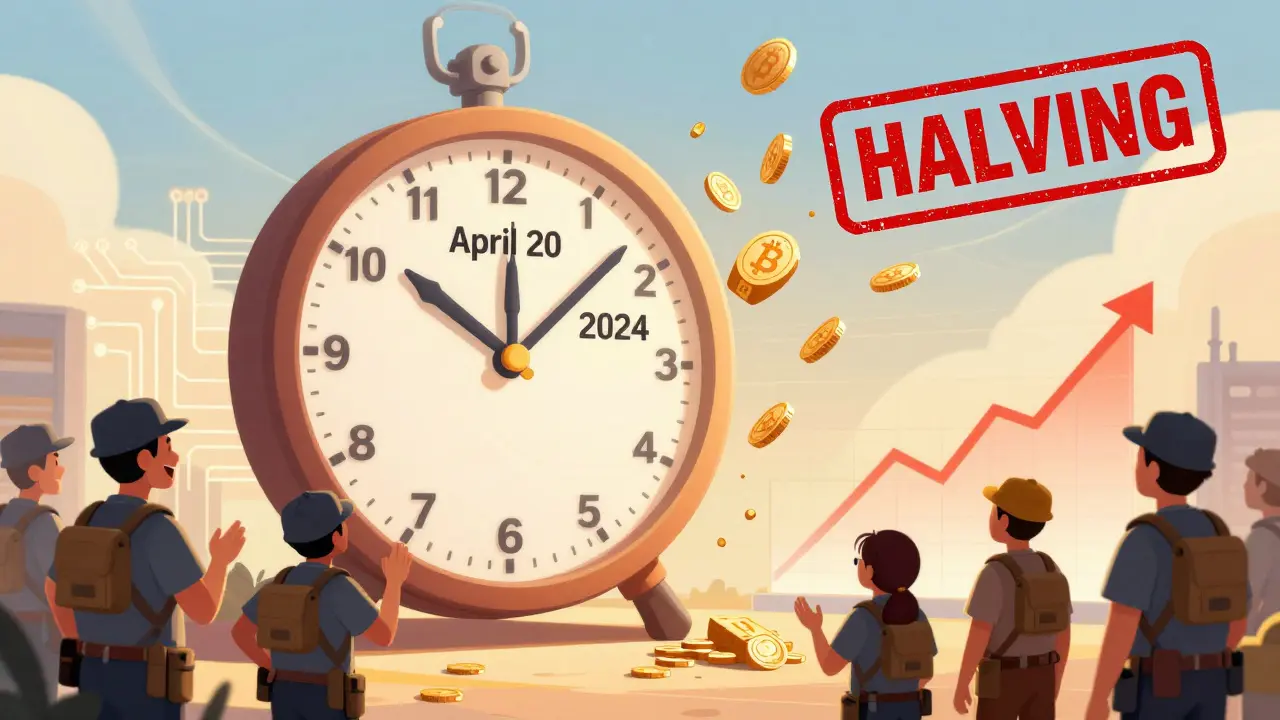
Every four years, something quiet but massive happens on the Bitcoin network. No news alert. No press conference. Just a silent code change that cuts the number of new bitcoins created in half. This is the Bitcoin halving - and it’s the single most predictable, repeatable event in all of crypto. If you’ve ever wondered why Bitcoin prices seem to spike years after a halving, this is why.
Halving isn’t a marketing stunt. It’s baked into Bitcoin’s code. Satoshi Nakamoto designed it this way: every 210,000 blocks - roughly every four years - the reward miners get for securing the network drops by 50%. It’s not optional. It’s math. And it’s been happening without fail since 2012. The last one? April 20, 2024. The next? Around April 2028. What happens in between? Price. Always price.
How Halving Works - Simple
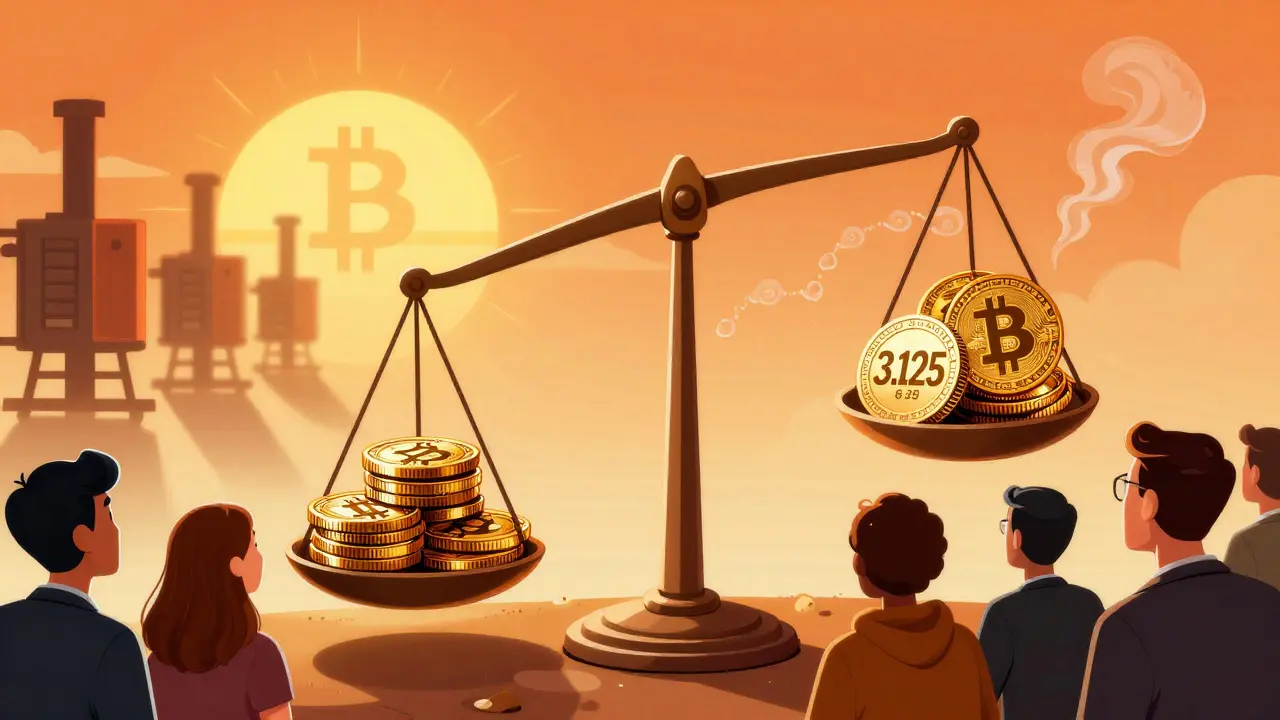
Miners use powerful computers to verify Bitcoin transactions and bundle them into blocks. For their work, they get paid in two ways: a block reward (newly created bitcoins) and transaction fees. The block reward is what halving changes. Before 2024, miners got 6.25 BTC per block. After April 20, 2024, they got 3.125 BTC. That’s it. No more. No less. The total supply of Bitcoin is capped at 21 million. Halving ensures we don’t reach that cap too fast. By 2140, no new bitcoins will be created. Only fees will pay miners.
This isn’t inflation. It’s the opposite. Fiat money? Central banks can print more anytime. Bitcoin? The supply growth rate drops by half every four years. Less supply entering the market, while demand stays steady or grows - that’s classic economics. And history shows it works.
The Four Halvings - What Actually Happened
Let’s look at the real data. Not guesses. Not predictions. What happened after each event.
- 2012 - First Halving: Block reward dropped from 50 to 25 BTC. Bitcoin was trading at $12. By April 2013? $229. By November? Over $1,100. A 1,800% gain in five months.
- 2016 - Second Halving: Reward fell from 25 to 12.5 BTC. Price was $640. By the end of 2017? Nearly $20,000. That’s a 3,000% rise from halving day.
- 2020 - Third Halving: Reward cut to 6.25 BTC. Price was around $9,000. Within 180 days? $14,849. By December 2021? Over $60,000. Even during a global pandemic, Bitcoin surged.
- 2024 - Fourth Halving: Reward now 3.125 BTC. Price hit $73,750 just before the event, dipped to $63,000 on halving day, then climbed again. By late 2025, it was consistently above $90,000.
Notice a pattern? Each time, the price didn’t jump right away. It took months - sometimes over a year. But every single halving was followed by a major bull run. Not once has Bitcoin gone down long-term after a halving.
Why Does Price Go Up After Halving?
It’s not magic. It’s supply and demand.
Before halving, miners were getting, say, 6.25 BTC per block. After? 3.125. That means half as many new bitcoins enter circulation every ten minutes. If people still want to buy Bitcoin - and they do - but fewer coins are being created, the price has to rise to balance the market.
Think of it like oil. If a major oil producer suddenly cuts output by 50%, and global demand stays the same, prices go up. Bitcoin works the same way. The halving is a supply shock - but a planned one.
There’s also psychology. Every halving gets covered by mainstream media. Retail investors notice. Institutions start buying ahead of time. The "fear and greed index" consistently spikes into "greed" territory in the 6-12 months after a halving. That’s not random. It’s expectation.
What About Miners? Do They Go Broke?
Short-term? Yes, some do. When the block reward drops, miners with older, inefficient hardware suddenly lose money. Their electricity costs exceed what they earn. Many shut down. The Bitcoin network’s hash rate - the total computing power - dips for a few weeks.
But here’s what happens next: Bitcoin’s price rises. And when it does, mining becomes profitable again. The miners who stayed in - the ones with cheap power and modern ASICs - start making more. The network’s hash rate rebounds, often stronger than before. This cycle has repeated four times. It’s not a bug. It’s a feature.
Post-2024, we saw something new: transaction fees jumped. On halving day, fees in the first block exceeded $2.6 million - six times higher than usual. Why? Because investors wanted their transactions confirmed in the historic block. That’s a sign of a maturing market. Miners aren’t just relying on block rewards anymore. Fees are becoming a real income stream.
The 2024 Halving - Different This Time?
Yes. And no.
Before 2024, Bitcoin was already a $1 trillion asset. ETFs were approved in the U.S. Institutions like Fidelity and BlackRock were buying. The market wasn’t driven by hobbyists anymore. It was driven by portfolio managers.
Because of that, the price didn’t explode the day after halving. It was already priced in. The $73,750 peak before the event meant traders had already bet on the rally. The immediate drop to $63,000? That was just profit-taking.
But the long-term trend? Still up. By August 2025, Bitcoin hit $102,000. By December? $118,000. Analysts who expected a 12-18 month rally were right. The pattern held - just smoother.
The big difference now? Bitcoin isn’t just a speculative asset. It’s a macro hedge. When inflation spiked in 2022-2023, Bitcoin outperformed gold, stocks, and even real estate. Halving reinforces that story: limited supply, no central authority, immune to printing.
What Comes Next? The 2028 Halving and Beyond
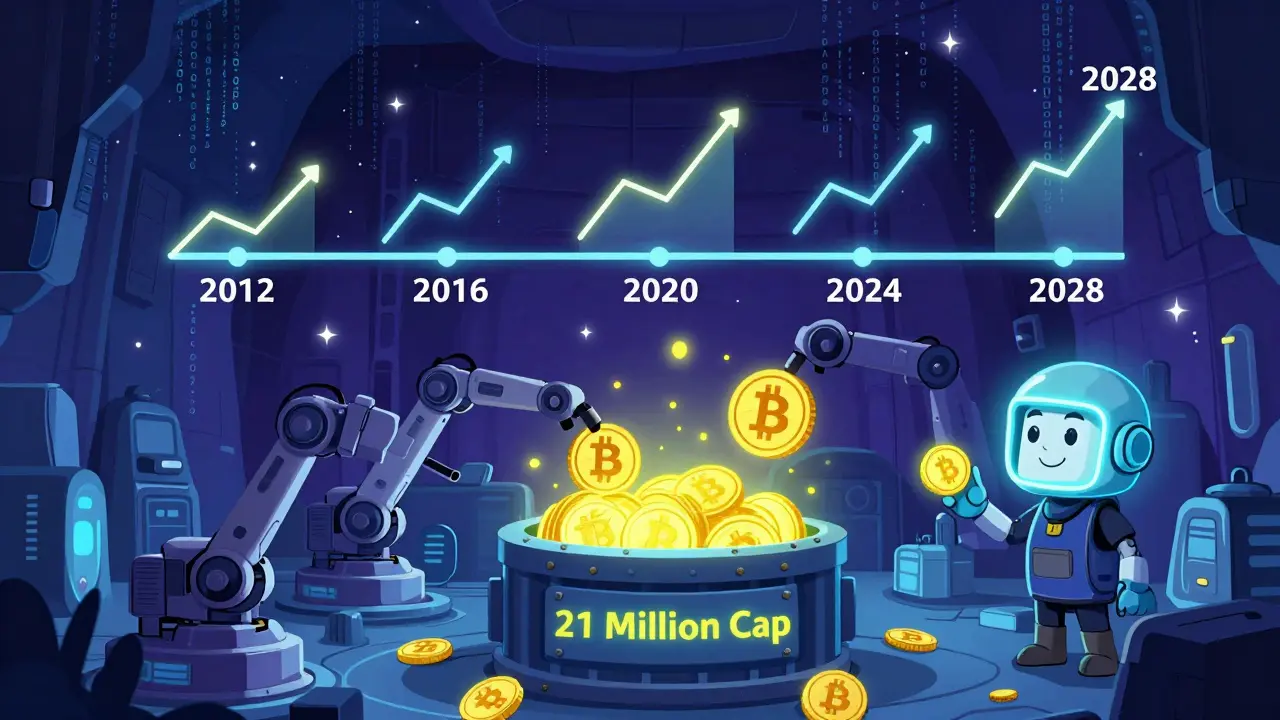
The next halving is expected in April 2028. By then, the block reward will drop to 1.5625 BTC. That’s less than 1% of Bitcoin’s original supply rate. The total supply in circulation? Over 19 million. Only 2 million left to mine.
By 2032? The reward drops again to 0.78125 BTC. That’s a 99.8% reduction from the original 50 BTC per block.
What does this mean? Bitcoin becomes scarcer than gold. Gold mines about 3,000 tons per year. Bitcoin will be producing less than 100 new coins per day by 2030. And those coins? They’ll be paid almost entirely in fees - not new supply.
Price targets? Analysts are already modeling $160,000-$200,000 by 2029. Some say $500,000 by 2035. It’s speculative - but the math doesn’t lie. With fewer new coins, and growing demand from global savings, the pressure on price is structural.
What Should You Do?
Don’t try to time the halving. You can’t. The market prices it in months ahead. Instead, understand the pattern:
- Halving = supply cut. Not a trigger. A slow-burning fuse.
- Price doesn’t spike immediately. Wait 6-18 months.
- Miners adapt. The network gets stronger.
- Every halving has been followed by a new all-time high.
If you’re holding Bitcoin, don’t panic during dips after a halving. That’s normal. The real move comes later. If you’re thinking of buying, don’t wait for the next halving. Wait for the next dip after it.
Bitcoin’s value isn’t built on hype. It’s built on code. And that code says: less supply, over time, with demand growing. That’s not speculation. That’s economics.
What exactly happens during a Bitcoin halving?
During a Bitcoin halving, the block reward that miners receive for validating transactions is cut in half. This happens every 210,000 blocks, roughly every four years. For example, after the April 2024 halving, miners went from receiving 6.25 BTC per block to 3.125 BTC. This reduces the rate at which new bitcoins enter circulation, making Bitcoin more scarce over time.
Has Bitcoin’s price always gone up after a halving?
Yes - every single time. Since the first halving in 2012, Bitcoin’s price has risen significantly in the months and years following each event. The 2012 halving led to a 1,800% increase within five months. The 2016 halving preceded a 3,000% rally by the end of 2017. The 2020 halving was followed by a surge past $60,000 in 2021. The 2024 halving was followed by a climb above $100,000 by mid-2025. While timing varies, the long-term trend is consistent.
Do miners suffer after a halving?
Some miners do struggle immediately after a halving, especially those with older equipment or high electricity costs. This causes a temporary drop in Bitcoin’s hash rate as inefficient miners shut down. But within weeks to months, as Bitcoin’s price rises, mining becomes profitable again. The network’s hash rate typically rebounds stronger than before. Larger, more efficient mining operations often survive and even gain market share.
Why did Bitcoin’s price rise before the 2024 halving?
By 2024, Bitcoin was no longer a niche asset. Institutional investors, ETF approvals, and growing macroeconomic concerns about inflation meant demand was already high. Traders anticipated the halving months in advance, pushing prices up before the event. This made the immediate post-halving price action less volatile than in past cycles - but the long-term upward trend still held.
Is Bitcoin’s halving mechanism likely to change?
No. Bitcoin’s halving is hardcoded into its protocol. It requires consensus from the entire network to change - and there’s no political or technical incentive to do so. Miners, users, and developers all benefit from the predictable scarcity it creates. The halving is as fixed as gravity in Bitcoin’s system. The next one is expected in April 2028, and the one after that in 2032. It will keep happening until the final bitcoin is mined around 2140.

blake blackner
bro this is literally the most predictable thing in crypto ever like i dont even need to look at charts anymore just wait 6 months after halving and boom
Tammy Chew
The elegance of Bitcoin's design is not merely technical-it's metaphysical. A digital asset whose scarcity is enforced by cryptographic certainty, not central bank decree. The halving is not an economic event; it is a ritual of entropy reversal.
Gaurav Mathur
you think the gov is really letting this happen? they already control the mining pools. halving is fake. they just moved the reward to off-chain ledgers. you're being played
Crystal McCoun
I just want to say thank you for laying this out so clearly. I'm new to Bitcoin and this post helped me understand why I should care about halvings. It's not about speculation-it's about understanding a system that values scarcity over manipulation. I'm holding.
Elijah Young
The data is compelling. Every halving has preceded a bull market. The question isn't whether it'll happen-it's whether you're positioned to benefit when it does.
Beth Trittschuh
I keep thinking about how this mirrors natural systems. Trees don't grow forever. Rivers don't flow endlessly. Even abundance has its rhythm. Bitcoin's halving feels like the universe saying: "limitation creates value."
Benjamin Andrew
Let's be real. The 2024 halving was priced in months before it happened. The $73k peak was a trap for retail. The real move is in 2026 when institutions start dumping their ETFs. This isn't a cycle-it's a pump and dump dressed up as economics.
Donna Patters
To call this "economics" is a gross mischaracterization. This is monetary theology. A cult of scarcity, worshiped by those who fear fiat. The fact that you celebrate a 50% reduction in supply as virtue is... tragic.
Michelle Cochran
I used to think Bitcoin was about freedom. Now I see it's just another pyramid where the early adopters get rich while the latecomers get told to "hodl" through another 18-month grind. The halving is just the latest myth to keep us believing.
Peggi shabaaz
i just like how the network keeps going even when people panic. miners shut down, then come back stronger. price dips, then climbs. it's kind of beautiful in a quiet way
Kaz Selbie
The entire narrative is built on confirmation bias. You cherry-pick the four halvings and ignore the 2018-2019 bear market that followed 2016. The market doesn't care about your charts. It cares about liquidity, interest rates, and global risk sentiment.
Robbi Hess
I read this whole thing. Honestly? Boring. Everyone knows this. Why are we still talking about halvings like they're news? It's a code change. Get over it.
Keturah Hudson
In Nigeria, we call this "market logic"-when supply shrinks and demand stays, price rises. Simple. No blockchain needed. Just basic trade. Bitcoin just made it digital and global.
Ace Crystal
If you're not buying Bitcoin before the next halving, you're not just missing an opportunity-you're ignoring history. This isn't gambling. It's arithmetic. And the numbers are screaming at you.
Brittany Meadows
so the halving is supposed to make bitcoin scarcer... but what if everyone just starts hoarding it? like literally locking keys in vaults? then supply goes to zero and price goes to infinity? 😂
krista muzer
i think people forget that the halving doesn't just affect miners-it affects everyone who uses bitcoin. less new coins means more pressure on fees, which means more incentive for layer 2s. this isn't just a price thing. it's a whole system evolution
Lindsey Elliott
The 2024 halving was a joke. $73k before? That's peak mania. The fact that it dipped to $63k and then went to $118k proves nothing. It's just volatility. You're mistaking noise for signal.
Andrea Atzori
Australia's central bank just announced a digital currency pilot. Meanwhile, Bitcoin quietly cuts its issuance by half. One is a tool of control. The other is a statement of sovereignty. The choice isn't technical-it's philosophical.
Jeremy Lim
I'm not saying this isn't interesting, but... why are we still acting like this is new? It's been happening since 2012. It's not a mystery. It's a schedule. Stop treating it like a prophecy.
Grace Mugambi
What's fascinating is how this pattern reflects human behavior more than economic theory. We're not reacting to supply and demand-we're reacting to the story we tell ourselves about scarcity. The halving is just the plot twist we all wait for.
monique mannino
i've been holding since 2021 and honestly? i didn't even notice the halving day. i just kept going. the real win is not timing-it's showing up. every day. even when it's quiet.
Holly Perkins
halving? i thought it was haling? or hoving? idk. but i bought 0.02 btc last week so i guess its working?