How to Track Crypto Whale Movements: Tools, Strategies, and Real-World Signals

When a single wallet moves 10,000 ETH - that’s over $30 million - the market takes notice. These aren’t random trades. They’re signals. And if you know how to read them, you can see price moves before they happen. Tracking crypto whale movements isn’t about guessing. It’s about watching what the biggest players do, and using that data to make smarter decisions.
What Exactly Is a Crypto Whale?
A crypto whale isn’t just someone with a lot of Bitcoin or Ethereum. It’s someone who holds enough to move markets. Usually, that means holding 1,000+ BTC, 10,000+ ETH, or 5,000+ BNB. At today’s prices, that’s tens of millions of dollars. These wallets don’t trade small amounts. When they move, it’s because they’re doing something strategic: dumping, accumulating, or shifting funds between exchanges and cold storage.
Why does this matter? Because whales don’t act randomly. When a whale pulls millions out of an exchange like Binance or Coinbase, it often means they’re preparing to hold long-term. When they deposit large sums onto an exchange, it usually signals they’re getting ready to sell. These patterns repeat - and they’re visible to anyone with the right tools.
How Blockchain Transparency Makes Tracking Possible
Unlike traditional banking, every crypto transaction is public. Every transfer, every swap, every movement from one wallet to another is recorded on the blockchain. You can see it. You can trace it. That’s the foundation of whale tracking.
Tools like Etherscan and BscScan let you look up any wallet address and see its entire history. But manually checking hundreds of addresses every day? That’s impossible. That’s why automated systems exist. These platforms scan the blockchain in real time, looking for transactions that cross predefined thresholds - say, 500 ETH or more. When one happens, they send you an alert.
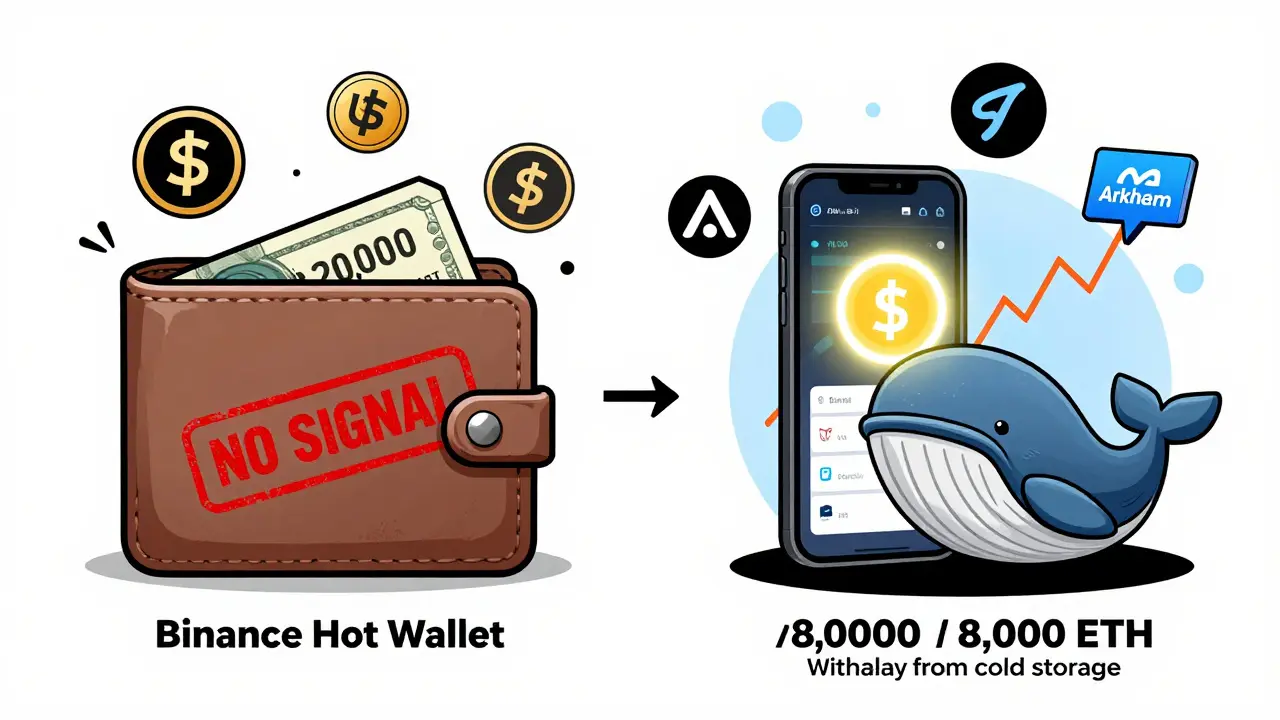
Here’s the catch: not all big transactions are from whales. A lot come from exchanges themselves. When Binance moves 20,000 ETH from one internal wallet to another, it’s not a whale. It’s just internal bookkeeping. Good tracking tools filter out these false signals by labeling known exchange wallets. Nansen.ai and Arkham Intelligence do this well. They don’t just show you a number. They tell you if it came from Coinbase, Kraken, or a private wallet.
The Top Tools for Tracking Whale Movements
You don’t need to build your own tracker. There are already powerful platforms out there - each with different strengths.
- Whale Alert - The original. Started in 2018, it’s free, simple, and runs on Twitter and Telegram. It alerts you when any transaction over 100 BTC, 5,000 ETH, or 1,000 BNB happens. It’s great for beginners. But it doesn’t tell you why it happened. Was it a sell? A transfer? A swap? You’re left guessing.
- Nansen.ai - This is where professionals go. It labels wallets: "Coinbase Hot Wallet," "Binance Deposit Address," "Known Whale Cluster." It shows you net flows - how much is going into or out of exchanges. It also tracks stablecoin movements, which is a huge clue. If a whale moves $10 million in USDT onto an exchange, they’re probably planning to buy something soon. Nansen costs $99/month, but the insights are worth it.
- Arkham Intelligence - Think of this as Nansen on steroids. It tracks 15 blockchains, clusters related wallets into "entities," and even shows profit/loss history. If a wallet bought ETH at $1,800 and now sells at $3,500, Arkham calculates the gain. It’s built for traders who want deep analytics. Starts at $149/month.
- Debank - Best for portfolio tracking. It connects all your wallets and shows you what whales are holding across chains. Free version is solid. Pro version at $20/month adds alerts and advanced filters.
- CryptocurrencyAlerting.com - A middle ground. Lets you set custom thresholds. Want alerts only for transactions over 300 ETH? Done. $29/month. Good balance of price and control.
Most of these tools send alerts via email, Telegram, Discord, or SMS. Set up a Telegram bot and get instant notifications. No more scrolling through charts hoping you’ll catch a move.
Five Proven Strategies to Interpret Whale Activity
Seeing a big transaction isn’t enough. You need to know what it means.
- Watch exchange net flows. If more ETH is flowing out of exchanges than in, whales are accumulating. If more is flowing in, they’re preparing to sell. Nansen.ai’s "Exchange Net Flow" dashboard is the gold standard for this.
- Track stablecoin movements. USDT and USDC are the oil of crypto. When a whale moves $5 million in stablecoins onto an exchange, they’re likely about to buy. This often happens 12-24 hours before a price pump. It’s one of the most reliable signals.
- Look for cold wallet withdrawals. If a whale pulls coins from a long-dormant cold wallet, they’re probably ready to trade. Cold wallets are for holding. If they’re moving out, it’s a shift in strategy.
- Spot wallet clusters. One whale might control 10 different addresses. Tools like Arkham group them together. If 5 wallets in the same cluster all start selling, it’s coordinated. Not random.
- Combine with technical indicators. Whale alerts alone aren’t foolproof. Use them with RSI, MACD, or volume spikes. One trader on TradingView backtested this: combining Whale Alert data with RSI divergence raised prediction accuracy from 52% to 68%.
What Whales Don’t Want You to Know - Manipulation Tactics
Not every big move is real. Some whales play games.
- Whale Wall Spoofing - They place a massive buy order on an exchange to make others think demand is high. Then they cancel it. The market pumps, and they sell into the frenzy.
- Wash Trading - They buy and sell the same coin between their own wallets to create fake volume. It tricks algorithms into thinking the asset is popular.
- FUD Dissemination - A whale dumps a large amount, then spreads rumors online: "This coin is dead." The panic sells, and they buy back cheaper.
These tricks are why you can’t rely on one signal. Always cross-check. Look at multiple data points. If a whale deposits 5,000 ETH onto Binance, but stablecoin inflows are rising and social sentiment is positive - it might not be a sell-off. It might be a prep for a rally.
What You’re Not Seeing - The Hidden 10%
Not all whale activity is trackable. Privacy coins like Monero, Zcash, and even newer Ethereum privacy layers (like Tornado Cash) make transactions untraceable. According to Chainalysis 2025, 8-12% of all crypto value moves through these hidden channels.
Also, institutional players like hedge funds use OTC desks - private deals that never hit public blockchains. These can be worth hundreds of millions, and you’ll never see them unless you’re on the inside.
That means whale tracking gives you 80-90% of the picture. Not 100%. That’s fine. You don’t need to see everything. You just need to see the patterns that matter.

Real Results: What Traders Are Actually Making
Reddit user u/CryptoWhaleWatcher tracked Nansen’s exchange outflow alerts in July 2025. They noticed ETH was leaving exchanges while stablecoin inflows spiked. They bought ETH at $2,800. Three days later, it hit $3,800. 37% profit.
Another trader, u/BlockchainNovice, saw a whale deposit 8,000 ETH into Binance and assumed it was accumulation. They bought in. Turns out, it was a wallet transfer between Binance’s internal systems. The price didn’t move. They lost 15%.
That’s the difference between using whale data as a signal and using it as a guarantee. The best traders treat it like weather radar. It shows storms coming. But you still need to check the ground.
Setting Up Your First Whale Tracker
Start simple. Here’s how:
- Sign up for Whale Alert on Telegram. It’s free.
- Set a personal threshold: only alert me for transactions over 500 ETH or 500 BTC. That cuts out noise.
- Check Nansen.ai’s free dashboard. Look at ETH exchange net flow for the last 7 days. See the pattern.
- Every time you see a big move, ask: "Is this an inflow or outflow? Is there stablecoin movement? Is it from a known wallet?"
- After 30 days, review your notes. Which alerts led to price moves? Which were false?
You don’t need to spend money at first. Learn the rhythm. Then upgrade.
Future of Whale Tracking - What’s Coming
The tools are getting smarter.
- Nansen.ai’s "Whale Pulse" (launched August 2025) now scans 50+ social platforms - Twitter, Reddit, Telegram - to match whale moves with sentiment. If a whale moves coins and suddenly there’s a spike in "this coin is going to the moon" posts? That’s a high-probability signal.
- Arkham just integrated with Coinbase Prime, giving institutional clients direct access to whale cluster data.
- Chainalysis bought Skynet in July 2025. Their new "Predictive Whale Analytics" (coming Q2 2026) will use AI to forecast whale behavior - not just react to it.
But here’s the truth: the more tools we build, the more whales adapt. Privacy tech improves. OTC deals grow. Regulation looms. The SEC is already looking at whether on-chain analytics violate data privacy laws.
Whale tracking won’t disappear. It’ll evolve. And the traders who win will be the ones who combine data with discipline.
Can I track crypto whales for free?
Yes. Whale Alert offers free alerts via Twitter and Telegram for transactions over 100 BTC, 5,000 ETH, or 1,000 BNB. Debank also has a free portfolio tracker that shows whale-like movements. But free tools lack context - they don’t label wallets or explain why the move happened. For serious trading, paid tools like Nansen or Arkham are worth the cost.
Are all large crypto transactions from whales?
No. Up to 40% of large transactions come from exchanges moving funds between their own wallets - not individual whales. That’s why tools like Nansen.ai and Arkham Intelligence label known exchange addresses. If you see a 15,000 ETH transfer from "Binance Hot Wallet," it’s likely internal, not a sell-off. Always check the source.
Why do whales move stablecoins instead of Bitcoin or Ethereum?
Stablecoins like USDT and USDC are the bridge between crypto and cash. Whales use them to move value quickly without price risk. When a whale sends $20 million in USDT to an exchange, they’re not trying to cash out - they’re getting ready to buy something else. It’s a liquidity signal. Historically, large stablecoin inflows onto exchanges precede crypto price pumps by 12-24 hours.
Can whale tracking predict the next Bitcoin bull run?
Not by itself. But it can give you early clues. When whales start accumulating (moving coins off exchanges, increasing cold wallet holdings), and stablecoin balances rise on exchanges, it often signals a buildup before a major move. A UC Berkeley study found whale activity explains 18.7% of Bitcoin’s short-term volatility. It’s one piece of the puzzle - not the whole picture.
What’s the biggest mistake beginners make with whale tracking?
They treat every big transaction like a buy or sell signal. A whale depositing ETH to Binance doesn’t always mean they’re selling. It could be a wallet transfer, a swap, or a move to a staking service. The best traders combine whale data with exchange net flow, stablecoin movement, and social sentiment. One data point isn’t enough.
Is whale tracking legal?
Yes. All blockchain data is public. Tracking wallets is legal. But some regulators are starting to question whether linking wallet addresses to real identities violates privacy laws. The SEC’s 2025 guidance says on-chain analytics tools must comply with data privacy rules - especially if they identify users. So while tracking is legal, how companies use that data is under review.
Whale tracking isn’t magic. It’s data. And like any data, it’s only as good as how you use it. Start small. Watch the patterns. Don’t chase every alert. Learn the difference between noise and signal. The biggest moves in crypto don’t happen because of headlines. They happen because whales moved first. If you can see it before the crowd, you’re already ahead.


Steph Andrews
i just use whale alert on telegram and its been fine honestly
no need to overcomplicate it
if you see a 5k eth move you dont need to know if its coinbase or a whale
you just know something big happened and you react
Prakash Patel
this whole whale tracking thing is a scam. you think you're ahead of the curve but you're just chasing ghosts. the market moves because of liquidity, not some guy on a blockchain. if you're relying on this to trade, you're already behind.
Elizabeth Kurtz
i love how this post breaks it down so clearly. i started with whale alert and now i use nansen every morning with my coffee. it's not magic but it's the closest thing we have to a crystal ball. also, stablecoin movements are king. if usdt is flooding binance and eth is leaving, that's your signal. no overthinking needed.
john peter
The notion that blockchain transparency confers any meaningful epistemic advantage is a neoliberal fallacy. One must interrogate the ontological foundations of on-chain surveillance. Are we not merely reinforcing a panopticon of capital, where every movement is quantified, commodified, and weaponized? The whale is not a subject - he is a symptom. And the tools you describe? They are merely the scalpel of the financial apparatus, sharpened to dissect the body of the market.
Marc Morgan
whale alert on telegram is my morning alarm. i laugh every time some guy dumps 10k eth and the whole reddit thread goes 'OMG BEAR MARKET'... nah bro, that was just binance moving funds between wallets. the real plays? when a cold wallet wakes up after 3 years and sends 2k eth to a new address. now THAT'S interesting.
Anastasia Thyroff
i just lost 20k because i followed a whale alert... and now i'm crying in my honda civic listening to 2007 eminem
why did i think i could outsmart a guy with 500 million in eth
why why why
why did i think i was special
Jesse Pals
dude whale tracking is like weather radar for crypto
you don't need to know every cloud formation
you just need to know when the storm's coming and grab your umbrella
free tools are enough to start
then when you're ready upgrade
but please stop chasing every alert like it's the end of the world
Diane Overwise
soo... if a whale moves 5000 eth to binance... but usdt inflows are up and twitter is buzzing... maybe it's not a sell? maybe it's a buy? maybe i'm overthinking? maybe i should just go for a walk? 🤔
Ann Liu
The post accurately outlines the mechanics of whale tracking. However, one critical omission is the distinction between on-chain activity and off-chain OTC settlements. Institutional players move hundreds of millions without leaving a trace. This creates a significant blind spot. Whale tracking tools capture approximately 82% of observable activity. The remaining 18% is where the real alpha resides - accessible only through proprietary networks.
Dionne van Diepenbeek
i saw a whale move 12k eth and i bought btc and now i have 2000 dollars and a broken heart and i still dont know if it was a dump or a transfer or a cat walking on a keyboard
Graham Smith
The efficacy of these tools is predicated upon a flawed assumption: that on-chain data is semantically rich. In reality, it is merely syntactic. Without contextual metadata - behavioral profiling, identity linkage, temporal clustering - the data is noise masquerading as signal. Nansen’s wallet labeling is a heuristic approximation. It does not reveal intent. It merely annotates. This is not intelligence. It is statistical pattern recognition dressed in venture capital finery.
Jerry Panson
I appreciate the comprehensive breakdown. However, I would respectfully suggest that the ethical implications of institutional-grade on-chain surveillance warrant deeper consideration. The aggregation and monetization of public blockchain data, particularly when linked to identifiable entities, may soon face regulatory scrutiny under evolving privacy frameworks such as GDPR and the proposed U.S. Crypto Accountability Act.
Katrina Smith
so uhhh yeah i used whale alert for a week and lost money every time
turns out the whales are just bots run by hedge funds
who even are these whales anyway??
Anastasia Danavath
whale tracking = watching paint dry but with more charts
and more hope
and more losses
Kira Dreamland
i started with whale alert and now i just check nansen once a day. it's not about catching every move. it's about catching the right ones. i've made more money not trading every alert than i ever did chasing them. patience > panic
shreya gupta
this is why india needs better crypto education. people think whale movements are lottery tickets. they are not. they are data points. learn to read context. learn to wait. learn to not trade every twitch.
Derek Lynch
you guys are overthinking this. the simplest strategy works: when whales pull coins off exchanges AND stablecoins start flowing in - that’s your green light. i made 40% last month just following that. no fancy tools. just patience and watching two charts. if you can’t do that, maybe crypto isn’t for you.
Shreya Baid
I find this approach deeply empathetic. Many traders operate from fear, chasing signals without understanding the underlying human behavior. Whales are not faceless entities - they are institutions, funds, individuals making decisions under uncertainty. The tools help us see the action, but true mastery comes from understanding the intention. This is not just analytics - it is behavioral economics in motion.
Christopher Hoar
yo so i tried arkham and it was like 150 a month and i was like 'this is gonna make me rich' and then i saw a whale move 8k eth and i bought and it was just binance moving money between their own wallets and now i have a 300 dollar balance and a dog named after eth
we all got scammed
Robert Kunze
i think people forget that whales are people too. they get scared. they make mistakes. they panic sell. they get hacked. this isn't a chess game. it's a messy human mess. so don't treat every alert like a prophecy. treat it like a clue. check the context. check the mood. check your own emotions. you'll do better than 90% of traders.
Sarah Zakareckis
start with whale alert. then add nansen. then use debank to see what they're holding. then watch exchange net flows. then check stablecoin movement. then combine it with rsi. then wait 24 hours. then act. that's the playbook. no need to spend 150 a month on day one. build your stack. like a pro.