How to Verify NFT Ownership on Blockchain: A Step-by-Step Guide
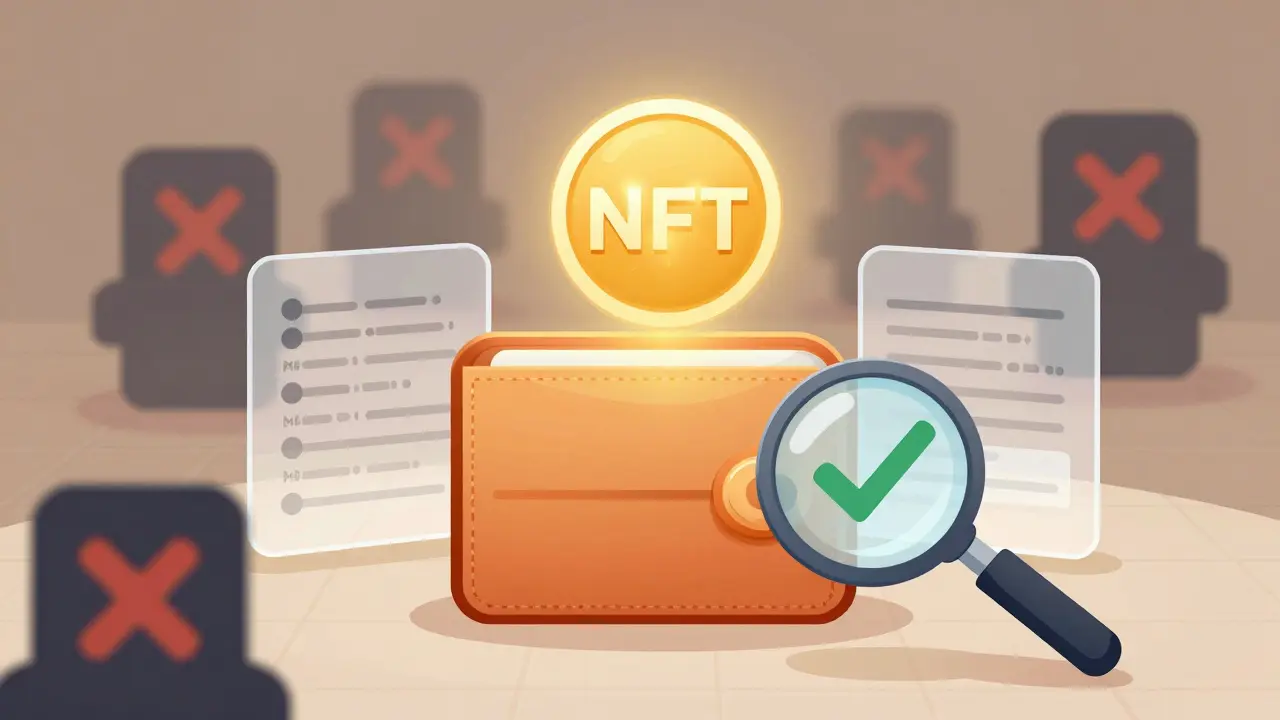
Own an NFT? Great. But do you really own it? Just because you bought it on OpenSea or saw it in your MetaMask wallet doesn’t mean it’s yours for good. Scammers, fake listings, and wrapped tokens make it easy to think you’ve got something valuable - when you actually own nothing but a digital ghost. Verifying NFT ownership on the blockchain isn’t optional anymore. It’s the only way to know for sure.
What NFT Ownership Actually Means
An NFT isn’t a file. It’s not the JPEG, the MP3, or the 3D model you see online. It’s a unique digital certificate stored on a blockchain. Think of it like a car title - it doesn’t give you the car, but it proves you’re the registered owner. The actual image or audio file? That’s usually stored elsewhere, often on a server that could vanish tomorrow. The NFT itself? It lives forever on the blockchain.Ownership is tied to a wallet address. When you buy an NFT, the smart contract transfers the token ID from the seller’s address to yours. That’s it. No middleman. No receipt. Just a public, unchangeable record. But here’s the catch: owning the token doesn’t mean you own the copyright. Digital artist Beeple made this clear - buying his NFT means you own the token, not the right to print and sell posters of the artwork. That’s a legal distinction most buyers miss.
How Blockchain Proves Ownership
Every NFT has two key identifiers: a contract address and a token ID. Together, they form a unique fingerprint. The contract address tells you which smart contract created the NFT (like the Bored Ape Yacht Club contract). The token ID is the specific number assigned to your NFT within that contract (like #8888).When you check ownership, you’re reading a public ledger. Every time that NFT changed hands - bought, sold, gifted, auctioned - it was recorded as a transaction on the blockchain. These records can’t be deleted, altered, or hidden. Even if the website hosting the NFT goes down, the blockchain still holds the truth.
This system works because of decentralization. Thousands of computers around the world validate every transaction. No single company controls it. That’s why blockchain ownership is more trustworthy than any database run by a startup or marketplace.
Step-by-Step: Verifying NFT Ownership on Etherscan
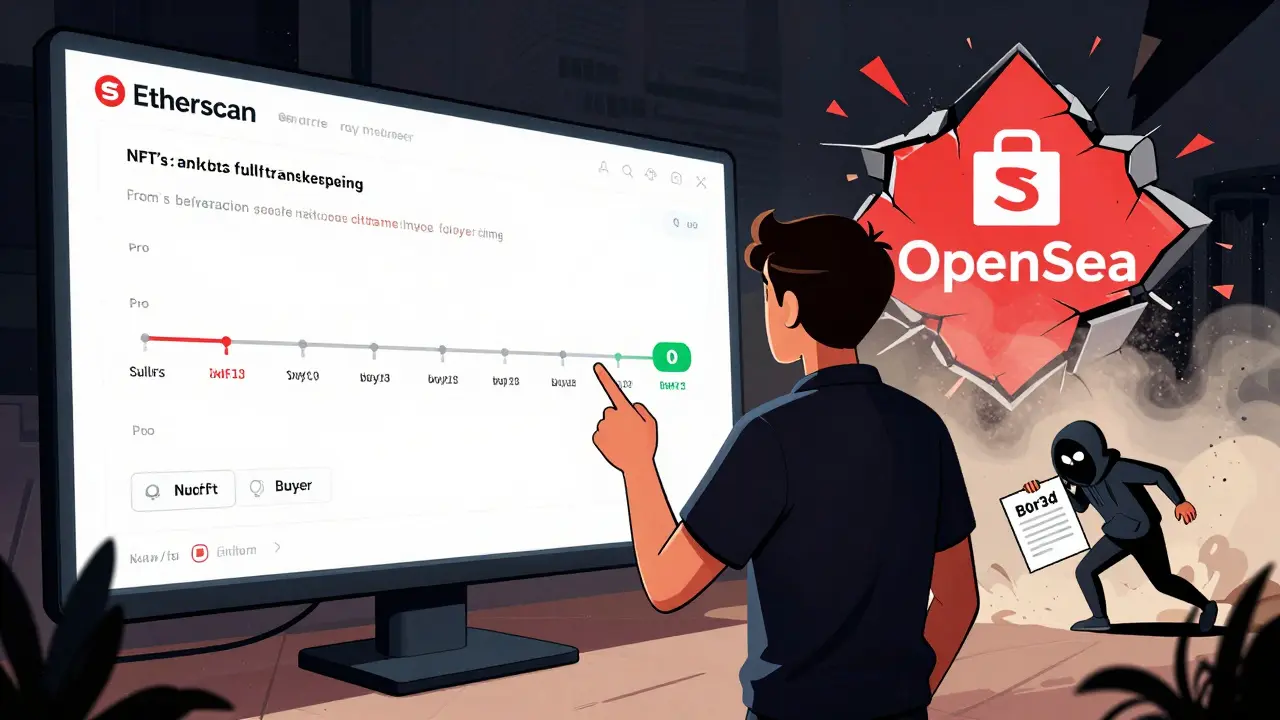
The most reliable way to verify NFT ownership is through Etherscan, the main blockchain explorer for Ethereum-based NFTs. Here’s how to do it:- Open Etherscan.io in your browser.
- Copy the wallet address that holds your NFT. You can find this in your MetaMask, Phantom, or other wallet under "Address" or "Public Key".
- Paste the address into Etherscan’s search bar and hit Enter.
- On the wallet page, click the "NFTs" tab.
- You’ll see a list of all NFTs linked to that wallet. Find your NFT by its name or token ID.
- Click on the NFT to open its details page.
- Look at the "Token Transfers" section. You’ll see a timeline of every transaction: who sent it, who received it, and when.
- Confirm the most recent transfer was from the seller’s address to yours.
- Check the contract address. Compare it to the official contract listed on the project’s website. If it doesn’t match, it’s fake.
For example, if you bought a CryptoPunk, the contract address should be 0x495f947276749ce646f68ac8c248420045cb7b5e. Any other address? Red flag.
Other Tools for Verification - Pros and Cons
Etherscan is powerful, but not always easy. Here are other tools and what they’re good for:| Tool | Best For | Limitations |
|---|---|---|
| Etherscan | Full ownership history, contract verification, technical users | Overwhelming for beginners; only works on Ethereum |
| OpenSea | Quick check for NFTs listed on their marketplace | Only shows NFTs you’ve listed or bought there; doesn’t show off-platform transfers |
| Nansen | Advanced analytics, tracking whale wallets, detecting scams | Subscription required; overkill for casual users |
| DappRadar | Multi-chain NFT tracking (Solana, Polygon, etc.) | Limited detail on individual NFTs; better for portfolio overview |
OpenSea is convenient - if your NFT is listed there, you can click "Ownership" and see who holds it. But if someone sold it privately or moved it to another wallet, OpenSea won’t show that. That’s why you should always cross-check with Etherscan.
Common Pitfalls and Scams
Even experienced users get fooled. Here are the most common traps:- Wrapped NFTs: Some NFTs from other chains (like Solana) are "wrapped" into Ethereum tokens. These aren’t the original - they’re proxies. Check the contract address carefully.
- Marketplace escrow: If you bought an NFT on OpenSea, the platform holds it until payment clears. During that time, the wallet showing ownership is OpenSea’s, not yours.
- Fake contracts: Scammers create lookalike contracts with slightly misspelled names. Always verify the official contract address on the project’s Twitter or website.
- Metadata mismatch: The NFT might point to a broken or fake image. Click the link in the NFT’s metadata. Does it load the real artwork? Or a placeholder? If it’s a 404 or a stock photo, you’ve been scammed.
One real case: In 2024, a buyer paid 5 ETH for a "Bored Ape" they thought was #7777. Etherscan showed the token ID was correct - but the contract address was a copycat. The real Bored Ape contract is verified on Etherscan with a green checkmark. This one didn’t have it.
What You Don’t Own (And Why It Matters)
Owning an NFT ≠ owning the rights to the art. Most NFTs come with a license - not copyright. The artist keeps the rights to reproduce, license, or sell the image. You get the right to display it, maybe use it as a profile picture, and resell the token.Some projects, like CryptoPunks, grant full commercial rights. Others, like many generative art collections, don’t. Always read the terms. If the project website doesn’t state what rights you get, assume you get nothing beyond the token.
This is why verification isn’t just about proving you have the token - it’s about understanding what you’re allowed to do with it. A fake NFT might look real. But a real NFT with no usage rights? That’s still a disappointment.
Future of NFT Verification
The tools are getting better. AI systems are now scanning NFT metadata and contract code to flag fakes automatically. Cross-chain verification tools are emerging so you can check ownership on Solana, Polygon, or Arbitrum from one dashboard. Some startups are even linking NFTs to physical items - like luxury watches or real estate deeds - using QR codes tied to on-chain tokens.But the core won’t change: blockchain is the only trusted source. No company, no marketplace, no app can replace it. Until someone invents a better way to prove ownership without trust, the blockchain will remain the gold standard.
Final Checklist: Did You Verify Properly?
Before you consider your NFT "verified," run through this:- ✅ Did you check the wallet address on Etherscan (or equivalent for other chains)?
- ✅ Did you confirm the contract address matches the official one from the project?
- ✅ Did you trace the most recent transfer to your address?
- ✅ Did you click the metadata link to ensure the image or file loads correctly?
- ✅ Did you check the project’s terms to understand what rights you actually have?
If you answered yes to all five, you’ve done it right. If not, stop. Don’t celebrate. Don’t post it on social media. Go back and verify again.
Can I verify NFT ownership without a wallet address?
No. Ownership is tied to wallet addresses on the blockchain. Without the address, you can’t trace the token. If someone gives you a link to an NFT on OpenSea, that’s not proof - it’s just a webpage. You need the wallet address to check the blockchain directly.
Is OpenSea enough to verify NFT ownership?
No. OpenSea only shows NFTs listed on its platform. If you bought an NFT privately, transferred it to another wallet, or it’s on a different blockchain, OpenSea won’t show the full history. Always use a blockchain explorer like Etherscan for full verification.
What if my NFT is on Solana or Polygon, not Ethereum?
Use the right explorer. For Solana, use SolanaFM or Solana Explorer. For Polygon, use Polygonscan. The process is the same: find the wallet address, go to the explorer, look up the NFT by token ID, and check the transfer history. Don’t assume Ethereum tools work on other chains.
Can someone steal my NFT after I verify it?
Not if your wallet is secure. Verification confirms ownership at a point in time. If someone hacks your wallet or you give away your private key, they can transfer the NFT. That’s why you need to protect your private key - not just verify the NFT once.
Why does my NFT show as owned by a different wallet than mine?
It could be a marketplace escrow (like OpenSea holding it during sale), a wrapped token from another chain, or a scam. Check the transaction history on the blockchain explorer. Look for the most recent transfer - if it didn’t come from your wallet, you don’t own it yet.

Lawal Ayomide
Bro, you don't need all this fancy stuff. Just check the wallet. If it's in your MetaMask, you own it. End of story.
Stop overcomplicating.
Blockchain ain't rocket science.
Reggie Herbert
That’s the most dangerously oversimplified take I’ve seen all week. Ownership isn’t about wallet possession-it’s about cryptographic provenance. If you can’t trace the token ID back to the verified contract on-chain, you’re holding a hyperlink, not an asset.
OpenSea is a glorified eBay listing. Etherscan is the deed to your house. Don’t confuse the brochure with the title.
And please stop saying ‘end of story.’ The blockchain doesn’t care how you feel.
Britney Power
How quaint. One assumes the author believes blockchain verification is a novel concept, when in fact, it’s merely the digital reiteration of the ancient principle of title registry-only now, with the added benefit of Byzantine fault tolerance and immutability. How tragically underappreciated is the ontological weight of decentralized ledgering in an era where ‘ownership’ has been reduced to a UI state in a web3 wallet.
One wonders whether the author has ever read the original whitepaper-or if they merely skimmed the OpenSea FAQ.
And yet, still, the masses cling to the illusion of digital possession as if it were a birthright, not a contractual artifact.
Maggie Harrison
YESSSSS 🙌 this is why I love web3-real ownership, no middlemen, no corporate gatekeepers!
Just you, your wallet, and the blockchain telling the world: ‘this is mine.’
And yes, I check my NFTs on Etherscan every morning like a ritual 😌✨
It’s not just tech-it’s freedom. 💫
samuel goodge
One must be cautious, however, to distinguish between ‘proof of possession’ and ‘proof of right.’ The blockchain confirms that a token resides in a given wallet-but it does not, by itself, confer intellectual property rights, nor does it guarantee the persistence of off-chain metadata. Many users conflate these; and this confusion is exploited daily by bad actors who deploy lookalike contracts with subtle misspellings-e.g., ‘BoredApeYachtClub’ vs. ‘BoredApeYachtC1ub’-which are functionally identical in UI but cryptographically distinct.
Moreover, the reliance on centralized metadata hosts (like IPFS gateways operated by Infura) introduces a single point of failure, undermining the very decentralization ethos we claim to champion.
Verification is necessary, yes-but it is not sufficient.
justin allen
Ugh. So you’re telling me I need to go to some nerd website just to prove I own a cartoon monkey? In America, we don’t need Etherscan. We trust our wallets. That’s freedom.
Also, why are we still on Ethereum? Solana’s faster, cheaper, and doesn’t make me pay $20 in gas to check my NFT.
Stop being so basic.
ashi chopra
I really appreciate how clear this guide is. I’m new to NFTs and was terrified I’d get scammed. This checklist saved me-literally. I checked my NFT last night and realized the contract address didn’t match. I almost sent more ETH to the scammer. Thank you.
It’s not about the money. It’s about not being taken advantage of.
❤️
Darlene Johnson
Of course they’re not telling you the real truth.
Did you know that Etherscan is owned by a venture capital firm that also invests in OpenSea?
And the ‘verified’ green checkmark? That’s just a paid badge. The real contracts are hidden behind private APIs.
They want you to think you’re safe. But you’re just another data point in their surveillance matrix.
Check your wallet? That’s the first step they want you to take. The real ownership? It’s all controlled by the Fed.
Ivanna Faith
so like... if your nft is on solana and you use etherscan... does it just show nothing?
or does it show a ghost?
why do we even have so many chains
it's so confusing
also i think the blockchain is just a big lie
but i still bought one
lol
its cute
Akash Kumar Yadav
Why do Americans treat blockchain like it’s their invention?
India has been doing decentralized ledgers since 1990s with Aadhaar.
You think NFTs are new? We’ve had digital identity systems longer than your crypto bros have had wallets.
And you still don’t know how to verify a contract address?
Pathetic.
alex bolduin
Man I just bought my first NFT last week and this post literally saved me
thought I was rich because OpenSea said so
turned out it was a fake contract
took me 10 mins on Polygonscan to find out
so glad I didn't post it on Twitter yet
thanks for the real talk
no cap
Vidyut Arcot
You’re doing great just by asking these questions. Most people skip verification and lose everything.
Double-checking the contract address? That’s the move.
Not every NFT is a masterpiece, but every safe NFT starts with a verified address.
Keep learning. You’re already ahead of 90% of the crowd.
And hey-if you need help reading a transaction, I’m happy to walk you through it. No judgment. We all started somewhere.
Jay Weldy
It’s wild how much emotion we attach to pixels on a screen, isn’t it?
But maybe that’s the point-NFTs aren’t about art or ownership. They’re about belonging.
Verifying your token isn’t just technical-it’s emotional. It’s saying, ‘I’m part of this community.’
So yeah, check the contract. Check the metadata.
But also, celebrate that you care enough to verify.
That matters more than you think.
Melinda Kiss
I cried when I realized my NFT was fake.
Not because of the money-because I believed in the artist.
Thank you for writing this with so much care.
I printed the checklist and taped it to my monitor.
Now I check every NFT before I even click ‘Buy.’
You’ve helped me protect my heart, not just my wallet.
❤️
Christy Whitaker
Of course you think you own it.
That’s what they want you to believe.
Every NFT you own is being tracked. Every transaction. Every wallet. Every click.
And who controls the blockchain? The same people who controlled the banks.
You’re not free. You’re just paying more gas fees.
Enjoy your digital ghost.
Nancy Sunshine
It is imperative to underscore that the veracity of NFT ownership hinges not upon the convenience of third-party interfaces, but upon the immutable, cryptographically secured, and consensus-validated records resident upon the distributed ledger.
One must, therefore, eschew the allure of user-friendly marketplaces and instead engage directly with the native blockchain explorers to ensure ontological authenticity.
Failure to do so constitutes, in effect, a surrender of epistemic agency to corporate intermediaries-precisely the phenomenon that blockchain was designed to obviate.
One cannot overstate the gravity of this principle.
Alan Brandon Rivera León
As someone from Latin America, I’ve seen how people get scammed with fake NFTs because they don’t know how to check the contract.
But here’s the thing-it’s not just about tech.
It’s about trust. We’ve been burned too many times by ‘official’ platforms that vanish overnight.
So yes, use Etherscan. Yes, verify the address.
But also teach your family. Your abuela. Your cousin who just bought a ‘Bored Ape’ because it looked cool.
Knowledge is the real NFT.