Is Crypto Legal in Costa Rica? Understanding the Non-Recognition Status

If you're looking at Costa Rica as a place to launch a blockchain project or move your digital wealth, you've probably noticed a strange contradiction: the country is incredibly welcoming to crypto entrepreneurs, yet the government refuses to call Bitcoin "money." Unlike its neighbor El Salvador, which made a global splash by adopting Bitcoin as legal tender, Costa Rica has taken a much more cautious, almost clinical approach. They aren't banning it, but they aren't embracing it as a currency either.
Quick Takeaways
- Cryptocurrencies are not legal tender or official currency in Costa Rica.
- The government focuses on fighting financial crime (AML/CFT) rather than promoting adoption.
- Businesses can operate, but they must register as Virtual Asset Service Providers (VASPs) with SUGEF.
- Opening a corporate bank account remains the biggest hurdle for crypto startups.
- The country is aligning with OECD standards to become a hub for compliant crypto operations.
The "Not Legal Tender" Distinction
To understand the situation, you have to understand a specific legal line. The Central Bank of Costa Rica (CBCR) has been very clear: digital assets are not legal tender, monetary currency, or foreign currency. In plain English, this means you cannot legally demand that a business accept Bitcoin as payment for a service, and the government won't back it as a stable store of value.
However, this isn't a ban. It's a "regulatory gray area." The government treats crypto as a Virtual Asset-a digital representation of value that can be traded online. By defining it this way, they avoid the chaos of volatile coins affecting the national economy while still allowing the tech industry to grow. It's a middle-ground strategy: they avoid the total prohibition seen in China but stop short of the full integration seen in the Central African Republic.
How the Rules Actually Work for Businesses
If you're starting a business, you aren't just a "crypto company"; you're likely a Virtual Asset Service Provider (VASP). This is a specific legal category for anyone exchanging crypto for cash, managing digital wallets, or issuing tokens. To stay on the right side of the law, you have to deal with SUGEF (the Superintendencia General de Entidades Financieras).
Here is the catch: registering with SUGEF doesn't mean the government has "authorized" your business model; it just means they know who you are and where your money is coming from. The focus here is almost entirely on anti-money laundering (AML) and counter-terrorist financing (CFT). If you can't prove where your clients' funds originate, you'll have a very bad time with the regulators.
| Requirement | Detail / Value | Estimated Timeline/Cost |
|---|---|---|
| Company Registration | Standard legal incorporation | 15-20 business days |
| Min. Capital | Depending on scope | $10,000 - $50,000 |
| Compliance Setup | AML/CFT policies & risk frameworks | 3-6 months / $25k - $75k |
| Technical Capacity | Transaction monitoring (min 1k/hr) | Variable based on software |
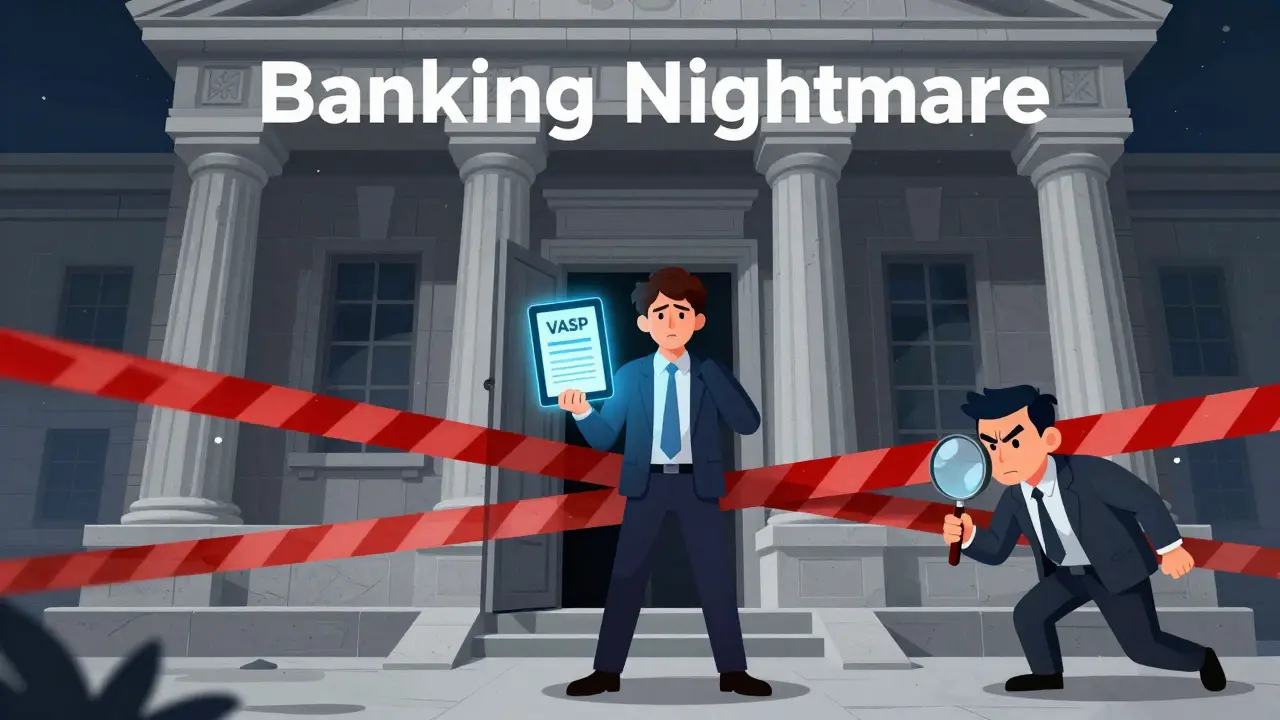
The Banking Nightmare
Here is where the theory hits the wall. While the government might be okay with your VASP registration, the banks are a different story. Many entrepreneurs in the r/CryptoTravel community have reported a grueling process just to get a basic corporate account. It is not uncommon for founders to spend six to eight months knocking on doors, only to be rejected by the major players.
Why the hate? Traditional banks in Costa Rica are terrified of the risk. Even with a SUGEF registration, banks worry that a single compliance slip-up will bring a massive fine from international regulators. Most crypto startups eventually find a smaller, niche financial institution that is willing to work with them, but these banks usually impose strict monitoring conditions that can feel stifling.
Is It Still Worth Moving There?
Despite the banking headaches and the lack of "legal tender" status, many are still flocking to the country. Why? Because compared to places like India, which slapped a 30% tax on crypto, Costa Rica is relatively light-touch. The political stability is a huge draw, and the tax burden on foreign investment is low.
The country is also playing a long game. By aligning with the OECD's Crypto-Asset Reporting Framework (CARF), they are signaling to the world that they want to be a "clean" crypto hub. They aren't trying to be a Wild West tax haven; they want to be the place where compliant, institutional-grade crypto businesses reside. This measured approach is generally seen as more sustainable than the "all-in" approach of El Salvador, which has faced significant criticism from the IMF.

What to Expect in the Near Future
The legal landscape is shifting quickly. With the progress of Bill 22.837 and the "Cryptoassets Market Law" (Bill 23.415), we are moving away from the "gray area" and toward a formal code of conduct. By mid-2026, the goal is full alignment with FATF (Financial Action Task Force) standards.
For the average user, this means more legitimacy but less anonymity. SUGEF is investing millions into upgrading its KYC (Know Your Customer) platforms. If you're planning to operate in Costa Rica, don't expect to fly under the radar. The future of crypto in the region is professional, transparent, and heavily audited.
Can I buy things with Bitcoin in Costa Rica?
Yes, but only if the merchant agrees to it. Because crypto is not legal tender, a shop owner has no legal obligation to accept it. However, many tourist spots and tech-forward businesses do accept it as a private agreement.
Do I need a license to run a crypto exchange in Costa Rica?
You don't get a "license" in the traditional sense, but you must register as a Virtual Asset Service Provider (VASP) with SUGEF and implement strict AML/CFT protocols to avoid legal trouble.
Is it cheaper to start a crypto business in Costa Rica than in the US?
Generally, yes, due to lower foreign investment taxes and a more straightforward initial company registration process (often taking just 15-20 days). However, the cost of compliance software and AML officers can be high.
What is the risk of the government banning crypto suddenly?
The risk is currently low. The legislative trend (such as Bill 22.837) shows a move toward regulation and oversight rather than prohibition.
How do the laws compare to El Salvador?
El Salvador treats Bitcoin as an official currency (legal tender). Costa Rica treats it as a "Virtual Asset"-a tradeable commodity that is not official money. Costa Rica is much more focused on financial crime prevention than on mass adoption.
Next Steps for Entrepreneurs
If you are moving forward with a venture in Costa Rica, start with your banking strategy first. Do not wait until your company is incorporated to research which banks are crypto-friendly; that is where most founders get stuck. You'll also want to hire a local compliance expert. Trying to DIY your AML policies can lead to registration delays with SUGEF.
For those just visiting, keep in mind that while the government doesn't recognize crypto, the culture is increasingly open to it. Just keep a backup of traditional currency for those moments when you encounter a business that sticks strictly to the Central Bank's definition of money.



Andrew Southgate
It is really interesting to see how Costa Rica is positioning itself as a compliant hub rather than a lawless frontier, which I think is a much smarter long-term play than what we've seen in other regions. If you are actually planning to move your operations there, I would strongly suggest looking into the specific tax treaties between your home country and Costa Rica first because the territorial tax system can be a huge advantage if you set it up correctly from day one. Most people focus on the VASP registration and the banking hurdles, but the real magic happens when you optimize your tax structure to complement that regulatory stability. I've seen a few founders struggle because they treated the move as just a legal checkbox rather than a holistic financial strategy, so definitely take the time to map out your capital flow before you commit to the move.
Trudy Morse
Value is just a social construct anyway. This is just the state playing a game of semantics to keep control.
Thomas Jewett
Just another example of how the world is becoming a giant laundry mat for criminals and we just let it happen while the US should be the only place where real money matters because our system is the only one that actually works despite what these globalist types say and its honestly discusting that people are moveing their wealth to some jungle to avoid paying their fair share for the roads and schools we all use back home in the states!!!
Shannon Kelly Smith
Love the energy here! 🚀 Just remember that the banking struggle is a great opportunity to network with other founders in the area! Keep pushing! 💪✨
Ian Chait
Obvious psyop by the OECD to centralize all the ledger data via CARF. They want total visibilty on every satoshi to ensure the G20 can flip the switch when the CBDC is ready. Total surveillance state masquerading as "compliance" lol. Wake up people, the VASP registration is just a digital leash.
Gaurav Undirwade
It is profoundly disappointing that individuals seek to bypass national fiscal responsibilities by migrating to such jurisdictions. One must consider the ethical implications of operating in a "gray area" where the state refuses to acknowledge the nature of the asset.
Sean Douglas
The absolute audacity of these banks to treat entrepreneurs like common criminals is simply breathtaking. I am practically vibrating with indignation at the thought of spending eight months begging for a corporate account while the world burns in a fire of bureaucratic incompetence!
Kevin Lư
Banks are just lazy and scared of a little risk, but hey, who cares as long as we can get our fancy crypto setups running in the tropics, right?
Prachi Bhadarge
Imagine thinking a SUGEF registration actually makes the banks like you. That's adorable.
Chintu Parikh
I believe this measured approach could actually serve as a blueprint for other emerging economies. By balancing innovation with rigorous AML standards, Costa Rica is fostering a sustainable ecosystem that benefits both the state and the entrepreneur.
Mike Kempenich
It seems like a fair trade-off for the stability they offer. The banking issues are a pain, but the lack of a 30% tax is a massive win for anyone trying to scale.
Shantal Sanjur
Oh sure, just "register" with the government and give them your entire client list. I'm sure the SUGEF is just doing this for our own protection and not to create a perfect database for the eventual crackdown. Such a "safe" hub!
Vicky Duffala
This is the kind of forward-thinking we need! Embracing the tech while keeping the economy stable is a total vibe. Let's see where this leads by 2026! 🌟
Nishant Goyal
Sounds like a solid plan for the country.