Is Crypto Regulated in China? The 2025 Total Ban Explained

Forget everything you thought you knew about buying Bitcoin in China. As of June 1, 2025, holding a single satoshi can get you into serious legal trouble. If you are wondering is crypto regulated in China, the short answer is yes-it is banned entirely. Trading, mining, and even simple ownership are now classified as illegal financial activities under mainland Chinese law.
This isn't just a suggestion or a loose guideline. It is a sweeping decree issued by the People's Bank of China (PBOC) that marks the end of an era for private digital assets in the world's second-largest economy. For anyone with ties to China-whether you are an investor, a business owner, or just curious about your stash of tokens-the rules have changed drastically. Here is exactly how the landscape looks today, why it happened, and what it means for your money.
The Final Nail: The June 2025 Decree
For years, China played a cat-and-mouse game with cryptocurrency. They cracked down on exchanges, then miners, then initial coin offerings. But on May 30, 2025, the PBOC pulled out all the stops. They issued a comprehensive prohibition that went into effect just one day later, on June 1, 2025.
This decree prohibits three main things:
- Trading: Buying or selling cryptocurrencies on any exchange, domestic or foreign.
- Mining: Using computational power to validate transactions and earn rewards.
- Ownership: Simply holding crypto assets in a wallet.
Before this date, owning crypto wasn't explicitly criminalized for individuals, though trading was heavily restricted. Now, possession itself triggers legal penalties. The government treats these assets not as property, but as tools for illegal financial activity. This shift represents a complete reversal from China's position just a decade ago, when it was one of the largest hubs for Bitcoin adoption and mining.
A Decade of Tightening Screws
The 2025 ban didn't happen overnight. It was the final step in a systematic crackdown that started back in 2013. Understanding this timeline helps explain why the enforcement is so aggressive today.
| Date | Action Taken | Impact |
|---|---|---|
| Dec 5, 2013 | Banks banned from Bitcoin transactions | Cut off fiat on-ramps for early adopters |
| Sept 30, 2017 | ICO ban and exchange closures | Domestic exchanges shut down; prices plummeted |
| June 2021 | Targeted mining operations | Major miners fled to Kazakhstan, US, and elsewhere |
| Sept 24, 2021 | Comprehensive trading/mining restrictions | Effectively banned digital tokens like Bitcoin |
| Aug 2024 | Supreme Court updates anti-money laundering laws | Crypto transactions explicitly defined as money laundering methods |
| June 1, 2025 | Total ban on ownership, trading, and mining | All crypto activities become criminal offenses |
Each step removed a layer of infrastructure. First, they stopped banks from processing payments. Then, they closed the exchanges where people bought coins. Next, they made mining unprofitable through energy taxes and direct bans. Finally, in 2025, they criminalized the asset itself. By the time the 2025 decree hit, the domestic market was already hollowed out, but the legal risk for individuals had never been higher.
How Enforcement Actually Works
You might wonder how the government catches someone holding Bitcoin in a private wallet. The answer lies in a coordinated surveillance network involving multiple agencies. The Ministry of Public Security leads anti-money laundering efforts, while the Cyberspace Administration monitors internet traffic.
Financial institutions and non-bank payment providers (like Alipay and WeChat Pay) are mandated to implement deep monitoring systems. These systems combine online tracking with offline inspections. If your bank account shows any transaction linked to a known crypto exchange-even if it's overseas-you could face frozen assets or investigation.
Internet companies are also required to block and report crypto-related content. This means search results for "Bitcoin price" or "how to buy Ethereum" are often scrubbed or redirected to warnings about financial risks. Overseas exchanges are explicitly banned from serving Chinese residents, meaning if you try to sign up using a Chinese phone number or ID, you will likely be rejected or flagged.

Real Consequences: The Liu Case
To understand the severity, look at recent court precedents. In August 2024, the Beijing No. 2 Intermediate People's Court sentenced a defendant named Liu to 3.5 years in prison plus a fine of 40,000 yuan (about $5,570).
Liu hadn't mined Bitcoin or run an exchange. He simply facilitated cryptocurrency transactions involving stolen funds. He sold USDT tokens worth 200,000 yuan ($27,850), knowing the money came from fraud victims. The court ruled that he committed the crime of concealing and disguising criminal proceeds.
Crucially, this case established the "should have known" legal standard. Even if you claim ignorance about where the money came from, if you were handling crypto transactions, the court assumes you should have realized it was illicit. With the Supreme Court revising anti-money laundering laws in August 2024 to explicitly recognize crypto as a money laundering method, prosecutors now have a clearer framework to punish holders and traders alike.
The Exception: e-CNY and State Control
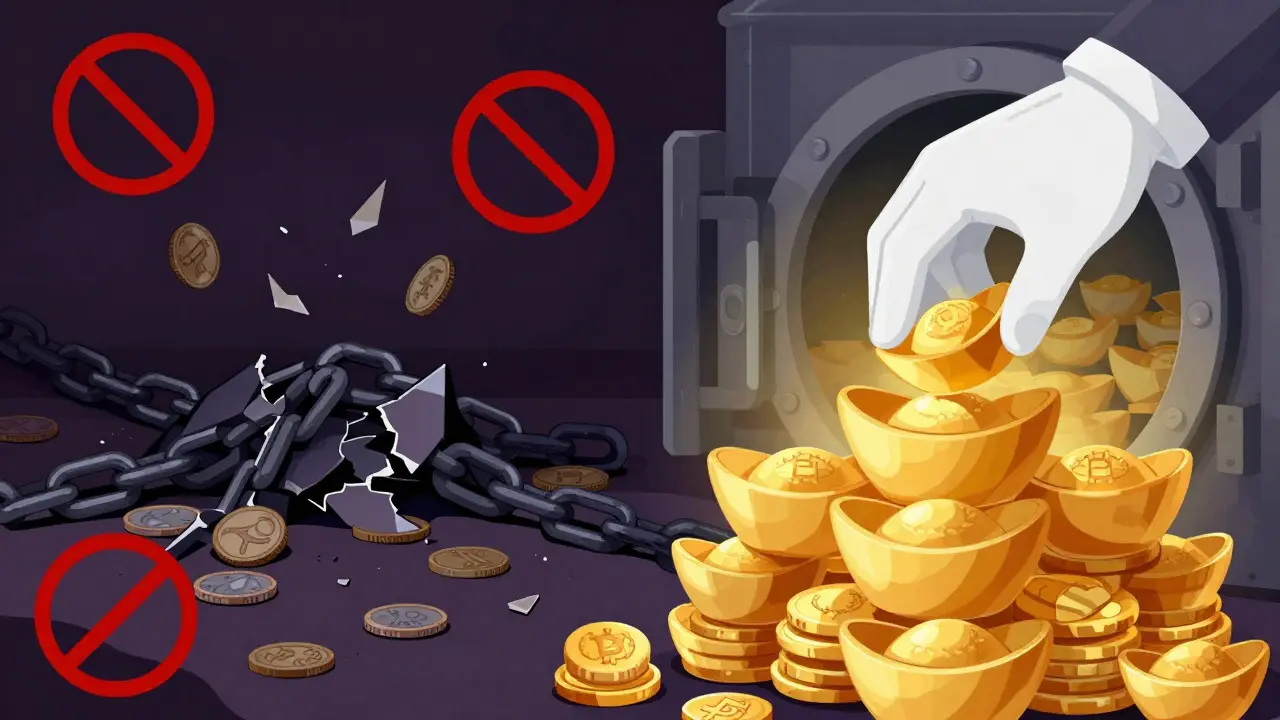
If China hates crypto so much, why do they talk about blockchain so often? The key distinction is control. China doesn't hate digital currency; it hates decentralized currency.
While private cryptocurrencies are banned, the state-backed digital currency, known as the e-CNY (Digital Currency Electronic Payment), is thriving. The e-CNY is a central bank digital currency (CBDC). Unlike Bitcoin, which operates on a public ledger no one controls, the e-CNY is issued and controlled directly by the People's Bank of China.
This allows the government to track every transaction, enforce capital controls, and stimulate spending through programmable money features. For example, the government could issue e-CNY vouchers that expire after 30 days, forcing citizens to spend them quickly during economic slowdowns. Private crypto offers none of this control, which is why it remains on the chopping block.
Is There Any Hope for Change?
As of July 2026, the ban remains absolute. However, there are whispers of internal debate. In July 2025, the Shanghai State-owned Assets Supervision and Administration Commission held meetings to discuss strategic responses to stablecoins and digital currencies.
Experts suggest that the rapid evolution of global digital assets might force China to soften its stance slightly in the future. They may eventually allow limited access to regulated stablecoins or tokenized real-world assets, provided they are tightly monitored. But don't hold your breath. For now, the zero-tolerance approach stands. Any policy softening would likely apply only to institutional players under strict supervision, not individual retail investors.
What This Means for You
If you live in mainland China, the advice is clear: stay away. The risks outweigh the potential gains. Asset seizure measures target individuals involved in crypto activities, and criminal penalties include multi-year prison sentences. Monitoring systems track both online activities and conduct offline inspections, creating a net that is hard to escape.
If you are a business operating in China, ensure your Anti-Money Laundering (AML) protocols identify virtual currencies as major risks. Financial institutions must monitor all customer funds for links to crypto trading. Since all crypto transactions are illegal, traditional Know Your Customer (KYC) requirements focus on prevention. You need to know your customers well enough to block any attempt to move money into virtual currency channels.
For those outside China, the impact is mostly indirect. The exodus of Chinese miners and traders has increased liquidity and competition in markets like the United States, Europe, and Southeast Asia. But for anyone trying to bridge the gap between Chinese fiat and global crypto, the wall is higher than ever.
Can I still own Bitcoin in China in 2026?
No. As of June 1, 2025, individual ownership of cryptocurrencies is prohibited under Chinese law. Holding crypto assets can trigger legal penalties, including fines and imprisonment, especially if linked to financial transactions.
Is the e-CNY considered cryptocurrency?
Technically, it is a digital currency, but it is distinct from cryptocurrencies like Bitcoin. The e-CNY is a Central Bank Digital Currency (CBDC) issued and fully controlled by the People's Bank of China. It is legal tender and encouraged for use, unlike decentralized cryptos which are banned.
What happens if I mine Bitcoin in China?
Mining is strictly banned. Authorities regularly raid mining farms, seize equipment, and impose heavy fines. Miners who stayed or returned risk criminal charges related to illegal business operations and energy theft.
Are overseas crypto exchanges accessible in China?
Most major overseas exchanges are blocked by the Great Firewall. Additionally, Chinese financial institutions are required to freeze accounts associated with overseas exchange transactions. While some users bypass blocks via VPNs, doing so carries significant legal and financial risk.
Will China legalize crypto in the future?
There is no official indication of a full legalization. While there are discussions about regulated stablecoins or institutional blockchain use, the current stance favors state-controlled digital currency (e-CNY). A reversal of the total ban is unlikely in the near term.