Liquidity on DEXs vs Centralized Exchanges: What Really Matters for Traders

When you trade crypto, the real question isn’t just price-it’s whether you can actually buy or sell what you want, when you want it, without getting ripped off. That’s liquidity. And it’s where decentralized exchanges (DEXs) and centralized exchanges (CEXs) don’t just differ-they operate on completely different rules.
What Liquidity Actually Means
Liquidity isn’t a buzzword. It’s the difference between buying 10 ETH at $3,200 and having to pay $3,280 because there’s not enough sellers. High liquidity means tight spreads, low slippage, and fast fills. Low liquidity means your trade moves the market-and you pay for it. CEXs like Binance or Coinbase have been doing this for years. They’ve built massive order books with millions of users, market makers, and institutions all feeding depth into the system. DEXs like Uniswap or SushiSwap? They’re built on liquidity pools. No order books. No middlemen. Just code and users staking tokens.Why CEXs Have More Liquidity
Let’s be blunt: CEXs win on volume. In 2025, the top five centralized exchanges handled over $1.2 trillion in monthly trading volume. That’s not a typo. That’s billions per day. This isn’t accidental. It’s by design. CEXs aggregate orders from retail traders, hedge funds, algo bots, and institutional players. They use professional market makers who are paid to keep spreads tight. When you place a $50,000 buy order on Binance, it’s filled across hundreds of small orders in the background. You don’t feel the friction. You get a clean price. Their infrastructure doesn’t rely on the blockchain for every trade. Transactions happen off-chain, matched internally. That means near-instant execution, no gas fees, and zero network congestion. High-frequency traders love this. Institutions demand it. And that’s why liquidity stays deep-even during crashes.How DEXs Build Liquidity (And Why It’s Fragile)
DEXs don’t have order books. They use Automated Market Makers (AMMs). The most common formula? x * y = k. If you add 100 USDT to a ETH/USDT pool, the price adjusts automatically based on the ratio of tokens inside. Simple. Transparent. But fragile. Liquidity on DEXs comes from users-regular people-who deposit pairs of tokens into pools. In return, they earn a share of trading fees. Some even get extra rewards through yield farming. That’s great for decentralization. But it’s also why liquidity can vanish overnight. If ETH drops 20% in an hour, liquidity providers might pull their funds to avoid impermanent loss. If a new yield farm offers 500% APY on a different token, everyone moves. That’s not speculation-it’s behavior. And it creates wild swings in pool depth. A $10 million pool can shrink to $2 million in minutes during a panic.Slippage: The Silent Killer on DEXs
Slippage is the gap between the price you see and the price you get. On CEXs, slippage under 0.5% is normal for trades under $100,000. On DEXs? For the same size, you might see 2-5% slippage-or worse. Why? Because DEX pools are shallow compared to CEX order books. If you try to buy $200,000 worth of SOL on Uniswap, you’re consuming most of the available liquidity. The algorithm pushes the price up as it fills your order. You end up paying significantly more than expected. CEXs absorb that with depth. DEXs don’t. And if the network is congested-like during a NFT drop or a major airdrop-your transaction might even fail. You pay gas, lose time, and still don’t get your trade done.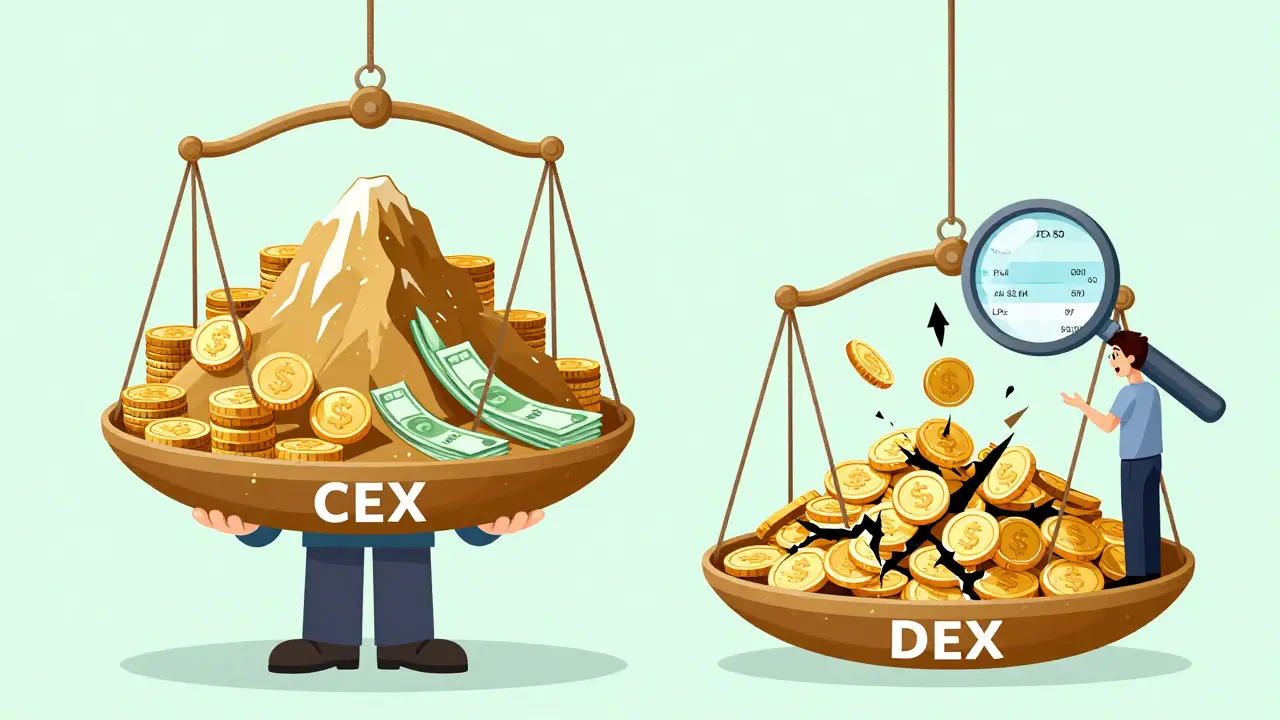
Transparency vs Opacity
One of the biggest advantages of DEXs? Everything is on-chain. You can look up any liquidity pool. See exactly how much USDC and ETH are in the pool. Track how much fee revenue it’s generated. Check who the top liquidity providers are. On CEXs? You get a price. That’s it. You don’t know if the “market” is being manipulated by a few大户. You don’t know if your trade is being front-run internally. You can’t audit their liquidity. You trust them. That transparency gives DEXs an edge in trust-but not necessarily in execution. You can see the water is shallow. But you still have to swim through it.Who’s Incentivized to Provide Liquidity?
On CEXs, liquidity comes from professionals. Market-making firms with teams, algorithms, and capital. They’re paid to keep spreads tight. Their goal? Consistency. On DEXs, liquidity comes from anyone with a wallet. A crypto enthusiast. A yield farmer. A bot. Some do it for fun. Others chase rewards. Many don’t even understand impermanent loss. That’s why you’ll see massive pools on popular pairs like ETH/USDT-but tiny, risky pools on obscure tokens. A DEX can have $500 million in ETH/USDT liquidity and $12,000 in a new memecoin pair. CEXs spread liquidity more evenly because they’re incentivized to list and support widely traded assets.Speed, Cost, and Network Bottlenecks
Every DEX trade requires a blockchain transaction. That means gas fees. That means waiting for blocks. That means delays during peak times. On Ethereum, a DEX trade might take 15-30 seconds. On Base or Arbitrum, it’s faster-but still not instant. CEXs execute trades in milliseconds. No waiting. No fees. No blockchain congestion. This isn’t just about convenience. It’s about arbitrage. When a token price jumps on Binance, arbitrage bots snap it up and push the price up on DEXs within seconds. That keeps prices aligned. But if the DEX is slow, the price gap stays open longer. That’s bad for traders and bad for liquidity efficiency.
Regulation and Trust
CEXs are regulated. They require KYC. They freeze accounts. They comply with AML rules. That scares some users. But it also attracts banks, hedge funds, and pension funds. Those players bring billions in liquidity. DEXs are permissionless. No ID needed. No freeze button. That’s why they’re popular in places with capital controls or unstable banking systems. But regulators are watching. If a major DEX gets targeted, liquidity could flee overnight. No warning. No notice.What Should You Use?
Here’s the real breakdown:- If you’re trading under $5,000 and want to swap tokens fast? DEXs are fine. Use Uniswap or PancakeSwap. Check the pool depth first.
- If you’re trading $10,000 or more? Use a CEX. The slippage alone makes DEXs too expensive.
- If you’re holding a new token with low volume? Avoid DEXs unless you’re prepared for huge price swings.
- If you’re a liquidity provider? Stick to major pairs (ETH/USDT, WBTC/USDC). Avoid volatile or new tokens unless you’re betting on long-term yield.
The Future: Hybrid Liquidity Is Coming
The gap isn’t going to disappear. But it’s narrowing. Some CEXs now offer non-custodial wallets. Some DEXs are integrating with CEX liquidity via bridges. Institutions are starting to use DeFi protocols through regulated gateways. Layer-2 chains like zkSync and Starknet are slashing gas fees and speeding up DEX trades. New AMM designs-like concentrated liquidity on Uniswap V3-are letting liquidity providers focus capital where it’s most needed, like a CEX order book. The endgame? Not one replacing the other. But a system where traders choose the right tool for the job. DEXs for transparency and access. CEXs for speed and depth. And the best traders? They use both.Which has better liquidity: DEX or CEX?
Centralized exchanges (CEXs) have far deeper liquidity than decentralized exchanges (DEXs). CEXs handle trillions in monthly volume thanks to institutional traders, market makers, and aggregated order books. DEXs rely on user-provided liquidity pools, which are smaller and more volatile. For trades under $5,000, DEXs work fine. For larger trades, CEXs are the only practical choice.
Why is slippage higher on DEXs?
DEXs use liquidity pools with fixed token ratios. When you trade a large amount, you consume a big chunk of the pool, forcing the price to shift. For example, buying $100,000 of a token with only $500,000 in the pool will push its price up significantly. CEXs have deep order books that absorb large trades without major price moves.
Can DEX liquidity disappear suddenly?
Yes. Liquidity providers on DEXs can withdraw their funds at any time. If a token crashes or a better yield opportunity appears, liquidity can vanish in minutes. This is why small or new token pairs on DEXs are especially risky-they often have low or unstable liquidity.
Are DEXs safer than CEXs because they’re decentralized?
It depends. DEXs eliminate counterparty risk-you keep control of your keys. But smart contracts can have bugs, and liquidity pools can be drained through exploits. CEXs are vulnerable to hacks and freezes, but they’re regulated and often insured. Neither is perfectly safe. DEXs offer transparency; CEXs offer reliability.
Should I provide liquidity on a DEX?
Only if you understand impermanent loss and are comfortable with volatility. Stick to major token pairs like ETH/USDT or WBTC/USDC. Avoid new or low-volume tokens. You’ll earn trading fees, but if the price of either token swings sharply, you could lose value compared to just holding. Use tools like Uniswap’s liquidity calculator to estimate risk before depositing.
Do CEXs manipulate liquidity?
There’s no public proof of widespread manipulation, but CEXs operate privately. They control order matching, can delay withdrawals, and sometimes prioritize large clients. DEXs are transparent-you can see every trade. But CEXs are less prone to sudden liquidity collapses because their liquidity is professionally managed and less dependent on retail sentiment.
Will DEXs ever match CEX liquidity?
Not in the same way. CEX liquidity comes from centralized capital and institutions. DEX liquidity comes from decentralized, often speculative, user participation. But with layer-2 scaling, concentrated liquidity models, and institutional DeFi adoption, DEXs are getting closer. The future isn’t one replacing the other-it’s both working together.