Margin Call and Liquidation Explained: How Leverage Risks Work in Crypto Trading
Margin Call & Liquidation Calculator
Calculate Your Risk Exposure
Enter your trading parameters to see your liquidation price and margin level.
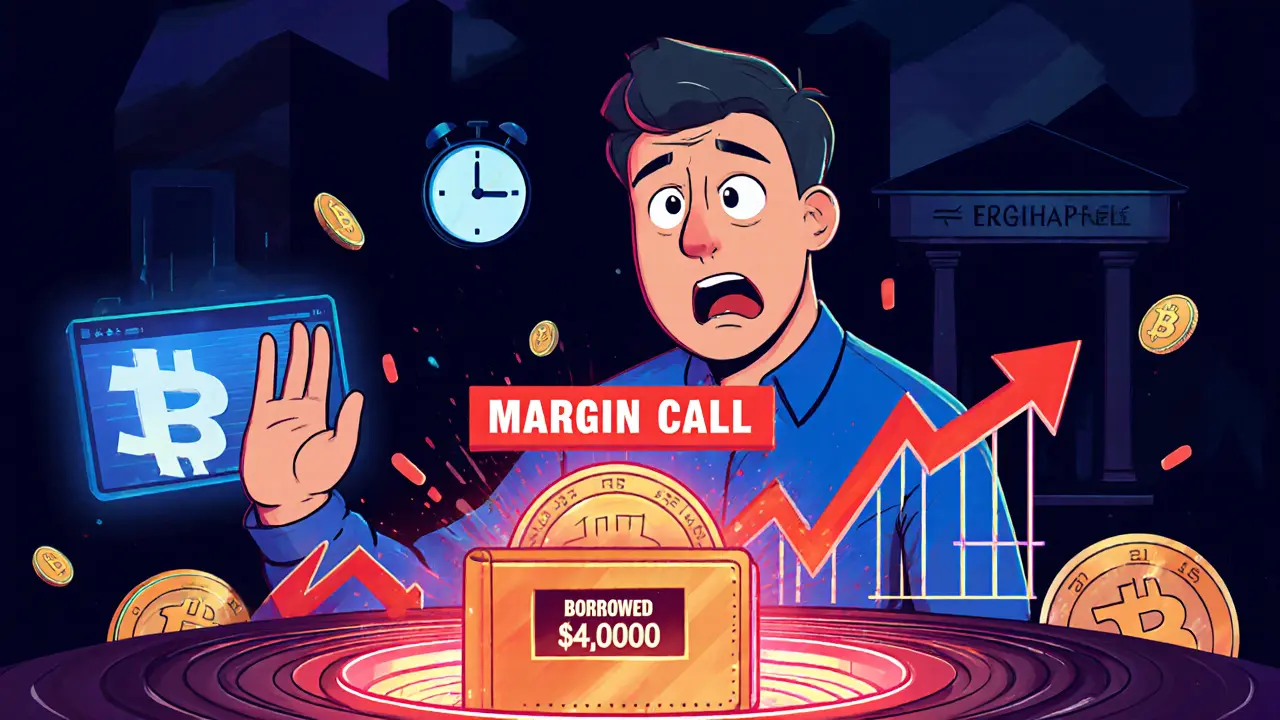
When you trade crypto with leverage, you’re borrowing money to放大 your position. It sounds powerful - a $1,000 deposit can control $10,000 worth of Bitcoin. But that power comes with a hidden trap: margin call and liquidation. These aren’t abstract terms. They’re the moment your trade blows up - and you lose money you didn’t think you could lose.
Imagine this: you buy $5,000 worth of Ethereum using 5x leverage. That means you’re borrowing $4,000 from the exchange. Your $1,000 is your collateral. If ETH drops just 20%, your position loses $1,000 - your entire deposit. The exchange doesn’t wait for you to notice. It automatically sells your position to cover the loan. That’s liquidation. And it happens fast - often before you can react.
What Is a Margin Call?
A margin call is a warning. It’s not a final notice. It’s the exchange saying, “Your account is getting dangerously low. Add more money or sell something - or we’ll do it for you.”
Every exchange has a minimum equity level you must maintain. This is called the maintenance margin. On Binance.US, it’s 25%. That means if your account value drops to 25% of your total position, you’re at risk. But here’s the twist: most exchanges trigger the margin call before you hit that level. Coinbase Pro sends a warning when your equity hits 20% of your position value. Kraken alerts you at 15%. Why? Because they want you to act before it’s too late.
Let’s say you’re trading with 10x leverage on Solana. You put in $2,000. Your total position is $20,000. The maintenance margin is 10%. So you need to keep at least $2,000 in equity. If Solana drops 15%, your position is now worth $17,000. Your equity is $1,700. That’s below the $2,000 threshold. You get a margin call. The exchange emails you, texts you, flashes a red alert on your screen. You have hours - sometimes less - to deposit more cash or close part of your position.
But here’s what most new traders don’t get: a margin call doesn’t mean you’re broke. It means you’re one bad price move away from losing everything.
What Happens During Liquidation?
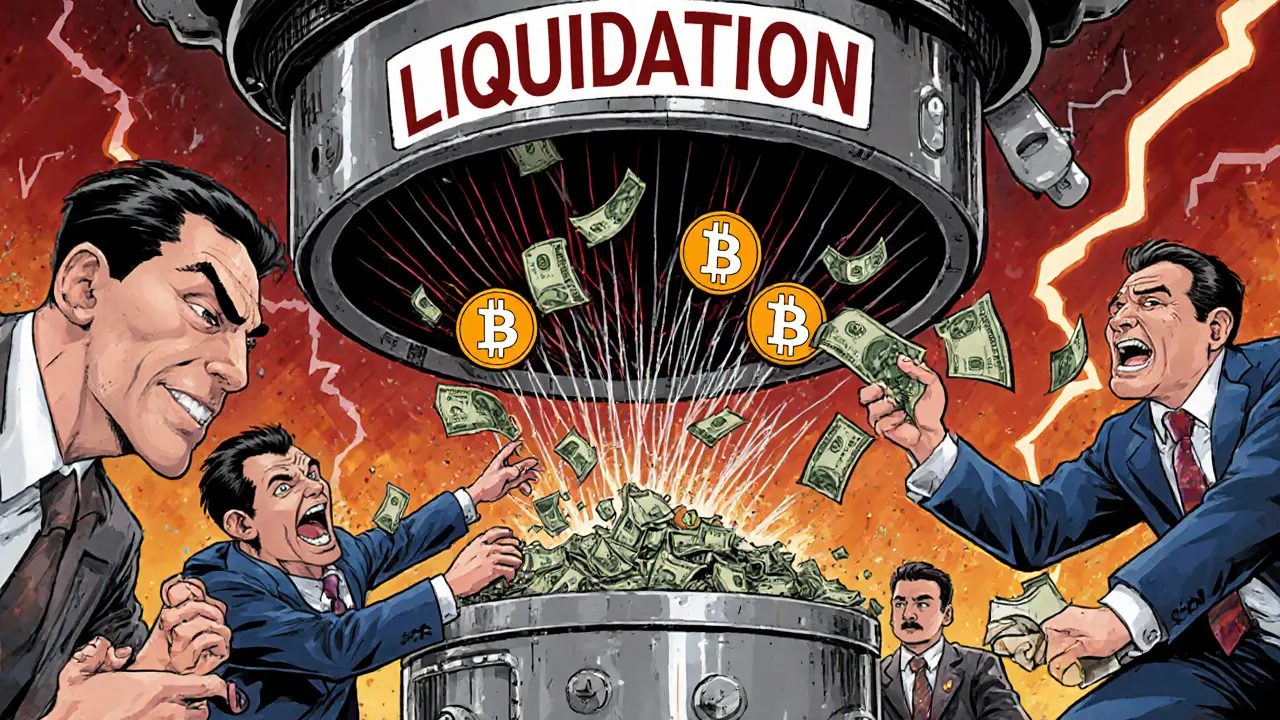
Liquidation is the endgame. If you ignore the margin call - or if the market crashes faster than you can react - the exchange sells your position to recover the loaned money. And they don’t care about your feelings. They sell at the best price they can get right now.
During the March 2020 crypto crash, Bitcoin dropped 50% in 36 hours. Thousands of leveraged traders got wiped out. On Kraken, positions were liquidated at prices 25% lower than the market average because there were no buyers. The exchange didn’t wait. It didn’t negotiate. It just sold. And you lost your money.
Liquidation isn’t always clean. Some platforms use FIFO (first in, first out) to close positions. Others pick the most volatile asset in your portfolio. If you’re holding BTC, ETH, and SOL with 5x leverage on each, and ETH crashes first, they might sell your ETH position - even if you wanted to hold it. You don’t get a say.
And it gets worse. If the market is moving fast, the exchange might sell your position at a price that doesn’t reflect the real market. This is called “slippage.” You might have thought you were risking $500. You end up losing $1,200 because the liquidation happened in a vacuum.
Why Do Exchanges Do This?
Exchanges aren’t out to get you. They’re protecting themselves. When you trade on margin, they’re lending you money. If you default, they lose. Liquidation is their insurance policy.
Think of it like a bank giving you a car loan. If you stop paying, they repossess the car. Same thing here. The exchange owns the loan. You own the position. If your position can’t cover the loan, they take it back.
Regulators like FINRA and the SEC have rules about this. In traditional markets, brokers must keep at least 25% equity in margin accounts. But crypto exchanges? They’re less regulated. That means their rules vary wildly.
For example:
- Binance.US: Margin call at 130% of maintenance (76.9% utilization), liquidation at 100%
- Coinbase Pro: Margin call at 125% (80% utilization), liquidation at 100%
- PrimeXBT: Margin call at 100%, liquidation at 50%
That means on PrimeXBT, you can go much deeper into the red before you’re liquidated. But that also means you’re risking more. On Coinbase, you get warned earlier - but you’re also more likely to get called in a normal dip.
How to Avoid Liquidation
You can’t eliminate risk. But you can avoid getting wiped out.
1. Use less leverage. Most retail traders lose money using 5x or higher. Try 2x or 3x. A 2x leveraged position only needs a 50% drop to liquidate. A 10x position needs just 10%. The lower the leverage, the more room you have to breathe.
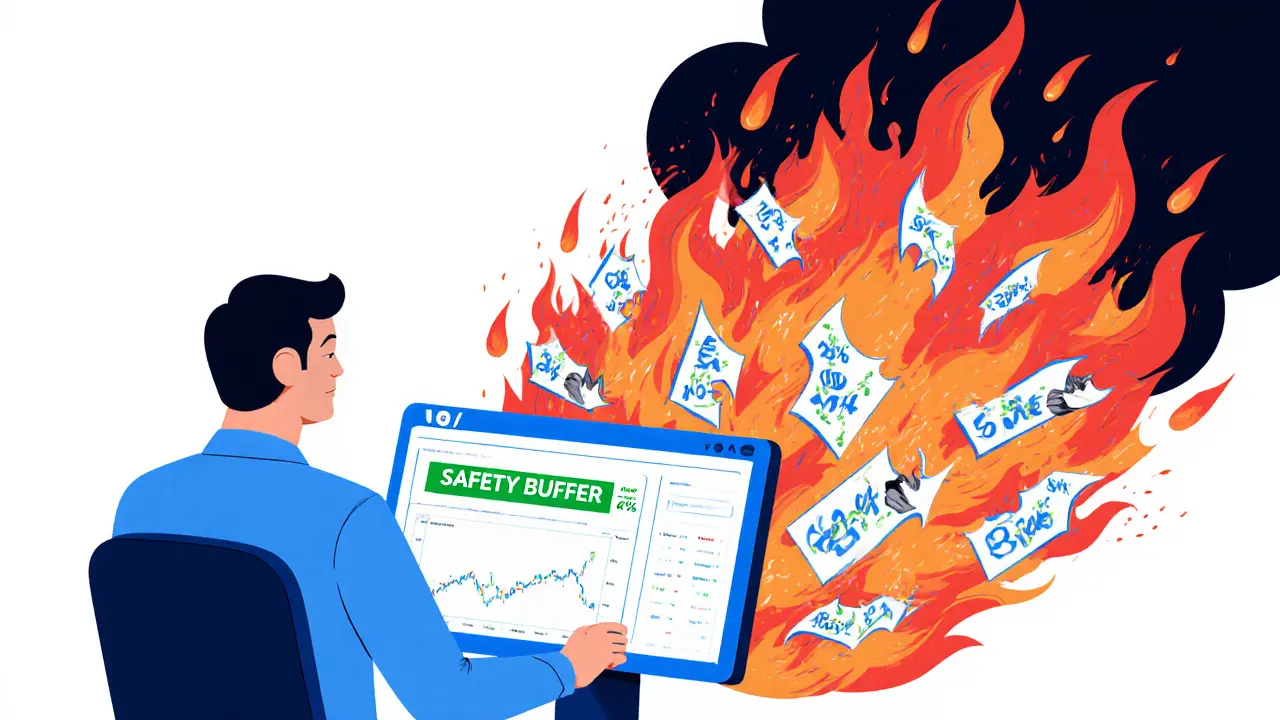
2. Keep a buffer. Don’t trade right up to the margin call line. If the maintenance margin is 10%, aim to keep at least 15% equity. That 5% cushion can save you during a 15-minute flash crash.
3. Monitor your position constantly. Don’t just set a stop-loss and walk away. Use platforms like TradingView to set alerts for your margin utilization percentage. If it hits 85%, start thinking about reducing your position.
4. Avoid trading during low liquidity. Crypto markets are quiet between 2 AM and 6 AM UTC. That’s when prices gap. A small move can turn into a big liquidation. Trade during peak hours - when there are buyers and sellers.
5. Know your exchange’s rules. Read the fine print. Binance, Kraken, and Bybit all have different liquidation triggers. Don’t assume they’re the same. If you’re not sure, test it in demo mode first.
Real Stories: What Goes Wrong
One trader on Reddit, u/TradeWithCaution, had $85,000 in Tesla stock on margin. He used 4x leverage. When Tesla dropped 18% after-hours, his account was liquidated at a price 22% below the last trade. He lost $28,500. He says he got the email alert - but it came 17 minutes after the price started falling. By then, it was too late.
Another user on Elite Trader said he avoided three margin calls in 2022 by using Interactive Brokers’ SMA tracking. He watched his available margin in real time and added cash before the system flagged him. He didn’t panic. He acted.
These aren’t rare cases. FINRA found that 58% of margin traders got at least one margin call in 2021. One in five got liquidated. And those with accounts under $25,000 were almost four times more likely to lose everything.
What Experts Say
Dr. Robert R. Johnson, finance professor at Creighton University, says: “Margin calls crystallize paper losses into real losses at the worst possible moment.” He’s right. When the market panics, everyone sells. Your position gets dumped into a sea of red candles. You’re not just losing money - you’re losing it at the bottom.
Liz Ann Sonders, Charles Schwab’s chief investment strategist, puts it bluntly: “Leverage is a time accelerator for losses. A 20% drop in a 4x leveraged position wipes you out. There’s no recovery.”
And she’s not wrong. If you’re using 5x leverage and the market drops 20%, you’re down 100%. No second chances. No do-overs.
The Bigger Picture
Margin trading isn’t going away. In fact, it’s growing. The global market hit $1.27 trillion in 2022 and is projected to grow 6.8% a year. But most retail traders don’t understand the mechanics. They see “100x leverage” on a banner and think they’re getting rich. They don’t see the liquidation risk.
Even big players get burned. In March 2021, Archegos Capital lost $20 billion in a single day because of margin calls. Their positions collapsed across multiple exchanges. The fallout rippled through banks like Goldman Sachs and Credit Suisse.
That’s systemic risk. And it starts with one trader who didn’t know how much they were risking.
Final Advice: Trade Like a Pro
Here’s what separates the traders who survive from the ones who get erased:
- Never risk more than 2% of your total capital on one leveraged trade.
- Always keep 15-20% extra cash in your account as a safety net.
- Use 2x or 3x leverage - never more than 5x unless you’re a professional.
- Track your margin utilization every hour, not every day.
- Know your exchange’s liquidation trigger. Test it in demo mode.
Margin trading can be profitable. But only if you treat it like a scalpel - not a sledgehammer. The market doesn’t care how smart you are. It only cares how prepared you are.
If you’re not ready for a margin call, you’re not ready to trade on leverage. Period.
What triggers a margin call in crypto trading?
A margin call is triggered when your account’s equity falls below the exchange’s maintenance margin requirement. For example, if you’re trading with 5x leverage and the maintenance margin is 10%, you need to keep at least 10% of your position value as equity. If your position drops and your equity falls below that level, you get a margin call. Most exchanges send alerts before you hit that point - usually when your equity reaches 15-20% of your position value.
Can I avoid liquidation after a margin call?
Yes - if you act fast. You can deposit more funds into your account, or close part of your position to reduce your leverage. Some exchanges, like Interactive Brokers, offer features like automatic cash conversion to help you avoid full liquidation. But if you wait too long - or if the market crashes faster than you can react - the exchange will sell your assets to cover the loan. Timing matters more than anything.
Do all crypto exchanges have the same margin rules?
No. Each exchange sets its own rules. Binance.US triggers liquidation at 100% of maintenance margin, while PrimeXBT waits until you’re at 50%. Coinbase Pro sends warnings at 125% utilization (80% used), while Kraken alerts you at 15%. Always check your exchange’s help section before trading on margin. Never assume rules are the same across platforms.
Is it possible to lose more than I deposited?
On most major crypto exchanges, no. They have a “negative balance protection” system that stops your account from going negative. But this isn’t universal. On some lesser-known platforms, you could owe money if liquidation happens during extreme volatility. Always use reputable exchanges like Binance, Kraken, or Coinbase - and never trade on platforms that don’t clearly state their liquidation policy.
How can I calculate my liquidation price?
Use this formula: Liquidation Price = Entry Price × (1 - (1 / Leverage)) / (1 - Maintenance Margin %). For example: You buy BTC at $60,000 with 5x leverage and a 10% maintenance margin. Your liquidation price is $60,000 × (1 - 0.2) / (1 - 0.1) = $48,000. That means if BTC drops to $48,000, you’ll be liquidated. Many platforms show this number in real time - but if yours doesn’t, calculate it yourself before you trade.

Sam Daily
Bro, leverage is like dating someone who screams when they’re mad - exciting until they trash your whole apartment. I used 10x on Solana last year, thought I was a genius… then it dipped 12% and BOOM. Gone. My dog ate my laptop out of sympathy. 🐶💔
Kristi Malicsi
margin calls are just exchanges saying hey we dont care about your feelings just give us our money back
Rachel Thomas
lol so you're telling me crypto isn't just free money? Newsflash: the system is rigged. Banks get bailouts, you get liquidated. Wake up sheeple.
Sierra Myers
you dont need leverage at all. just buy btc and hold. everyone else is just gambling with play money.
SHIVA SHANKAR PAMUNDALAR
the real tragedy is not the liquidation but the fact that you ever trusted a corporation with your money in the first place. capitalism is a pyramid scheme dressed in blockchain.
Shelley Fischer
While the article provides a comprehensive overview of margin mechanics, it fails to address the psychological predispositions that lead retail traders to over-leverage. Behavioral finance suggests that overconfidence bias and loss aversion are primary drivers of catastrophic risk-taking in leveraged environments.
Puspendu Roy Karmakar
bro i learned this the hard way too. i lost 3 months of salary on 5x eth. now i only use 2x and keep 20% extra cash. no stress, no sleepless nights. you dont need to be a hero to make money.
Evelyn Gu
I just want to say… I’ve been there… I’ve stared at my screen for hours… watching the red candle climb… feeling my stomach drop… hearing the notification ping… and then… nothing… just… silence… and then… the liquidation email… and I just… sat there… for twenty minutes… not crying… not screaming… just… breathing… because I realized… I had forgotten to set a stop-loss… and I had trusted the platform… and I had thought… ‘this time is different’… and it wasn’t… and now I don’t trade on margin anymore… and I’m okay… I’m really okay…
Michael Fitzgibbon
It’s wild how the same principles that broke Archegos apply to a 19-year-old trading on their phone. We’re all playing the same game - some with $20M, some with $200. The machine doesn’t care who you are. Just don’t let it make you bitter. Learn, adjust, come back smarter.
Komal Choudhary
why do you even use exchanges?? just use p2p and dont give them your money they will steal it anyway
Tina Detelj
Every time I see someone say ‘just use less leverage’ I want to scream - because it’s not about leverage, it’s about control. You think you’re in control until the market laughs and flips the table. That’s the real lesson: the market doesn’t negotiate. It doesn’t care if you’re ‘good’ or ‘smart.’ It just… moves.
Wilma Inmenzo
Did you know that 87% of margin traders get liquidated because the exchanges secretly manipulate the liquidation price? They use algorithms to trigger it just below key support levels… it’s not luck… it’s coordinated theft… and the SEC? They’re in on it.
priyanka subbaraj
My cousin lost $120k in 3 minutes. Now he works at a gas station. Don’t be him.
George Kakosouris
The entire framework is flawed. You’re treating margin as a binary risk-reward construct, but the real alpha lies in understanding cross-margin collateralization efficiency and the delta-gamma tradeoff under extreme kurtosis. If you’re not using a VaR model with stochastic volatility, you’re just gambling with Excel sheets.
Tony spart
if you cant handle losing money you shouldnt be trading. america made me rich and if you cant handle the heat go back to your 9-5 job.
Ben Costlee
Just want to say - if you’re reading this and you’re new to leverage, you’re not behind. You’re exactly where you need to be. The market will teach you. Not with a lecture. With a punch. But you’ll come out stronger. I’ve been where you are. You’re not alone.
Mark Adelmann
my rule? if you're stressed checking your position every 10 minutes, you're using too much leverage. go chill. drink water. watch a movie. come back tomorrow.
ola frank
The article overlooks the endogenous feedback loop between liquidation cascades and order book depth. When multiple leveraged positions are triggered simultaneously under low liquidity, the resulting slippage creates a non-linear price impact that violates the assumptions of standard risk models. This is why backtests are misleading.
imoleayo adebiyi
thank you for this post. i am from nigeria and we dont have much access to good education on this. your explanation helped me understand why my friend lost everything. i will use only 2x from now.
Angel RYAN
Just remember: your position isn’t yours until the exchange says so. That’s the truth. The rest is noise.
stephen bullard
It’s not about winning big. It’s about staying in the game. I’ve seen guys make 1000% in a week and vanish by month’s end. The winners? They’re the ones who still have their wallet open five years later.
SHASHI SHEKHAR
Here’s a pro tip: set up a google sheet that auto-calculates your liquidation price every time you open a position. Use this formula: Entry Price × (1 - 1/Leverage) / (1 - Maintenance %). I’ve saved myself from 3 liquidations just by checking this before I sleep. Also, use emojis to mark your alerts - 🚨 for margin call, 💀 for liquidation zone. Makes it fun 😄
Vaibhav Jaiswal
Been there. Lost my rent money on a 10x ETH trade. Now I just buy btc on the 1st of every month and forget about it. Life’s better. Peace.
Grace Zelda
So you’re telling me the whole system is designed to make small traders fail? And the exchanges make money whether you win or lose? That’s not a market - that’s a casino with a blockchain logo. I used to think I was smart for using leverage. Turns out I was just the bait.
Mark Adelmann
Yeah, and the worst part? They show you fake ‘profit’ pop-ups to keep you hooked. I saw one that said ‘+87% in 2 mins!’ - turned out it was a demo account. They’re playing mind games.