Moving Crypto Abroad from India: Legal & Tax Guide (2026)

Imagine you’ve built a solid portfolio in Bitcoin or Ethereum. You’re sitting on gains, maybe looking to diversify your risk by moving some assets to a wallet in Singapore or the US. Sounds simple enough, right? Just hit "send" and wait for the confirmation. But if you’re an Indian resident, that single click triggers a complex web of tax liabilities, banking restrictions, and regulatory scrutiny that can freeze your funds faster than you can say "blockchain."
As of September 2026, India remains one of the most restrictive jurisdictions for Virtual Digital Assets (VDAs). While they are legal to trade, they aren’t legal tender, and moving them across borders isn’t just a technical transfer-it’s a regulated financial event. With over 107 million users, India has the world’s largest crypto community, yet it ranks low on adoption freedom due to strict oversight. If you’re planning to move assets abroad, you need to understand the specific legal traps waiting for you.
The Regulatory Maze: RBI, SEBI, and the Finance Ministry
Before you touch your exchange settings, realize that three major bodies are watching your every move. The Reserve Bank of India (RBI) treats crypto transfers as current account transactions under the Foreign Exchange Management Act (FEMA). This means you can’t just treat crypto like cash; it’s subject to foreign exchange rules. Meanwhile, the Securities and Exchange Board of India (SEBI) has stepped in for securities-like tokens, adding another layer of compliance. And let’s not forget the Income Tax Department, which views these moves through the lens of capital gains and undisclosed asset penalties.
In April 2025, a Multi-Agency Framework was implemented to coordinate these efforts. The goal? To stop money laundering and ensure taxes are paid before wealth leaves the country. For you, this means any cross-border transfer is flagged. If you’re using a centralized exchange like WazirX or CoinDCX, expect their compliance teams to demand documentation before releasing your funds. It’s not paranoia; it’s procedure.
Tax Implications: The 30% Hit and Beyond
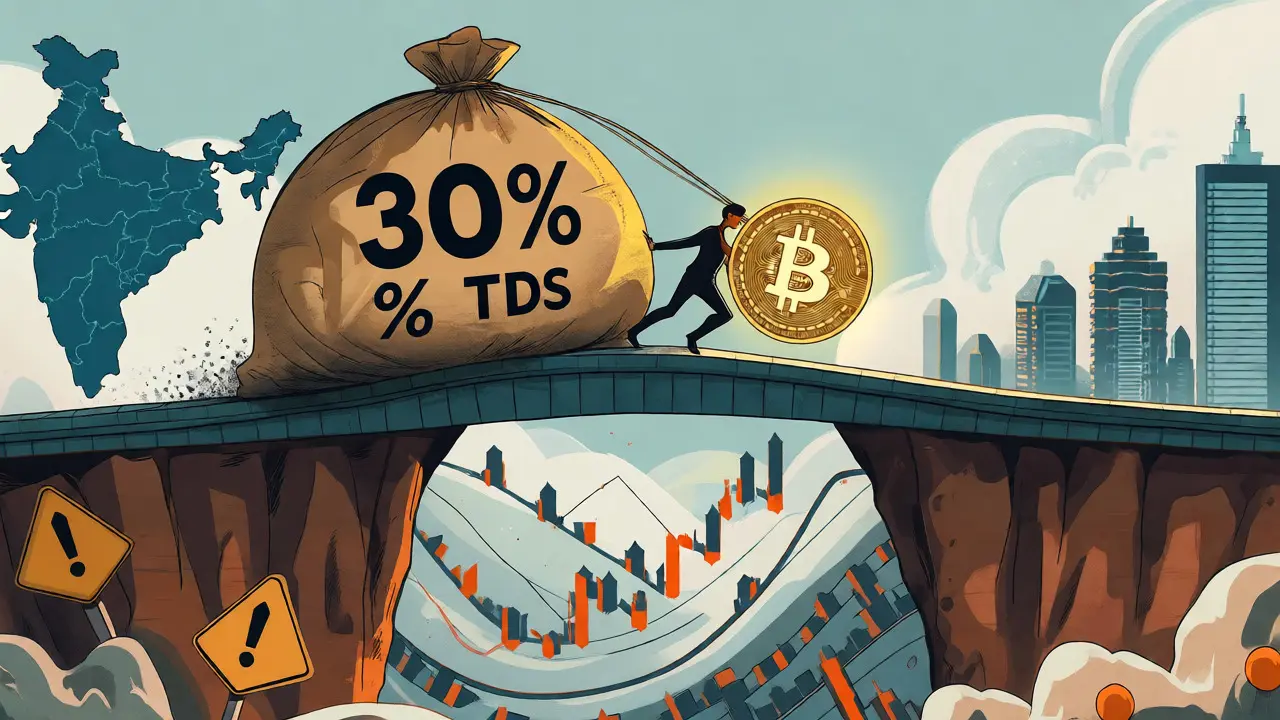
Let’s talk numbers, because this is where most people get burned. India imposes a flat 30% tax on crypto profits. There is no provision to offset losses against other income types, and no indexation benefit. If you sell BTC at a profit and then move the stablecoin equivalent abroad, that 30% applies to the gain realized at the moment of sale or transfer valuation.
But wait, there’s more. A 1% Tax Deducted at Source (TDS) applies to all transactions exceeding ₹50,000 per financial year. Some platforms, like Bybit, have even added an 18% Goods and Services Tax (GST) on various services, pushing the effective cost higher. Dr. Rajeshree Agarwal from the National Institute of Public Finance and Policy noted that these combined rates create an effective burden exceeding 50% for many transactions. That’s steep compared to global averages.
Crucially, you must disclose foreign holdings. The Income Tax Department requires you to report all VDAs held abroad in Schedule VDA of your ITR-2 or ITR-3 forms. Fail to do this, and you face Section 158B penalties: a 60% fine on the undisclosed value plus potential criminal prosecution. It’s not just about paying tax; it’s about declaring what you own, wherever it sits.
FEMA Compliance and Banking Hurdles
Moving crypto abroad often involves converting fiat to crypto, sending it out, and sometimes converting back. Under FEMA, residents are generally allowed to hold VDAs, but repatriating funds (bringing money back) or sending it out has limits. For transfers exceeding $250,000 annually, you might need prior approval from authorized dealer banks. Yes, banks are involved even if you’re dealing purely in digital assets.
A common pitfall is the "current account" vs. "capital account" distinction. The RBI treats crypto purchases as current account transactions, but holding them long-term blurs the line. Manish Gupta, former RBI Deputy Governor, warned that this ambiguity leads to arbitrary enforcement. In practice, this means your bank might block a wire transfer related to crypto if they suspect it violates FEMA norms, even if the crypto itself was bought legally.
The FATF Travel Rule: No Small Transfers Allowed
India implements the Financial Action Task Force (FATF) Travel Rule with zero tolerance for small amounts. Unlike jurisdictions that exempt transactions under $1,000, India requires detailed sender and receiver info for every transaction. Your exchange must share your full name, account number, address, and ID number with the receiving platform. If the receiving platform doesn’t comply, the transaction can be rejected or frozen.
This creates friction. If you’re sending ETH to a personal MetaMask wallet, who provides the beneficiary info? Often, exchanges require you to declare the purpose and details of the external wallet. Failure to provide accurate data results in delays. According to Chainalysis, Indian cross-border volumes rose 38% in early 2025, but so did compliance failures, leading to frequent freezes.
| Requirement | Authority | Impact on User |
|---|---|---|
| 30% Flat Tax + 1% TDS | Income Tax Dept | Reduces net proceeds significantly; no loss offsetting. |
| Schedule VDA Disclosure | CBDT | Mandatory reporting of foreign holdings; 60% penalty for non-compliance. |
| FEMA Approval | RBI / Banks | Required for large transfers (> $250k/year); prevents unauthorized outflows. |
| Travel Rule Data | FIU-IND | Requires full KYC data sharing for all transfers, regardless of size. |
Practical Steps to Move Assets Safely
So, how do you actually do this without getting your account frozen? Here is a checklist based on recent enforcement trends:
- Keep Immaculate Records: Maintain a spreadsheet of every buy, sell, and transfer. Note the date, time, amount, and INR value at the time of transaction. Use the RBI exchange rate for valuation, as clarified in CBDT Circular No. 18/2025.
- Use FIU-Registered Exchanges: Only use platforms registered with the Financial Intelligence Unit-India. Unregistered offshore platforms like Binance (in its earlier iterations) faced notices and blocks. Stick to compliant domestic gateways or fully compliant international ones.
- Pre-Clear with Your Bank: Before making a large fiat withdrawal linked to a crypto purchase, inform your bank. Get written confirmation that the transaction code used (e.g., for software imports or other services) is acceptable.
- Declare Foreign Holdings Early: Don’t wait until audit season. Report your foreign wallets in your next ITR filing. If you missed previous years, consider voluntary disclosure schemes if available.
- Beware of P2P Traps: Peer-to-peer transfers are popular but risky. Ensure the counterparty is verified. Many P2P scams involve stolen bank accounts, leading to police cases against you, the recipient.

Common Pitfalls and Enforcement Actions
Recent history shows the government is serious. In June 2025, the Enforcement Directorate sent notices to 25 offshore platforms, including giants like KuCoin and Bybit, demanding strict KYC compliance. CERT-In also mandated cybersecurity audits for exchanges. If you use a non-compliant platform, your assets could be stuck in limbo while regulators sort things out.
User experiences highlight the pain points. A survey by CryptoWire India found that 68% of users faced transaction freezes during cross-border attempts. The top complaint? Getting bank certifications for FEMA compliance. Banks often lack clear guidelines on how to certify crypto-related remittances, leading to days of delay.
Another trap is timing. Crypto prices fluctuate rapidly. Valuing your asset for tax purposes uses the RBI rate at the time of transfer. If you transfer when the price spikes, your tax liability jumps. Plan your transfers during periods of lower volatility if possible, though this is easier said than done.
The Future Outlook: Will It Get Easier?
Is relief coming? The Finance Minister stated in February 2025 that there is "no fixed timeline" for comprehensive liberalization. However, India is aligning with global standards like the Crypto-Asset Reporting Framework (CARF) ahead of the FSB peer review. This suggests tighter integration, not looser rules. Expect automatic exchange of tax information on crypto holdings between India and countries like Singapore and the UAE soon.
For now, moving crypto abroad from India is a high-friction, high-cost endeavor. It requires meticulous record-keeping, proactive communication with banks, and a willingness to pay significant taxes. If you’re just starting out, consider keeping your assets onshore unless you have a compelling reason to move them offshore. The regulatory clarity needed for seamless cross-border movement is still evolving, and being caught in the middle of transition can be expensive.
Can I send crypto directly from an Indian exchange to a foreign wallet?
Yes, but it is heavily regulated. The exchange will likely require you to provide proof of relationship or purpose for the transfer to comply with FEMA and Travel Rule norms. Direct sends to unhosted wallets (like MetaMask) often trigger additional verification steps compared to sending to another registered exchange.
Do I have to pay tax again if I move crypto abroad?
You pay tax on the gain realized when you dispose of the asset (sell or swap). Simply moving coins from one wallet to another usually isn't a taxable event, but converting INR to Crypto is a purchase, and selling Crypto later is a disposal. If you convert to Stablecoins and move them, you may have triggered a taxable event depending on whether the conversion is treated as a sale. Always consult a CA for specific scenarios.
What happens if I don't report my foreign crypto holdings?
Under Section 158B, non-disclosure of Virtual Digital Assets held outside India attracts a penalty of 60% of the undisclosed asset's value. Additionally, you may face criminal prosecution for willful evasion. The Income Tax Department is increasingly using blockchain analytics to spot discrepancies between declared income and lifestyle/assets.
Are there limits on how much crypto I can take abroad?
There isn't a hard cap on the amount of crypto itself, but FEMA regulations limit the flow of foreign exchange. Large transfers (over $250,000 annually) may require prior approval from authorized dealer banks. Also, remember that you cannot use crypto to make payments for goods/services abroad easily; it's primarily an investment asset.
Which countries are best for moving Indian crypto assets?
Singapore, the UAE, and the USA are top destinations due to established infrastructure. However, each has its own tax implications. Singapore has no capital gains tax for individuals, making it attractive. The UAE offers a tax-free environment. The US has complex reporting requirements for foreigners. Choose based on your residency status and long-term plans.