Nanu Exchange Crypto Exchange Review: What Happened and Why It Shut Down
When you think of a cryptocurrency exchange, you picture a place where you can buy Bitcoin, trade altcoins, and move money quickly. But not all exchanges last. Some disappear without warning. Nanu Exchange was one of them.
Launched in 2017 and based in Brazil, Nanu Exchange wasn’t trying to be Binance or Coinbase. It was built for one market: Brazilian crypto users. It supported BTC, ETH, LTC, XRP, TRX, and DOGE. You could deposit and withdraw Brazilian reais directly. That was its only real advantage - local access. For a while, it worked. But by November 2020, it vanished.
How Nanu Exchange Operated - And Why It Wasn’t Enough
At its peak, Nanu Exchange handled about 0.98 BTC in daily trading volume. That’s less than 1 Bitcoin. Compare that to Binance, which trades over 50,000 BTC daily. Nanu’s volume was tiny. Bitcoin made up nearly half of its trades (47.17%), followed by XRP at 25.86% and ETH at 18.95%. The rest? A mix of lesser-known coins with almost no liquidity.
Fees were standard: 0.25% for takers, 0.15% for makers. Bitcoin withdrawals cost exactly 0.0008 BTC - right on par with the global average. That’s not bad. But fees don’t save an exchange if the platform is unstable.
It didn’t have a mobile app. No API for advanced traders. No educational content. No 24/7 customer support. And crucially - no regulation. Nanu Exchange operated without any official license. That meant no legal protection for users. No insurance for funds. No oversight. If something went wrong, you had no recourse.
The User Experience Was Broken
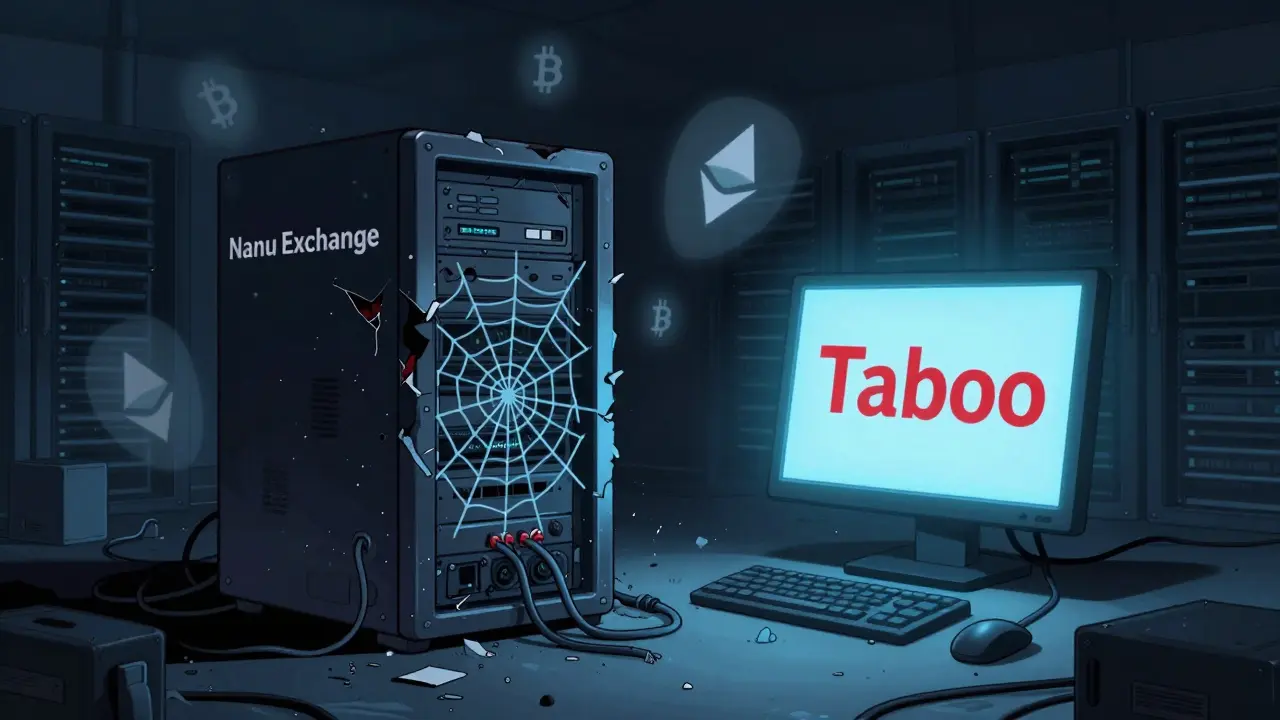
People who used Nanu Exchange didn’t leave happy reviews. One user on Revain described logging in and seeing just the word “Taboo” on the homepage. That’s not a glitch. That’s a shutdown. Other reports mentioned a confusing interface, slow loading times, and no clear guides for new users.
Liquidity was the biggest problem. If you wanted to sell 5 ETH, you couldn’t. The order book was thin. Prices jumped up and down because there weren’t enough buyers or sellers. That makes trading risky. Even experienced traders avoid low-liquidity exchanges.
There were no positive mentions of customer service. No one said, “They helped me fix my withdrawal.” No one praised their support team. That’s a red flag. When problems happen - and they always do - you need help fast. Nanu Exchange didn’t offer it.
Why It Failed When Brazil’s Crypto Market Was Booming
Brazil was (and still is) one of the fastest-growing crypto markets in Latin America. In 2020, millions of Brazilians were buying Bitcoin. Mercado Bitcoin and Foxbit were expanding. International platforms like Kraken and Coinbase were launching Portuguese interfaces.
Nanu Exchange had a chance. It understood the local market. It supported reais. But it didn’t scale. It didn’t improve. It didn’t invest in security, tech, or user education. While competitors added features, Nanu stayed the same. And in crypto, standing still means falling behind.
By late 2020, the platform stopped updating. Servers went quiet. The website disappeared. No official announcement. No email to users. Just silence.

What Happened After the Shutdown?
There’s no record of Nanu Exchange ever reopening. No press release. No social media update. No forum post from the team. The domain likely expired. The servers were turned off. Users who had funds on the platform lost access.
Some tried to recover their money through legal channels. Others gave up. There was no insurance, no regulatory body to file a complaint with, and no way to prove ownership. It was a total loss for many.
Today, if you search for Nanu Exchange, you’ll find dead links, archived pages, and frustrated forum posts from 2021. It’s a ghost. A cautionary tale.
How Nanu Compares to Other Exchanges
| Feature | Nanu Exchange | Binance | Mercado Bitcoin |
|---|---|---|---|
| Operational Status | Shut down since Nov 2020 | Active | Active |
| Regulation | Unregulated | Regulated in multiple jurisdictions | Regulated in Brazil |
| Daily Volume | ~0.98 BTC | 50,000+ BTC | 5,000+ BTC |
| Liquidity | Very low | Extremely high | High |
| Support | None | 24/7 multilingual | 24/7 Portuguese support |
| Fiat Integration | Only BRL | 20+ fiat currencies | BRL only |
| Trust Score (BeInCrypto) | 3 (ranked 764) | 9.2 (ranked 1) | 8.7 (ranked 12) |
The difference is clear. Nanu Exchange was a small, unregulated, underfunded operation. Binance and Mercado Bitcoin have teams, security audits, legal teams, and billions in reserves. Nanu had none of that.
What You Can Learn from Nanu Exchange
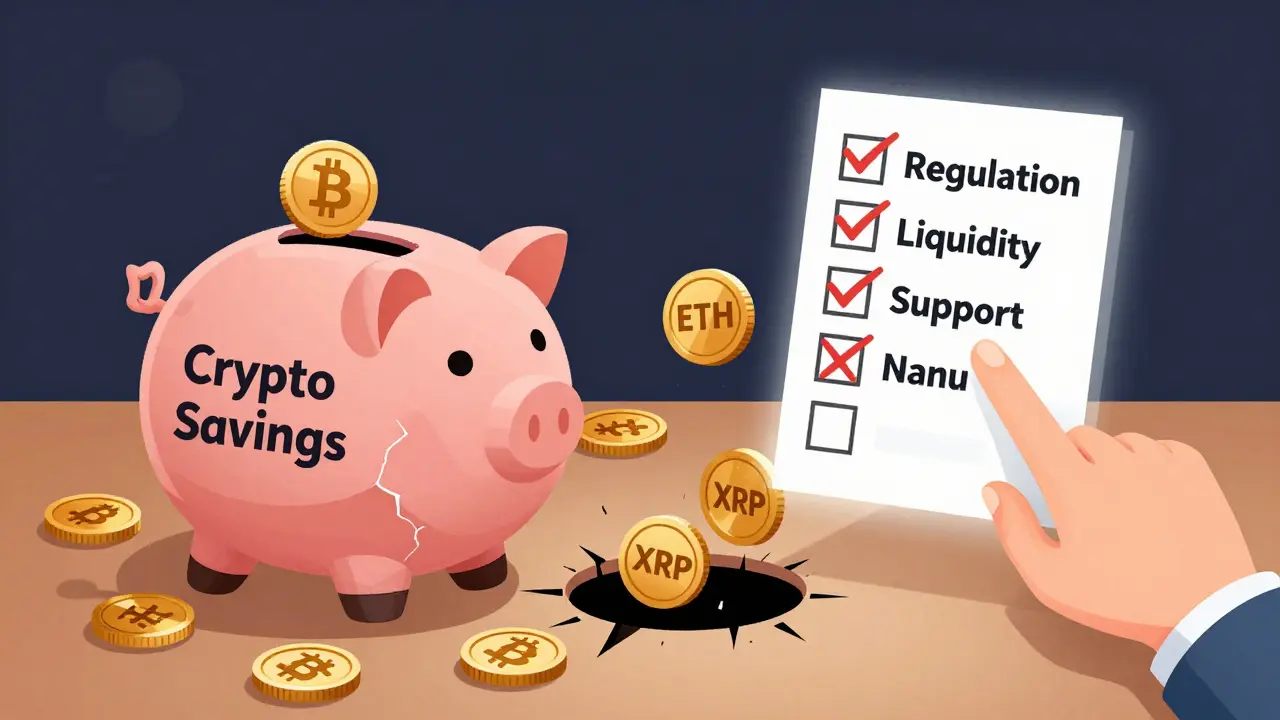
If you’re thinking about using a small, unknown exchange - stop. Here’s what to look for instead:
- Regulation: Does the exchange have licenses? Is it registered with financial authorities?
- Liquidity: Can you trade large amounts without the price moving wildly?
- Transparency: Are trading volumes and fees clearly listed? Is there a public audit?
- Support: Can you contact someone if something goes wrong?
- History: Has the platform been around for more than 3 years? Has it survived market crashes?
Nanu Exchange checked none of these boxes. It was a gamble - and it lost.
Where to Go Instead
If you’re in Brazil and want to trade crypto safely, use Mercado Bitcoin or Foxbit. Both are regulated, have high liquidity, and offer real customer support. If you’re outside Brazil, stick with Coinbase, Kraken, or Binance. They’re trusted, secure, and built to last.
There’s no reason to risk your money on a platform that’s already dead. Nanu Exchange is gone. Don’t look for it. Don’t try to revive it. Learn from it.
Was Nanu Exchange a scam?
There’s no proof Nanu Exchange stole money or ran a Ponzi scheme. It was more likely a poorly run business that ran out of money, couldn’t handle technical issues, and shut down without warning. Still, the lack of regulation, transparency, and communication makes it just as dangerous as a scam.
Can I still access my funds on Nanu Exchange?
No. The platform shut down in November 2020. Its website is offline, and there’s no way to log in or recover assets. If you held crypto on Nanu Exchange, you lost it. This is why using regulated exchanges with strong security is critical.
Why did Nanu Exchange shut down?
There’s no official reason. Experts believe it was due to low trading volume, lack of funding, poor user experience, and inability to compete with larger platforms. The Brazilian crypto market was growing fast, but Nanu didn’t adapt. It faded out quietly.
Was Nanu Exchange safe to use?
No. It wasn’t regulated, didn’t use cold storage for most funds, had no insurance, and offered no customer support. Even if it didn’t steal money, it failed at the most basic job of a crypto exchange: keeping your assets safe.
Does Nanu Exchange have a mobile app?
No. Nanu Exchange only had a web-based platform. It never released a mobile app. This made it harder for users to trade on the go - a major disadvantage compared to competitors who offered apps with push notifications and quick trading.


Michael Suttle
This isn't a failure-it's a *warning label* wrapped in a website. 🚨 Nanu didn't just shut down... it got *erased*. Like a ghost in the machine. And guess who's next? The 500 other 'local' exchanges betting on 'trust' instead of cold storage. You think you're saving on fees? Nah. You're just prepaying for your crypto funeral.
karan narware
Ah, yes. The Brazilian crypto dream... crushed under the weight of ‘we’ll get around to security… someday.’ I mean, imagine running a bank that doesn’t lock its doors. And then wondering why the thieves came. 🤦♀️ Why do we keep romanticizing ‘local’ when ‘local’ means ‘unregulated, underfunded, and utterly unprepared’? We’re not building communities-we’re building sandcastles before the tide.
Anshita Koul
I remember when I first heard of Nanu… I thought, ‘Finally! Someone who gets us!’ But then… silence. No email. No apology. Just… a blank screen with the word ‘Taboo.’ That’s not a shutdown. That’s a poetic injustice. 💔 We don’t need more ‘exchanges.’ We need accountability. And someone to hold the mic when the lights go out.
Zephora Zonum
I’m not surprised. Most of these ‘local’ platforms are just guys in basements with a WordPress site and a dream. They don’t have lawyers. They don’t have audits. They have a Discord channel and a prayer. And then they vanish like my ex after I sent him the bill for our last vacation.
Chelsea Boonstra
Let’s cut the BS. Nanu didn’t ‘fail.’ It was *never meant to last*. They knew. They *knew* they were building a house of cards. They just didn’t care-because they weren’t using their own platform. They were taking user funds as ‘operating capital.’ That’s not incompetence. That’s theft. And the fact that no one’s been charged? That’s the real scandal.
Lindsay Girvan
Liquidity is everything. No one cares about your ‘local’ anything if you can’t move 5 ETH without a 30% slippage. Nanu was a ghost town with a trading interface. And people still deposited? I have questions. And no answers.
Tina Keller
I used Nanu for a few months. Just small trades. But the interface? Clunky. The support? Nonexistent. I once tried to withdraw 0.2 BTC. It took 11 days. Then I got a ‘system error.’ No email. No reply. Just… gone. I didn’t lose much. But I lost trust. And that’s harder to recover than crypto.
Alex Thorn
There’s a quiet tragedy here. Nanu wasn’t evil. It was *inadequate*. It didn’t have malice. It had ignorance. And in crypto, ignorance is the deadliest force. Because it doesn’t scream. It just… fades. Like a candle in a hurricane. We don’t need more heroes. We need more humility. And better systems.
Julie Tomek
The data is unequivocal: Nanu Exchange operated with zero regulatory compliance, minimal liquidity, and no operational continuity protocols. Its collapse was not an accident-it was an inevitability. Institutions with robust governance frameworks, such as Mercado Bitcoin, maintain 99.98% uptime and full audit transparency. Nanu’s model was not a startup-it was a liability waiting for a name.
Douglas Anderson
I still remember the day I saw ‘Taboo’ on the homepage. I thought it was a joke. Then I checked my balance. Gone. No warning. No explanation. Just… a blank screen. I’m not mad. I’m just… disappointed. We keep giving these guys our money because we want to believe in the dream. But dreams don’t pay bills. Infrastructure does.
ann neumann
I know what really happened. They were hacked. Or worse-government took it. Or maybe the devs sold out to a Chinese syndicate and just wiped the servers. The ‘no announcement’? Classic cover-up. They knew. They *knew*. And they left us in the dark like rats in a sinking ship. I still have nightmares about that ‘Taboo’ screen. It’s not a glitch. It’s a curse.
PIYUSH KOTANGALE
Bro. I used Nanu too. Lost like $800. But honestly? I learned more from that loss than from any ‘safe’ exchange. Don’t use anything that doesn’t have a public audit. Don’t trust anyone who doesn’t answer emails. And never, ever use a platform that doesn’t have a mobile app. Just… don’t.
Howard Headlee
Nanu didn’t die. It was murdered. By apathy. By complacency. By the delusion that ‘small’ means ‘authentic.’ Nah. Small means ‘easy prey.’ The big boys didn’t crush it. We did. We gave them our money, our trust, and our silence. And now? We’re just ghosts haunting the forums, asking ‘why?’ Like it’s a mystery. It’s not. It’s capitalism with no brakes.
Jenni James
I find it fascinating how the article romanticizes ‘local access.’ As if supporting BRL was some noble act. Let me remind you: regulation isn’t bureaucracy-it’s armor. And Nanu didn’t just lack armor. It didn’t even wear underwear. And yet, people still handed over their keys? I don’t understand humanity.
vishnu mr
i used nanu tooo... lost my ltc... i thought it was just slow... but then i saw the tabboo... i cried... not for the money... for the trust... why do we keep doing this to ourselves?
Craig Gregory
Let’s be honest. Nanu was a honeypot. The entire operation was designed to accumulate funds, then vanish. The ‘low volume’? A lie. The ‘Brazilian focus’? A smokescreen. The lack of communication? A calculated move. This wasn’t a failed startup. It was a well-orchestrated exit scam with a website. And the regulators? They’re still asleep.
Anthony Marshall
Look. I get it. You want to support local. You want to feel like you’re part of something. But crypto isn’t a community project. It’s a battlefield. And if you’re not armored, you’re not a participant-you’re a casualty. Nanu didn’t fail because of competition. It failed because it wasn’t built to survive. Period.
Grace van Gent-Korver
I just think we need to be kinder to small platforms. Maybe they just needed a little help. A mentor. A grant. A push. Not a eulogy.
William Montgomery
You’re all missing the point. Nanu didn’t shut down because it was bad. It shut down because it was *too real*. It showed us what happens when you don’t have investors, lawyers, or PR teams. It showed us that crypto isn’t about tech. It’s about power. And the powerful don’t like small, honest players. So they let them die quietly.
Brandon Kaufman
I lost money on Nanu too. But honestly? The worst part wasn’t the crypto. It was the silence. No one said ‘sorry.’ No one said ‘we’re sorry.’ Just… nothing. It made me feel like I was the only one who cared. And that’s the real tragedy.
vasantharaj Rajagopal
The systemic failure here is epistemological. Nanu’s operational architecture lacked cryptographic integrity, consensus validation, and institutional accountability. The absence of a KYC/AML framework coupled with non-compliance with FATF guidelines rendered the platform a non-viable economic actor. This is not anecdotal. It is structural.
Mara Alves Mariano
USA-based exchanges are just corporate monsters. Nanu was real. It was human. It was Brazilian. And now? They erased it because it didn’t fit the Big Crypto playbook. You think Binance is better? They’re just the same thing with more money. And more lawyers. And more lies.
Adam Ashworth
I’m not defending Nanu. But let’s not pretend Mercado Bitcoin is perfect. They had a 3-day outage last year. They charge 0.3% on withdrawals. And they’re ‘regulated.’ So what? Regulation doesn’t mean security. It means paperwork. And paperwork doesn’t stop hackers.
Allison Davis
The lesson here is simple: if an exchange doesn’t have a public audit report, a 24/7 support team, and a history of surviving a bear market, don’t use it. Period. No exceptions. No ‘but it was local.’ No ‘but it had low fees.’ Your crypto is not a charity project.
Tom Jewell
There’s a deeper truth here. We don’t just lose crypto when exchanges die. We lose faith. In ourselves. In the idea that this system can work. Nanu didn’t just take money. It took our belief that technology could be fair. And that… that’s the hardest thing to recover.