Non-Resident Indians and Crypto Taxes: No Exemptions, Only Flat 30% Rules

There’s a common myth floating around among Non-Resident Indians (NRIs) that investing in crypto might give them the same tax breaks they get on stocks, bonds, or mutual funds. It’s not true. As of 2025, crypto investments for NRIs in India come with no special exemptions, no loss offsets, and no reinvestment benefits. Just a flat 30% tax - no matter how long you hold it, where you live, or how much you earn.
There’s No Such Thing as Long-Term Crypto Gains for NRIs
In traditional investing, holding stocks or mutual funds for more than a year usually means lower taxes. That’s not the case with crypto. Since April 2022, India has treated all Virtual Digital Assets (VDAs) - Bitcoin, Ethereum, Solana, Dogecoin, you name it - the same way: 30% tax on profits, no matter if you held it for 10 days or 10 years. And this rule applies equally to residents and NRIs.The government doesn’t care if you’re living in Dubai, London, or San Francisco. If you sell crypto and make a profit, India wants 30% of that gain. Even if you bought your Bitcoin in 2017 and sold it in 2025 while living abroad, you still owe the full 30% tax to the Indian tax department.
What You Can’t Deduct (And Why It Matters)
Here’s where things get even tougher. When you file your taxes, you can only subtract the original purchase price of your crypto. That’s it. No transaction fees. No wallet fees. No gas fees. No mining costs. Not even the cost of buying a hardware wallet. If you spent ₹5,000 on fees trading Ethereum across three different exchanges, that’s money you can’t recover on your tax return.This is different from how stocks or real estate are taxed. With those, you can deduct brokerage fees, legal costs, and other expenses. With crypto? Zero deductions. That means your taxable gain is often much higher than you expect. If you bought 1 BTC for ₹30 lakh and sold it for ₹50 lakh, your profit is ₹20 lakh. But if you paid ₹80,000 in fees along the way, you still pay 30% tax on the full ₹20 lakh - not ₹19.2 lakh.
Gifts, Airdrops, and Mining? They’re Taxed Differently
If you received crypto as a gift, through an airdrop, or by mining it, the rules change slightly - but not in your favor. These aren’t taxed at the flat 30% rate. Instead, they’re added to your total income and taxed at your personal income tax slab rate. For an NRI earning ₹20 lakh a year in the U.S., that could mean paying up to 30% anyway. But for someone with lower income, it might be as low as 5%.That sounds like a loophole - until you realize the government doesn’t track these gifts or airdrops automatically. If you received 5 ETH as a gift from a relative in India and didn’t report it, the tax department has no way of knowing - unless you file your return and disclose it. And if they find out later, penalties can be steep: up to 200% of the tax evaded, plus interest.
No Reinvestment Exemption - Unlike Stocks or Bonds
NRIs have long relied on Section 115F to avoid capital gains tax when they reinvest money from foreign assets into Indian bonds, shares, or mutual funds. But crypto is explicitly left out. Even if you sell your Ethereum for ₹1 crore and immediately buy ₹1 crore worth of Indian government bonds, you still owe 30% on the crypto gain. There’s no tax holiday, no reinvestment relief.This is a huge difference compared to traditional investments. If you sold a property in the U.S. and used the money to buy a house in India, you might avoid capital gains tax under Section 54. But if you sold Bitcoin and bought a mutual fund? No such luck. The government treats crypto as a separate, untouchable asset class - one with no tax advantages whatsoever.
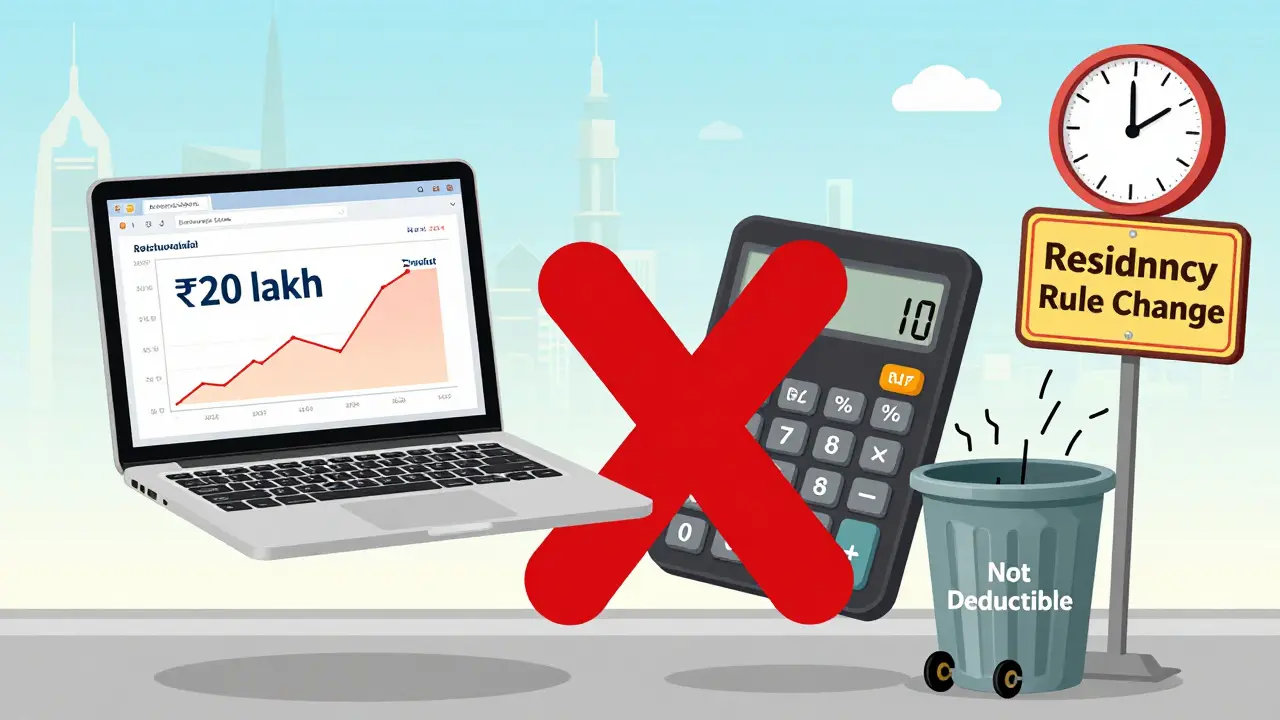
1% TDS Is Automatically Deducted - Even If You’re an NRI
Every time you sell crypto on an Indian exchange like CoinDCX, WazirX, or ZebPay, and the transaction value exceeds ₹50,000 in a financial year, the exchange automatically deducts 1% as Tax Deducted at Source (TDS). This applies to NRIs too. Even if you’re not an Indian resident, if you use an Indian platform, they’re required by law to withhold this tax.Here’s the catch: this TDS is not your final tax. It’s just a prepayment. You still have to report the full gain on your income tax return and pay the remaining 29% if needed. If you paid ₹50,000 in TDS but your actual tax liability is ₹3 lakh, you owe the difference. If you paid too much TDS, you can claim a refund - but only if you file your return.
Residency Rules Are Changing - And It Could Trap You
Starting April 1, 2026, the residency rules for NRIs are getting stricter. If you spend 120 days or more in India in a year - and earn more than ₹15 lakh from Indian sources - you’ll be classified as a “Resident” for tax purposes. That means your global income, including crypto gains from foreign exchanges, becomes taxable in India.Before this change, NRIs only paid tax in India on income earned or received here. Now, if you’re in India for four months and earn ₹16 lakh from your Indian salary, your crypto profits from Coinbase or Binance could suddenly become taxable here too. Many NRIs who thought they were safe because they lived abroad may find themselves caught in this net.
Even the RNOR (Resident but Not Ordinarily Resident) status - which gives a 2-year tax grace period after returning to India - doesn’t help much with crypto. If you’re RNOR and you bought crypto while abroad, the gains from selling it while RNOR are still taxable in India if the transaction is connected to an Indian source.
Losses Can’t Offset Anything
This might be the most unfair part. If you lose money on crypto - say you bought Solana at ₹8,000 and sold it at ₹3,000 - you can’t use that loss to reduce your tax on other crypto gains. You can’t offset it against stock profits. You can’t carry it forward to next year. It just disappears.Compare that to stocks: if you lose ₹5 lakh on one stock but make ₹10 lakh on another, you pay tax only on the net ₹5 lakh. With crypto? You pay 30% on the ₹10 lakh gain, and the ₹5 lakh loss? Gone. No benefit. No carryforward. No deduction.

What You Must Do to Stay Compliant
If you’re an NRI with crypto, here’s what you need to do right now:- Track every single transaction - buy, sell, swap, gift, airdrop.
- Record the date, amount, INR value at time of transaction, and platform used.
- Keep proof of purchase price and fees.
- Disclose all crypto holdings in your Indian income tax return under Schedule FA.
- File even if you think you owe nothing - failure to report can trigger penalties.
- Understand your residency status each year. Don’t assume you’re automatically an NRI.
Many NRIs think they don’t need to report crypto if they didn’t bring money into India. That’s wrong. The tax department now has access to data from Indian exchanges, KYC records, and even blockchain analytics. If you’re on an Indian exchange, they know you traded. If you’re not, but you’re an Indian citizen, they can still find you through your PAN or bank details.
There Are No Workarounds - Yet
Some try to use foreign exchanges to avoid TDS. But that doesn’t make the income tax-free. If you’re an NRI with Indian tax obligations, your global crypto gains are still reportable. Using Binance or Kraken doesn’t erase your liability - it just makes it harder to prove.Others try to gift crypto to family members in India, hoping the recipient pays lower tax. But the tax department can trace these transfers. If you gifted crypto and later the recipient sells it, the original cost and date of acquisition still matter. The tax department can look back and assign the gain to you.
As of October 2025, no new exemptions have been announced. No proposals are under discussion. The government has made it clear: crypto is not a tax-efficient asset. It’s a high-tax, high-risk, low-benefit investment.
What This Means for Your Investment Strategy
If you’re an NRI thinking about crypto as part of your portfolio, ask yourself: Is this worth the tax burden?Compared to other options - like NRE fixed deposits (tax-free interest), sovereign gold bonds (tax-free after 8 years), or foreign mutual funds (eligible for Section 115F reinvestment) - crypto offers no tax breaks, no income, no dividends, and no capital gains relief. You’re paying 30% on every profit, with no way to reduce it.
That doesn’t mean you shouldn’t invest. But it means you should treat crypto like gambling - not investing. Only risk what you can afford to lose, and never assume the government will give you a break. The rules aren’t changing soon. The tax department isn’t making exceptions. And for NRIs, crypto is simply one of the most expensive ways to speculate.
Plan accordingly. Track everything. File everything. And don’t believe the hype that crypto is a tax loophole for NRIs. It’s not. It’s a tax trap.



roxanne nott
lol so you're telling me I paid $800 in gas fees to swap tokens and now the govt takes 30% of my profit AND I can't deduct it? That's not taxation, that's robbery with extra steps.
Naman Modi
Nah bro, just move to Portugal. 🤷♂️
Jayakanth Kesan
I'm an NRI in Dubai and this hit me hard. I thought crypto was my ticket out of the 30% tax trap. Turns out it's the trap itself. 😅
Amit Kumar
Bro, the government doesn't care if you're in San Francisco or Singapore. If your PAN is linked to that exchange, they know. I've seen people get notices for $200 gains. Don't sleep on this.
Mmathapelo Ndlovu
This is why I stick to gold bonds now. At least they don't make me feel like I'm being taxed for breathing. 🙏
Ellen Sales
So... I spent 2 years mining ETH on my laptop and now I owe taxes on it? Cool. I'll just send my thermal camera to the IT dept as proof I was "earning". 😌
Dan Dellechiaie
The 1% TDS is a joke. It's like the taxman saying "here's a lollipop while I take your wallet." And then you still owe 29% more. That's not compliance, that's psychological warfare.
Luke Steven
The real issue isn't the tax. It's that crypto is treated like a vice. Like smoking or gambling. But nobody's banning it. Just making it painfully expensive. That's not policy. That's passive aggression.
chris yusunas
I used to think crypto was freedom. Now I know it's just a high-risk, high-tax, no-refund, no-mercy financial rollercoaster with no seatbelts. And the government's holding the lever.
Lloyd Yang
Let me break this down for the folks still clinging to the dream: Crypto isn't an investment here - it's a liability with volatility. You're paying 30% on every win, zero on every loss, and you can't even write off the cost of your hardware wallet. That’s not a tax code. That’s a trapdoor disguised as a financial system. And if you think moving to Binance or Kraken saves you, you’re forgetting that the Indian government has eyes everywhere - PAN, Aadhaar, bank links, KYC trails. They don’t need you to deposit rupees to know you traded. If you’re an Indian citizen, you’re in the net. Even if you’re living in Reykjavik and trading in Bitcoin while sipping geothermal coffee. The only way out? Don’t trade. Or treat it like lottery tickets - money you’re okay with losing. Because the taxman always wins.
Radha Reddy
I'm an NRI in the US and I filed my crypto gains this year. The form was 17 pages long. I cried. But I did it. Because I'd rather pay the tax than risk a 200% penalty later.
Shubham Singh
The fact that you can't offset losses is the most absurd thing I've ever seen in tax policy. It's like saying if you lose money on a bet, you still have to pay the house. And if you win, they take 30%. That's not capitalism. That's extortion with a spreadsheet.
Aaron Heaps
Anyone who thinks they're "safe" because they use a foreign exchange is delusional. The Indian govt has data-sharing agreements with 12+ countries now. Your wallet address isn't private. Your IP isn't hidden. Your PAN is linked. You're not a hacker. You're a walking tax liability.
Zavier McGuire
i just sold my btc and paid the tax. no big deal. its just money.
Jordan Renaud
Crypto’s not about tax breaks. It’s about decentralization. But if you’re here for tax efficiency, you were never meant to be in this space. Maybe stick to NRE FDs. They’re boring. But at least they don’t make you feel like you’re being audited by your own shadow.
Steve B
I don't understand why people are surprised. India treats crypto like a rebellious teenager - punish it, don't nurture it. The government doesn't want you to succeed with crypto. It wants you to obey. And if you don't? Well, they'll find you.
Brian Martitsch
30%? Cute. In the US we pay 20% on long-term gains AND you can deduct fees. This is why India will never lead in crypto. They're scared of innovation. They want control. And control is the opposite of freedom.
Charles Freitas
The fact that you can't carry forward losses is the most anti-capitalist thing I've ever seen. You're penalizing risk-taking. You're rewarding fear. And you're telling people: "Don't try, because if you fail, you get nothing. And if you win, we take 30%." That's not policy. That's cruelty disguised as law.
Collin Crawford
The legislative framework governing Virtual Digital Assets under Section 115BBH of the Income Tax Act, 1961, as amended in 2022, explicitly excludes any form of capital loss carryforward, deduction of ancillary transactional expenses, or reinvestment-based exemptions. This constitutes a deliberate policy choice to classify VDAs as speculative instruments, not investment vehicles. Consequently, the absence of concessional treatment is not an oversight - it is a feature.
Sarah Glaser
This isn't just about taxes. It's about trust. If you're an NRI who still believes in India's future, you file. You pay. You track. Because you know that systems change when people show up - even when the rules feel unfair. This isn't surrender. It's strategy. Stay compliant. Stay loud. And maybe, just maybe, the next generation will get better rules.