OKX Crypto Access Limitations by Country: What’s Blocked and Why
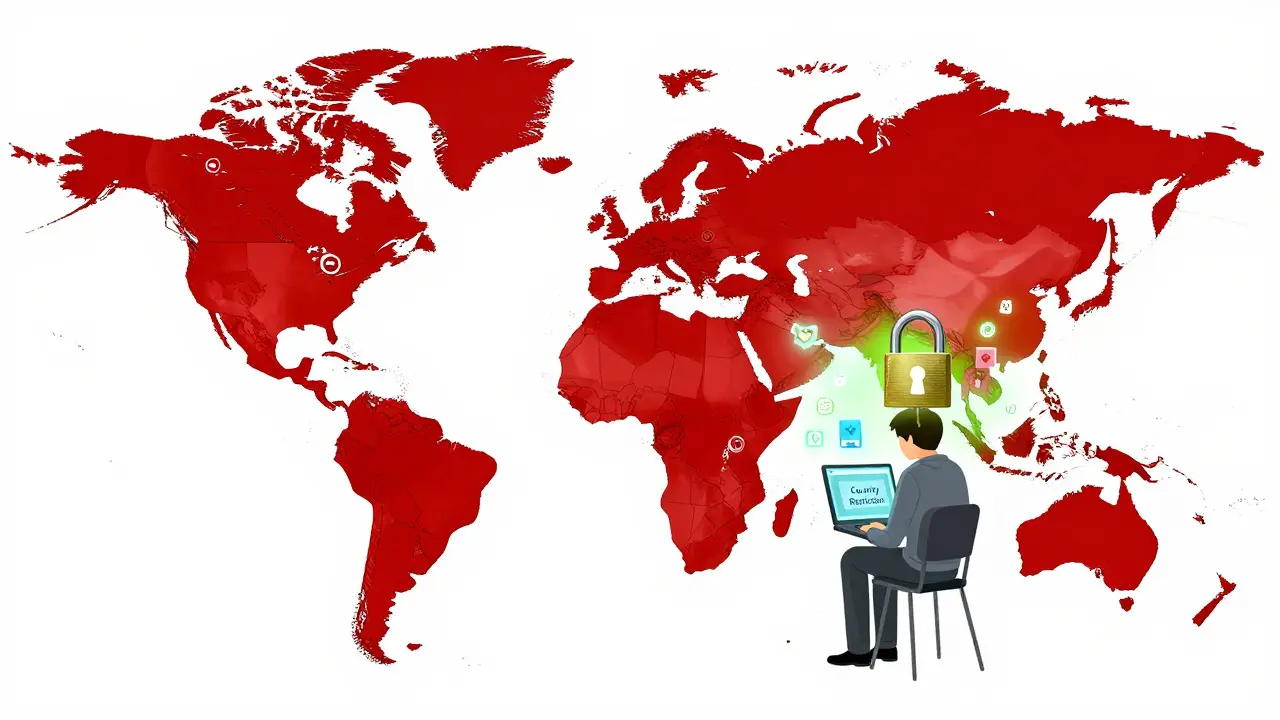
If you’ve ever tried to sign up for OKX and got slapped with a "country restriction" message, you’re not alone. Thousands of users around the world hit this wall every day-not because of a technical glitch, but because of hard rules baked into how OKX operates. The exchange doesn’t just randomly block people. It follows a complex, documented, and constantly changing map of global regulations. And if you’re wondering why you can’t trade futures in Australia or even create an account from Texas, the answer isn’t simple. It’s legal, financial, and deeply tied to where you live.
Which Countries Are Fully Blocked by OKX?
OKX outright bans users from 12 countries and regions. These aren’t arbitrary. They’re based on international sanctions, anti-money laundering laws, and pressure from global regulators. The full list includes: the United States, Canada, Malaysia, Singapore, the Bahamas, the United Kingdom, Cuba, Iran, North Korea, Syria, Crimea, and the Donetsk and Luhansk regions. If you’re in any of these places, you won’t be able to create an account, deposit funds, or trade anything on the main OKX platform-even if you use a passport or local ID.
But here’s the twist: Singapore is on this list, yet OKX runs a separate, MAS-regulated entity called OKX Singapore that serves only local residents under strict conditions. This isn’t a mistake-it’s a legal workaround. The global platform blocks Singaporean IPs, but the licensed subsidiary allows locals to trade under Singapore’s rules. The same applies to the UK: while the main site blocks British users, OKX Europe operates under EU rules and serves EU residents. This creates confusion. You might see someone in London trading on OKX Europe and wonder why you can’t do the same. The answer? Location, not nationality, determines access.
Where Are Features Limited, Not Blocked?
Some countries aren’t banned outright-they’re just stripped of certain tools. This is where things get messy. In Australia, Brazil, South Korea, and the UK, you can still trade spot markets (buying and selling Bitcoin, Ethereum, etc.), but derivatives like futures, perpetual contracts, and leveraged tokens are locked down. Why? Because regulators there see these products as too risky for retail investors.
Australia’s ASIC and the UK’s FCA have both issued warnings about high-leverage crypto trading. OKX responded by disabling those features for users in those jurisdictions-even if they’re not banned from the site entirely. The same applies to the European Union under MiCA regulations, which took full effect in December 2024. EU residents can trade spot assets, but derivatives are off-limits. This isn’t OKX being picky-it’s playing by the rules to stay operational.
Meanwhile, countries like Bangladesh, Bolivia, and Malta sit in a gray zone. Access isn’t fully blocked, but deposits and withdrawals are often restricted. Some users report being able to log in but not deposit fiat or withdraw crypto. Others get blocked entirely. The inconsistency isn’t a bug-it’s a sign that OKX is still adjusting to local regulatory demands. In Bangladesh, for example, the central bank banned crypto transactions in 2023, and OKX responded by limiting services. In Malta, the government is crypto-friendly, but OKX still restricts some features due to EU-wide compliance.
How OKX Knows Where You Are
OKX doesn’t guess your location. It uses multiple layers of detection to enforce restrictions:
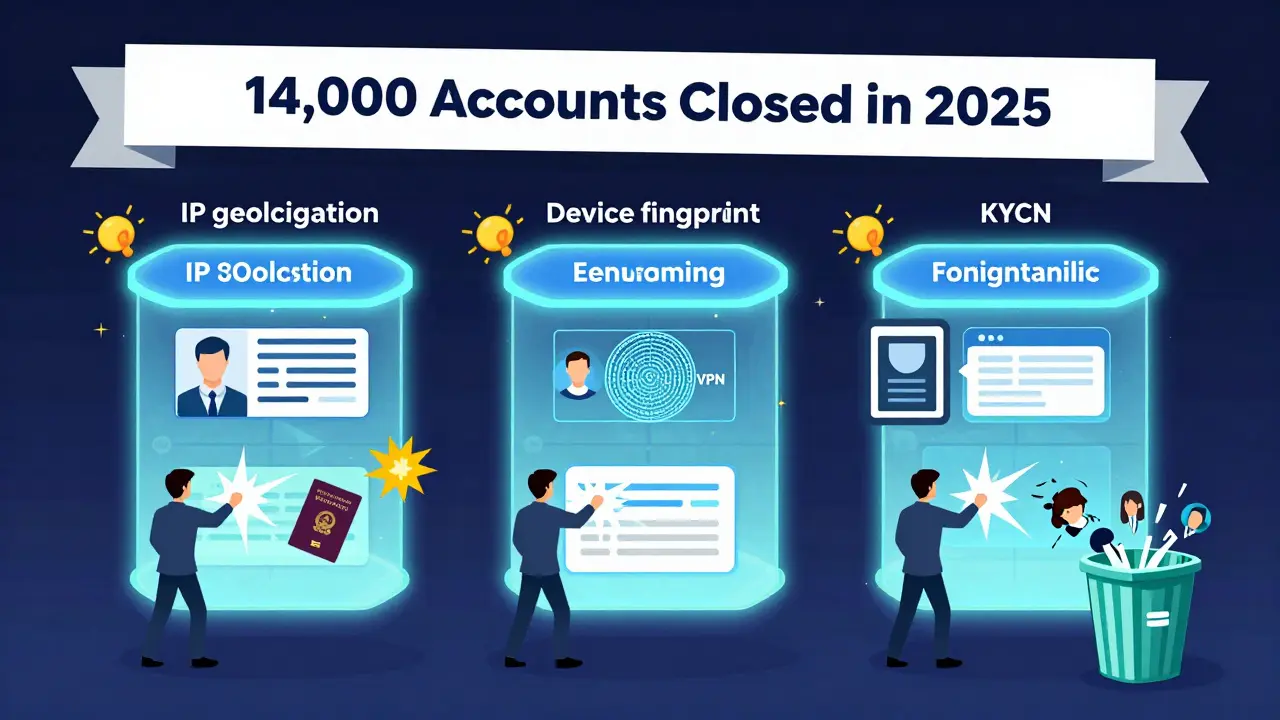
- IP geolocation: Your internet address tells OKX which country you’re connecting from. According to OKX’s own audit, this system is 99.2% accurate.
- Device fingerprinting: Your browser, operating system, screen resolution, and installed fonts create a unique profile. Even if you change your IP, this profile can still flag you as coming from a restricted region.
- KYC documents: When you upload your ID or passport, OKX checks the issuing country. If you’re from the U.S. and try to verify with a Texas driver’s license, your account gets rejected-no exceptions.
These systems work together. Even if you use a VPN to mask your IP, your device fingerprint and KYC documents will still expose you. OKX’s September 2025 enforcement report shows they closed over 14,000 accounts for “geolocation fraud” in just eight months. That’s not a typo. People trying to bypass restrictions aren’t just getting denied-they’re getting banned permanently.
Why the U.S. Is Completely Off-Limits
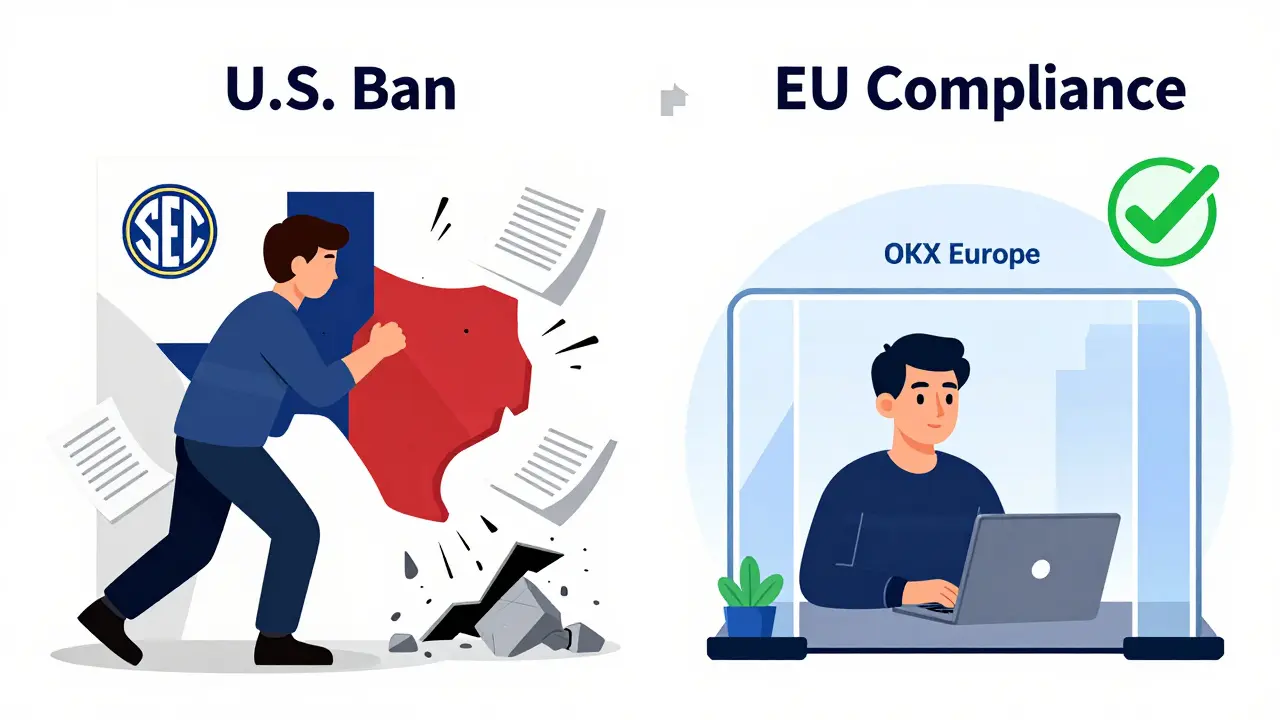
The U.S. is the biggest exception. While OKX serves users in 160 countries, it has zero presence in the United States. Not because it’s too big a market-it’s the largest crypto market in the world-but because the regulatory environment is too risky. The SEC has sued major exchanges like Binance and Coinbase, and OKX doesn’t want to be next.
Unlike Coinbase, which built its entire business around U.S. compliance, OKX chose to exit the market entirely. The cost of licensing, reporting, and legal defense in the U.S. is enormous. And with the SEC still actively investigating crypto platforms, OKX’s leadership decided it’s safer to walk away. That’s why U.S. users get blocked at every step-even if they use a foreign passport or try to verify from abroad.
Some users swear they’ve seen U.S. residents trade on OKX. That’s either a scam, a misidentified IP, or someone using a third country’s account. OKX’s terms clearly state that using a VPN or fake documents violates their User Agreement. And they don’t just warn you-they delete accounts and freeze funds.
What About Users in Restricted Countries?
People in banned countries aren’t just out of luck-they’re stuck. Many try to use VPNs, fake IDs, or accounts created in permitted countries. But these workarounds rarely last. OKX’s compliance team actively hunts for these patterns. A user in Iran who signs up with a German address and a VPN? Their account gets flagged within hours. A Nigerian user who uploads a Canadian passport? They’ll get locked out before they make their first trade.
Reddit threads and Trustpilot reviews are full of frustration. One user in Texas wrote: “I used my passport. I verified my address. Still got ‘country restriction.’ What am I supposed to do?” Another from Bangladesh said: “I can log in, but I can’t deposit. I’ve been waiting three months.” These aren’t edge cases-they’re the norm.
And the support? It’s uneven. Users in Germany or Japan get replies in under 10 hours. Users in Africa or Southeast Asia wait over 24 hours. Documentation is clearer in English and EU languages, but less detailed for users in Hindi, Arabic, or Bahasa Indonesia. The system isn’t designed to help-you’re expected to know the rules before you start.
How OKX Compares to Other Exchanges
OKX isn’t alone in blocking countries-but it’s one of the most complex. Here’s how it stacks up:
| Exchange | Full Bans | Feature Restrictions | U.S. Access |
|---|---|---|---|
| OKX | 12 countries + regions | 4+ countries (derivatives blocked) | No |
| Binance | 49 countries | 15+ countries (e.g., derivatives blocked in Canada) | No |
| Coinbase | 140+ countries | None (only operates where fully licensed) | Yes |
| Kraken | 47 countries | Canada (limited derivatives) | Yes |
OKX’s strategy is unique. While Coinbase and Kraken operate only where they’re fully licensed, OKX uses a patchwork of regional entities. That lets them stay active in more places-but it also creates confusion. You might be able to trade in Germany but not in France, even though both are EU countries. Why? Because France’s AMF added OKX to its restricted list in September 2025, while Germany’s BaFin hasn’t. OKX responds by blocking French users, not German ones.
What’s Next for OKX?
OKX isn’t standing still. In October 2025, they announced plans to launch a U.S.-compliant entity, but gave no timeline. They’ve also invested $230 million in compliance infrastructure since early 2025, mostly to set up offices in Switzerland and the UAE. These moves aren’t about growth-they’re about survival.
They’ve already expanded derivatives access to 18 new countries, including Thailand and Vietnam. But they’ve also pulled out of Bangladesh and Nepal after those governments tightened rules. This back-and-forth isn’t random. It’s a direct response to regulatory pressure.
Analysts predict that by mid-2026, OKX will have compliant operations in 35 previously restricted countries. But the U.S. remains a hard wall. Until the SEC changes its stance-or OKX gets licensed-American users won’t see any change.
What Should You Do If You’re Blocked?
If you’re in a restricted country, there’s no workaround that’s safe or legal. Using a VPN or fake ID risks permanent account loss, frozen funds, and even legal trouble in your own country. The best move? Wait. Monitor OKX’s official announcements. If they open up a new region, you’ll be among the first to know.
If you’re in a partially restricted country, check what features are still available. You might not be able to trade futures, but spot trading could still work. Use OKX’s Help Center, filter by your country, and read the fine print. Don’t assume-verify.
And if you’re in the U.S.? Stick to licensed platforms like Coinbase, Kraken, or Gemini. They’re slower to add new coins, but they won’t shut down your account tomorrow.
Why can’t I create an OKX account even though I’m not in a banned country?
You might be using a VPN, a foreign passport, or a device that’s been flagged. OKX uses IP, device fingerprinting, and KYC data together. Even if your country is allowed, using a U.S. IP or uploading a document from a banned region will block you. Try logging in from your home network without a VPN, and make sure your ID matches your current location.
Can I use OKX in Europe if I’m not an EU citizen?
Yes-if you’re physically located in an EU country and complete KYC with local documents, you can use OKX Europe. Citizenship doesn’t matter. Residence does. If you’re traveling in Germany with a U.S. passport but live there, you can register. But if you’re just visiting, your IP will likely block you.
Why are derivatives banned in Australia but spot trading allowed?
Australia’s ASIC considers crypto derivatives too risky for retail investors. They’ve warned exchanges to stop offering them. OKX complied by disabling futures and perpetual contracts for Australian users. Spot trading (buying and selling crypto directly) is still allowed because it’s seen as less risky. This is common-many countries follow this split.
Does OKX ever lift restrictions?
Yes, but only after local regulators change their stance. OKX expanded derivatives access to Thailand and Vietnam in 2025 because those countries updated their crypto rules. They’ve also quietly allowed more users in Latin America and Africa as regulations softened. But they never lift restrictions without legal approval.
What happens if I get banned for using a VPN?
Your account will be permanently terminated. All funds may be frozen, and you’ll be barred from creating new accounts. OKX’s terms explicitly forbid using proxies or VPNs to bypass restrictions. Enforcement is strict: over 14,000 accounts were closed for this reason in 2025 alone.

Sanchita Nahar
Why does OKX even bother blocking India? We can't even trade futures but spot is fine. Guess they don't care about us. I just use Binance now. Less hassle.
bala murali
The regulatory fragmentation is fascinating from a compliance architecture standpoint. OKX's geo-fragmented entity model represents a sophisticated adaptation to jurisdictional arbitrage under MiCA and FATF guidelines. The device fingerprinting + KYC convergence layer is particularly robust-99.2% accuracy suggests deterministic identity binding, not probabilistic geolocation.
Desiree Foo
It's irresponsible for anyone in the U.S. to even try to bypass these restrictions. You're not just risking your funds-you're enabling money laundering and undermining financial stability. OKX is doing the right thing by locking us out. If you want to trade crypto legally, use Coinbase. End of story.
Elijah Young
I live in Texas and tried signing up with my state ID. Got blocked immediately. Then I used my cousin’s Canadian passport and a VPN. Got flagged in 3 hours. Account frozen. Funds still stuck. I’m not mad-just disappointed. This system doesn’t care if you’re legit.
Donna Patters
Let’s be clear: OKX’s compliance infrastructure is a masterpiece of regulatory evasion masquerading as legitimacy. The fact that they operate under 17 different legal entities across 12 jurisdictions while claiming neutrality is laughable. This isn’t a crypto exchange-it’s a geopolitical chessboard with wallets as pawns.
Holly Perkins
okx is just being lazy. they could make it work in the us if they wanted. instead they just say no and walk away. meanwhile binance is doing 10x better in every country except the usa. why? because they dont give up. sad.
Will Lum
Honestly I don't get the hype around this. If you're in the US, just use Kraken or Coinbase. If you're in Australia, trade spot and chill. No need to rage over a VPN. Life's too short to fight crypto exchanges. I've been on OKX since 2021 and never had issues outside of the usual regional limits. Just play by the rules.
Ben Pintilie
lol imagine getting banned for using a vpn 😂 i tried it once. got flagged in 10 mins. funds gone. now i just use local p2p. less stress. also i'm still waiting for okx to come to bangladesh. 3 years and counting... 🤷♂️
Sakshi Arora
why is malaysia banned but singapore not? same language same culture. okx just picks randomly right? and why can i log in from india but cant deposit? they say its regulatory but it feels like they dont wanna deal with us. its so inconsistent
Ekaterina Sergeevna
How quaint. OKX is merely a corporate puppet dancing to the tune of SEC pressure groups and EU technocrats. The notion that this is 'compliance' rather than capitulation to authoritarian financial oversight is delusional. Derivatives are banned not because they're risky-but because central banks fear decentralized wealth. The real scandal? That we accept this as normal.
SAKTHIVEL A
Let me elucidate the systemic implications of OKX’s jurisdictional stratification. The entity-based regulatory arbitrage model-while ostensibly compliant-creates an asymmetric information landscape wherein users in developing economies are subjected to opaque, non-uniform access protocols. This is not market efficiency; it is neo-colonial financial gatekeeping under the guise of legal pragmatism.
Santosh kumar
Hey everyone, just wanted to say-don’t give up. I was stuck in Nepal for months, couldn’t deposit, couldn’t withdraw. Then one day, outta nowhere, deposits opened up. OKX listens, even if slowly. Keep checking their blog. Stay patient. It’ll get better.
Claire Sannen
For users in the UK: remember that while futures are blocked, spot trading remains fully functional. The FCA’s stance is clear-high leverage is a retail risk. OKX’s response is proportionate. If you’re unsure about your eligibility, check the Help Center under ‘Country-Specific Features’. They’ve updated it recently with clearer filters.