Omni Exchange V3 Crypto Exchange Review: What You Need to Know Before Trading
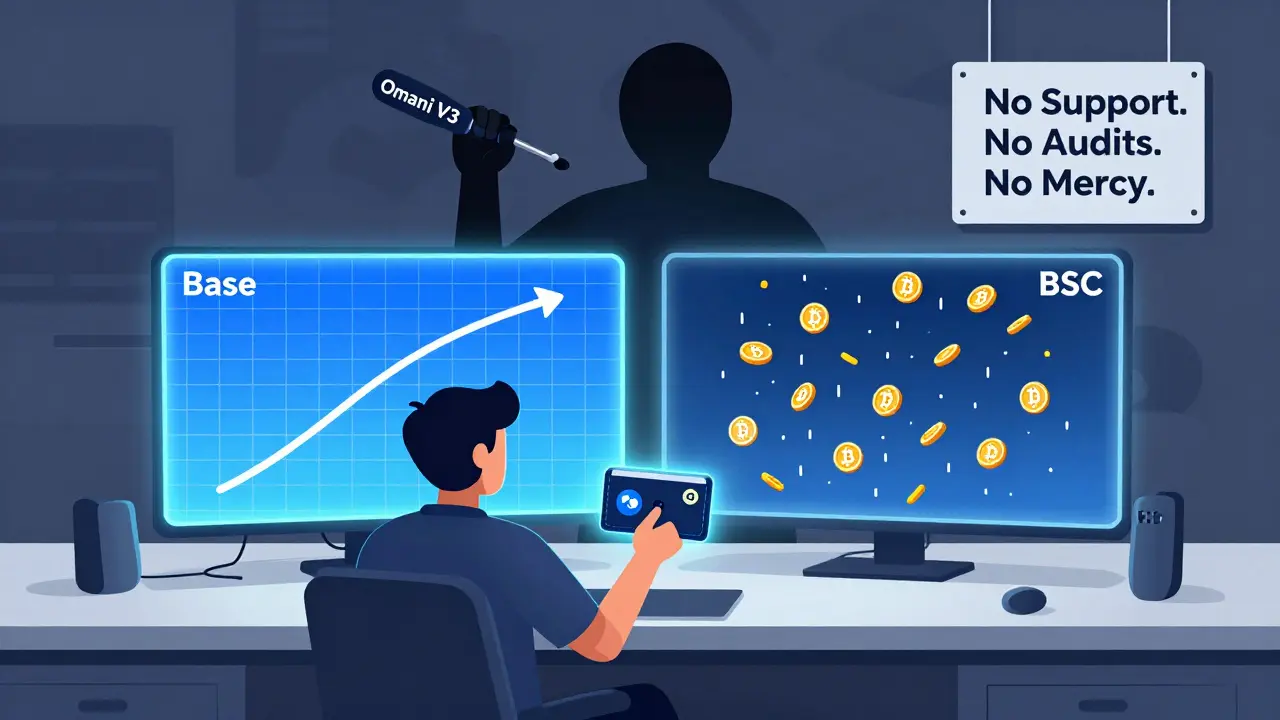
If you're looking for a decentralized exchange that works fast and cheap on Base or Binance Smart Chain, you've probably heard of Omni Exchange V3. But here's the truth: it's not another Uniswap. It's not another PancakeSwap. It's something quieter, narrower, and far less talked about. And if you don't know exactly what it does - and what it doesn't - you could end up confused, stuck with a failed transaction, or worse, trading tokens no one else wants.
What Exactly Is Omni Exchange V3?
Omni Exchange V3 isn't one platform. It's two. One runs on Base is a Layer 2 scaling solution built by Coinbase that uses Ethereum's security but with much lower fees and faster confirmations. The other runs on Binance Smart Chain is a blockchain developed by Binance that prioritizes speed and low-cost transactions for DeFi apps.
Both versions are automated market makers (AMMs), meaning there's no order book. Instead, you trade directly against liquidity pools. You swap tokens like USDC for WETH, or BNB for a new meme coin on BSC. That’s it. No sign-up. No KYC. No deposit limits. Just connect your wallet - MetaMask, Trust Wallet, or any Web3 wallet - and start swapping.
Unlike centralized exchanges like Kraken or Gemini, Omni Exchange V3 doesn’t let you buy crypto with a credit card. You need to already have crypto in your wallet. If you’re trying to cash out your earnings into USD, this isn’t the place for you.
How It Works: Simple, But Not Foolproof
Using Omni Exchange V3 is straightforward - if you’ve used a DEX before. Here’s the step-by-step:
- Open your Web3 wallet (MetaMask is most common)
- Make sure you have enough ETH for gas on Base, or BNB for gas on BSC
- Go to the Omni Exchange V3 website - either the Base or BSC version
- Connect your wallet
- Select the tokens you want to swap
- Set slippage tolerance (usually 0.5%-1% is safe)
- Approve the token transfer
- Confirm the swap
That’s it. No forms. No waiting. No customer service ticket.
But here’s where things get tricky. If you’re swapping a new token with low liquidity, you might get a terrible price. If your slippage is too low, your transaction fails. If you forget to check the network, you’ll send ETH to the BSC version - and it’s gone forever.
There’s no guide. No tutorial. No live chat. You’re on your own.
What You Get: Speed and Low Fees
The real reason people use Omni Exchange V3 isn’t because it’s flashy. It’s because it’s fast.
On Base, transactions settle in under 3 seconds. Gas fees? Often under $0.10. On BSC, it’s even cheaper - sometimes 1 cent. Compare that to Ethereum mainnet, where a simple swap can cost $5-$15 during peak times.
Trading fees are standard for DEXs: 0.3%. That fee goes to liquidity providers, not a company. That’s fair. You’re not paying a middleman. You’re paying the people who make the market.
It also supports native tokens from both networks. On Base, you’ll find tokens like USDbC is a USD-pegged stablecoin issued by Circle on the Base network. On BSC, you’ll see BNB is the native token of Binance Smart Chain, used for gas and staking.
Yield farming is available too. You can stake LP tokens and earn rewards. But again - no audit reports. No public security reviews. You’re trusting code that no one has publicly vetted.
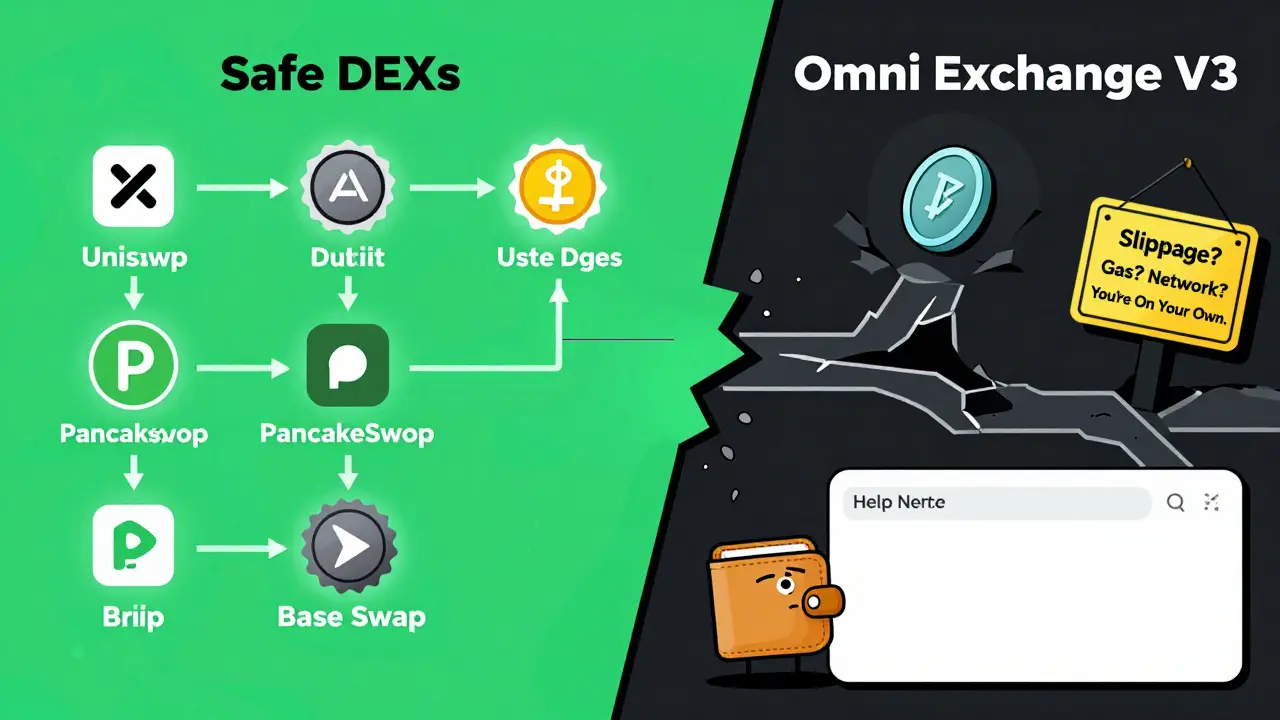
What You Don’t Get: Safety, Support, and Scale
Here’s the dark side.
Omni Exchange V3 has zero user reviews on CoinGecko. Zero Reddit threads. Zero G2 ratings. Zero YouTube tutorials. You won’t find a single testimonial. Not one. That’s not normal. Even obscure DEXs have at least a few users who post about their experience.
There’s no customer support. No email. No Discord. No help center. If you mess up a transaction, you’re out of luck. No one can reverse it. No one can help you.
And the token selection? Tiny. Compared to Uniswap, which lists over 20,000 tokens, Omni Exchange V3 has maybe a few hundred - mostly new projects from the Base or BSC ecosystem. If you’re looking for Bitcoin, Ethereum, or Solana tokens, you won’t find them here.
Advanced trading tools? No limit orders. No stop-losses. No margin trading. You can only swap spot pairs. That’s fine if you’re a casual trader. But if you’re trying to hedge or scalp, you’ll be frustrated.
Security? Unknown. There’s no public audit from CertiK, OpenZeppelin, or Hacken. No bug bounty program. No transparency report. That’s a red flag. In crypto, if you can’t prove you’re secure, you’re not.
Who Is This For? And Who Should Avoid It?
Omni Exchange V3 isn’t for everyone. Here’s who it works for:
- You’re trading Base or BSC-native tokens and want the cheapest, fastest swap possible
- You already know how DEXs work and don’t need hand-holding
- You’re comfortable with self-custody and accepting full risk
- You’re not looking for fiat on-ramps or regulatory compliance
Here’s who should avoid it:
- You’re new to crypto and don’t understand slippage or gas fees
- You want to use a credit card to buy crypto
- You need customer support when things go wrong
- You’re trading large amounts and want security guarantees
- You’re looking for a wide selection of tokens or advanced trading features
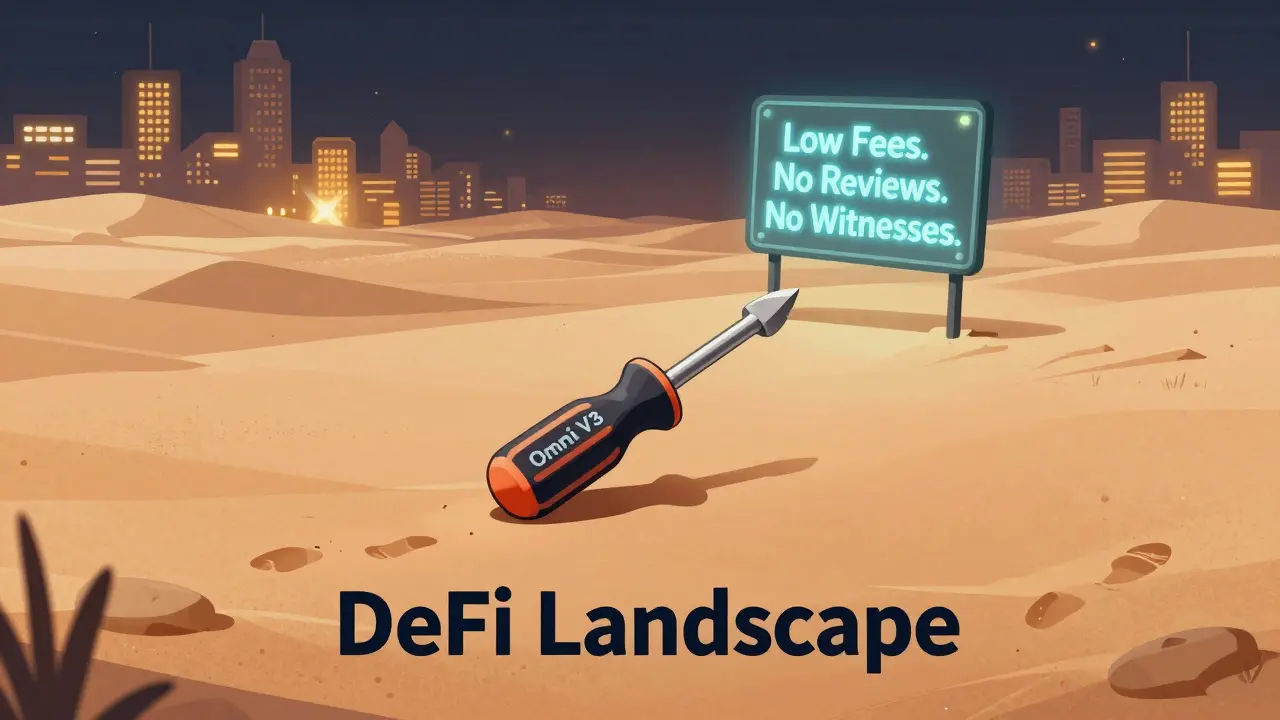
How It Compares to Other DEXs
Let’s put it in perspective.
| Feature | Omni Exchange V3 (Base/BSC) | Uniswap (Ethereum) | PancakeSwap (BSC) | Base Swap (Base) |
|---|---|---|---|---|
| Network | Base or BSC | Ethereum | BSC | Base |
| Trading Fees | 0.3% | 0.3% | 0.2% | 0.2% |
| Gas Cost (Avg) | $0.05-$0.20 | $5-$15 | $0.10-$0.50 | $0.05-$0.15 |
| Token Selection | Low (100-300) | High (20,000+) | High (1,500+) | Medium (500+) |
| Advanced Orders | No | No | No | No |
| Security Audits | None reported | Multiple | Multiple | Yes |
| Customer Support | None | None | Community only | None |
| User Reviews | None | Thousands | Thousands | Several hundred |
Omni Exchange V3 sits in a strange spot. It’s not the cheapest - Base Swap and PancakeSwap beat it on fees and liquidity. It’s not the most secure - both have public audits. It’s not the most popular - no one’s talking about it.
So why does it exist?
The Big Question: Is It Legit?
It’s not a scam. CoinGecko lists it. The contracts are live. No one has reported a hack. The Cryptolegal.uk scam list doesn’t include it. That’s good.
But legitimacy doesn’t mean safety. A DEX can be real and still be dangerous. Without audits, without support, without community, you’re trusting anonymous developers. And in crypto, that’s a gamble.
Think of it like this: Omni Exchange V3 is a tool. A very specific tool. It’s not a Swiss Army knife. It’s a single screwdriver. If you need that exact screwdriver - and you know how to use it - it’s perfect. If you’re trying to fix a TV with it? You’re going to break something.
Final Verdict: Use With Caution
Omni Exchange V3 isn’t broken. It’s just… underdeveloped. It does one thing well: swap tokens on Base or BSC with low fees. But it does nothing else. No education. No help. No transparency. No future roadmap.
If you’re an experienced DeFi user who wants the absolute cheapest way to trade a new Base or BSC token - go ahead. Connect your wallet. Swap. Move on.
If you’re anyone else - new, unsure, or looking for reliability - stick with Uniswap, PancakeSwap, or Base Swap. They’ve been tested. They have communities. They have audits. You’re not saving much by going with Omni Exchange V3. But you’re risking a lot.
It’s not the future of DeFi. It’s a quiet experiment. And right now, that experiment has no witnesses.
Is Omni Exchange V3 safe to use?
Omni Exchange V3 isn’t a scam, but safety depends on your risk tolerance. There are no public security audits, no bug bounties, and no customer support. Transactions are irreversible. If you’re comfortable with self-custody and understand DeFi risks, it’s usable. If you want guarantees, use a DEX with audits like Uniswap or PancakeSwap.
Can I buy crypto with a credit card on Omni Exchange V3?
No. Omni Exchange V3 is a decentralized exchange (DEX). It only allows token swaps between cryptocurrencies. You need to already have crypto in your wallet - like ETH on Base or BNB on BSC - to use it. You cannot deposit fiat or buy crypto with a card.
What’s the difference between Omni Exchange V3 (Base) and (BSC)?
They run on different blockchains. The Base version uses Coinbase’s Layer 2 network - faster and cheaper than Ethereum. The BSC version runs on Binance Smart Chain - known for low fees and high speed. You must use the correct version for your network. Sending ETH to the BSC version will result in permanent loss.
Does Omni Exchange V3 have a mobile app?
No. Omni Exchange V3 is a web-based platform. You access it through your browser by connecting your wallet (like MetaMask). There is no official mobile app. Be cautious of fake apps claiming to be Omni Exchange V3 - they’re scams.
Why is there so little information about Omni Exchange V3?
The platform appears to be a niche, low-traffic DEX with minimal marketing. Unlike major exchanges, it has no public team, no blog, no social media presence, and no community forums. This lack of transparency makes it hard to assess its long-term viability. Most users stick with more established platforms that offer clearer documentation and support.



PIYUSH KOTANGALE
This is the kind of DEX I love 🚀 Cheap gas, no BS, just swap and go. If you know what you're doing, why overcomplicate it with audits and customer service? We're not in kindergarten.
Zephora Zonum
Omni Exchange V3 is basically crypto's version of a back alley mechanic who says 'I fix everything' but only has a hammer and duct tape. You're not saving money-you're just gambling with your portfolio
Anshita Koul
I love how people act like safety is a given in DeFi... as if any of this is *real*? The fact that Omni has no reviews means it's not drowning in hype. That’s a feature, not a bug. The quiet ones often outlast the loud ones. Think deeper, not louder.
vishnu mr
i tried this thing last week and totally forgot i was on base and sent bnb to the bsc version... yeah... its gone. forever. lesson learned. dont be me lol
Douglas Anderson
I’ve used this for small swaps on Base for months now. No issues. No drama. The lack of support? That’s the point. You’re not paying for a bank-you’re paying for permissionless access. If you need hand-holding, go to Coinbase. If you want freedom, this works.
ann neumann
They’re not telling you the truth. Omni Exchange V3 is a honeypot. The devs are sitting there watching who sends ETH to the BSC version. Then they drain the liquidity pools. No audits? No transparency? That’s not negligence-that’s a trap. I’ve seen this pattern before. It’s not a DEX. It’s a ghost town with a front door.
Anthony Marshall
Stop being scared of tools because they don’t have a customer service hotline. This isn’t Amazon. It’s crypto. If you can’t handle irreversible transactions, go play with your ETFs. This platform is a scalpel-not a teddy bear.
Lindsay Girvan
I’ve used every DEX on BSC and Base. This one? Barely functional. Zero community. Zero docs. Zero future. It’s a ghost. And ghosts don’t build ecosystems.
Tina Keller
There’s something beautiful about a tool that doesn’t try to be everything. Omni doesn’t have a blog, a Discord, or a PR team. But it works. And sometimes, the quietest builders are the ones who actually ship. Maybe we’re just too loud to hear them.
vasantharaj Rajagopal
The architectural asymmetry between Omni and Uniswap is non-trivial. While Uniswap leverages a robust liquidity layer with incentivized mining, Omni operates as a minimal viable AMM with constrained tokenomics. This is not a deficiency-it’s an ontological choice. The trade-off is intentional: speed over scale.
William Montgomery
You people act like you're brave for using this. You're not brave-you're clueless. If you can't verify an audit, you're not a degenerate. You're just reckless. And now you're risking other people's money by pretending this is 'decentralized innovation'.
Mara Alves Mariano
Base? BSC? Who even cares anymore? This whole 'layer 2 war' is just Wall Street repackaging the same scam with new logos. Omni? More like Omni-Scam. Why are we still falling for this? The system is rigged. You think you're free? You're just another node in the machine.
Allison Davis
I use this for quick swaps between USDbC and native tokens on Base. It’s fast, reliable, and I’ve never had a failed tx. If you’re not using it because it’s 'unknown', you’re letting FUD kill your efficiency.
Tom Jewell
The real tragedy isn’t Omni’s lack of audits-it’s that we’ve stopped valuing simplicity. We’ve turned DeFi into a circus of dashboards, alerts, and whitepapers. Sometimes, a clean contract with no fanfare is the most honest thing left.
Sherry Kirkham
I used to think this was too risky. Then I did a 500 USDbC swap and it cleared in 1.8 seconds for $0.07. That’s not luck. That’s design. Stop comparing it to Uniswap. It’s not supposed to be.
Jennifer Pilot
I'm deeply concerned about the ontological fragility of this platform. The absence of a governance token, coupled with zero community engagement metrics, suggests a fundamentally unsustainable economic model. One must question: is this a tool-or a time bomb?
Sharon Tuck
I just want to say-thank you for writing this. So many people are scared of tools that don’t have a logo or a team photo. But sometimes the most useful things are the ones no one’s trying to sell you. This is one of them.
PIYUSH KOTANGALE
Lmao @commenter_id:2099 you're paranoid. If this was a honeypot, why hasn't anyone drained it yet? It's been live for months. Maybe... just maybe... it's not evil. Maybe it's just quiet.