Public Key vs Wallet Address: The Real Difference Explained
You’ve probably seen long strings of letters and numbers when sending Bitcoin or Ethereum. Maybe you’ve even copied one to pay a friend. But have you ever stopped to ask what that string actually is? Is it your public key? Your wallet address? Or something else entirely?
Most people use these terms interchangeably, but they are not the same thing. Confusing them can lead to serious security mistakes. In this guide, we break down exactly how public keys and wallet addresses differ, why both matter for your crypto safety, and how the math behind them keeps your funds safe from hackers.
The Core Difference: Identity vs. Destination
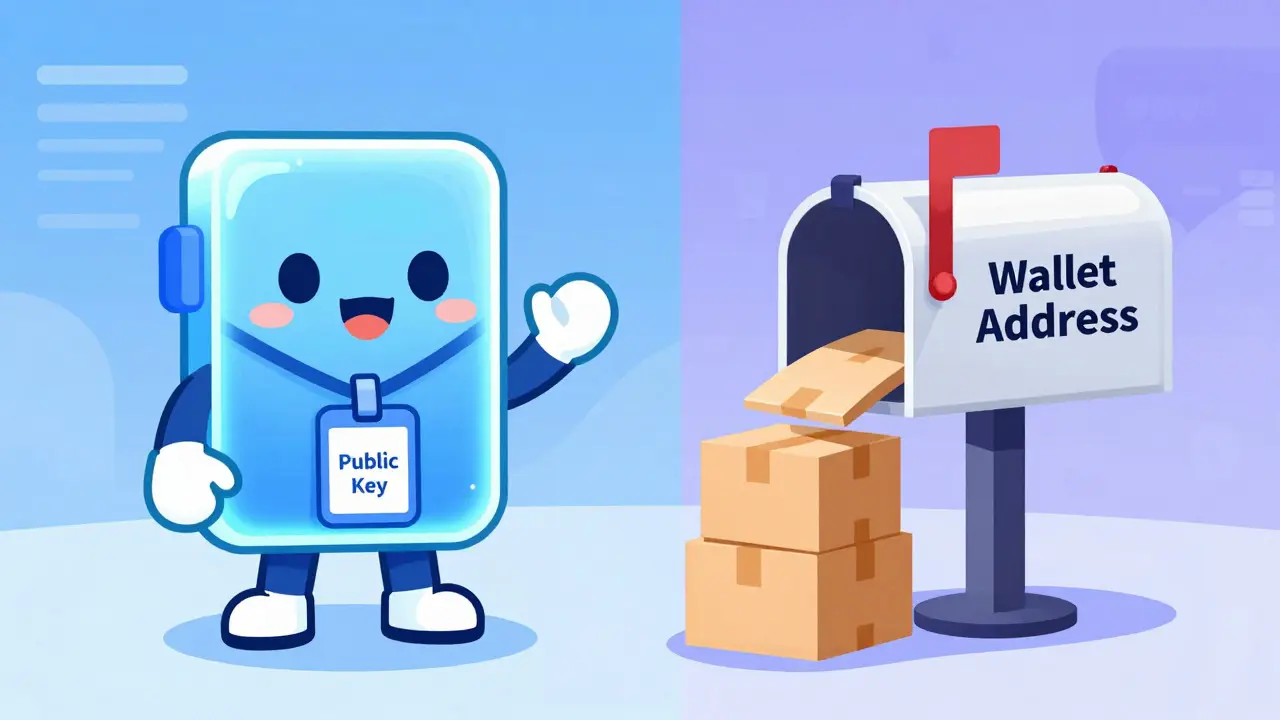
Think of your cryptocurrency setup like mailing a physical letter. To send a package, you need two things: the recipient’s name (identity) and their street address (destination). In the world of blockchain technology, the public key acts as your identity, while the wallet address is where the money goes.
A public key is a cryptographic identifier that proves who you are on the network without revealing your secret codes. It is derived directly from your private key using complex mathematics. On the other hand, a wallet address is a compressed, user-friendly version of that public key. You share your wallet address with others so they can send you funds. You rarely, if ever, share your raw public key directly in everyday transactions.
This distinction matters because each serves a different function. The public key verifies digital signatures, ensuring that only you could have authorized a transaction. The wallet address simply tells the network where to deposit the coins. Understanding this separation helps you navigate wallets, exchanges, and security settings with confidence.
How They Are Created: The Math Behind the Magic
To understand why these two elements are different, we need to look at how they are generated. The process starts with your private key. This is a randomly generated number that gives you full control over your assets. It is the most sensitive piece of data in your crypto life.
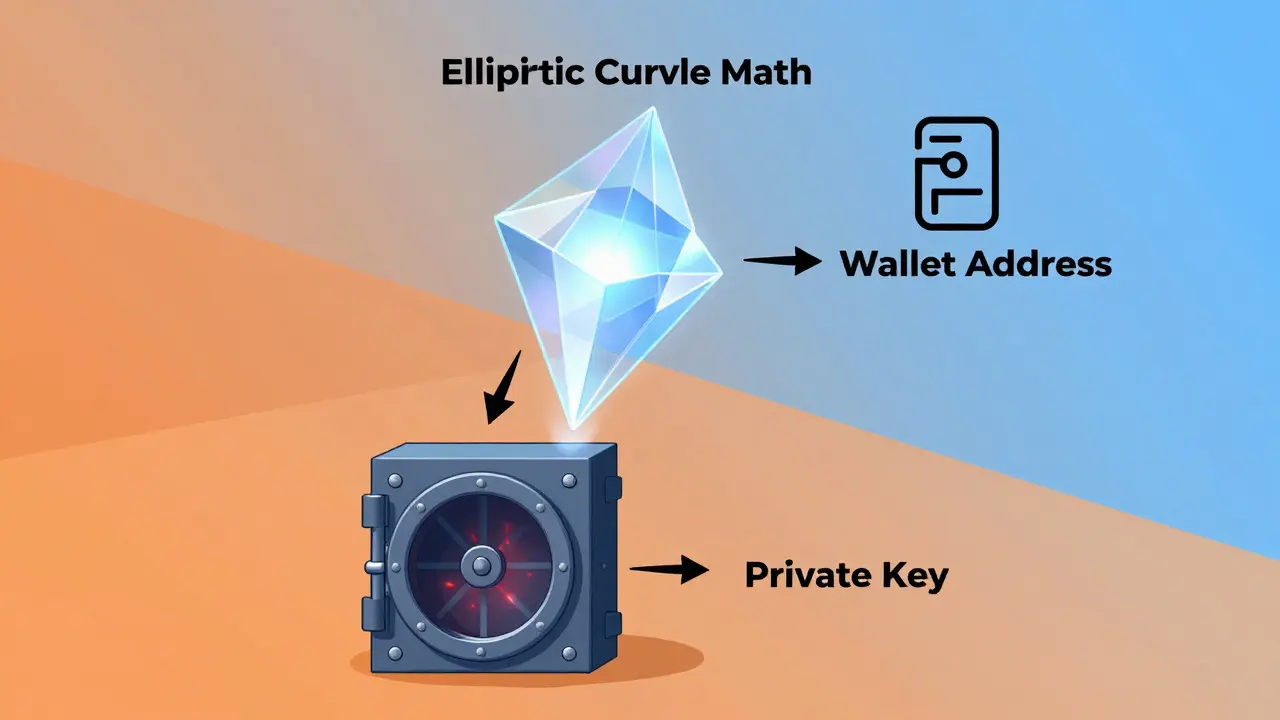
From this private key, your wallet software performs a mathematical operation called elliptic curve cryptography. This creates your public key. Here is the crucial part: this process is one-way. It is easy to go from private key to public key, but nearly impossible to reverse-engineer the private key from the public key. This asymmetry is what makes asymmetric encryption secure.
Once the public key exists, the wallet doesn’t stop there. It takes that public key and runs it through a hashing algorithm (like SHA-256 and RIPEMD-160 in Bitcoin). This compresses the long, complex public key into a shorter, alphanumeric string. That final result is your wallet address. So, the chain looks like this:
- Private Key: Generated randomly. Keeps secrets.
- Public Key: Derived from private key. Proves identity.
- Wallet Address: Hashed from public key. Receives funds.
Because the wallet address is hashed from the public key, you cannot calculate the public key from the address alone. This adds another layer of privacy and security. Even if someone sees your address, they don’t immediately see your public key, which is required to verify your signature on a transaction.
Visibility and Security Risks
One of the biggest fears for new crypto users is sharing the wrong information. Let’s clear up the confusion about what is safe to share.
Your wallet address is designed to be public. You can post it on social media, print it on business cards, or email it to vendors. Anyone can send funds to that address. There is no risk in exposing it. In fact, many wallets generate a new address for every transaction to enhance privacy, making it harder for observers to link all your holdings together.
Your public key is also generally safe to share, though less commonly used directly by end-users. It becomes visible on the blockchain when you spend funds from an address, as the network needs it to verify your signature. However, merely knowing your public key does not allow anyone to steal your coins.
The danger lies in the private key. If you expose your private key, you lose everything. Unlike a password, there is no "forgot password" option in decentralized crypto. If someone has your private key, they have total control. They can drain your wallet instantly. This is why hardware wallets store private keys offline, keeping them away from internet-connected devices where malware might lurk.
| Feature | Private Key | Public Key | Wallet Address |
|---|---|---|---|
| Primary Function | Signs transactions, unlocks funds | Verifies signatures, proves ownership | Receives funds, identifies destination |
| Visibility | Secret (Never share) | Public (Safe to share) | Public (Safe to share) |
| Format | Long hex string (e.g., 64 chars) | Long alphanumeric string | Shorter alphanumeric (e.g., 34 chars) |
| Security Risk if Leaked | Critical (Total loss) | Low (No direct loss) | None (Intended for sharing) |
| Derivation Source | Random generation | Derived from Private Key | Hashed from Public Key |
Practical Usage: When Do You Use Which?
In daily life, you will interact with wallet addresses far more often than public keys. When you want to receive Bitcoin, you open your wallet app and click "Receive." The app shows you a QR code and a string of characters starting with '1', '3', or 'bc1'. That is your wallet address. You give this to the sender.
When you send Bitcoin, you enter the recipient’s wallet address. Your wallet then uses your private key (stored securely inside the app or hardware device) to sign the transaction. The network broadcasts this signed transaction. Other nodes on the network check the signature against the public key associated with that address to ensure the transaction is valid.
You rarely see the public key during this process. Modern wallets handle the cryptographic heavy lifting in the background. However, understanding that the public key is the bridge between your secret private key and the public address helps you appreciate why the system works. It allows the network to trust your transaction without needing to know your private key.
For advanced users interacting with smart contracts on platforms like Ethereum, the concept remains similar but the terminology might shift slightly. You still have an address (starting with '0x') and a pair of keys. The address is what you publish; the keys are what you protect.
Common Mistakes and How to Avoid Them
Misunderstanding these components leads to costly errors. Here are three common pitfalls:
- Sharing Private Keys via Email: Some users think they are sharing their "public" info when they paste a private key. Always double-check the label. If it says "Private Key," "Seed Phrase," or "Recovery Phrase," keep it offline. Never type it into a website unless you are restoring a wallet on a trusted device.
- Confusing Seed Phrases with Addresses: A seed phrase (usually 12 or 24 words) generates your private keys. It is not an address. Losing the seed phrase means losing access to all addresses derived from it. Back it up physically, not digitally.
- Reusing Addresses for Privacy: While reusing an address isn’t a security breach, it hurts your privacy. Every time you reuse an address, anyone can trace all transactions to that single point. Using a new address for each receipt makes it harder for outsiders to analyze your spending habits.
Another mistake is assuming that seeing a public key on the blockchain compromises your security. It does not. The beauty of asymmetric cryptography is that the public key can be verified by millions of computers simultaneously without endangering the private key. The system is designed to be transparent yet secure.

Why This Matters for Future Crypto Adoption
As cryptocurrencies move toward mainstream adoption, clarity around these technical terms becomes essential. Banks and traditional finance institutions rely on account numbers and PINs. Crypto relies on keys and addresses. For average users, the complexity can be intimidating.
Wallet developers are working to abstract this away. Many apps now hide the public/private key distinction entirely, showing only the address and balance. However, for self-custody enthusiasts, developers, and investors, knowing the difference provides peace of mind. It empowers you to audit your own security rather than blindly trusting an interface.
Moreover, as new protocols emerge, such as those involving multi-signature wallets or decentralized identity (DID), the role of public keys expands beyond just verifying payments. They become part of your digital identity across various applications. Understanding that your public key is your verifiable ID, while your address is your payment portal, prepares you for this evolving landscape.
Summary of Key Points
Let’s wrap up the essentials. Your private key is the master secret. Your public key is the mathematical proof of your identity. Your wallet address is the practical tool for receiving funds. They are linked in a strict hierarchy: Private Key → Public Key → Wallet Address.
Sharing your wallet address is safe and necessary for transactions. Sharing your public key is safe but uncommon for casual users. Sharing your private key is catastrophic. By keeping these roles distinct in your mind, you navigate the blockchain with greater confidence and security. Remember, in crypto, you are your own bank. Knowing how the vault works is the first step to protecting your wealth.
Can I recover my private key from my wallet address?
No, it is computationally impossible to derive a private key from a wallet address. The hashing process used to create the address is one-way, meaning information is lost in the compression. This ensures that even if your address is public, your private key remains secure.
Is it safe to share my public key online?
Yes, sharing your public key is safe. It cannot be used to steal your funds because it cannot be reversed to find your private key. However, most people share their wallet address instead, as it is shorter and easier to handle.
What happens if I lose my wallet address?
If you lose track of a specific wallet address but still have your private key or seed phrase, you haven't lost your funds. Most wallets can regenerate all associated addresses from the seed phrase. You just need to restore your wallet to see the balances again.
Do I need a new wallet address for every transaction?
It is recommended for privacy reasons. Reusing addresses allows anyone to link all your transactions together, creating a public ledger of your activity. Generating a new address for each receipt makes it harder for third parties to analyze your financial history.
How does a public key verify a transaction?
When you send crypto, your wallet signs the transaction with your private key. This creates a unique digital signature. The network uses your public key to verify that this signature matches the transaction, proving that the holder of the corresponding private key authorized the transfer.