Russia's Crypto Crackdown: CBR Restrictions, The 1% Cap, and the 2026 Reality

Imagine trying to use Bitcoin to buy coffee in Moscow. It’s not just difficult; it’s effectively illegal. But try using that same Bitcoin to pay a supplier in Turkey or India for industrial machinery, and suddenly, the doors open slightly. This is the confusing, high-stakes reality of doing business with digital assets in Russia today.
The Russian Central Bank (CBR), led by Governor Elvira Nabiullina, has carved out a path that is as restrictive as it is pragmatic. They hate the idea of crypto replacing the ruble, but they need crypto to bypass Western sanctions. The result? A regulatory framework that feels like a maze designed to trap anyone who isn’t a state-approved entity.
If you are an investor, a bank executive, or a business owner looking at the Russian market, understanding these nuances isn't optional-it's survival. By mid-2026, the rules have hardened into what experts call "CryptoBasel," a set of capital requirements so strict they make most institutional involvement unprofitable.
The Core Conflict: Stability vs. Sanctions
To understand where Russia stands in 2026, you have to look at the two opposing forces driving policy. On one side, you have the CBR’s obsession with financial stability. On the other, you have the Ministry of Finance’s need to keep trade flowing despite heavy international pressure.
The CBR views cryptocurrencies as inherently dangerous. They see them as tools for money laundering, tax evasion, and capital flight. For years, their stance was simple: no crypto payments, no mining without permits, and banks stay away. But then came the sanctions. Traditional SWIFT transfers became unreliable or blocked. Businesses needed a way to move money across borders.
This created a loophole. In summer 2024, legislation passed allowing digital currency payments specifically for international trade settlements. This was the compromise. You can use crypto to import goods from non-friendly countries, but you cannot use it to buy groceries or pay your neighbor. This dual-track system is the backbone of current Russian crypto policy.
| Activity Type | Legal Status | Key Restriction |
|---|---|---|
| Domestic Payments | Illegal | Banks must block transactions; users face fines. |
| International Trade | Limited Legal | Only for foreign trade settlements; strict reporting required. |
| Bank Investment | Highly Restricted | Capped at 1% of bank capital; full collateralization required. |
| Trading on Exchanges | Legal (for qualified investors) | Must use registered exchanges within the ELR regime. |
The 2026 Capital Cap: What "CryptoBasel" Means for Banks
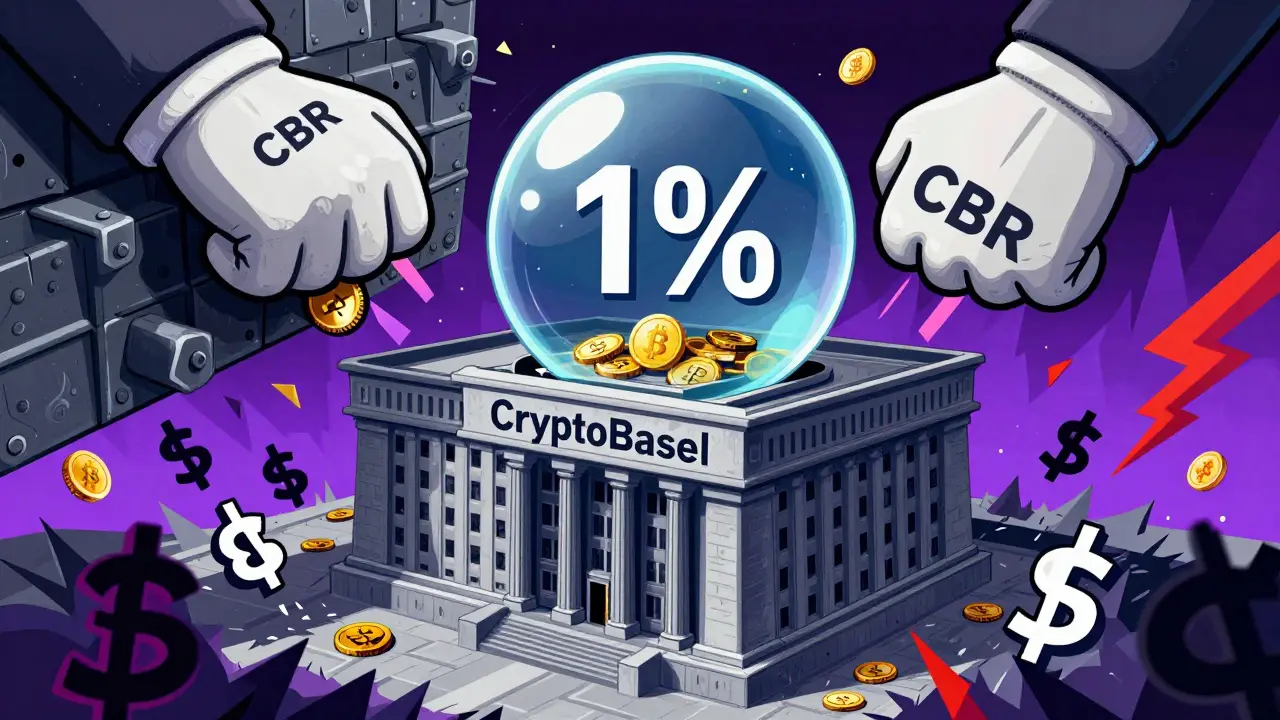
By 2026, the theoretical fears of the CBR have turned into concrete math. The most significant change affecting the banking sector is the implementation of stricter capital requirements, often referred to by legal experts as "CryptoBasel."
Here is the bottom line: If a Russian bank wants to touch cryptocurrency, it costs them dearly. Under the new rules, which fully took effect this year, digital asset transactions are capped at no more than 1% of a bank’s total capital. To put that in perspective, if a bank has $1 billion in capital, only $10 million worth of crypto-related activity is allowed on its books. And even that $10 million must be fully backed by the bank’s own funds.
This stems from the CBR’s informational letter IN 03-23/87 issued in May 2025. The regulator demanded that every ruble of investor funds exposed to crypto risk be covered by a ruble of the bank’s own equity. Why? Because if Bitcoin crashes, the CBR doesn’t want taxpayers bailing out the bank. They want the bank to eat the loss.
Andrey Tugarin, founder of GMT Legal, noted that while this sounds dramatic, it’s largely a formalization of existing conservative practices. Most major Russian banks were already avoiding crypto due to the risks. These 2026 rules just put a legal wall around that hesitation. It effectively kills any hope of mainstream retail banking integration for crypto in Russia anytime soon.
The Experimental Legal Regime (ELR): A Gilded Cage?
You might wonder, "If banks are locked out and domestic payments are banned, how does anyone legally trade?" Enter the Experimental Legal Regime (ELR).
The ELR is the CBR’s answer to the demand for innovation. It creates a sandbox where certain crypto activities can happen under strict supervision. But don’t mistake this for freedom. Participation is restricted to "especially qualified" investors. These aren’t your average retail traders. We’re talking about institutions and individuals with massive balance sheets who can pass stringent vetting processes.
Inside the ELR, you can trade crypto assets on registered exchanges. However, the moment you step outside this bubble, the rules tighten. The CBR has proposed banning cryptocurrency settlements between residents entirely unless conducted through the ELR infrastructure. Violating this prohibition carries liability.
The goal here is control. The CBR wants to know who owns what, when they bought it, and where the money came from. The ELR allows them to monitor every transaction while keeping the general public away from the volatility of digital assets.
Surveillance and Compliance: The End of Anonymity
If you think privacy is dead elsewhere, wait until you hear about Russia’s approach. The CBR has made it clear: anonymity is not welcome. In collaboration with the Ministry of Digital Development, the central bank has developed a digital platform for the de-anonymization of cryptocurrency users.
What does this mean for you? It means that if you are a Virtual Asset Service Provider (VASP)-whether you’re an exchange, a broker, or a mining pool-you must integrate into the state-regulated system. Rosfinmonitoring, Russia’s financial intelligence unit, has openly discussed regulating these providers. The choice is binary: comply with extensive Know Your Customer (KYC) and Anti-Money Laundering (AML) protocols, or get blocked.
For individual users, the threshold for scrutiny is low. Any crypto transaction exceeding 600,000 rubles (roughly $6,000 USD depending on the rate) must be reported to tax authorities. The CBR issues methodological recommendations to help banks identify suspicious activities, particularly focusing on peer-to-peer (P2P) trades, which have become a gray area for circumventing bans.
This level of oversight makes Russia one of the most transparent-and invasive-jurisdictions for crypto tracking. Every transaction is recorded. Every participant is identified. There is no shadow market that the state cannot eventually illuminate.

Stablecoins and the Road Ahead
While Bitcoin and Ethereum remain risky assets in the eyes of the CBR, stablecoins present a different puzzle. They offer the speed of crypto with the stability of fiat. Deputy Finance Minister Ivan Chebeskov confirmed that Russia would finalize new rules for stablecoins by the end of 2025. As we move through 2026, these frameworks are taking shape.
The Ministry of Finance and the CBR are working jointly, though tensions exist. The Finance Ministry sees stablecoins as a tool to boost Russia’s position in the global market and facilitate trade. The CBR worries about monetary sovereignty. The resulting regulations aim to align with international standards while ensuring that stablecoins used in Russia are pegged to assets that don’t threaten the ruble’s dominance domestically.
Expect to see regulations that require stablecoin issuers to hold reserves in approved jurisdictions and report holdings regularly. The CBR plans to consolidate cryptocurrency infrastructure under state control following the full implementation of the ELR. This suggests a future where private crypto innovation exists only with the government’s explicit permission and constant monitoring.
Practical Implications for Businesses and Investors
So, what should you do if you are operating in or near Russia? First, assume that any crypto activity will be scrutinized. Second, understand that the "international trade exception" is narrow. You cannot use it for speculative trading or personal wealth management. It is strictly for settling invoices for imported/exported goods.
For banks, the 1% capital cap means that crypto services will likely remain a niche offering for specialized subsidiaries rather than a core product. For investors, the ELR provides a legal pathway, but the entry barriers are high. You need to be "qualified," which implies significant net worth and professional experience.
Finally, beware of the gray market. P2P platforms and unregistered brokers may seem like easy ways to bypass restrictions, but the de-anonymization platform is getting smarter. The risk of account freezing, fines, or worse, criminal charges for violating payment laws, is real. The CBR has signaled that it will pursue violators aggressively to maintain the integrity of its dual-track system.
Can I use cryptocurrency to pay for everyday goods in Russia?
No. Using cryptocurrency for domestic payments is strictly prohibited. Merchants cannot accept crypto for local sales, and individuals cannot use it to pay for utilities, rent, or consumer goods. Doing so violates the law and can result in fines or account blocking.
What is the 1% capital cap for Russian banks?
The 1% cap is a regulation implemented in 2026 that limits a bank's exposure to cryptocurrency assets. A bank can only engage in crypto-related transactions up to 1% of its total regulatory capital. Furthermore, these exposures must be fully collateralized by the bank's own funds, making large-scale institutional crypto adoption economically unviable.
How does the Experimental Legal Regime (ELR) work?
The ELR is a controlled environment where "especially qualified" investors can legally trade cryptocurrency assets. It requires participants to meet high financial thresholds and undergo strict vetting. Transactions within the ELR are monitored by the state, and participation is limited to specific exchanges and instruments approved by the Central Bank.
Is mining cryptocurrency legal in Russia?
Mining is legal but heavily regulated. Miners must register with the state and obtain permits. The Central Bank and energy authorities monitor mining operations closely due to concerns about energy consumption and environmental impact. Unregistered mining is considered illegal and subject to seizure of equipment.
When will stablecoin regulations be finalized?
The framework for stablecoins was targeted for finalization by the end of 2025. As of 2026, these rules are being implemented, requiring stablecoin issuers to adhere to strict reserve requirements and reporting standards. The goal is to allow stablecoins for international trade while preventing them from destabilizing the domestic currency.