Russia’s Crypto Payment Ban: Domestic Rules vs. International Bitcoin Use
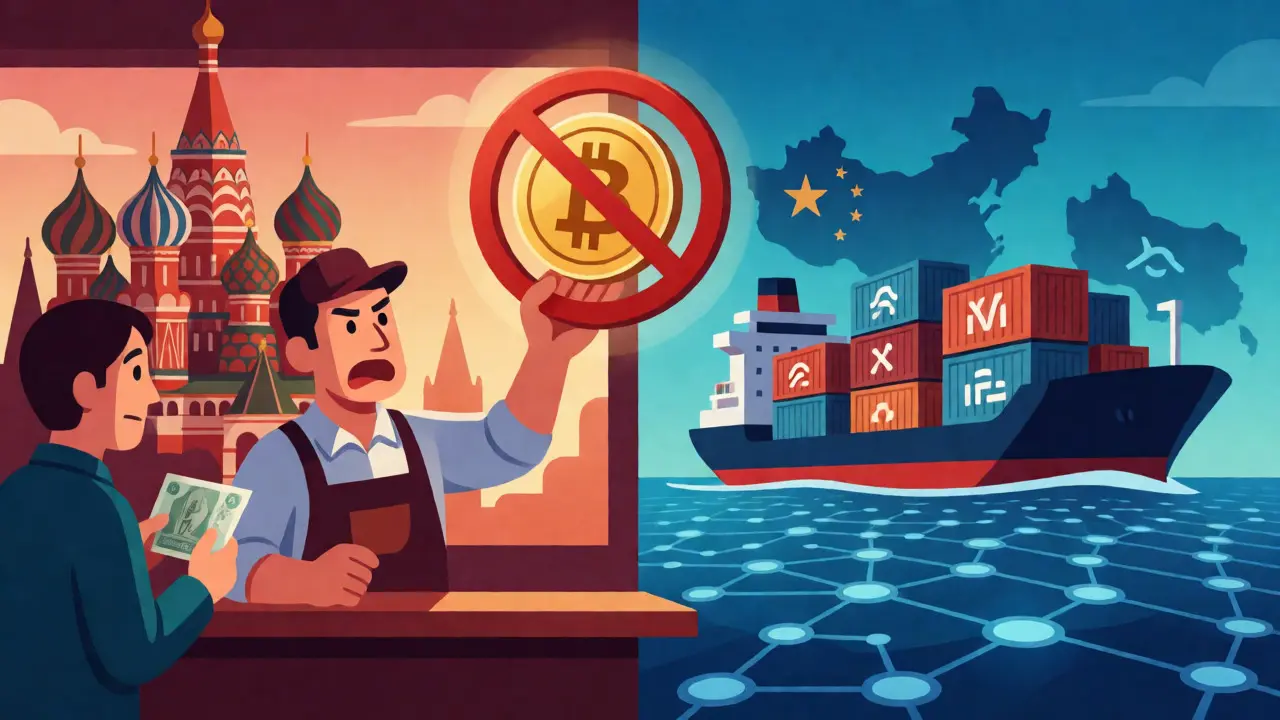
Imagine trying to buy a coffee in Moscow with Bitcoin and getting fined $5,000 for the privilege. That is not a hypothetical scenario; it is the legal reality in Russia as of late 2025. While you can legally own, mine, and trade cryptocurrency within the country, using it to pay for goods or services domestically remains strictly prohibited. Yet, just across the border, Russian exporters are quietly settling millions of dollars in trades using digital assets. This paradox defines Russia’s current stance on Digital Financial Assets and cryptocurrency regulation. The government has drawn a hard line between domestic consumption and international trade, creating a complex compliance landscape that frustrates local merchants while offering a lifeline to sanctioned businesses.
If you are a business owner, an investor, or just curious about how one of the world’s largest economies handles digital money, understanding this split is crucial. It is not just about banning crypto; it is about controlling where value flows. Let’s break down exactly what is allowed, what gets you fined, and why the rules differ so wildly depending on whether your transaction stays inside Russia or crosses its borders.
The Core Legal Framework: Ownership Is Fine, Spending Is Not
Russia’s approach stems from Federal Law No. 114-FZ, signed by President Vladimir Putin in July 2020. This legislation legalized cryptocurrency transactions but explicitly banned their use as a means of payment for goods and services within Russian territory. As of January 1, 2021, this prohibition took full effect. The logic here is straightforward from the state’s perspective: the Ruble is the only legal tender. Allowing Bitcoin or Ethereum to compete as currency undermines monetary sovereignty.
However, the law did not ban ownership. You can hold crypto, trade it on exchanges, and even mine it. In fact, mining became fully legal and regulated. The distinction is critical. If you sell your Bitcoin for rubles, that is a taxable event involving property. If you hand over Bitcoin to buy a car, that is an illegal payment method. The Tax Code was updated on January 1, 2025, to officially recognize cryptocurrency as property, subjecting mining and trading operations to taxation at a 13% capital gains rate for individuals.
| Feature | Domestic Transactions | International Transactions |
|---|---|---|
| Payment Status | Banned for goods/services | Allowed under Experimental Legal Regime (EPR) |
| Legal Tender? | No (Ruble only) | No (Used as settlement asset) |
| Investor Threshold | N/A for payments; High for qualified trading | Must be "Especially Qualified Investor" (>100M RUB assets) |
| Tax Rate | 13% Capital Gains | 13% Capital Gains + Reporting Obligations |
| Penalty for Violation | Fines up to 200k RUB (individuals) | Compliance revocation, fines up to 1M RUB (entities) |
Why the Domestic Ban Persists Despite Global Trends
You might wonder why Russia doesn’t follow El Salvador’s lead in adopting Bitcoin as legal tender. The answer lies in the philosophy of the Bank of Russia. Governor Elvira Nabiullina has consistently argued that cryptocurrencies are volatile, unregulated, and pose systemic risks to financial stability. In her view, they are speculative assets, not reliable currencies. For a central bank trying to control inflation and maintain confidence in the Ruble, allowing parallel currencies for daily commerce is a nightmare.
Moreover, there is a practical enforcement angle. If every merchant accepted Bitcoin, tracking economic activity would become nearly impossible for tax authorities. By keeping crypto out of retail, the state ensures that consumer spending remains visible and taxable. Recent data shows that despite the ban, only about 2.1% of Russian merchants attempt to accept crypto, often risking fines because customers demand it. But for the vast majority, the Ruble remains king.
The proposed fine structure, set to take full effect in early 2026, reinforces this stance. Individuals caught paying with crypto face penalties between 100,000 and 200,000 rubles ($2,500-$5,000). For companies, the stakes are higher: fines range from 700,000 to 1,000,000 rubles ($8,750-$12,500), plus mandatory confiscation of the cryptocurrency involved. Anatoly Aksakov, head of the State Duma’s Committee on Financial Markets, stated that these fines are necessary to close the "gray area" where responsibility was previously unclear.
The International Loophole: Sanctions Drive Adoption
While domestic users struggle, international traders have found a way around the restrictions. In summer 2024, Russia passed Law No. 382-FZ, which permits digital currency payments specifically for international trade. This was a direct response to Western economic sanctions that cut off many Russian banks from the SWIFT system. Suddenly, Bitcoin and stablecoins became vital tools for settling exports with partners in China, Iran, and Belarus.
This international usage isn’t free-for-all, though. It operates under an Experimental Legal Regime (EPR). To participate, entities must register with the Central Bank and implement real-time transaction monitoring systems capable of processing at least 1,000 transactions per second. The goal is transparency. The state wants to know exactly who is sending crypto across borders and why.
The results have been significant. The Central Bank reported $3.2 billion in crypto-facilitated exports during the first half of 2025 alone. Nearly half of this volume went to China, with Iran and Belarus accounting for another 43%. This suggests that for B2B exporters, crypto is no longer a speculative gamble-it is a necessary operational tool to keep supply chains moving when traditional banking channels fail.
Who Can Actually Trade? The "Qualified Investor" Barrier
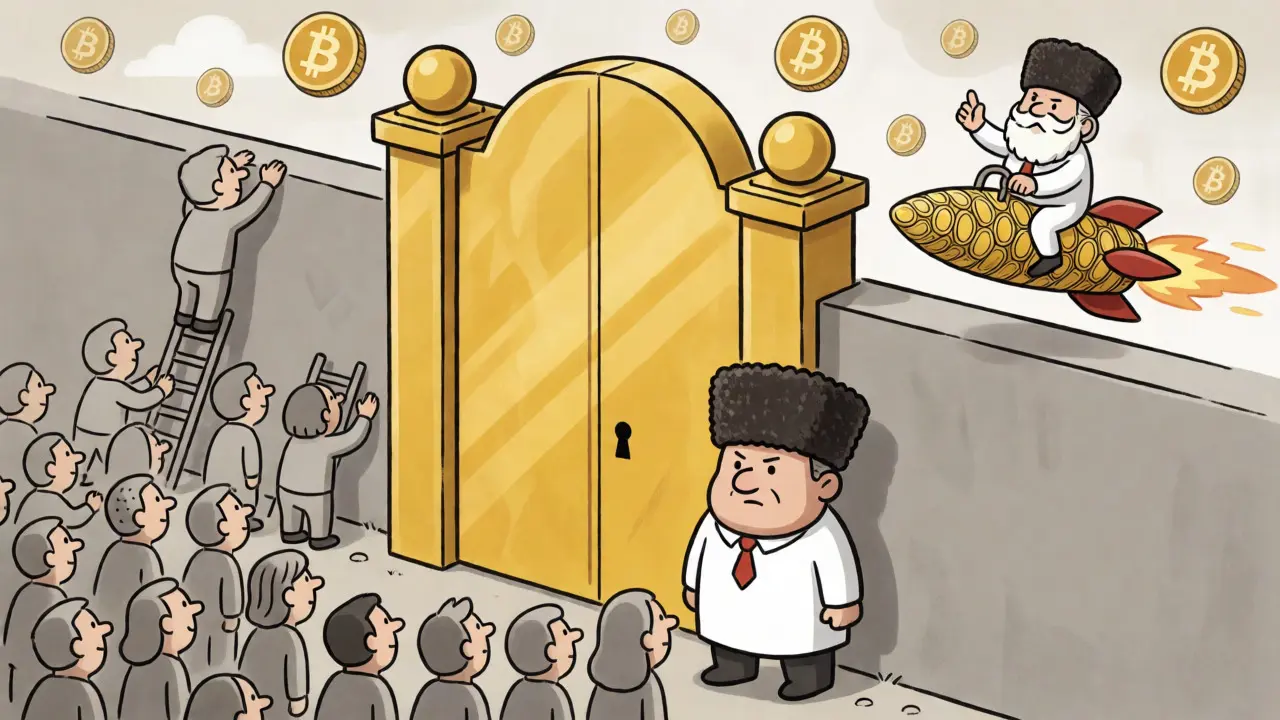
Here is where things get tricky for regular Russians. Even if you want to invest rather than spend, access is heavily restricted. The Bank of Russia’s proposed framework requires individuals to qualify as "especially qualified investors" to trade cryptocurrencies freely. To meet this bar, you need either:
- Financial assets exceeding 100 million rubles (approximately $1.2 million).
- An annual income above 50 million rubles (approximately $580,000).
For context, India’s threshold for similar qualifications is roughly $25,000, and Japan’s is around $320,000. Russia’s barrier is exponentially higher. Critics like Dr. Ivan Sidorov from HSE University argue this creates market distortions, effectively limiting legal crypto trading to oligarchs and large institutions. Data supports this concern: 87% of Russia’s estimated 18 million crypto owners do not meet these wealth criteria. Consequently, many continue to use peer-to-peer (P2P) platforms and non-custodial wallets to bypass these requirements, operating in a regulatory gray zone.
Compliance Nightmares: What Businesses Face
If you run a company wanting to leverage the international allowance, prepare for heavy paperwork. Registering under the EPR is not a quick online form. A case study from Interfax highlighted a Moscow-based IT exporter who abandoned crypto payments entirely because the registration process required 17 different documents and took eight weeks to complete. Only 1,842 entities had registered under the EPR by mid-2025, far below the projected 10,000 target, with 92% being financial institutions rather than commercial enterprises.
Key compliance hurdles include:
- AML Monitoring: Financial institutions must report P2P transactions exceeding 600,000 rubles ($7,500).
- KYC Verification: Foreign exchanges operating in Russia must establish local legal entities and link all crypto-to-fiat transactions to Russian bank accounts.
- Technical Requirements: Systems must integrate with the Federal Tax Service’s CryptoTrack system and maintain 99.95% accuracy in transaction monitoring.
- Record Keeping: Companies must retain seven years of transaction records with blockchain forensic analysis capabilities.
BitLegal, a Moscow-based consultancy, reports that achieving full compliance costs an average of 1.8 million rubles ($22,500) and 220 staff hours. For small and medium-sized businesses, this cost often outweighs the benefits of using crypto for cross-border settlements.

Global Context: How Russia Compares
Russia’s hybrid model-ban domestic use, allow international settlement-is unique but shares DNA with other jurisdictions. Unlike China, which implemented a total ban on all crypto transactions in 2021, Russia permits ownership and mining. Unlike the EU’s MiCA framework, which allows crypto payments with consumer protections, Russia prohibits them domestically. However, its international regime resembles Singapore’s Payment Services Act, albeit with much stricter entry barriers.
The World Bank’s 2025 Russia Economic Report warned that restrictive policies might hinder integration into alternative payment systems, yet acknowledged the legitimacy of the Central Bank’s anti-money laundering concerns. The IMF commended the clear distinction between domestic and international use but cautioned that the 100 million ruble qualification threshold appears excessively restrictive for broader market development.
Future Outlook: Tightening Screws or Opening Gates?
Looking ahead to 2026 and beyond, the trend seems to be toward tighter control rather than liberalization. The Ministry of Finance has drafted legislation to extend the domestic payment ban to include all stablecoins by 2027, citing systemic risks from algorithmic failures like TerraUSD. Additionally, the Central Bank plans to expand transaction monitoring to cover non-custodial wallets by Q2 2026 and introduce biometric verification for crypto transactions over 500,000 rubles by Q4 2026.
Elvira Nabiullina reiterated in June 2025 that volatility makes crypto unsuitable for most Russians as a payment instrument. Unless geopolitical pressures force further innovation in settlement mechanisms, the status quo will likely persist: crypto as a store of value for the wealthy and a settlement tool for exporters, but never as cash for the grocery store.
Can I buy groceries with Bitcoin in Russia?
No. Using cryptocurrency to pay for goods and services within Russia is illegal. While you can own and trade Bitcoin, handing it over to a merchant for a purchase violates Federal Law No. 114-FZ. Merchants risk fines up to 1 million rubles, and buyers may face penalties up to 200,000 rubles.
Is mining cryptocurrency legal in Russia?
Yes, mining is legal and regulated. Since 2021, miners must register with Roskomnadzor and comply with energy consumption limits of 150 MW per facility. Mining operations are also subject to taxation under the updated Tax Code effective January 1, 2025.
What is the Experimental Legal Regime (EPR)?
The EPR is a special regulatory framework introduced in 2024 that allows limited use of cryptocurrency for international trade settlements. Participants must register with the Central Bank, undergo strict KYC checks, and implement real-time transaction monitoring. It is primarily used by exporters dealing with countries facing sanctions.
Do I need to be rich to trade crypto legally in Russia?
To trade freely without restrictions, you generally need to qualify as an "especially qualified investor." This requires holding over 100 million rubles ($1.2 million) in assets or earning more than 50 million rubles ($580,000) annually. Many ordinary citizens still trade via P2P markets, but they operate outside the formal qualified investor framework.
Are foreign crypto exchanges allowed in Russia?
Foreign exchanges must establish a Russian legal entity and maintain minimum capital reserves of 100 million rubles to operate legally. They must also link all crypto-to-fiat transactions to Russian bank accounts subject to full KYC verification. Failure to comply can result in being blocked or fined.