Russian Sanctions and Crypto Exchange Access Limitations: The Garantex, Grinex, and A7A5 Story
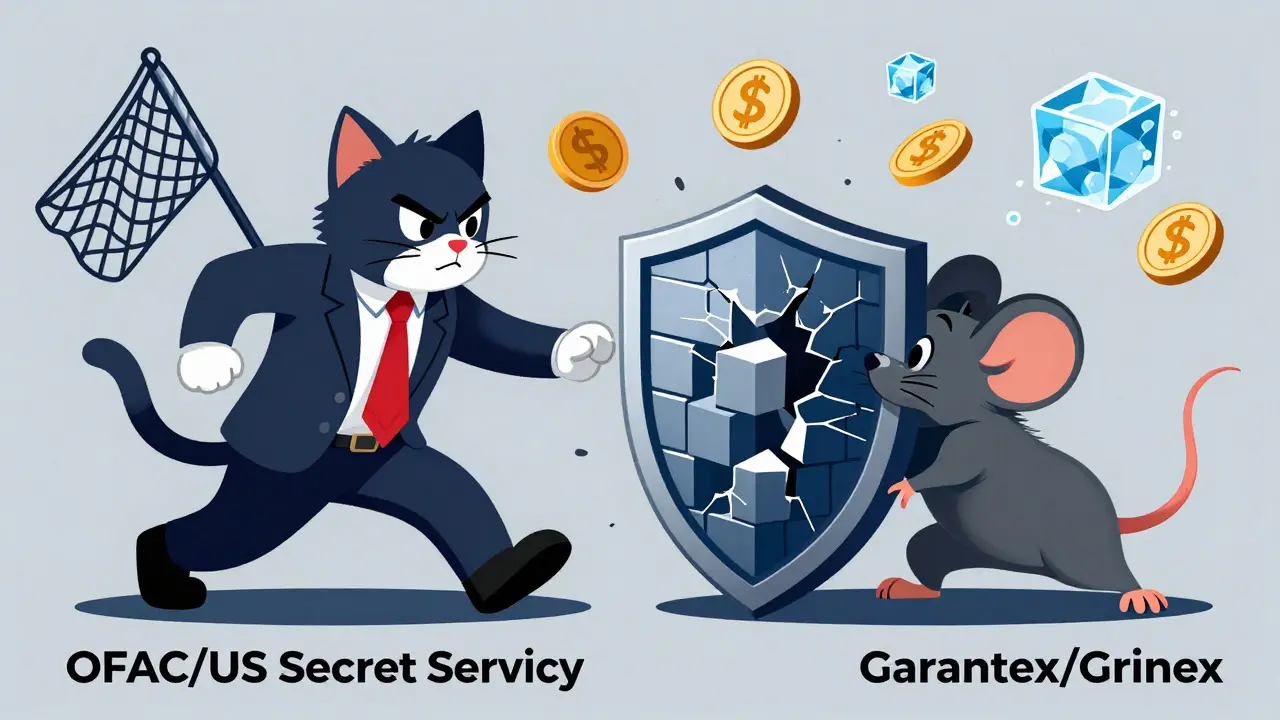
The landscape for cryptocurrency users in Russia has shifted dramatically since the initial wave of financial restrictions began. What started as a simple disconnect from traditional banking systems like SWIFT has evolved into a complex game of cat-and-mouse between sanctioned entities and global enforcement agencies. If you are trying to move funds, access an exchange, or understand why your preferred platform suddenly vanished, you are likely dealing with the ripple effects of targeted U.S. sanctions against specific crypto infrastructure.
By mid-2026, the story is no longer just about broad economic pressure. It is about precise strikes against exchanges that facilitate illicit flows, cybercrime proceeds, and sanctions evasion. The most prominent examples are Garantex, a Russian-operated cryptocurrency exchange designated by OFAC in 2022 and again in 2025 and its successor, Grinex, a replacement exchange created to circumvent sanctions on Garantex. Understanding these specific cases explains why access limitations exist today and what they mean for the average user.
From Garantex to Grinex: The Cycle of Designation
To understand current access issues, you have to look at the timeline of how enforcement has tightened. Garantex Europe OU was first hit by U.S. sanctions from the Office of Foreign Assets Control (OFAC) on April 5, 2022. At that time, it was targeted under Executive Order 14024 for operating in the financial services sector of the Russian economy. But the real escalation happened later.
In March 2025, the U.S. Secret Service led an international operation that seized three Garantex domains, confiscated servers, and froze over $26 million in cryptocurrency. They also arrested co-founder Aleksej Besciokov in India. This wasn't just paperwork; it was a physical takedown of infrastructure. In response, Garantex employees didn't shut down. They pivoted immediately, creating Grinex as a direct successor.
Grinex’s own promotional materials admitted it was "formed in response to sanctions and asset freezes that affected Garantex." For months, it operated in the shadows, allowing former Garantex customers to regain access to their accounts using a new token system. However, this window was short-lived. On August 14, 2025, OFAC re-designated Garantex and simultaneously sanctioned Grinex. The legal logic was clear: if an entity is owned or controlled by a blocked person (Garantex), it is also blocked. This means any exchange claiming to be the "new home" for Garantex users is likely already on the radar of U.S. authorities.
| Date | Action | Entity/Target | Impact |
|---|---|---|---|
| April 5, 2022 | Initial OFAC Designation | Garantex Europe OU | Blocked from U.S. financial system; assets frozen. |
| March 6, 2025 | Law Enforcement Raid | Garantex Domains & Servers | $26M+ crypto frozen; arrest of co-founder Aleksej Besciokov. |
| Mid-2025 | Launch of Successor | Grinex | Users migrated using A7A5 token; operations continued briefly. |
| August 14, 2025 | Secondary OFAC Designation | Grinex & Executives | Grinex blocked; rewards offered for leadership arrests. |
The Role of A7A5 and the 'A7' Network
When traditional stablecoins like USDT became risky due to centralized control and freezing capabilities, sanctioned entities needed an alternative. Enter A7A5, a ruble-backed digital asset issued by a Kyrgyzstani firm used to bypass sanctions. This token was designed specifically to help Garantex customers regain access to their accounts after the March 2025 disruptions.
A7A5 isn't just a random altcoin. It is part of a larger ecosystem known as the "A7" network. According to analysis by blockchain analytics firm Elliptic, a leading blockchain analytics company tracking illicit crypto flows, companies linked to this network-including A7, A71, A7 Agent, Old Vector, and others-have received approximately $8 billion in cryptocurrency transactions since early 2024. That figure is considered a conservative lower bound because many wallets remain unidentified.
Why does this matter to you? Because A7A5 represents the adaptive strategy of sanctioned actors. When one door closes (USDT freezes), another opens (ruble-backed stablecoins). However, enforcement has adapted too. Elliptic announced in August 2025 that they added support for screening A7A5 transactions on both TRON and Ethereum blockchains. This means that while A7A5 might seem like a safe haven, it is now visible to the same analytics tools used by regulators and law enforcement.
Who Is Being Targeted?
Sanctions are not just about blocking websites. They target individuals and affiliated companies to dismantle the entire operational structure. The August 2025 actions were comprehensive. Alongside Garantex and Grinex, OFAC sanctioned three key executives:
- Sergey Mendelev: Co-founder of Garantex.
- Aleksandr Mira Serda: Co-founder and Chief Commercial Officer. The U.S. State Department offered up to $5 million for information leading to his arrest.
- Pavel Karavatsky: Co-owner and regional director.
Additionally, six associated companies across Russia and the Kyrgyz Republic were designated. These entities allegedly supported the exchange's involvement in malicious cyber activities. The U.S. Department of State announced total financial rewards of up to $6 million for information leading to the arrest or conviction of Garantex's leaders. This high-value bounty signals that the U.S. government views these individuals as critical nodes in the sanctions evasion network.
How Blockchain Analytics Enable Enforcement
You might wonder how authorities track anonymous blockchain transactions. The answer lies in sophisticated wallet obfuscation techniques and counter-analysis. Garantex employed advanced methods to hide transaction trails and avoid detection. However, firms like Elliptic were able to overcome these obfuscations.
In one documented case, Elliptic provided actionable intelligence to the U.S. Secret Service that directly enabled the freezing of $26 million in USDT during the March 2025 raid. The process involves linking public addresses to real-world identities through pattern recognition, clustering algorithms, and data leaks. The "A7 leaks" that surfaced in mid-2025 disclosed information allowing wallets to be linked to A7 companies, further eroding anonymity.
This creates a paradox for users seeking privacy. The more sophisticated the obfuscation, the more attention it draws from analytics firms. Once a wallet cluster is identified as belonging to a sanctioned entity, every interaction with that cluster becomes a potential compliance risk for other platforms.
Implications for Users and Exchanges
If you are a user in a sanctioned jurisdiction, the message is clear: access is fragile. Platforms that emerge to fill the void left by sanctioned exchanges often inherit the same risks. Grinex existed for only a few months before being designated itself. This rapid cycle suggests that new platforms will face similar fates unless they fundamentally change their business models.
For legitimate businesses, the implication is stricter due diligence. You must screen not just for known sanctioned entities but also for their successors and associated networks. The A7 network, for example, includes multiple shell companies and stablecoin issuers. Ignoring these connections can lead to secondary sanctions or frozen assets.
The development of ruble-backed alternatives like A7A5 shows resilience in the system, but also vulnerability. Centralized control over stablecoins remains a double-edged sword. While it allows for quick adjustments, it also provides a single point of failure for enforcement agencies. As long as there is a central issuer or administrator, there is a target.
What Comes Next?
The trend is toward greater precision and speed. The gap between the creation of a successor platform (like Grinex) and its subsequent sanctioning is shrinking. Enforcement agencies are leveraging real-time blockchain analytics to identify patterns of migration and fund movement.
Geopolitical developments continue to drive policy. President Trump’s statement in August 2025 indicating preparedness to impose further sanctions if ceasefire talks failed underscores the link between diplomatic outcomes and financial restrictions. Crypto infrastructure remains a key lever in this broader strategy.
For users, the advice is cautious diversification and awareness. Relying on a single exchange or stablecoin is risky. Understanding the underlying technology and the regulatory environment helps in making informed decisions. The era of easy, unmonitored cross-border crypto transfers for sanctioned entities is ending, replaced by a highly monitored, adaptive enforcement landscape.
Is Grinex still operational in 2026?
As of August 2025, Grinex was designated by OFAC, meaning its assets are blocked and U.S. persons are prohibited from transacting with it. While it may technically still run servers, accessing it carries significant legal and financial risks for anyone connected to the U.S. financial system or using platforms that comply with U.S. sanctions. Most major custodians and liquidity providers have likely cut ties.
What is the A7A5 token used for?
A7A5 is a ruble-backed stablecoin issued by a Kyrgyzstani firm. It was primarily used to allow former Garantex customers to regain access to their funds after the exchange was disrupted in March 2025. It serves as an alternative to USDT for users trying to bypass sanctions, though it is now monitored by blockchain analytics firms like Elliptic.
Who are the key figures behind Garantex?
The main figures include Sergey Mendelev (co-founder), Aleksandr Mira Serda (co-founder and CCO), and Pavel Karavatsky (co-owner). All three were sanctioned by OFAC in August 2025. Additionally, co-founder Aleksej Besciokov was arrested in India in March 2025.
How much money flowed through the A7 network?
According to Elliptic, companies linked to the A7 network have received approximately $8 billion in cryptocurrency transactions since early 2024. This figure is considered a conservative estimate as it does not account for all unidentified wallets.
Can I still use USDT if I am in Russia?
Technically, yes, but with caution. Tether (the issuer of USDT) has the ability to freeze wallets. During the Garantex disruptions, USDT's centralized control became a liability for users whose funds were tied to sanctioned entities. Many users moved to alternatives like A7A5 to mitigate this risk, though those alternatives are also increasingly monitored.