Smart Contract Interaction Tracking on Blockchain: A Practical Guide

Every time you swap tokens on a decentralized exchange or mint an NFT, your wallet sends a signal to the network. That signal triggers code, changes state, and leaves a permanent mark on the ledger. But how do you actually see what happened? This is where smart contract interaction tracking comes in. It’s not just about watching a transaction hash turn green; it’s about understanding the full lifecycle of that interaction-from the initial call to the final state change.
For developers, auditors, and even curious users, tracking these interactions is the difference between guessing and knowing. You might wonder why this matters if the blockchain is already public. The answer lies in complexity. A single user action can trigger dozens of internal calls, state updates, and event emissions across multiple contracts. Without proper tracking tools, you’re essentially looking at a black box that only tells you "success" or "failure," without explaining *how* it got there.
What Exactly Is Smart Contract Interaction Tracking?
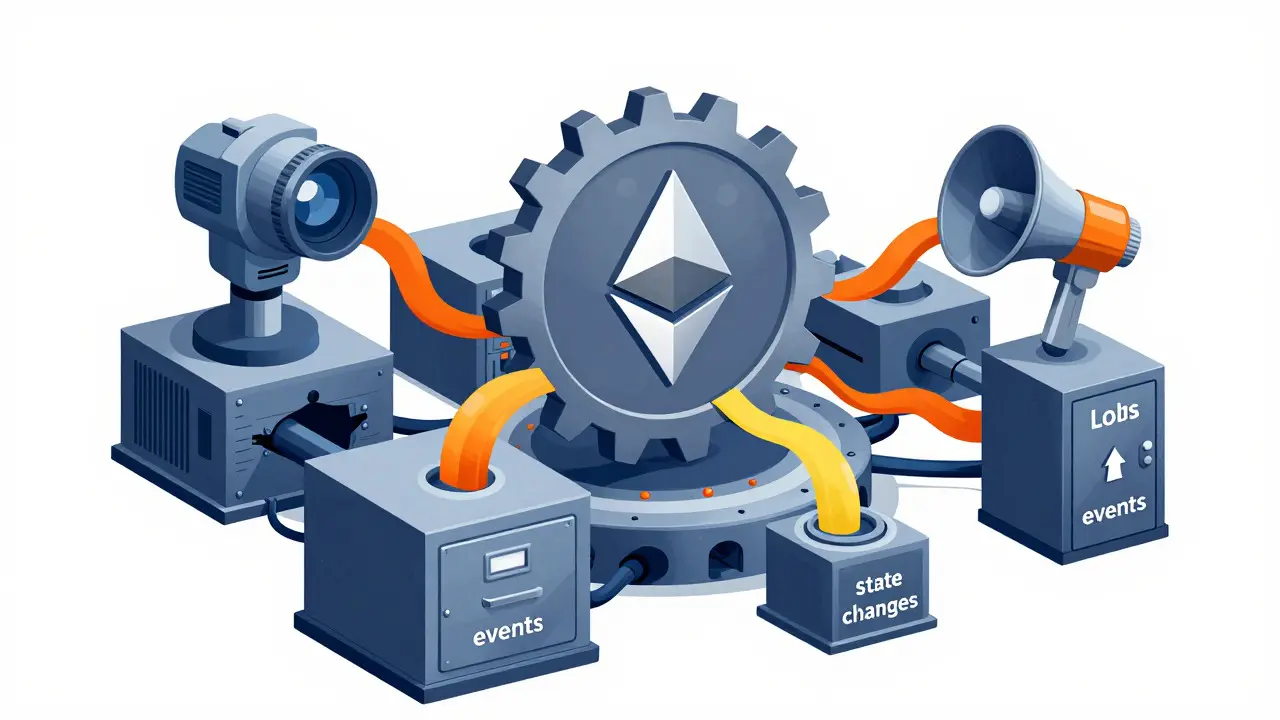
Smart contract interaction tracking is the process of monitoring, recording, and analyzing all activities, transactions, and state changes when entities interact with deployed smart contracts on a blockchain network. Think of it as a comprehensive security camera system for your dApp. It doesn’t just record that someone entered the room (the transaction); it records who they talked to (other contracts), what they moved (state changes), and what they said (events).
This tracking relies on two core components of any blockchain architecture: the immutable history and the current world state. When a smart contract executes, it primarily performs three actions on the world state: putting new data, getting existing data, and deleting old data. Simultaneously, it may emit events. These events are crucial because they act like log statements, providing structured information that external applications can easily parse. Without tracking, you’d have to manually decode every byte of raw transaction data, which is nearly impossible for complex DeFi protocols.
The Core Mechanics: Events, Logs, and State
To understand how tracking works, you need to know what the blockchain is actually logging. In Ethereum-based networks, this happens through the Ethereum Virtual Machine (EVM). The EVM uses specific opcodes, known as LOG0 through LOG4, to create indexed transaction logs. Each log entry contains topics and data payloads. Topics are indexed parameters that make searching fast and cheap. Data payloads contain the detailed, unindexed information.
Here’s a practical example. Imagine a lending protocol like Aave. When you deposit ETH, the following sequence occurs:
- Your wallet calls the
depositfunction on the Aave Pool contract. - The Pool contract emits a
Depositevent with your address, asset ID, and amount as topics/data. - The Pool contract updates its internal accounting variables in the world state.
- If you’ve enabled auto-supply, it might call another contract to optimize yield, creating a nested interaction.
Tracking tools capture all four steps. They don’t just show you the top-level call; they visualize the entire execution path. This is critical for debugging. If a transaction fails, was it because the user didn’t have enough gas? Did a price oracle return an unexpected value? Or did a permission check fail in a sub-call? Interaction tracking reveals these details instantly.
Why DeFi and NFTs Rely on This Technology
You might ask, "Who actually needs this level of detail?" The short answer: everyone involved in high-value on-chain activity. Let’s look at two major sectors where this is non-negotiable.
Decentralized Finance (DeFi)
In DeFi, capital efficiency is everything. Users often move funds across multiple protocols to maximize yield. Tracking allows portfolio dashboards to aggregate data from dozens of sources into a single view. For instance, a tool like Zapper or DeBank doesn’t just read your balance; it tracks every interaction you’ve ever had with Uniswap, Curve, or Lido. By indexing these historical interactions, they can calculate your realized P&L, average cost basis, and risk exposure in real-time.
Furthermore, risk management depends on tracking. If a protocol introduces a new feature, auditors use interaction tracking to simulate potential attack vectors. They analyze past interaction patterns to detect anomalies, such as reentrancy attacks or front-running attempts. By monitoring the sequence of calls, they can spot when a malicious actor tries to exploit a race condition.
NFT Marketplaces
NFTs seem simpler, but they have their own tracking complexities. Royalty payments are a prime example. Many marketplaces enforce royalties via smart contracts. Tracking verifies that when an NFT is resold, the royalty payment actually occurred and went to the correct artist address. Before advanced tracking tools, artists often had to trust the marketplace. Now, they can verify compliance on-chain. Additionally, floor price calculations rely on tracking recent sales volumes and prices across multiple platforms to provide accurate market data.
Tools and Platforms for Monitoring Interactions
You don’t need to build your own indexer from scratch to benefit from this technology. Several specialized platforms have emerged to handle the heavy lifting.
| Platform | Primary Use Case | Key Feature | Best For |
|---|---|---|---|
| Etherscan / BscScan | Basic Exploration | Transaction history, event logs, internal txns | Quick checks, verifying individual transactions |
| Chainlens | Advanced Analytics | SaaS/on-premises data platform, pattern analysis | Enterprises, deep-dive audits, custom dashboards |
| Dune Analytics | Data Querying | SQL-like queries on indexed blockchain data | Researchers, analysts, creating visual reports |
| Tenderly | Development & Debugging | Fork testing, simulation, error tracing | Developers debugging failed transactions |
Traditional explorers like Etherscan are great for quick lookups. If you want to see if a specific address received a token, you go there. But if you want to analyze the trading behavior of a whale over the last six months, you’ll need something more powerful like Dune or Chainlens. These platforms index the raw event data and store it in queryable databases, allowing you to run complex filters and aggregations.
Security Implications and Risk Detection
One of the most underrated benefits of interaction tracking is security. Smart contracts are immutable, meaning once deployed, they can’t be changed. This makes bugs permanent. Comprehensive monitoring helps identify malicious activities before they cause massive losses.
Consider a sandwich attack. This occurs when a bot detects a large pending transaction in the mempool and places its own buy order before it, then sells immediately after, profiting from the price impact. By tracking the sequence of interactions and gas prices, monitoring systems can flag these patterns. Similarly, reentrancy attacks involve a contract calling back into itself before the first call finishes. Tracking the depth of call stacks and state changes during execution helps auditors spot these vulnerabilities during testing phases.
For enterprise users, tracking also aids in compliance. If a company uses a private or permissioned blockchain like Hyperledger Fabric, interaction tracking ensures that endorsement policies are being met. It provides an audit trail that proves exactly who approved what transaction, satisfying regulatory requirements for transparency.
Challenges: Scalability, Privacy, and Cost
It’s not all smooth sailing. Implementing robust interaction tracking comes with significant challenges.
- Scalability: High-volume networks like Ethereum generate terabytes of data daily. Storing and querying this efficiently requires expensive infrastructure. Layer 2 solutions help by bundling transactions, but they introduce additional complexity in tracking cross-layer interactions.
- Privacy Concerns: While blockchains are transparent, not all data should be public. If you’re tracking business-to-business payments, you might not want competitors to see your volume. Zero-knowledge proofs are emerging as a solution, allowing verification of interactions without revealing underlying data.
- Gas Costs: Every event emitted costs gas. If a developer logs too much detail, transaction fees skyrocket. Developers must strike a balance between useful tracking data and cost efficiency. Excessive logging can make a dApp unusable for small users.
- Cross-Chain Complexity: As assets move between Ethereum, Solana, and Polkadot, tracking becomes fragmented. A user might deposit on Ethereum, bridge to Arbitrum, and swap on Uniswap v3. Connecting these dots across different chains requires sophisticated multi-chain indexing capabilities.

Future Trends in On-Chain Monitoring
Where is this heading? The future of interaction tracking is increasingly intelligent. We’re seeing the integration of AI and machine learning to predict anomalies. Instead of just alerting you when a transaction fails, these systems will warn you when a transaction *looks* suspicious based on historical patterns. Real-time analytics are becoming standard, enabling instant risk assessment for traders.
Additionally, privacy-preserving tracking is gaining traction. With the rise of confidential computing and zero-knowledge rollups, we’ll soon be able to track compliance and ownership without exposing sensitive financial data to the public eye. This opens up new possibilities for healthcare and supply chain applications, where patient data or proprietary logistics info needs to remain private while still being verifiable on-chain.
Practical Tips for Getting Started
If you’re a developer or analyst looking to implement tracking, start simple. Don’t try to monitor everything at once. Identify the critical events in your smart contract-deposits, withdrawals, swaps, mints-and ensure those are properly logged with indexed topics. Use a development environment like Tenderly to simulate transactions and verify that your events are firing correctly before deploying to mainnet.
For users, leverage existing dashboards. Don’t rely solely on your wallet’s built-in display. Use third-party trackers to get a holistic view of your portfolio health. And always keep an eye on gas costs; if you’re running complex scripts that generate many events, consider batching operations to save fees.
Frequently Asked Questions
What is the difference between a transaction and an event in blockchain tracking?
A transaction is the atomic unit of work sent from a wallet to the network, containing the input data and gas limit. An event is a log entry emitted by a smart contract during execution. One transaction can produce multiple events. Transactions represent the 'action,' while events represent the 'result' or 'notification' of that action.
Do I need a node to track smart contract interactions?
Not necessarily. You can use RPC providers like Infura or Alchemy to fetch data. However, for high-frequency or historical analysis, running your own node or using a specialized indexing service like The Graph or Chainlens is more efficient. Direct node access gives you lower latency but higher maintenance overhead.
How does interaction tracking help prevent scams?
Tracking allows you to verify the legitimacy of a contract before interacting with it. By checking the contract's historical interactions, you can see if it has been used by reputable addresses, if it holds locked liquidity, and if it has a consistent pattern of normal activity. Sudden spikes in unusual interactions or admin key usage can signal a potential rug pull or exploit.
Is smart contract interaction tracking available on all blockchains?
Yes, but the implementation varies. Ethereum and EVM-compatible chains use LOG opcodes. Hyperledger Fabric uses channel-based validation. Solana uses program logs. The core concept remains the same: recording state changes and notifications. However, tooling support is strongest on Ethereum and its Layer 2s due to market dominance.
What is the cost of implementing comprehensive tracking?
The cost depends on scale. For basic monitoring, free tiers of explorers suffice. For enterprise-grade analytics, expect to pay for data storage, compute resources, and potentially SaaS subscriptions. Gas costs for emitting events are minimal per event but add up if you log excessively. Most developers find that optimizing event data size reduces both gas costs and storage requirements.

Phelan Deihl
I read through this twice and it actually made sense, which is rare for technical guides. The part about how a single swap can trigger dozens of internal calls really clicked for me. I used to just look at the green checkmark in my wallet and assume everything was fine, but now I realize I was basically ignoring half the story. It’s quiet work, but it feels important to understand what’s actually happening under the hood.
Darren Moon
One must acknowledge that while the exposition on EVM opcodes is technically sound, it remains a rather pedestrian overview of a complex subject matter. The reliance on standard LOG topics as the primary vector for state observation is, frankly, somewhat dated given the advent of more sophisticated indexing paradigms. Furthermore, the assumption that all enterprise-grade solutions require expensive infrastructure is a lazy generalization; one need only look at the efficiency gains from modern data sharding techniques to see that storage costs are not an immutable constant. It is a competent piece, yet it lacks the nuance required for truly advanced practitioners who deal with high-frequency trading environments where microsecond latency matters more than historical data integrity.
Kate Staab
Ooh, look at you all getting so excited about 'tracking'! 🙄 As if we didn't already know that every time you click 'swap,' you're leaving a digital footprint bigger than your actual life. It’s dramatic, isn’t it? The idea that you need a whole platform like Dune or Chainlens just to see where your money went is honestly a bit much. We should be ashamed of how dependent we are on these third-party eyes watching our wallets. It’s not privacy, it’s surveillance with extra steps!
Calliope Clio
Mmm, the pretentiousness is palpable even in the writing style 😏. Let’s be real, most people reading this aren’t going to care about the difference between a transaction and an event unless they’re trying to build the next Uniswap. But hey, if you want to feel smart by decoding raw bytes, go right ahead. Just don’t expect the average user to understand why their gas fees spiked because some developer decided to log too much data. It’s all very theoretical until your portfolio drops 10% in a minute.
Tasha Davis
This is SO helpful! I’ve been struggling with understanding why my NFT royalties weren’t showing up correctly on some marketplaces, and this explained exactly why tracking those specific events matters. It’s such a relief to finally have a clear breakdown of how the system works behind the scenes. Thanks for making it easy to understand!
Abigail Sparks
Stop overthinking it! If you’re a dev, use Tenderly. If you’re a user, use DeBank. Done. The article is great but let’s not forget that simplicity wins. Don’t get bogged down in the weeds of cross-chain complexity unless you’re actually bridging assets daily. Focus on the core interactions first. You’ll save yourself hours of headache. Get started today!
OLIVER CHRISTIAN
Great point about the security implications. I’ve seen too many projects rug pull simply because nobody was monitoring the admin key usage patterns. It’s not just about seeing the trade happen; it’s about seeing the context. For anyone starting out, I’d recommend looking into open-source indexers before jumping straight to paid SaaS. It teaches you a lot about how the data flows. Also, keep an eye on gas costs when designing your events. Small details make a big difference in user experience.
Kelsey Anne
You don't need a node. Use Infura. Stop asking basic questions. The article says it right there. Read more.
Mike Baca
man this got me thinking about how much we trust the 'green check'. i mean sure its cool to see the code run but isnt it kinda scary that we rely on these tools to tell us the truth? like if the indexer is wrong do we even know? its a wild thought but i guess thats the price of transparency. also the part about AI predicting anomalies sounds like something out of a sci-fi movie but im guessing its coming soon lol
Teri W
Drama alert! 🚨 Who decided that we needed to track EVERYTHING? Is it too much to ask for a little privacy? I mean, sure, blockchain is public, but does everyone need to see my exact yield farming strategy? It feels like we’re living in a glass house where every move is scrutinized. And don’t get me started on the gas costs. It’s a disaster waiting to happen. We need better standards, people! Not just more tools to watch us fail.
Leah Humphrey
The discussion on cross-chain complexity is understated. In practice, correlating state changes across heterogeneous consensus mechanisms introduces significant latency and data inconsistency issues. Most current solutions rely on heuristic matching rather than cryptographic proof of equivalence, which is a fragile foundation for any serious risk management framework. We need robust multi-chain indexing protocols that can handle atomic composability without relying on trusted intermediaries.
Rod Sidoroff
Most of you are missing the forest for the trees. The real value here isn't in the visualization dashboards, it's in the raw data architecture. If you can't query the underlying state efficiently, your 'tracking' is just a pretty picture. Look at how the top quant firms handle this. They don't use Dune. They build custom pipelines. The rest of you are playing with toys while the pros are moving billions. Wake up.
Jay Johhnston
It’s interesting to see how different cultures approach this. In my experience working with teams in Asia, the focus is often on speed and low cost, whereas Western teams tend to prioritize auditability and compliance. Both are valid, but the tooling needs to reflect that diversity. A one-size-fits-all solution rarely works well. We need flexible frameworks that can adapt to different regulatory and operational contexts.
Niall O'Rourke
yeah whatever. another long post about tech that probably wont change anything. i still think most of this is hype. people will keep losing money to scams no matter how good the tracking is. maybe if we stopped trusting code and started trusting humans again things would be better. but nah lets just keep adding more layers of complexity to simple problems
Jillian Groskreutz
Finally!! Someone is talking about the REAL issues. Privacy! Compliance! These are the things that will kill DeFi if not handled properly. The fact that we’re debating whether to use ZK proofs is absurd. We need them NOW. Every second we wait, more data leaks. And don’t get me started on the lack of standardization. It’s a mess. We need regulations, not just more apps. Fix the system before you break it further!
Carmene Jackson
honestly i just want to know if my nft sold or not. do i really need to understand the EVM opcodes? feels like overkill for a casual user. but i guess its good to know its all there if you need it. just wish the interfaces were simpler. less jargon please
Jennifer Ulmer
Let’s cut the fluff. The 'security' angle is a red herring for most users. The real problem is UX. If tracking makes your dApp slow or confusing, you lose users. Period. Developers need to balance granularity with performance. Too much logging = high gas + bad UX. Too little = blind spots. It’s a tightrope walk. Most teams get it wrong. They prioritize backend elegance over frontend usability. Fix that and you’ll have real adoption.
Stephanie Millar
Very informative, thank you! It’s always nice to see a detailed guide that breaks down the technical aspects without being too intimidating. I particularly liked the comparison table of the tools. It helped me decide which one might be best for my current project. Keep up the good work!
Nikki keller
To add to the earlier points, I think we should also consider the psychological aspect of tracking. When users can see exactly what happened, their trust in the protocol increases. It reduces anxiety. However, if the data is too complex, it can cause confusion and doubt. So, the presentation layer is just as important as the data layer. We need to design for clarity, not just completeness. A balanced approach is key.
miranda gamboa
Love the energy here! This topic is so dynamic. I’m curious about how machine learning will evolve in this space. Will we see predictive analytics becoming standard for retail investors? It could democratize access to professional-grade insights. Imagine having a personal AI advisor that watches your portfolio in real-time. That’s the future! Exciting times ahead for blockchain tech.
Kiran Jayaram
stop wasting time on theory. go build something. if your contract fails you already lost money. tracking is for after the fact. fix your code before deploying. stop blaming the tools for your poor engineering skills. its embarrassing really. get a grip and learn solidity properly instead of reading articles
Zothana Pachuau
Hey team, nice discussion! I appreciate the mix of perspectives here. It’s great to see both the technical deep dives and the user-focused concerns. Remember, the goal is to make blockchain accessible, not just impressive. Keep sharing your tips and experiences. We’re all in this together, learning as we go. Great job everyone!
Darren Moon
Indeed, the pedagogical value of such a thread is undeniable, provided one ignores the occasional lapse in logical rigor. It serves as a useful primer for the uninitiated, though perhaps less so for those entrenched in the trenches of distributed systems engineering. Nevertheless, a commendable effort in distilling complexity into digestible chunks.
Tasha Davis
Thanks for the kind words! It’s always encouraging to hear when a guide actually helps someone solve a real problem. Glad you found the royalty section useful. That’s one of the trickier parts of NFT tracking, so it’s good to clarify it. Happy minting!