Social Media Sentiment for Crypto: How to Read the Real Signals in 2026
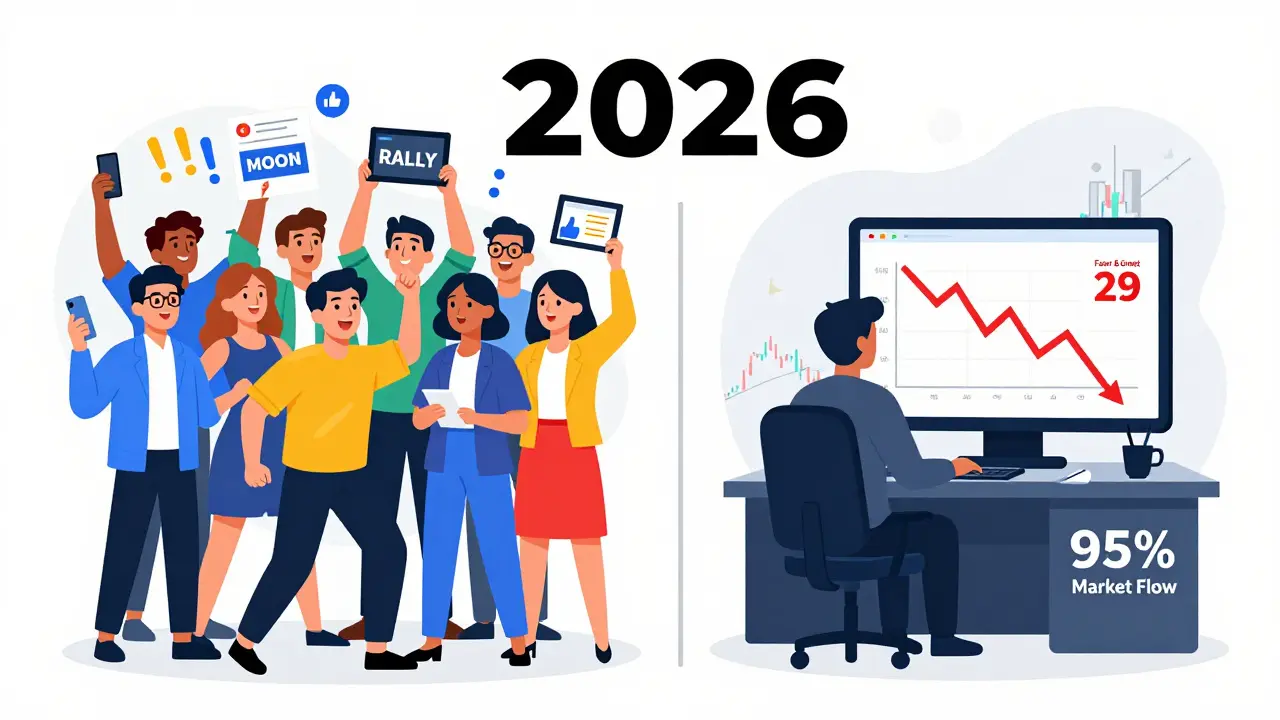
Ever notice how everyone on Twitter seems convinced Bitcoin is about to moon, yet your portfolio feels like it’s stuck in neutral? You aren’t imagining things. In early 2026, we are witnessing a massive disconnect between what people say online and what money is actually doing. This gap between social media hype and cold hard cash flow is the most critical signal you can track right now.
Social media sentiment for crypto isn’t just noise anymore. It has become a measurable asset class metric. But if you treat every viral post as a buy signal, you will likely get burned. The real value lies in understanding the paradox: retail enthusiasm is high, but institutional fear is deeper. Let’s break down how to read these signals so you don’t get left holding the bag when the music stops.
The Paradox of 2026: Hype vs. Reality
We need to look at the numbers because they tell a story that emotions hide. At the start of 2026, Santiment, a leading analytics platform, tracked a 20% increase in positive mentions across major social networks since January 1. Terms like "rally," "opportunity," and "new bull cycle" jumped by 40% compared to December 2025. On the surface, this looks like pure optimism. Retail investors are talking, engaging, and feeling good.
But then you check the Fear & Greed Index, which measures overall market psychology through volatility, momentum, and volume. As of early February 2026, this index sat at 29. That places it firmly in the "Fear" category. It has stayed in the "Fear" to "Extreme Fear" range since November 2025. So, we have a situation where social media is cheering, but the technical indicators are screaming caution. Why does this matter? Because history shows that markets often move opposite to widespread expectations. When everyone is euphoric, there are no buyers left to push prices higher.
| Metric Source | Data Point | Interpretation | Market Implication |
|---|---|---|---|
| Santiment Social Data | +20% positive mentions | Retail Optimism | High engagement, potential FOMO risk |
| Fear & Greed Index | Score of 29 (Fear) | Institutional Caution | Smart money is waiting or hedging |
| Binance Sentiment Report | 85% Negative (Feb 2026) | Panic Selling | Potential bottom forming or continued bleed |
Who Actually Moves the Market?
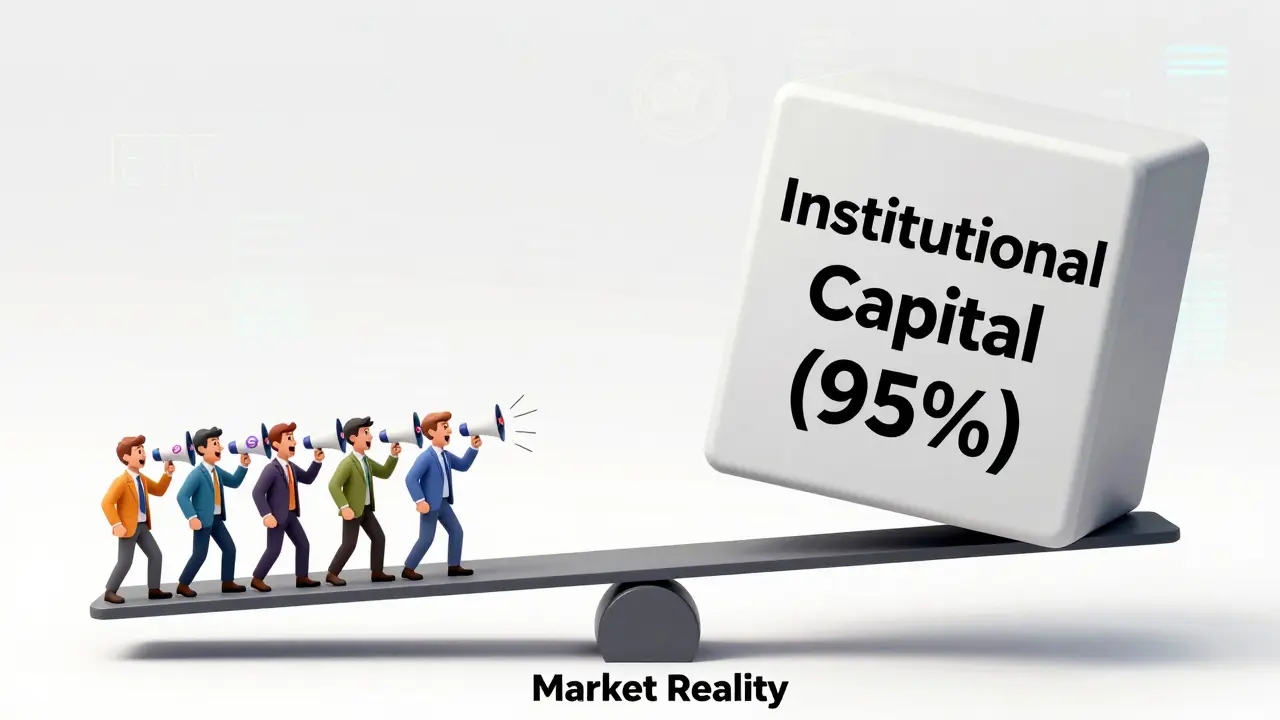
You might think that because millions of people are posting about crypto, their collective opinion drives price. Unfortunately, that’s not how capital works. According to Santiment data, Institutional Investors account for approximately 95% of total cryptocurrency market flows. Retail investors represent only 5% to 6%. This means that while you see thousands of tweets, the actual buying power is concentrated in the hands of a few large entities.
This imbalance creates a dangerous illusion. Retail sentiment is visible, loud, and easy to measure. Institutional sentiment is quiet, hidden, and reflected in order books and on-chain large wallet movements. When institutions are fearful (as indicated by the low Fear & Greed score), they are not buying the dip aggressively; they are likely sitting on cash or hedging against downside. If you follow the crowd on social media into a trade while institutions are pulling back, you are swimming upstream.
Consider the context of 2025. Bitcoin surged to all-time highs, creating a mix of excitement and anxiety. Now, in 2026, regulatory shifts under new political leadership have changed the landscape. About 60% of survey respondents expect values to rise, and 28% of Americans now own crypto. This mainstream adoption is real, but it doesn’t mean the market is ready for another parabolic run immediately. The institutional hesitation suggests they are waiting for clearer fundamentals or better entry points.
The Rapid Flip: From Euphoria to Panic
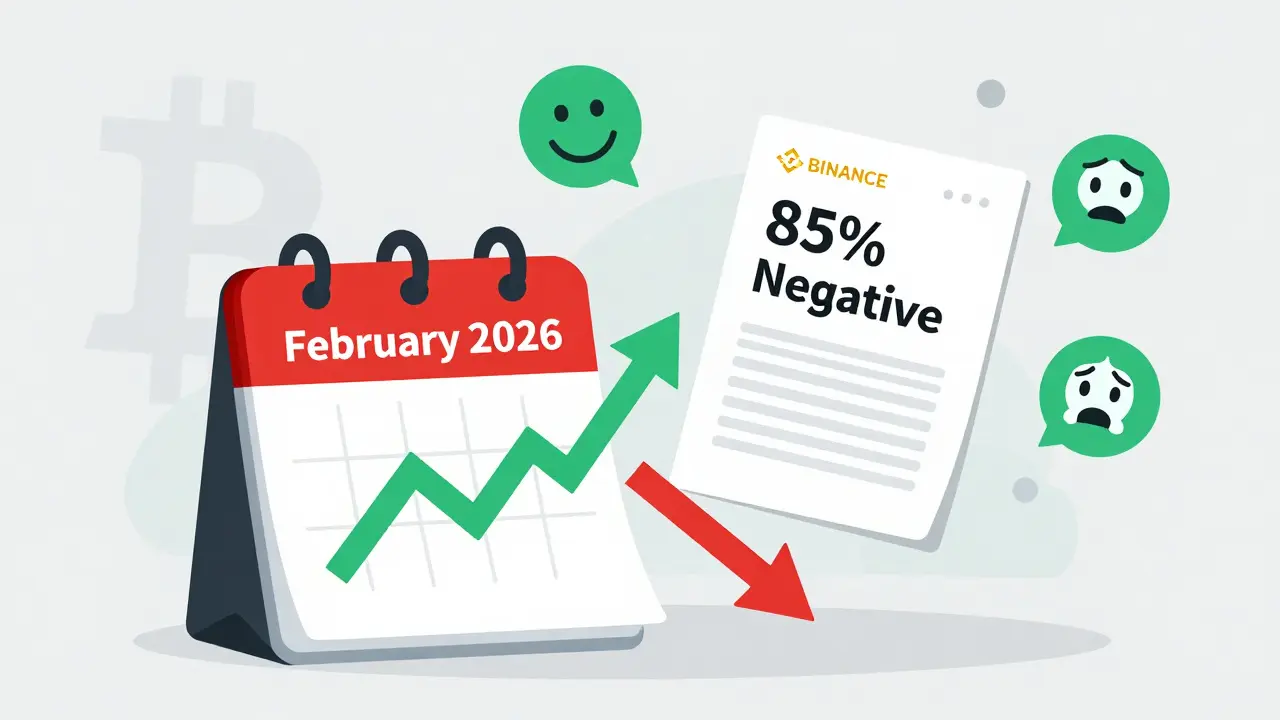
Sentiment in crypto is notoriously volatile. Just weeks after the positive spike in January 2026, the mood shifted dramatically. A comprehensive report by Binance covering February 2026 showed that sentiment toward Bitcoin leaned heavily negative. The breakdown was stark: only 15% positive sentiment versus 85% negative. This reversal highlights how quickly retail psychology can swing from greed to fear based on short-term price action or macroeconomic news.
Why did this happen? Often, it’s due to a lack of follow-through. If prices don’t rise despite the hype, frustration sets in. Or, if external factors like interest rate decisions or geopolitical tensions hit, the fragile optimism collapses. The Binance report noted that while some analysts see this pessimism as a sign of a potential market bottom, the dominance of negative sentiment is undeniable. For traders, this rapid flip is a warning: do not anchor your strategy to last week’s sentiment. The narrative changes faster than you can react.
How to Use Sentiment Without Getting Burned
So, should you ignore social media entirely? No. But you must use it differently. Instead of using sentiment as a direct buy/sell signal, treat it as a contrarian indicator or a gauge of market temperature. Here is a practical framework for interpreting these signals:
- Watch for Extremes: When social sentiment hits extreme greed (everyone is bullish) and the Fear & Greed Index is above 75, be cautious. This is often a local top. Conversely, when sentiment is extremely negative (like the 85% negative reading in Feb 2026) and the index is in Extreme Fear, consider it a potential accumulation zone.
- Track the Divergence: Pay attention to gaps like the one in early 2026. If social media is bullish but technical indicators are fearful, the market is unstable. Price may chop sideways or correct before moving up. Wait for alignment.
- Monitor Key Levels: Analysts like Brian Quinlivan from Santiment have pointed out specific price triggers. For example, if Bitcoin rapidly approaches $92,000, it could trigger significant FOMO among retail investors. Knowing these psychological levels helps you anticipate sudden spikes in volume and subsequent corrections.
- Focus on Flow, Not Noise: Since institutions control 95% of flows, prioritize on-chain data showing large wallet movements over tweet volume. If big wallets are accumulating while Twitter is panicking, that’s a strong bullish signal.
The Role of New Financial Products
The landscape in 2026 is different from previous cycles due to the arrival of new financial products. Cryptocurrency ETFs have brought traditional finance players into the space. These investors operate on different time horizons and risk tolerances than typical retail traders. Their presence dampens extreme volatility but also introduces new dynamics. For instance, corporate adoption is accelerating, with Pantera Capital reporting that 76% of companies plan to add tokenized assets to their portfolios. This structural demand provides a floor for prices, even when retail sentiment sours.
However, this also means that retail sentiment alone is less predictive. The market is becoming more efficient. Information spreads instantly, and algorithms adjust positions in milliseconds. By the time a trend becomes obvious on social media, it has often already been priced in by sophisticated actors. Your edge comes from understanding the lag between social perception and institutional execution.
Practical Tools for Monitoring
To stay ahead, you need reliable tools that aggregate data beyond just likes and shares. Platforms like Santiment provide deep dives into engagement quality, not just quantity. They track tone, volume, and influencer impact. Similarly, the Fear & Greed Index offers a quick snapshot of market emotion. Combining these with on-chain metrics gives you a holistic view.
Don’t rely on a single source. Cross-reference social data with technical analysis and fundamental developments. For example, if regulatory clarity emerges in the US, it might boost sentiment, but if on-chain activity doesn’t increase, the move may be short-lived. Always ask: who is behind this sentiment? Is it driven by genuine adoption or speculative hype?
Looking Ahead: What Comes Next?
As we move through 2026, the key question is whether the February pessimism represents a normalization or the start of a bearish phase. The analytical consensus suggests that social sentiment serves best as a caution signal. If retail enthusiasm remains measured and slightly impatient, conditions are favorable for gradual appreciation. If it swings to extreme FOMO, expect a correction.
The institutional-retail divide will remain a central theme. Until retail capital aligns more closely with institutional flows, expect continued divergence between social noise and price action. Keep your eyes on the 95% of the market that actually moves the needle. Stay disciplined, ignore the hype, and let the data guide your decisions.
What is the current state of crypto social sentiment in 2026?
In early 2026, there is a significant divergence. Social media platforms show increased positive mentions (up 20% since Jan 1), indicating retail optimism. However, technical indicators like the Fear & Greed Index remain in the "Fear" zone (score of 29), suggesting institutional caution. By February, sentiment shifted sharply to 85% negative according to Binance reports, highlighting high volatility in investor psychology.
How much of the crypto market is controlled by retail vs. institutional investors?
According to Santiment data, institutional investors account for approximately 95% of total cryptocurrency market flows, while retail investors represent only 5% to 6%. This means that despite high visibility on social media, retail sentiment has limited direct impact on price movements compared to institutional capital allocation.
What does the Fear & Greed Index measure?
The Fear & Greed Index aggregates data from multiple sources including volatility, trading volume, and social media trends to gauge overall market psychology. Scores range from 0-100, with below 25 being "Extreme Fear," 25-45 "Fear," 45-55 "Neutral," 55-75 "Greed," and above 75 "Extreme Greed." It is widely used to identify potential market reversals.
Why did Bitcoin sentiment drop to 85% negative in February 2026?
The sharp decline in sentiment reflects rapid shifts in retail psychology often triggered by price corrections, lack of immediate rallies, or broader macroeconomic concerns. The Binance report noted that while this negativity might signal a market bottom, it primarily indicates a loss of confidence among retail participants following the earlier January optimism.
Should I trust social media hype for trading decisions?
No, you should not rely solely on social media hype. Historical data shows that peak social euphoria often precedes market corrections. Instead, use social sentiment as a contrarian indicator. Combine it with technical analysis, on-chain data, and institutional flow metrics to make informed decisions. Remember that institutions control 95% of market flows, so their actions matter more than retail chatter.