Timestamp Verification for IP Claims: Prove Ownership with Blockchain
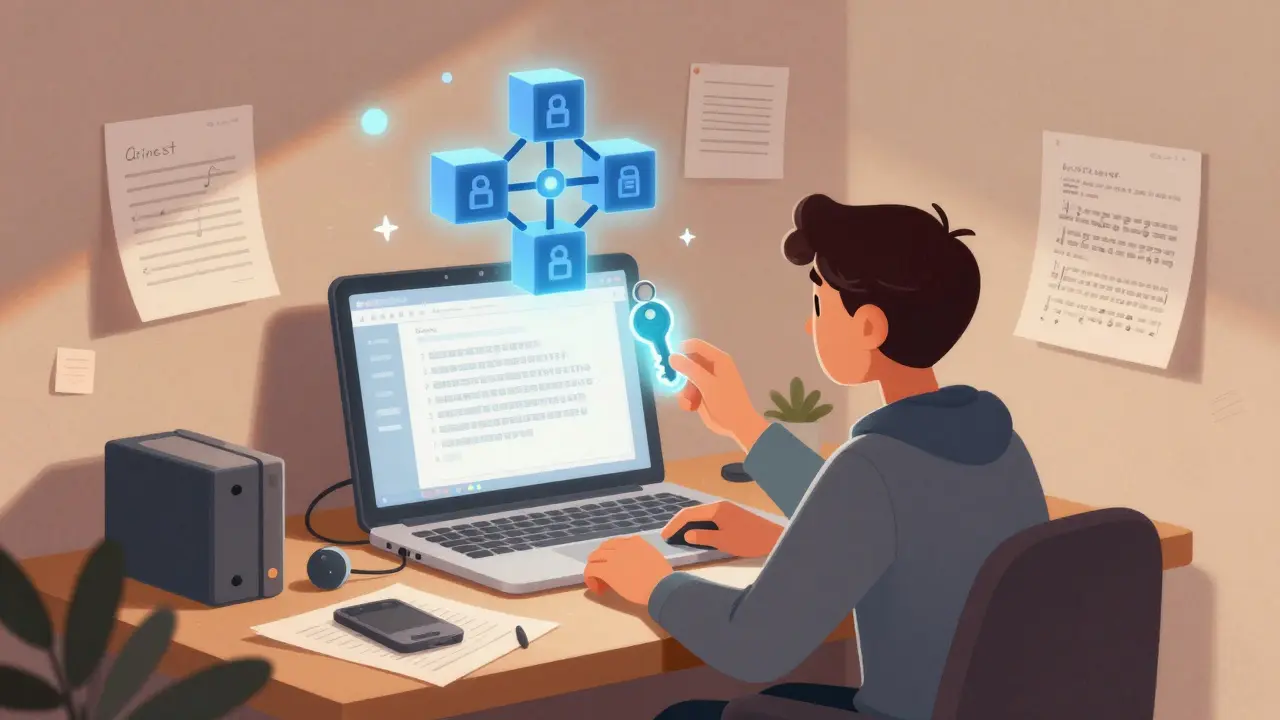
When you finish writing a song, designing a logo, or coding a new app, you own it. But ownership isn’t enough. In a world where copies spread in seconds, proving you created it first is the real battle. That’s where timestamp verification for IP claims comes in.
Think of it like a digital notary that locks your work in time. No more guessing if your draft existed before someone else copied it. No more "I had it first" arguments that go nowhere. A timestamped record gives you undeniable proof - not just to yourself, but to courts, companies, and competitors.
How Timestamps Work: It’s Not Just a Date
A timestamp isn’t just your computer’s clock saying "February 14, 2026, 3:12 PM." That’s easy to fake. Real timestamp verification uses cryptography to create a unique fingerprint of your file - a digital DNA made of numbers and letters that only that file produces. This fingerprint is then tied to an exact moment in time by a trusted third party.
The magic happens when that fingerprint gets recorded on a blockchain. Blockchains are public, tamper-proof ledgers. Once your file’s hash is written there, it can’t be changed, deleted, or backdated. Even if someone alters your original file later, the timestamped version stays frozen in time. That’s why courts and IP offices now take these records seriously.
Why WIPO PROOF Changed the Game
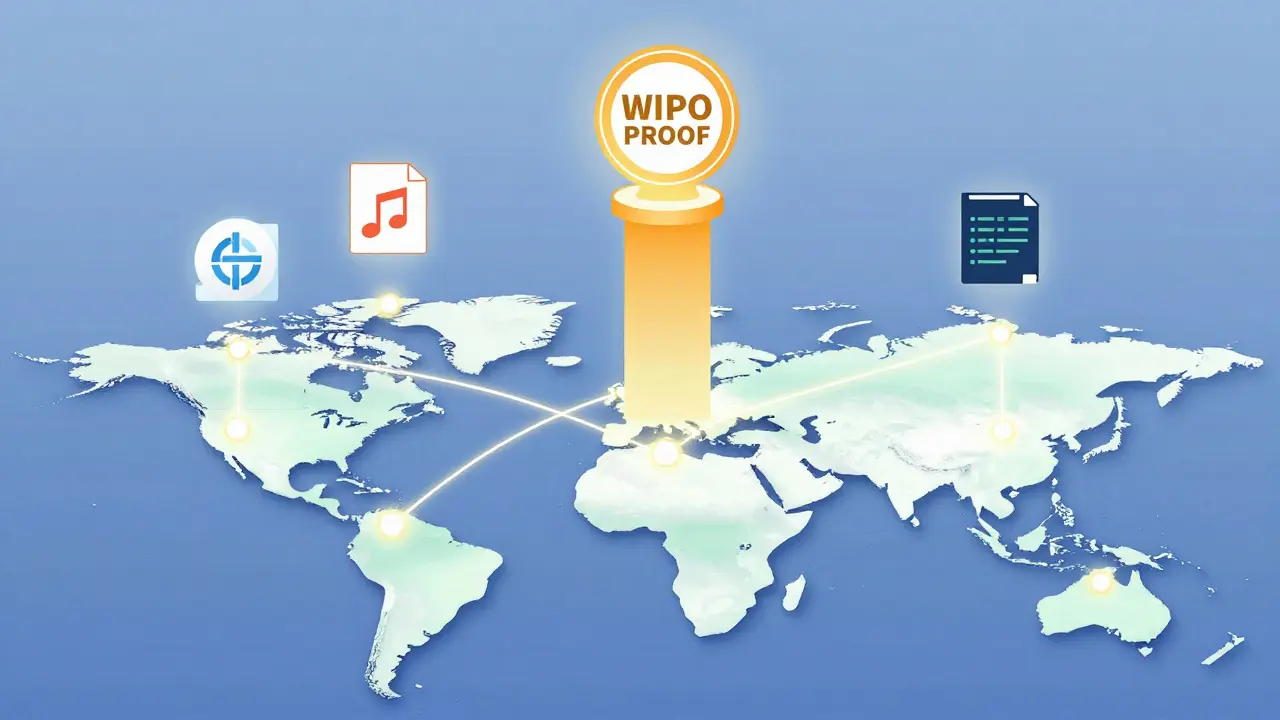
In 2020, the World Intellectual Property Organization (WIPO) launched WIPO PROOF - the first global, official service built for this exact problem. Before this, creators used private services with uncertain legal weight. WIPO PROOF changed that.
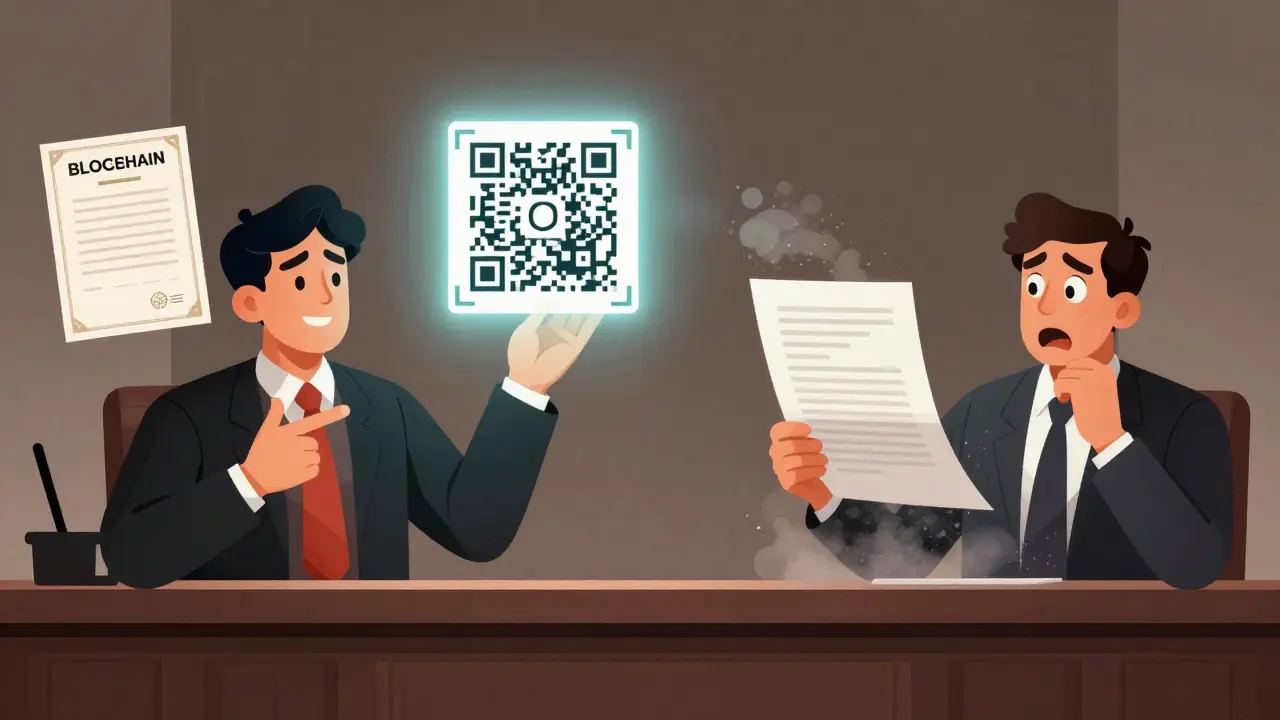
Here’s how it works: You upload your file - a PDF, MP3, PNG, or even a code file. The system generates a unique hash. That hash gets stamped with the exact UTC time and anchored to a blockchain. You get a token - a digital certificate with a QR code and a unique ID. You can verify it anytime, anywhere, using WIPO’s public checker.
Important: WIPO PROOF doesn’t give you copyright or patent rights. It doesn’t register your work. But it proves you had it on a specific date. That’s the first, critical step in any dispute. If someone claims they invented your design in March, but your WIPO PROOF shows it was sealed in January - you win.
What You Can Protect
This isn’t just for artists. Timestamp verification works for anyone creating digital content:
- Writers: Manuscripts, poems, scripts - timestamp before submitting to publishers.
- Musicians: Raw tracks, demos, lyrics - prove you wrote them before a label claims co-ownership.
- Designers: Logos, UI layouts, product mockups - stop clients from stealing concepts.
- Developers: Code snippets, algorithms, API designs - protect your work before open-sourcing or pitching.
- Researchers: Lab notes, datasets, prototypes - timestamp before publishing to establish priority.
Even if you don’t plan to register a patent, timestamping your R&D work creates a trail. If a rival company files a patent on something you invented six months earlier, your timestamp becomes your evidence.
Blockchain vs. Traditional Timestamping
Not all timestamping is equal. Some services use simple digital signatures or server logs. These can be challenged. Blockchain-based systems are stronger because they’re decentralized.
For example, KeeeX combines RFC 3161 standard timestamps with blockchain anchoring. That means your proof is verified by a trusted time authority and locked on a public ledger. Drawy does something similar - upload your design, get a PDF with the timestamp, owner name, and a unique reference number.
But the strongest proof comes from services like WIPO PROOF, which uses blockchain not just for storage, but for public verification. Anyone can check the hash. No backdoor. No private database. Just math and transparency.
Legal Weight: What Courts Actually Accept
Lawyers used to shrug off timestamps. Now, they’re common evidence. In the EU, eIDAS regulation gives qualified timestamps the same legal weight as handwritten signatures. In the U.S., courts accept blockchain timestamps under the Federal Rules of Evidence as "business records" or "certified digital evidence."
Here’s what matters in court:
- Was the timestamp issued by a trusted third party? (WIPO PROOF - yes. Your laptop clock - no.)
- Can the hash be independently verified? (Yes, if it’s on a public blockchain.)
- Is the file unchanged since timestamping? (If the hash matches, it hasn’t been altered.)
One real case: A graphic designer in Berlin used WIPO PROOF to prove she created a logo six months before a client tried to register it as their own. The court accepted the timestamp as proof of anteriority. The client dropped the claim.
What Timestamps Can’t Do
It’s easy to overstate what timestamps do. They don’t:
- Grant you legal rights (copyright exists automatically - this just proves when).
- Replace patents or trademarks (those still require formal registration).
- Stop plagiarism outright (they help you prove it happened).
Think of it as your digital alibi. It doesn’t prevent theft - but if theft happens, you have the receipts.
How to Use It: A Simple 3-Step Process
Getting started takes less than five minutes:
- Save your file. Final version. No drafts. This is the one you want to protect.
- Go to WIPO PROOF. Visit the official site. Upload the file. Pay the small fee (around $10 USD).
- Download and store your token. Save the PDF and the unique code. Keep it safe - like a deed to your idea.
Do this every time you finish something important. Don’t wait until someone steals it. Proactive timestamping is cheap insurance.
Who’s Using This Right Now?
It’s not just indie creators. Major tech firms use it. A startup in Wellington used WIPO PROOF to timestamp their AI training dataset before pitching to investors. A film studio in Canada timestamped early script versions to avoid future writer credit disputes. Even universities are adopting it - researchers timestamp lab notebooks to protect discoveries.
Why? Because in 2026, your biggest threat isn’t piracy. It’s someone else claiming your idea as theirs - and having the paperwork to prove it.
Future of IP Protection
The next step? Integration. Services are starting to link timestamping with smart contracts. Imagine uploading your design, automatically getting a timestamp, and instantly licensing it via blockchain - all in one click.
But the core hasn’t changed: prove you were first. That’s what timestamp verification does. It turns "I had it first" into "Here’s the proof."
Can I use timestamping to copyright my work?
No. Copyright exists automatically when you create an original work. Timestamping doesn’t register or grant copyright. But it proves when you created it - which is often the key to enforcing your copyright in court.
Is blockchain timestamping legal everywhere?
Yes, if it’s issued by a trusted authority like WIPO PROOF. Courts in the U.S., EU, Canada, Australia, and New Zealand accept blockchain timestamps as credible evidence. Services using eIDAS standards (like KeeeX) have extra legal weight in Europe.
What if I lose my timestamp token?
You don’t need the file - you need the hash and timestamp ID. Most services let you re-verify your proof online using just the unique code. Keep that code safe - not the file. The hash is what matters.
Can someone copy my timestamped file and claim it’s theirs?
They can copy the file, but they can’t copy the timestamp. Only the original creator can prove they uploaded it first. If they try to timestamp the same file later, their timestamp will show a later date - and your earlier one will prove you were first.
Do I need to timestamp everything I create?
No. But you should timestamp anything you plan to share, license, sell, or defend. If it has value - especially if it’s digital - timestamp it. It’s cheap, fast, and works.

Ruby Ababio-Fernandez
This is just another way to make creators pay for something that should be free. Copyright exists automatically. Why pay $10 to prove you wrote it? Lazy.
Jenn Estes
I love how people treat blockchain like it’s magic. It’s just math. And math doesn’t care if you’re the original creator. It just records what you feed it.
James Breithaupt
The WIPO PROOF model is actually a brilliant convergence of cryptographic hashing, time-stamping protocols (RFC 3161), and decentralized immutability. It’s not about copyright-it’s about anteriority in a zero-trust environment. Most creators don’t get that.
Jeremy Fisher
Look, I’ve been doing this for years-uploading my design files to a private server, timestamping them with a digital signature, and emailing myself a copy. It’s all theater. Blockchain doesn’t make it more real. It just makes it more expensive. And honestly? Most disputes get settled with emails and drafts anyway. No court is going to prioritize a hash over a Gmail timestamp.
Angela Henderson
I tried this with a logo I made last year. Took five minutes. Paid ten bucks. Got a PDF. I printed it and put it in a folder labeled ‘IP stuff’. I didn’t even open the QR code. But now I sleep better. Sometimes peace of mind is worth $10.
sruthi magesh
Blockchain? Who owns the blockchain? Big tech. Big gov. WIPO is just a UN front. You think they’re not selling your hash data? Wake up. This isn’t protection. It’s surveillance with a nice UI.
Kyle Tully
You know what’s wild? People pay for this but won’t pay for a real lawyer. You spend $10 on a hash but won’t spend $50 on a contract? That’s not smart. That’s just confused. Your idea isn’t safe because you have a PDF. It’s safe because you have a team. Period.
Ian Plunkett
I just lost a case because I didn’t timestamp. My client’s logo was stolen. We had emails. We had drafts. But the other side had a WIPO PROOF from three months before. I cried in court. Not because I was wrong. Because I was naive.
yogesh negi
This is a game-changer for small creators everywhere. I’ve helped five indie musicians in India use WIPO PROOF to protect their demos. One of them got a licensing deal because the label couldn’t dispute the timestamp. It’s not about tech-it’s about equity. Now, a kid in Jaipur has the same proof as a studio in LA.
Scott McCrossan
Oh wow, so now we’re using blockchain to prove we didn’t copy ourselves? This is the dumbest thing I’ve read all year. Who even uses this? The same people who buy NFTs of JPEGs and cry when the market crashes.
Rajib Hossaim
While the technical framework is sound, I would urge caution regarding over-reliance on blockchain timestamps in jurisdictions without clear legal recognition. The evidentiary weight varies significantly across legal systems, and one must consider local precedent before assuming universal enforceability.
Beth Erickson
I’m sick of people treating WIPO like some holy grail. It’s just a website. You think they care about your song? They care about their budget. This whole thing is a money grab disguised as protection
Anandaraj Br
You think you’re safe with a hash? What if WIPO gets hacked? What if they get bought by a corporation? What if they just delete your record tomorrow? You’re trusting a private company with your creative soul. That’s not smart. That’s tragic.
AJITH AERO
So I pay $10 to prove I made something... that I already own? Cool. Next you’ll sell me a receipt for breathing.
george chehwane
The entire premise is a fallacy. You don’t need to prove you created something-you need to prove you can monetize it. Timestamps are a placebo for people too scared to market their work. The market doesn’t care when you made it. It cares who you know.
Alex Williams
For developers: if you’re using GitHub, you’re already timestamping. Every commit is a hash. Every PR is a public record. WIPO PROOF is just a paid version of that. But if you’re not using version control, then yeah, maybe you need this. But honestly? Learn Git first.
Sarah Shergold
I timestamped my poem. Got the PDF. Then I posted it on Instagram. Now someone copied it. And I have the proof. But guess what? No one cares. The internet doesn’t care about your receipts. It cares about vibes.
Lisa Parker
I just did it. Uploaded my song. Got the token. Cried. It felt like I finally had a piece of me that couldn’t be taken. I don’t care if it’s expensive. I needed this.