Wealth Tax Treatment of Crypto in Switzerland: What You Need to Know in 2026

Switzerland doesn’t tax your crypto profits - but it does tax your crypto holdings. That’s the simple, surprising truth behind one of the world’s most investor-friendly crypto tax systems. If you own Bitcoin, Ethereum, or any other digital asset and live in Switzerland, you’re not paying capital gains tax when you sell. But every year, on December 31st, you must declare the total value of your crypto as part of your personal wealth. And yes, that’s taxed - at rates that vary from canton to canton.
How Switzerland Classifies Crypto
Switzerland doesn’t treat cryptocurrency like cash. The Swiss Federal Tax Administration (FTA) calls it kryptobasierte vermögenswerte - crypto-based assets. That means it’s grouped with stocks, bonds, and gold, not with Swiss francs or euros. This classification matters because it determines how it’s taxed. The FTA breaks crypto into three types:- Payment tokens - like Bitcoin and Litecoin. Used mainly for buying goods or services.
- Utility tokens - like those giving access to a platform or service. Their tax treatment depends on how they’re used.
- Security tokens - tokens that represent ownership, dividends, or profit-sharing. These are treated like traditional stocks.
For wealth tax purposes, all three are included in your total assets. But only security tokens trigger income tax if they pay dividends or interest. Payment and utility tokens? No income tax - just wealth tax.
How Wealth Tax Works
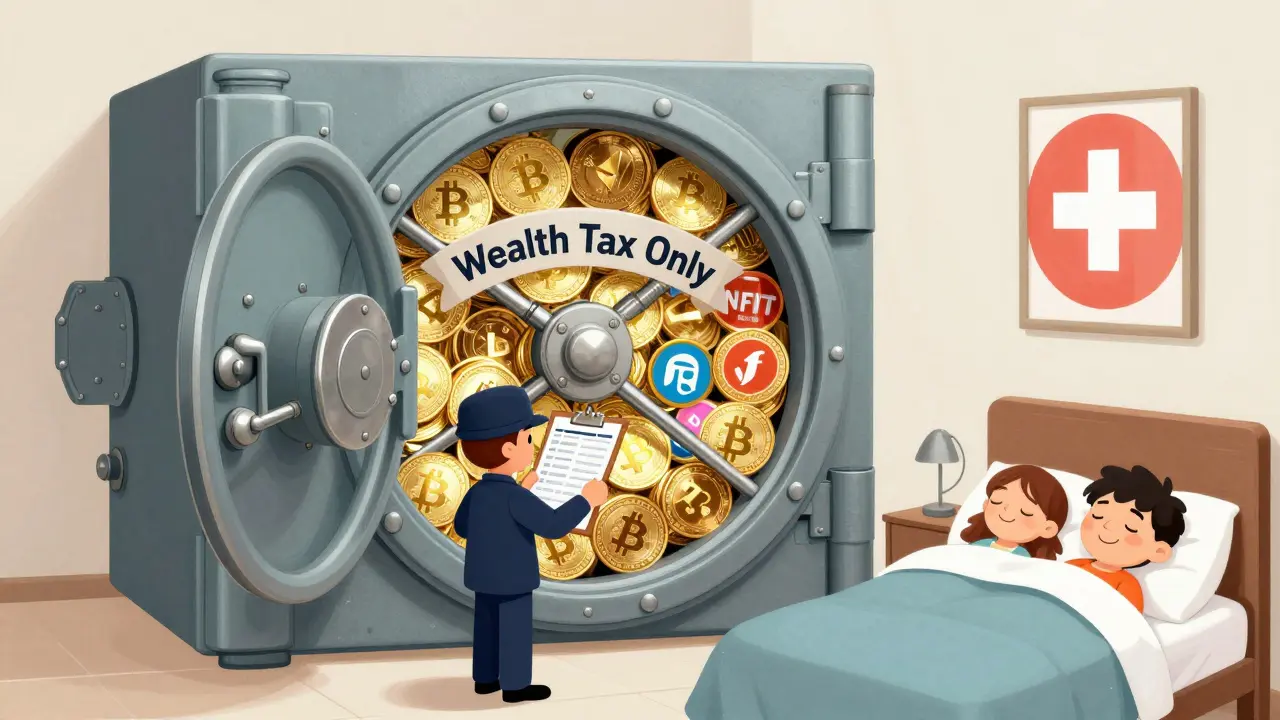
Every Swiss resident must declare their net wealth as of December 31 each year. This includes everything: your bank account, house, car, jewelry - and your crypto. The FTA publishes official year-end exchange rates for major cryptocurrencies. For Bitcoin, Ethereum, Ripple, Bitcoin Cash, and Litecoin, you must use these rates to convert your holdings into Swiss francs. If you hold something less common - say, Solana or Polygon - you use the price from the exchange where you bought or traded it. If you can’t find a price? Then you use your original purchase cost in CHF. Once you’ve totaled your crypto value in francs, you add it to all your other assets. Then, your canton applies its wealth tax rate. Most cantons charge between 0.3% and 1% per year. For example, if you have CHF 200,000 in Bitcoin and live in Zurich (rate: 0.5%), you pay CHF 1,000 in wealth tax on your crypto alone.Why You Don’t Pay Capital Gains Tax
Here’s the big win: if you’re a private investor, you pay zero capital gains tax on crypto profits - no matter how much you make. That’s right. Buy Bitcoin at CHF 30,000. Sell it at CHF 120,000. Keep the CHF 90,000 profit. The Swiss government doesn’t take a cent. This rule applies to all private assets: stocks, real estate, gold, and crypto. It’s one of the few places in the world where this is true. The catch? You have to be a private investor. If you’re trading crypto full-time, running a crypto business, or mining as a commercial operation, you’re classified as a professional trader. And that changes everything.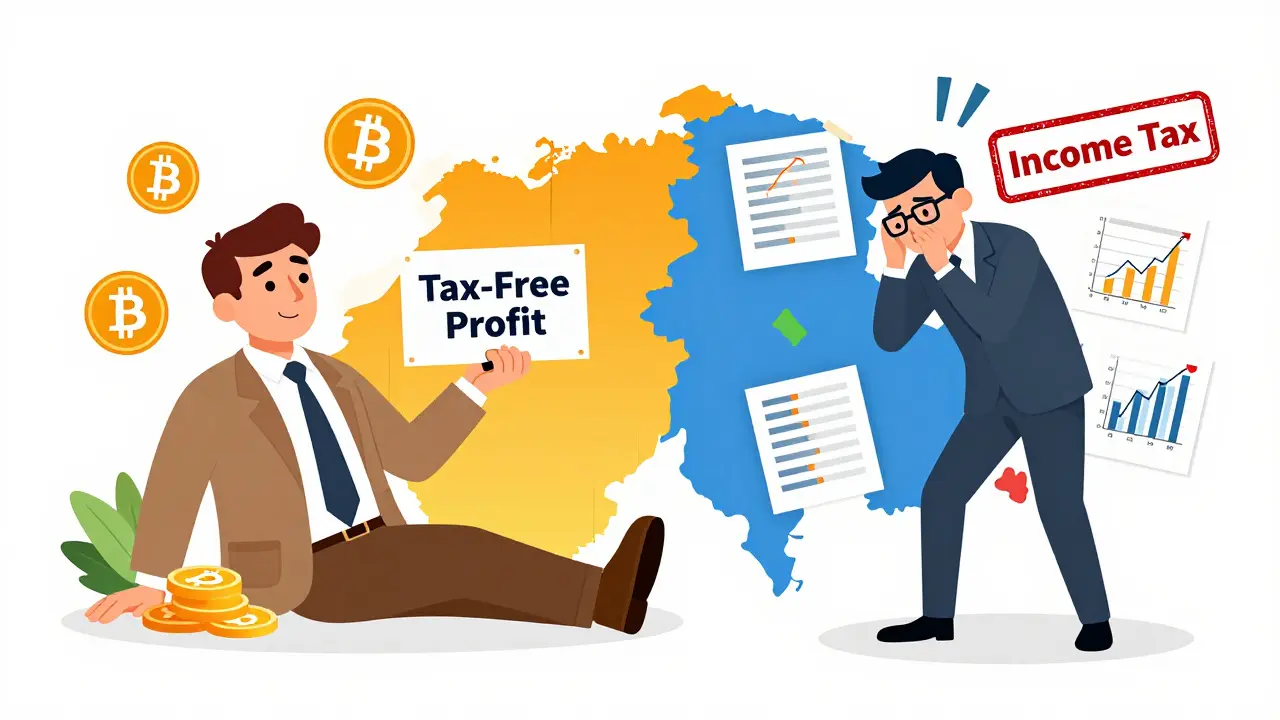
Professional Traders Pay Income Tax
The FTA uses Circular No. 36 to decide who counts as a professional trader. Factors include:- How often you trade
- Whether crypto is your main source of income
- If you use advanced strategies or leverage
- Whether you operate through a company or legal entity
If you’re flagged as a professional, your crypto gains are added to your income and taxed at regular rates. That means federal income tax (up to 11.5%), plus cantonal and municipal taxes. In high-income cantons like Geneva or Zug, total tax rates can hit 40% or more on crypto profits.
Miners are also treated as businesses. If you run mining equipment and earn rewards, that income is taxable. Staking? It depends. If you’re staking for passive rewards, it’s usually treated as wealth appreciation - not income. But if you’re running a staking pool or service, it’s business income.
Cantonal Differences Matter
Switzerland isn’t a one-size-fits-all country. Tax rates vary wildly between cantons. Zurich, Bern, and Lucerne have moderate wealth tax rates. Basel-Stadt and Geneva are higher. Some rural cantons, like Appenzell Innerrhoden, charge almost nothing.This isn’t just about saving money - it’s about strategy. Many crypto investors choose where to live based on tax rates. A person with CHF 1 million in crypto could pay over CHF 8,000 more in wealth tax living in Geneva than in a low-rate canton. That’s why relocation for tax purposes is common - and legal.
What About NFTs and DeFi?
Switzerland’s system is technology-neutral. That means NFTs, DeFi loans, and yield farming fall under existing rules - no new taxes, no special rules. NFTs? Treated like collectibles. If you buy an NFT and sell it later for profit, it’s a capital gain - but only if you’re a professional. For private investors, it’s still tax-free. DeFi staking? If you earn interest from lending crypto on a platform like Aave or Compound, the FTA considers it wealth appreciation. You don’t pay income tax on it - but you must declare the increased value of your holdings on December 31st.There’s no separate tax for DeFi rewards. No new forms. No confusion. Just add the value to your total crypto holdings and move on.
Record-Keeping Is Everything
The Swiss system is simple - but only if you keep good records. You need to track:- When you bought each coin
- How much you paid (in CHF)
- Which exchange you used
- The year-end price for each asset (or your exchange’s price if not listed by FTA)
Many investors use tools like Koinly or CoinTracker to auto-import exchange data and generate reports for tax filing. Swiss tax advisors recommend saving screenshots of your wallet balances and transaction histories. The FTA doesn’t require proof - but if they ask, you need to be ready.
One common mistake? Assuming your wallet balance equals your taxable value. If you hold crypto on a centralized exchange, the value is clear. But if you hold it in a hardware wallet? You still need to declare it - and value it correctly.
Why This System Works
Switzerland’s approach is built on clarity, not complexity. By separating wealth tax from capital gains tax, they’ve created a system that:- Encourages long-term holding
- Discourages speculative day-trading
- Keeps compliance simple for average investors
- Attracts global crypto talent and capital
The Swiss Blockchain Federation reports over 1,200 crypto companies now operate in Switzerland - many because of this tax structure. It’s not just about low rates. It’s about predictability. You know exactly what you’ll pay each year. No surprises. No retroactive rules.
Even as DeFi, DAOs, and new token types emerge, the FTA has signaled no major changes are coming. Their 2024 update confirmed the core principles remain unchanged. That stability is rare in crypto taxation - and it’s why Switzerland remains Europe’s top jurisdiction for digital assets.
What’s Next?
If you’re a private investor in Switzerland, the message is clear: hold your crypto. Don’t trade. Don’t overthink it. Just declare your holdings each year, pay your modest wealth tax, and keep the gains.If you’re a trader or business owner? Get professional advice. The line between private and professional is thin - and crossing it can cost you big.
Switzerland’s system isn’t perfect. The paperwork can be tedious. Valuing obscure tokens is frustrating. But compared to the U.S., Germany, or the UK - where capital gains tax can hit 30% or more - it’s a dream.
For now, the rules stay the same. No new taxes. No crackdowns. Just a quiet, stable system that lets you keep what you earn.
Do I have to declare crypto even if I didn’t sell it?
Yes. Switzerland taxes your wealth, not your sales. Even if you never sold a single Bitcoin, you must declare its value as of December 31st each year. If you held 1 BTC worth CHF 80,000 on that date, you pay wealth tax on that amount - regardless of whether you bought it for CHF 5,000 or CHF 70,000.
What happens if I don’t declare my crypto?
Failure to declare crypto assets is considered tax evasion. Swiss cantonal tax authorities cross-reference bank data, exchange reports, and blockchain analytics. Penalties include back taxes, interest, and fines up to 100% of the unpaid tax. In severe cases, criminal charges may apply. It’s not worth the risk.
Can I avoid wealth tax by moving my crypto offshore?
No. Swiss tax law applies to all residents, regardless of where assets are held. Even if your Bitcoin is stored on a U.S. exchange or in a wallet outside Switzerland, you must declare it if you’re a Swiss resident. Non-residents don’t pay Swiss wealth tax - but if you live in Switzerland, location doesn’t matter.
Are crypto airdrops taxable?
Yes, but only when you receive them. If you get a free token from an airdrop, its value on the day you receive it is added to your wealth. You don’t pay income tax on it - but you must declare it. If you later sell it, the gain is still tax-free if you’re a private investor.
Do I need to report every single transaction?
No. You only need to report your total crypto holdings as of December 31st. You don’t need to list every buy, sell, or transfer. But you must keep records of all transactions in case the tax office requests them. Most investors use software to auto-generate this data.


Ken Kemp
Just got back from Zurich and let me tell you, this system is insane in the best way. I had no idea they didn’t tax capital gains at all. I sold some ETH last year for a huge profit and just shrugged like it was pocket change. Swiss tax guy looked at me like I was an alien, then said, 'Ah, private investor? Good. File your wealth statement and you’re done.' No forms. No stress. Just add up your coins and pay 0.5% in Zurich. Absolute dream.
Julie Potter
OMG I CAN’T BELIEVE THIS. SO YOU’RE SAYING I COULD MOVE TO SWITZERLAND, BUY 100 BTC AT $30K, WATCH IT HIT $150K, AND KEEP EVERY SINGLE DOLLAR?!?!?!?!?!?!? I’M PACKING MY BAGS RIGHT NOW. I’M TALKING A 100K GAIN AND ZERO TAX?!?!?!?!?!!?!
nalini jeyapalan
This is why I’m moving to Lucerne next year. I’ve been in Canada for 12 years and paid over $40k in crypto taxes alone. Here, I’d pay maybe $1,200 on my portfolio. I’m not even joking. I’ve already rented a studio in the old town. The bank accounts are easier to open than in the US too. People here treat crypto like normal money. No drama. Just declare, pay, and move on. No one cares if you hodl or not. It’s beautiful.
Drago Fila
For anyone thinking about this: DO IT. Don’t overthink. If you’re not trading every day, you’re a private investor. That’s it. Use Koinly. Sync your wallets. Export the PDF. File it. Done. No need to panic about NFTs or DeFi. They’re just part of your total. I’ve got 12 different tokens and I didn’t even know how to value them until last month. Now I just look at CoinGecko and plug it in. Swiss tax office doesn’t even blink. It’s the most chill tax system I’ve ever seen.
Steven Lefebvre
Wait, so if I buy a Solana NFT for $500 and sell it for $5,000, I don’t pay tax? Even if I do it 50 times a year? I mean, technically I’m trading, right? What’s the line? Is it about frequency? Or intent? I’m confused. I’ve been doing this for 3 years and I’m not rich - just obsessed. Do they care if I have 200 transactions? Or just if I’m living off it?
James Burke
Yup. The key is whether crypto is your job. If you’re working 9-5 and crypto is just a side hustle? You’re golden. If you’re waking up at 3am to scalp altcoins, trading 10x leverage, and running a Discord group for ‘alpha drops’? Yeah, you’re probably a pro. The FTA doesn’t care how much you make - they care if you’re treating it like a business. Keep it chill. Don’t brag. Don’t automate. Just hold. Simple.
Jonathan Chretien
It’s not about tax avoidance - it’s about philosophy. Switzerland doesn’t punish you for getting rich. They don’t see wealth as a sin. In America? You’re a greedy capitalist if you make money. In Switzerland? You’re just… smart. And that’s why I moved here. Not for the chocolate. Not for the trains. For the mindset. You can build, you can hold, you can grow - and no one will guilt-trip you for it. 🤝💎
Bill Pommier
Let’s be clear: this is a loophole designed for the ultra-wealthy. The average Swiss citizen doesn’t even own crypto. This system was crafted by bankers and lawyers to attract hedge funds, not Joe Schmo with 2 Bitcoin. The fact that they let you use obscure exchange prices? That’s a gift to the rich who can afford to game valuation. And don’t get me started on the ‘wealth tax’ - it’s a regressive joke. Pay 0.3% on $10M? That’s a discount. Pay 0.3% on $50K? You’re still paying more than a middle-class worker on salary. This isn’t fairness. It’s class engineering.
Olivia Parsons
I’ve been using CoinTracker for 2 years and it auto-fills my Swiss declaration. I just double-check the year-end prices. For ETH, I use the FTA rate. For Shiba, I use the Binance price from Dec 31. It’s that simple. I don’t even think about it anymore. My accountant just signs off. I wish the US did this. We’d have way less stress. Also - yes, you must declare hardware wallet holdings. I learned that the hard way when I forgot my Ledger in 2022. They sent a letter. Not scary. Just… annoying.
Nick Greening
Oh wow, so Switzerland is the crypto paradise? Cool. So what about when they inevitably change the rules? You think they won’t tax gains eventually? You think the EU won’t force them to? You think the IMF won’t come knocking? This system is built on sand. It’s a bubble of tax haven nonsense. Wait until 2027. Wait until 2030. Then come back and tell me how great this was. I’ll be here laughing.
jonathan swift
They’re lying. The FTA is watching every wallet. Every transaction. They’re using Chainalysis and linking your IP to your Swiss bank. You think they don’t know you transferred 10 BTC from Binance to your Ledger? They already have your transaction history. They’re waiting for you to slip up. Then they’ll hit you with back taxes, fines, and a criminal investigation. This isn’t freedom. It’s a trap. 🕵️♂️💸
Ian Thomas
Think about it: the state isn’t taxing your profit. It’s taxing your existence. You own something? You pay. It’s not about fairness. It’s about presence. You’re here. You have value. You’re part of the system. That’s why it works. No capital gains tax? That’s not a loophole. That’s a philosophical choice. They’re saying: ‘We don’t care how you grow. We care that you’re here, contributing, stable.’ That’s deeper than tax policy. That’s a culture.
Austin King
This is the most practical crypto tax system I’ve ever seen. Just declare. Pay a little. Keep your gains. No stress. I wish my state did this. Just one less thing to worry about.
Bryanna Barnett
Wait, so you’re telling me I can move to Switzerland, buy a bunch of Dogecoin, and never pay capital gains? That’s literally the dumbest thing I’ve ever heard. I mean, come on. Dogecoin? Really? And they call this a ‘stable’ system? This is a joke. A rich person’s playground. I’m not even mad. I’m just… confused.
Josh Moorcroft-Jones
Okay, let’s unpack this. First, the FTA publishes official rates for only five coins - BTC, ETH, XRP, BCH, LTC. That’s it. What about ADA? SOL? MATIC? DOGE? AAVE? You’re supposed to use ‘exchange prices’ - but which exchange? Coinbase? Kraken? Binance? Do you use the buy price? The sell price? The average of the day? What if the exchange is down? What if there’s no liquidity? What if you bought on a decentralized exchange? And what if you hold 37 different tokens? You’re now spending 40 hours a year just valuing your portfolio. And don’t get me started on the fact that the FTA doesn’t accept blockchain explorers as proof - you need screenshots from exchanges. Which means you have to log in to every exchange, find your balance, take a screenshot, timestamp it, and save it. That’s not ‘simple.’ That’s a nightmare. And if you miss one? They’ll assume you’re hiding assets. And then you’re in trouble. So yes, it sounds nice. But it’s not. It’s a bureaucratic trap disguised as elegance.
Bonnie Jenkins-Hodges
Switzerland? Please. They’re just letting rich Americans dodge taxes. This isn’t innovation - it’s exploitation. The US is a superpower. We have laws for a reason. You don’t get to move to another country and laugh while we pay 30% on our gains. This is why America’s middle class is dying. You think this is fair? You think this is moral? No. It’s theft. And you’re all complicit.
Melissa Ritz
I read this whole thing. Honestly? It’s kind of beautiful. But also… kind of boring. I mean, I get it. Declare your coins. Pay 0.5%. No capital gains. Fine. But I don’t even own crypto anymore. I sold it all last year. And honestly? I’m glad. This system sounds like a lot of paperwork for something that’s already a gamble. Why not just invest in real estate? Or bonds? At least those don’t require you to screenshot your wallet every December.
Cerissa Kimball
Important to note that wealth tax applies to all residents regardless of citizenship. If you have a Swiss residence permit you must declare. Non-residents are exempt. Also, the FTA does not accept third-party valuations. Must be from exchange or original cost. Keep receipts. And if you use DeFi, the increased token value is included in your year-end total. No separate reporting. Just add it. Simple. But yes, record keeping is critical. Many people forget hardware wallets. Don’t be that person.
Basil Bacor
Switzerland’s system is a joke. They tax wealth but not gains? That’s like charging you for owning a car but not for driving it. I mean, what’s the point? If you’re not taxing the profit, why tax the asset? It’s illogical. And the cantons? Half of them are rural backwaters with zero crypto activity. Why even bother? This isn’t policy. It’s chaos.
Emily Pegg
Y’all are so naive. You think Switzerland doesn’t share data with the IRS? They do. Every year. They’ve been doing it since 2018. Your ‘tax-free’ gains? The IRS already knows. You’re just delaying the inevitable. And when they come for you? You’ll wish you’d paid the 15% in the first place. 🤭
Ethan Grace
It’s funny how we romanticize systems that don’t tax ambition. But what’s ambition without consequence? If you’re not paying for the privilege of wealth, who is? The poor? The workers? The system isn’t fair. It’s just quiet. And quiet doesn’t mean just. It just means we stopped asking questions.
Jamie Hoyle
This is the most absurd thing I’ve ever read. You’re telling me I can make $10M on crypto, move to Switzerland, and pay $50k in tax? Meanwhile, my cousin in Ohio paid $3M on the same profit? This isn’t innovation - it’s exploitation. Switzerland is a tax haven for the rich. And you’re all celebrating it like it’s justice. It’s not. It’s capitalism with a Swiss accent. And it’s disgusting.
Brian T
They don’t tax gains? Okay. But what about inflation? If your Bitcoin was worth $20k in January and $80k in December, you pay tax on $80k. But you didn’t sell. So you’re paying tax on paper gains. What if the price crashes next year? Do they refund? No. You’re stuck. You paid tax on money you never touched. That’s not tax policy. That’s psychological torture.
Ken Kemp
Actually, I just talked to my Swiss accountant. They do allow adjustments if the value drops significantly after declaration. It’s not automatic - you have to file a correction next year. But yeah, it’s a pain. Still better than paying 30% on paper gains like in the US. I’d rather overpay now and get a refund later than get hit with a 30% bill on a coin that went to zero.