What is Cramer Coin (CRAMER)? A Warning on This Low-Liquidity Token

Have you ever seen a cryptocurrency named after a famous person and wondered if it’s legitimate? That is exactly what happens with Cramer Coin (CRAMER), a digital token that trades under the shadow of financial TV personality Jim Cramer. But here is the catch: there is no connection between the man and the coin. In fact, Jim Cramer has been publicly skeptical about cryptocurrencies for years. So, what is this token really? Is it an investment opportunity or just another speculative experiment in the vast world of crypto?
As of early 2026, Cramer Coin sits in a very precarious position. It is a low-cap asset with almost zero trading volume, meaning buying or selling it can be incredibly difficult. If you are looking at CRAMER because you saw its name pop up on an exchange list, you need to understand the mechanics behind it before you risk any money. This isn’t about missing out on the next big thing; it’s about understanding why some tokens exist solely to confuse investors.
The Origin Story: A Name Without Permission
The most striking feature of Cramer Coin is a speculative cryptocurrency token that uses the name of CNBC host Jim Cramer without his endorsement or involvement is its namesake. Jim Cramer hosts "Mad Money" on CNBC and is known for his energetic commentary on traditional stocks. He has repeatedly expressed doubt about Bitcoin and other cryptos, often calling them risky or unnecessary for average investors.
Despite this skepticism, someone decided to launch a token called $CRAMER. There is no official whitepaper, no GitHub repository, and no announcement from Jim Cramer himself. This pattern is common in the crypto space. Experts like Dr. David Gerard, author of "Attack of the 50 Foot Blockchain," have warned that coins named after famous financial figures without their permission are nearly always scams. The goal is simple: piggyback on fame to attract curious clicks.
When you look at the timeline, Cramer Coin emerged during a period of market fear in late 2025. During times when established assets like Bitcoin drop, retail investors sometimes look for "cheap" alternatives, hoping for a quick multiplier effect. CRAMER fits this profile perfectly. It costs fractions of a cent, making it psychologically appealing to those who think they can buy millions of tokens for a few dollars. However, price per token does not equal value. A token costing $0.000083 is not necessarily "cheaper" than Bitcoin if the total supply and demand dynamics are broken.
Tokenomics and Supply: The Numbers Don't Lie
To understand the risk, we need to look at the hard data. According to exchange listings like Bybit and MEXC in early 2026, Cramer Coin has a maximum supply capped at 1 billion tokens. Currently, about 846.59 million of those tokens are in circulation. That means roughly 84.66% of all possible CRAMER tokens are already out there.
| Metric | Value | Implication |
|---|---|---|
| Price (Approx.) | $0.000083 USD | Extremely low unit cost, high quantity required for meaningful investment |
| Total Supply | 1 Billion Tokens | Fixed cap, but large supply dilutes individual token value |
| Circulating Supply | 846.59 Million Tokens | Most tokens are already distributed, limiting future scarcity plays |
| 24-Hour Volume | $0 - $4.22 USD | Near-zero liquidity; extremely hard to sell large amounts |
| Market Cap | ~$70,000 USD | Micro-cap status; highly volatile and susceptible to manipulation |
The lack of transparency extends to how these tokens were distributed. There is no public record of vesting schedules for the team, nor is there clear information on how much was allocated to marketing or development. In healthy projects, you see details about burn mechanisms or staking rewards. With CRAMER, the absence of such features suggests a static asset with no utility driving demand.

Liquidity Crisis: Why You Might Not Be Able to Sell
This is the most critical part for anyone considering buying Cramer Coin. Liquidity refers to how easily you can buy or sell an asset without affecting its price. For major coins like Ethereum or Solana, liquidity is deep. You can sell thousands of dollars worth instantly. For CRAMER, the situation is dire.
Data from January 2026 shows that the 24-hour trading volume on platforms like Bybit was recorded at a mere $4.22. On CoinMarketCap, it was listed as $0. What does this mean for you? It means the order book is empty. If you manage to buy 1 million CRAMER tokens, you might find no one willing to buy them back from you. Or worse, the only buyer is offering a price 15% lower than the current display price due to the wide spread.
One anonymous trader on CryptoSlate reported losing $50 trying to sell 600 million CRAMER tokens because the order never filled over three days. This is a classic symptom of a "zombie token." These are assets that still exist on exchanges but have effectively stopped moving. They become trapped capital. Even if the price chart looks like it’s going up, if there is no volume, that move is likely artificial or unsustainable.
Technical Void: No Code, No Community
In the world of blockchain, code is law. Legitimate projects publish their smart contracts on GitHub so developers can audit them for security flaws. They build communities on Reddit, Discord, and Telegram where users discuss updates and governance. Cramer Coin has none of this.
There is no verified website. The Twitter account associated with the token (@CramerCoinETH) has fewer than 50 followers and little engagement. The Reddit community, r/CramerCoin, has only 12 members and no active discussion. Compare this to even mid-tier projects that boast thousands of contributors and daily news updates. The silence around CRAMER is deafening.
Without a technical foundation, the token operates purely on speculation. It likely runs on standard ERC-20 (Ethereum) or BEP-20 (Binance Smart Chain) protocols, which are easy to deploy. Anyone can create a token in minutes using online tools. The barrier to entry is low, which explains why thousands of such tokens appear every year. Most vanish within months. CRAMER has survived long enough to get listed on minor exchanges, but listing alone is not a seal of approval. Exchanges like LBank and MEXC list thousands of tokens, many of which have negligible utility.
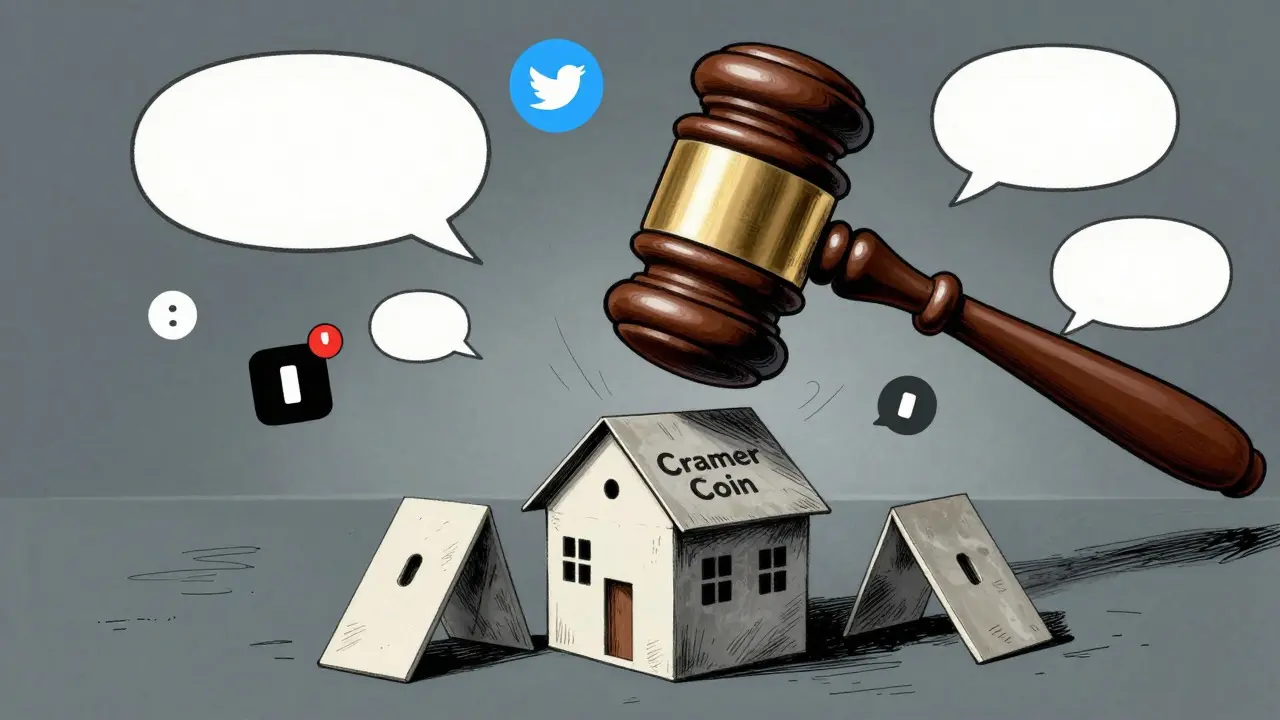
Regulatory Risks and Market Context
The regulatory landscape for cryptocurrencies tightened significantly in 2025 and 2026. The U.S. Securities and Exchange Commission (SEC) took action against several tokens that used celebrity names without endorsement, labeling them as potential securities violations. While Cramer Coin hasn’t been specifically targeted yet, it fits the profile of assets under scrutiny. Using a recognizable name like "Cramer" without permission can be seen as misleading investors, a key factor in fraud investigations.
Furthermore, industry reports from Delphi Digital and Chainalysis highlight a surge in "pump-and-dump" schemes involving celebrity-named tokens. These schemes rely on hype to drive prices up temporarily, allowing early creators to sell off their holdings before the rest of the market realizes there is no underlying value. Given the near-zero volume of CRAMER, it is unclear if any significant pumps have occurred, but the structure remains vulnerable to manipulation by whoever holds the largest portion of the remaining supply.
Is Cramer Coin Worth Your Attention?
If you are a seasoned trader looking for micro-cap gems, you might argue that anything with a market cap under $100,000 has upside potential. Perhaps. But you must weigh that potential against the probability of total loss. With no utility, no community, no developer activity, and virtually no liquidity, Cramer Coin offers little more than a gamble.
For the average investor, the answer is straightforward: proceed with extreme caution. Do not invest money you cannot afford to lose entirely. Understand that the low price per token is an illusion of affordability. The real cost is the risk of being stuck with an asset you cannot sell. In a market dominated by established players like Bitcoin, Ethereum, and even popular meme coins like Dogecoin and Shiba Inu, CRAMER struggles to find a reason to exist beyond its provocative name.
Is Cramer Coin officially endorsed by Jim Cramer?
No. Jim Cramer has no official connection to Cramer Coin ($CRAMER). In fact, he has publicly expressed skepticism toward cryptocurrencies and warned against tokens using his name without permission, suggesting they may be scams.
Where can I buy Cramer Coin (CRAMER)?
Cramer Coin is listed on several smaller cryptocurrency exchanges, including MEXC, Binance, Bybit, and LBank. However, due to extremely low trading volume, finding a buyer or seller at a fair price can be very difficult.
What is the total supply of CRAMER tokens?
The maximum supply of Cramer Coin is capped at 1 billion tokens. As of early 2026, approximately 846.59 million tokens are in circulation, representing about 84.66% of the total supply.
Why is the trading volume for Cramer Coin so low?
The low volume indicates a lack of interest and liquidity. With only a few dollars traded daily on some exchanges, the token suffers from wide spreads and difficulty executing trades, making it a "zombie token" with minimal market activity.
Does Cramer Coin have any utility or use case?
Currently, there is no documented utility for Cramer Coin. It lacks a whitepaper, active development, or a clear purpose beyond speculation. This absence of fundamental value increases the risk for investors.
Is it safe to invest in Cramer Coin?
Investing in Cramer Coin carries high risk. Due to its low liquidity, lack of transparency, and absence of official endorsement, it is considered a speculative asset. Investors should only allocate funds they are prepared to lose entirely.