What is Davos.xyz USD (DUSD) Crypto Coin? A Clear Breakdown of the Yield-Paying Stablecoin
DUSD Yield Calculator
Estimate Your DUSD Staking Yield
Calculate potential earnings from staking DUSD on the Davos Protocol. Remember: yield is variable and based on protocol activity.
Your Estimated Yield
Note: DUSD yield is variable and based on protocol usage. The current fee distribution is 5% of all fees generated from lending and borrowing within the Davos ecosystem. Higher protocol activity increases your yield. This calculator is for educational purposes only.
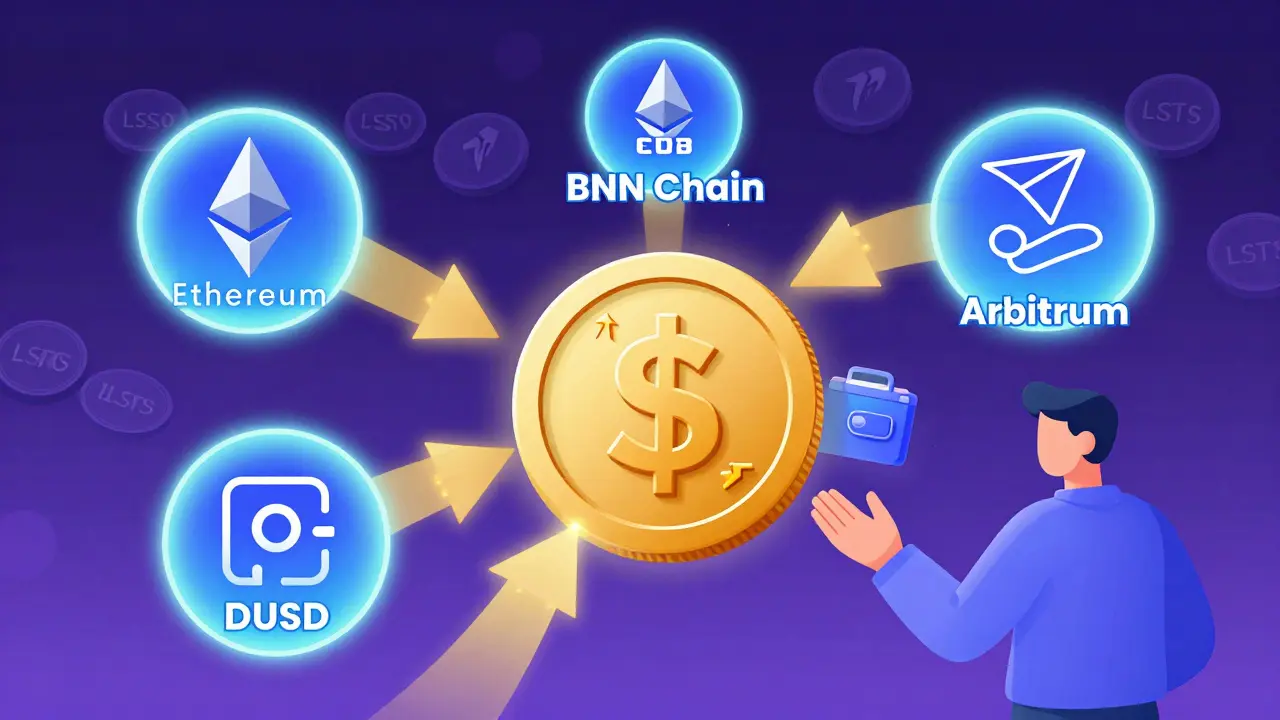
DUSD isn't just another stablecoin. It’s a decentralized, yield-generating stablecoin built to move freely across multiple blockchains - Ethereum, BNB Chain, Polygon, Arbitrum, and Optimism - while keeping its value locked to $1. But unlike USDC or USDT, which sit in bank accounts, DUSD is backed by crypto assets that earn interest on their own. That means when you hold DUSD, you’re not just storing value - you’re earning rewards just by holding it.
How DUSD Works: More Than Just a $1 Token
DUSD is issued by the Davos Protocol, which launched in February 2023. At its core, DUSD is designed to stay pegged to the U.S. dollar. But instead of holding cash or Treasury bills like USDC, DUSD is backed by things like Liquid Staking Tokens (LSTs) - tokens you get when you stake ETH on Ethereum 2.0 - and other yield-bearing crypto assets. These assets generate returns, and those returns are passed back to DUSD holders.
The protocol uses a dual-token system: DUSD and sDUSD. DUSD is the base stablecoin. When you stake your DUSD, you get sDUSD - a staked version that earns a share of the protocol’s fees. Right now, stakers get 5% of all fees generated from lending and borrowing within the Davos ecosystem. That’s not a fixed APY like a bank - it’s variable, based on how much activity happens in the protocol. If more people borrow DUSD, the rewards go up.
This design makes DUSD different from most stablecoins. You don’t need to deposit your coins into a lending platform like Aave or Compound to earn yield. The yield is built in. You hold DUSD, you earn. It’s simple, but the mechanics behind it are complex.
Why DUSD’s Collateral Model Matters
Most stablecoins fall into two camps: centralized (USDC, USDT) or over-collateralized crypto-backed (DAI). Centralized ones are backed by real dollars in banks. DAI is backed by crypto assets like ETH, but you have to lock up way more than $1 worth to mint $1 of DAI - often $1.50 or more. That’s safe, but inefficient.
DUSD tries to strike a middle ground. It uses crypto assets that are already earning yield - so the collateral isn’t sitting idle. That means less capital is wasted. But here’s the catch: those assets still fluctuate in price. If ETH drops sharply, the value of the LSTs backing DUSD could fall too. That’s a risk. Unlike DAI, which discloses its exact collateral ratios, Davos Protocol hasn’t publicly shared how much collateral backs each DUSD. That lack of transparency is a red flag for some DeFi veterans.
Still, the model makes sense if you believe crypto-native collateral is the future. Banks won’t let DeFi protocols hold cash. But they can hold staked ETH or liquid restaking tokens. DUSD is betting that this is the smarter way to build stablecoins long-term.
Performance: Is DUSD Really Stable?
DUSD’s price has been anything but perfectly stable. Since its launch, it’s hit a high of $1.17 in February 2024 and dropped as low as $0.63 in July 2024. As of mid-2024, it was trading around $0.996 - close, but not quite $1. That’s not a failure; it’s normal for newer stablecoins. The market corrects these deviations through arbitrage: if DUSD drops below $1, people buy it, redeem it for collateral, and profit. If it goes above $1, they mint more and sell it.
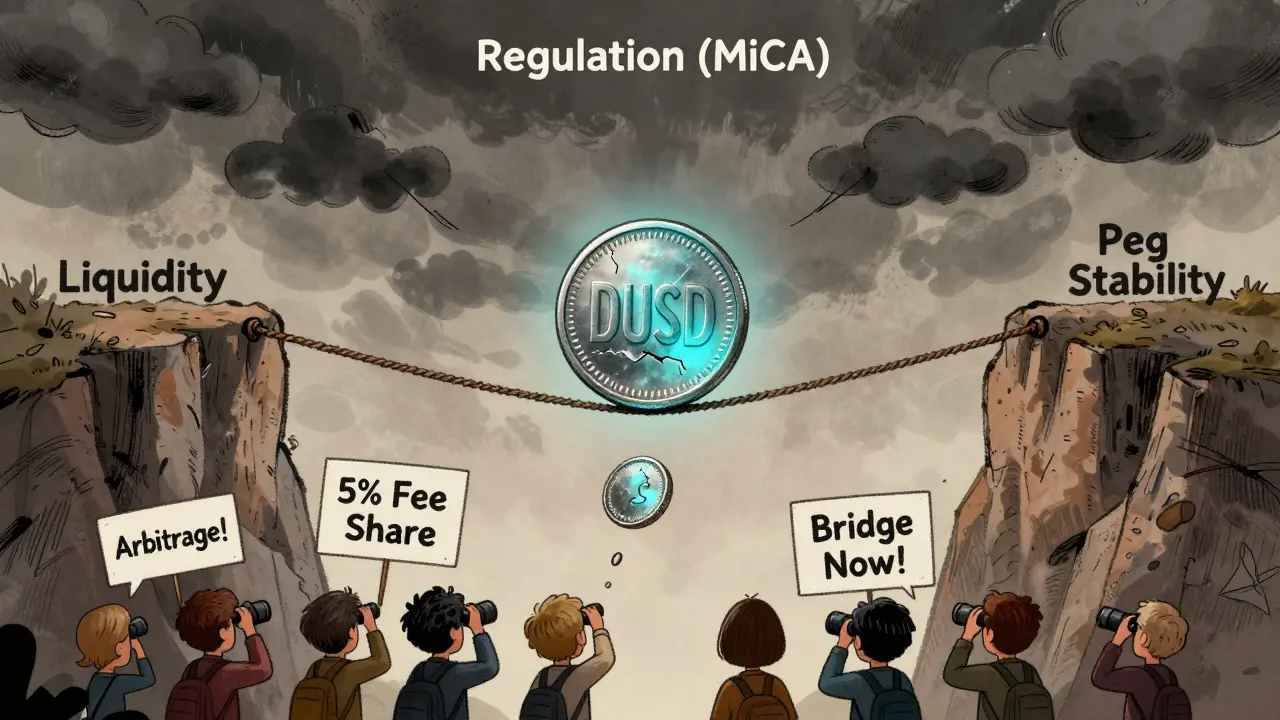
The problem? Low liquidity. With only $173,000 in market cap and a daily trading volume of about $3,500, there aren’t enough buyers and sellers to keep the price steady. Large trades can swing the price. That’s why most users don’t hold DUSD as a long-term store of value. Instead, they use it for cross-chain swaps.
TheDavosBridge: Where DUSD Shines
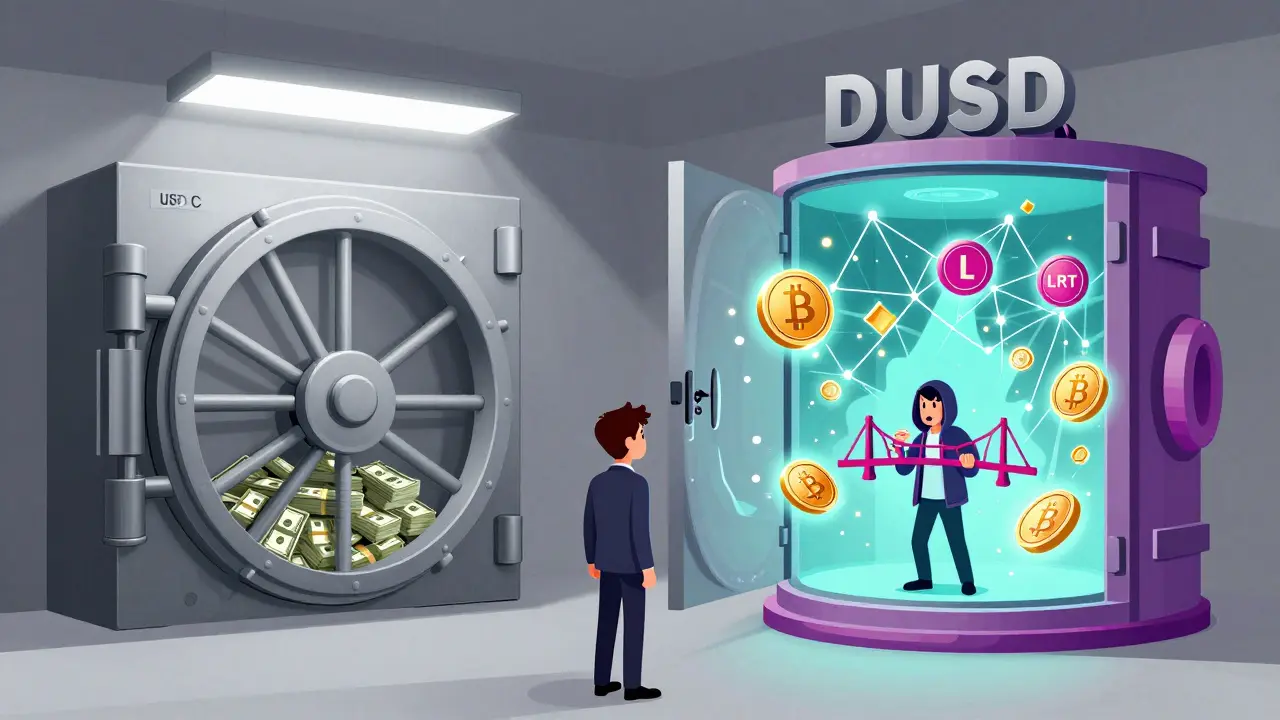
DUSD’s biggest advantage isn’t its yield - it’s TheDavosBridge. This tool lets you move DUSD between Ethereum, Polygon, Arbitrum, Optimism, and BNB Chain in under three minutes, with minimal fees. That’s faster and cheaper than bridging USDC or DAI between chains.
Imagine you’re swapping ETH for SOL on a decentralized exchange. You need stablecoins to trade. If you’re on Ethereum, you might pay $10 in gas to bridge USDC to Solana. With DUSD, you mint it on Ethereum, bridge it to Solana (via Polygon or Arbitrum as a hop), and use it - all for under $2 in total fees. That’s why users on Discord and Telegram say DUSD is their go-to for cross-chain swaps, not savings.
How to Get Started with DUSD
Getting DUSD isn’t hard, but you need a Web3 wallet like MetaMask or Coinbase Wallet. Here’s how:
- Go to davos.xyz and connect your wallet.
- Deposit collateral: Choose from supported assets like stETH, wstETH, LDO, or USDC.
- Mint DUSD: You’ll get 1 DUSD for every $1 worth of collateral. Gas fees vary - around $1.20 on Polygon, $3.50 on Ethereum.
- Stake your DUSD to get sDUSD and earn protocol fees.
The interface is clean, but you need to understand what collateral you’re using. If you deposit stETH, you’re exposing yourself to ETH price swings. If you deposit USDC, you’re relying on a centralized asset. The protocol doesn’t warn you about this - you have to know it yourself.
How DUSD Compares to Other Stablecoins
Here’s how DUSD stacks up against the big names:
| Feature | DUSD | USDC | DAI | USDT |
|---|---|---|---|---|
| Backing | Crypto-native (LSTs, LRTs) | USD reserves | Over-collateralized crypto | USD reserves |
| Yield | Yes (via sDUSD) | No | No | No |
| Chains Supported | 5+ (Ethereum, Polygon, Arbitrum, etc.) | 10+ | 10+ | 15+ |
| Market Cap | $173K | $34.1B | $5.1B | $111.8B |
| 24h Volume | $3,462 | $1.2B | $218M | $14.5B |
| Transparency | Low (collateral ratios undisclosed) | High (monthly audits) | High (on-chain data) | Low (opaque reserves) |
DUSD doesn’t compete with USDC or USDT on scale. It competes on utility. If you need a stablecoin that moves fast between chains and pays you to hold it, DUSD is one of the few options. But if you want safety, liquidity, and trust, stick with USDC or DAI.
Who Should Use DUSD?
DUSD isn’t for everyone. It’s not a good choice if you’re:
- Storing large amounts of savings - too low liquidity.
- Looking for guaranteed returns - yield is variable and depends on usage.
- Uncomfortable with crypto volatility - your collateral is still crypto.
But it’s great if you:
- Trade across multiple blockchains often.
- Want to earn yield without locking up funds in DeFi protocols.
- Believe in decentralized, crypto-backed stablecoins as the future.
Most experienced users treat DUSD like a bridge token - use it to move value quickly, then convert it to USDC or DAI on your target chain for better liquidity and safety.
Future of DUSD: Risks and Opportunities
The Davos Protocol has a roadmap. By late 2024, it plans to add Base and zkSync Era support, expand its collateral types, and introduce a governance token. That’s promising. But growth is slow. With a market cap under $200K, it’s a micro-cap project. Most institutional players ignore it.
The biggest threat? Regulation. The EU’s MiCA rules require stablecoins to be backed 1:1 by cash or cash equivalents. DUSD’s crypto-backed model doesn’t fit. If regulators crack down, DUSD could be forced to change - or disappear.
Another risk: competition. MakerDAO’s DAI is now on Arbitrum and Polygon. Circle’s USDC is on nearly every chain. If they add yield features, DUSD’s edge vanishes.
Still, the idea behind DUSD is strong. The crypto world needs stablecoins that work across chains and pay you to use them. DUSD is one of the first to try it. Whether it survives depends on whether enough users adopt it to create real liquidity.
Final Thoughts: Is DUSD Worth It?
DUSD isn’t a replacement for USDC. It’s a niche tool for a specific job: moving value across blockchains while earning a little extra. It’s not perfect. The price wobbles. The collateral is opaque. The market is tiny.
But if you’re active in DeFi and move between chains, DUSD saves you time and money. It’s not a store of value - it’s a utility token with a yield twist. Use it for swaps. Don’t hoard it. And always keep a backup of USDC or DAI for when things get shaky.
For now, DUSD is a bold experiment. It’s not the future of stablecoins - but it might be a step toward it.
Is DUSD a good investment?
No, DUSD is not a good investment. It’s a stablecoin designed to hold value, not grow it. Its price fluctuates, and its market cap is too small to be safe for holding large amounts. Use it for cross-chain swaps or to earn small protocol rewards - not as a long-term asset.
Can I lose money using DUSD?
Yes. If the collateral backing DUSD (like stETH or LDO) loses value sharply, the protocol could struggle to maintain its $1 peg. You could end up with DUSD worth less than $1. Also, if you mint DUSD using volatile assets, you’re exposed to price swings in those assets. Always understand what you’re depositing.
Is DUSD safer than USDC?
No. USDC is backed by cash and short-term U.S. Treasuries, audited monthly by a major accounting firm. DUSD is backed by crypto assets with no public collateral ratio. USDC is far safer. DUSD’s only advantage is yield and cross-chain speed - not safety.
How do I earn yield with DUSD?
Stake your DUSD on the Davos Protocol website to receive sDUSD. You’ll earn 5% of the fees generated from borrowing and lending within the protocol. The yield isn’t fixed - it changes based on how much activity happens. You can unstake sDUSD at any time to get your DUSD back.
Can I buy DUSD on Coinbase or Binance?
Not directly. DUSD is only listed on a few decentralized exchanges like Uniswap and Bitget. You can’t buy it on Coinbase, Binance, or Kraken. You’ll need to connect a Web3 wallet and trade it on a DEX using ETH, USDC, or another token.
What happens if DUSD breaks its $1 peg?
If DUSD drops below $1, arbitrageurs buy it and redeem it for its underlying collateral, which pushes the price back up. If it rises above $1, people mint new DUSD and sell it, bringing the price down. The system relies on this mechanism. But if there’s not enough liquidity, the peg can stay broken for days - which is why DUSD often trades at $0.996 instead of $1.
For users who move between blockchains often, DUSD offers a rare combo: stability, yield, and speed. But it’s still a high-risk, low-liquidity project. Use it wisely.

miriam gionfriddo
DUSD is literally just a glorified meme coin with a whitepaper. $173k market cap??? Bro I can mint more DUSD than the entire supply with my coffee money. This isn't finance it's a casino with a blockchain logo.
Kenneth Ljungström
I've been using DUSD for cross-chain swaps for months now and honestly? It's a game changer. 🚀 Gas fees are next level cheap and the yield is just gravy. Not for savings, but for moving value? 10/10. Don't overthink it.
Barb Pooley
They say it's backed by LSTs but nobody knows the ratio. Coincidence that the same devs who launched this also ran that 'DeFi Ponzi' from 2021? 🤔 I'm not buying it. This is a front for a rug pull. Watch the liquidity vanish after 1M in TVL.
Lore Vanvliet
America's crypto is dying. Why are we even talking about this trash? In China they have CBDCs that actually work. This DUSD nonsense is what happens when white guys with hoodies think they're smarter than central banks. 🇺🇸💀
Scott Sơn
DUSD isn't a stablecoin - it's a glitter bomb wrapped in a DeFi fever dream. One minute you're earning yield, the next your collateral's melting like ice cream in a sauna. I love it. The chaos is beautiful. 🌪️💎
Frank Cronin
You people are delusional. You think a stablecoin with no transparency, no audit, and a market cap smaller than my Netflix subscription is 'innovative'? This isn't DeFi. It's a glorified ICO with a fancy frontend. Don't be the sucker who dumps ETH into this.
Nicole Parker
I think what's interesting here isn't the yield or the bridge - it's the philosophical shift. We're moving from stablecoins that pretend to be like banks to ones that embrace the volatility of crypto as part of the system. It's messy, it's risky, but maybe that's the point. Maybe stability shouldn't mean stagnation. Maybe it's okay if value moves, if it moves *with purpose*.
Brooke Schmalbach
Let's be real - DUSD is a disaster waiting to happen. The collateral is opaque, the liquidity is microscopic, and the yield is just a bait-and-switch. You think you're earning 5%? You're just getting paid in hope. And when the peg breaks for good, you won't even be able to exit without losing 30%.
Cristal Consulting
Start small. Use DUSD for one bridge swap. See how fast it is. See how little you pay. Then decide if it's worth it. No need to stake it all. Just test it. You'll be surprised how useful it is for quick trades.
Tom Van bergen
Stablecoins should be stable not yield machines. The whole point is to not worry about price. This is just another way to turn crypto into gambling with extra steps
Sandra Lee Beagan
As someone who's bridged between Solana and Ethereum weekly, I can confirm DUSD is the quiet MVP. The fees are negligible, the speed is insane, and the yield? Just a bonus. It’s not perfect, but in the DeFi jungle, sometimes you need a Swiss Army knife - not a luxury sedan.
Ben VanDyk
The fact that the protocol doesn't disclose collateral ratios is a massive red flag. Not even a ballpark figure? That's not innovation - that's negligence. You can't build trust on opacity.
michael cuevas
Yield? Nah. This is just a way to get people to lock up their ETH and then the devs drain the pool. Seen this movie before. The credits always end with a 'contract upgraded' and a rug pull.
Nina Meretoile
I love how this feels like the future. Imagine a world where your stablecoin isn't just sitting there - it's working. Even if it's risky, I think we need more experiments like this. Not every stablecoin has to be a bank. Maybe the future is messy, but it's alive.
Joe West
I've minted DUSD on Polygon and bridged it to Arbitrum three times this week. Total gas cost: under $1.50. USDC would've cost me $8. DUSD is literally the only reason I don't hate cross-chain anymore.
Mariam Almatrook
It is profoundly irresponsible to promote a financial instrument with zero regulatory compliance and opaque collateralization as a viable alternative to USD-backed stablecoins. This is not innovation - it is financial recklessness dressed in blockchain aesthetics.
Chris Mitchell
DUSD isn't for holding. It's for moving. Treat it like a ferry - not a savings account. If you're using it to store value, you're already losing.
nicholas forbes
I'm not mad, just disappointed. This could've been something real. But the lack of transparency? The tiny liquidity? It's like building a Ferrari with a bicycle chain. Beautiful design, terrible engine.
Martin Hansen
You think you're being smart by earning yield on DUSD? You're just paying the devs to gamble with your ETH. They don't care if you lose. They get their fees upfront. This isn't DeFi. It's a casino with a GitHub repo.
Shane Budge
Why does nobody talk about the arbitrage risk? If the price dips to $0.95 and liquidity is $3k, who's actually buying to bring it back? Probably no one. That’s not a peg - that’s a suggestion.
sonia sifflet
This is why crypto fails. Everyone wants yield but no one wants to understand the risk. DUSD is a trap for beginners. Don't touch it unless you've read the contract and traced every collateral pool. Otherwise you're just giving your money to devs who don't even know what they're doing.
Richard T
I think DUSD is trying to solve a real problem - cross-chain friction. The yield is a clever incentive, but the real value is in the bridge. If they can scale liquidity and add more chains, this could be huge. But they need to be transparent about collateral. That’s non-negotiable.
jonathan dunlow
Look - I’ve been in DeFi since 2020. I’ve seen tokens crash 95%. But I’ve also seen tools that changed everything. DUSD might be the bridge token we didn’t know we needed. It’s not safe. It’s not big. But it’s fast, cheap, and pays you just for using it. That’s revolutionary in a world where every transaction costs $10. Don’t sleep on it. Just don’t bank on it.
rita linda
This is what happens when you let libertarians design money. No oversight. No accountability. Just 'trust the code' while your collateral evaporates. The EU will shut this down in 2025. You'll be left holding a worthless token and a lesson you didn't want to learn.
Regina Jestrow
I used DUSD to swap from Ethereum to Base last week. Took 2 minutes. Paid $0.89. USDC would've been $7. I don't care if it's $0.996 - it's doing its job. The yield is just the cherry on top. I'm not hoarding it. I'm using it. And that's the whole point.