What is deBridge (DBR)? A Guide to the Zero-TVL Cross-Chain Protocol

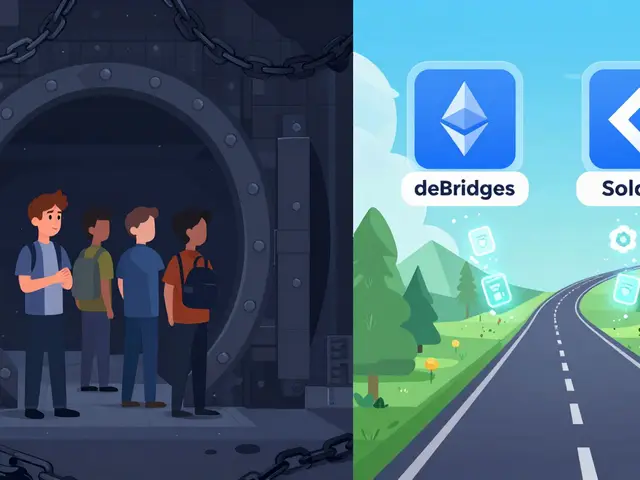
Imagine trying to send money from your bank in New Zealand to a friend in Japan, but instead of using SWIFT or Wise, you had to lock your cash in a middleman’s vault, wait for manual approval, and hope they didn’t lose the keys. That was essentially how early crypto bridges worked-clunky, risky, and slow. Enter deBridge, a protocol that promised to change the game by removing those middlemen entirely. If you’ve heard whispers about DBR token or seen it listed on exchanges like Gate.io or Bybit, you’re probably wondering: what exactly is this thing, and why does it matter?
deBridge isn’t just another bridge; it’s a decentralized cross-chain interoperability protocol launched in early 2022. Its mission? To create what the team calls “DeFi’s internet of liquidity.” Instead of locking your assets in a smart contract pool where they sit idle and vulnerable to hacks, deBridge uses a clever mechanism called the Zero Total Value Locked (TVL) Model. This shifts the risk from everyday users to professional market makers who are incentivized to keep things running smoothly. As of May 2026, the protocol has settled over $2.35 billion in volume across nearly 400,000 unique users with zero security incidents-a track record that stands out in an industry plagued by bridge exploits.
The Core Problem: Why We Need Better Bridges
Cryptocurrency ecosystems are fragmented. You might hold Ethereum on one chain, Solana on another, and Bitcoin wrapped on a third. Moving value between these chains used to mean trusting centralized custodians or complex liquidity pools that often suffered from slippage, high fees, and catastrophic security failures. Traditional bridges require users to deposit funds into a smart contract, which then locks them until the other side releases equivalent assets. It’s slow, capital-inefficient, and creates a massive honeypot for hackers.
deBridge solves this by acting more like a messaging system than a vault. When you want to move assets from Chain A to Chain B, you don’t lock them. Instead, you burn or escrow them on Chain A, and a network of independent validators and oracles signals this action to Chain B, where fresh assets are minted or released. The actual liquidity comes from off-chain market makers who hedge their positions instantly. This means your transaction happens at lightspeed without clogging up a shared pool.
How the Decentralized Liquidity Network Works
The engine behind deBridge is the Decentralized Liquidity Network (DLN). Think of it as a self-organizing swarm of participants who ensure trades execute asynchronously across different blockchains. Here’s how it breaks down:
- No Shared Pools: Unlike Uniswap-style swaps, there’s no single pot of money everyone draws from. Each trade is matched against specific liquidity providers.
- Professional Market Makers: These entities provide the immediate liquidity needed for instant swaps. They earn fees but also take on the counterparty risk, which is managed through sophisticated hedging strategies.
- Independent Oracles: A network of validators chosen via governance ensures that messages between chains are authentic. If a validator acts maliciously, they get slashed-losing their staked collateral.
- AI Optimization: The protocol employs state-of-the-art algorithms to route transactions efficiently, reducing latency and improving price discovery across disparate markets.
This architecture allows deBridge to offer three main products: deBridge Messaging for transferring data and arbitrary assets, dePort for custody solutions allowing users to wrap non-liquid assets, and the DLN itself for native asset swaps. For developers, integrating deBridge is surprisingly simple-you can embed cross-chain swaps into mobile apps or dApps with minimal code, customizing UI elements like colors and fonts to fit your brand.
Understanding the DBR Token
So, what is the DBR coin? It’s the native utility and governance token of the deBridge ecosystem. But unlike many tokens that exist solely for speculation, DBR has concrete roles within the protocol’s mechanics.
First, it’s the key to governance. Holders vote on critical decisions, including treasury management, protocol upgrades, and the selection of validators. Second, it serves as collateral for validators. If you run a node that validates cross-chain messages, you must stake DBR. This stake acts as insurance; if you censor transactions or collude with bad actors, your DBR is slashed. This aligns incentives perfectly-validators have skin in the game to keep the network secure and uptime high.
Let’s look at the tokenomics, which are crucial for understanding supply dynamics. The total maximum supply is fixed, with approximately 3.5 billion DBR tokens in circulation as of May 2026. However, sources vary slightly on exact figures due to ongoing distributions. Roughly 18% of the max supply is currently circulating, while significant portions are allocated to the community through genesis airdrops based on Season 1 points programs and future campaigns. About 20% of the total supply is reserved for the broader deBridge community, ensuring long-term alignment with user growth. Additionally, the protocol features a dynamic issuance rate mechanism. If borrowing demand exceeds targets, the system adjusts DBR issuance to maintain market equilibrium, preventing excessive inflation or deflation shocks.

Market Performance and Price Context (May 2026)
Crypto prices are volatile, and DBR is no exception. As of early May 2026, DBR is trading in the range of $0.030 USD across major exchanges like Gate.io, Bybit, HTX, and Bitget. While the 24-hour chart shows a dip of roughly 9.4%, the seven-day trend is much healthier, showing a 41.2% increase. This volatility reflects both general market sentiment and specific catalysts related to the project.
A major bullish signal came recently when Coinbase added deBridge to its listing roadmap. In the crypto world, being listed on one of the largest US-based exchanges is a stamp of institutional validation. It suggests that regulators and compliance teams see deBridge as a legitimate infrastructure layer rather than a speculative meme coin. Historically, such announcements have driven significant momentum, as seen in late 2025 when DBR saw a 25% surge following similar news.
However, not all analysts are singing praises. Some technical models, like those from CoinCheckup, predict a bearish short-term outlook, forecasting potential drops toward $0.010 by June 2026. These predictions often rely on resistance levels and trading volume patterns that may not account for fundamental adoption metrics. Meanwhile, longer-term speculators point to the protocol’s growing integration breadth and zero-hack history as reasons for optimism, with some bold projections suggesting multi-bagger returns by 2030 if Web3 interoperability continues to expand.
| Metric | Value / Status |
|---|---|
| Launch Date | Early 2022 |
| Cumulative Volume Settled | $2.35 Billion+ |
| Unique Users | 385,000+ |
| Security Record | Zero Incidents / Downtime |
| Current Price Range | $0.030 - $0.031 USD |
| Circulating Supply | ~3.5 Billion DBR |
| Market Cap Estimate | ~$105 Million |
| Major Exchange Listings | Gate.io, Bybit, HTX, Bitget, Coinbase (Roadmap) |
Why Developers and Institutions Care
You might be thinking, “This sounds great for traders, but what about builders?” deBridge is heavily focused on developer experience. The ability to integrate cross-chain functionality with minimal code lowers the barrier to entry for creating truly global dApps. Imagine a lending platform that accepts collateral from Ethereum, Solana, and Avalanche simultaneously, settling debts seamlessly across chains. deBridge makes this possible without forcing developers to build their own fragile bridge infrastructure.
Institutional interest is also growing. The classification of deBridge as a fundamental infrastructure layer for interoperable DeFi means it’s attracting attention beyond retail investors. Partnerships and integrations continue to expand, connecting numerous blockchain ecosystems. This broad connectivity reduces fragmentation in the DeFi space, allowing capital to flow more freely where it’s most needed. For institutions looking to diversify across chains without taking on custodial risk, deBridge offers a compelling solution.
Risks and Considerations
No technology is perfect, and deBridge has its challenges. The primary risk lies in the complexity of its architecture. Because it relies on external market makers and oracle networks, any failure in those layers could impact service continuity. While the zero-TVL model protects user funds from direct bridge hacks, it introduces counterparty risk with the market makers. If a major market maker goes insolvent or fails to hedge properly, it could lead to temporary liquidity shortages or price discrepancies.
Additionally, regulatory uncertainty remains a shadow over all crypto infrastructure. As governments worldwide scrutinize cross-border financial flows, protocols like deBridge may face compliance hurdles. The Coinbase listing roadmap helps mitigate this by signaling adherence to strict KYC/AML standards, but the landscape is still evolving. Finally, competition is fierce. Other bridges like LayerZero, Wormhole, and Axelar are also fighting for dominance in the interoperability space. deBridge must continue to innovate and maintain its speed and cost advantages to stay ahead.
Conclusion: Is DBR Worth Your Attention?
If you’re looking for a quick pump-and-dump scheme, DBR probably isn’t for you. But if you believe in the long-term vision of a connected, interoperable Web3, deBridge represents a solid piece of foundational infrastructure. Its zero-hack record, innovative zero-TVL model, and growing institutional support make it a standout player in the cross-chain arena. Whether you’re a developer building the next big dApp, a trader seeking efficient cross-chain swaps, or an investor interested in governance tokens with real utility, deBridge deserves a spot on your radar. Just remember to do your own research, understand the risks, and never invest more than you can afford to lose.
What is the main difference between deBridge and traditional crypto bridges?
Traditional bridges typically use a "lock-and-mint" model where your assets are locked in a smart contract pool on one chain, and equivalent assets are minted on another. This creates a large target for hackers and requires significant liquidity in the pool. deBridge uses a "Zero TVL" model, meaning it doesn't hold user funds in a central pool. Instead, it relies on professional market makers to provide liquidity and execute trades asynchronously, shifting the risk away from users and towards hedged professionals.
Can I lose my money using deBridge?
While deBridge has maintained a zero-security-incident record since its launch in 2022, no system is 100% immune to risk. The primary risks are not direct hacks of user funds (since there's no central pool), but rather potential issues with market maker solvency, oracle failures, or smart contract bugs in the underlying chains. Always verify transaction details and consider the inherent risks of interacting with new DeFi protocols.
What is the purpose of the DBR token?
The DBR token serves two main purposes: governance and security. Holders can vote on protocol decisions, such as treasury management and parameter updates. Additionally, validators who run nodes to secure the network must stake DBR as collateral. This stake can be slashed if they act maliciously, ensuring that validators are financially motivated to keep the network honest and operational.
Is deBridge available on Coinbase?
As of May 2026, Coinbase has added deBridge to its listing roadmap. This indicates that the exchange is in the process of evaluating and potentially adding DBR for trading. While it may already be available on other major exchanges like Gate.io, Bybit, and HTX, availability on Coinbase depends on the completion of their internal review and regulatory compliance processes.
How does deBridge ensure fast transaction speeds?
deBridge achieves speed by bypassing traditional liquidity pools that can become congested. It uses a Decentralized Liquidity Network (DLN) with independent oracles and validators to communicate cross-chain messages instantly. Combined with AI-driven optimization algorithms that route transactions efficiently, users experience near-instant swaps without waiting for block confirmations on the receiving chain to finalize liquidity.