What is Human Intelligence Machine (HIM) crypto coin?
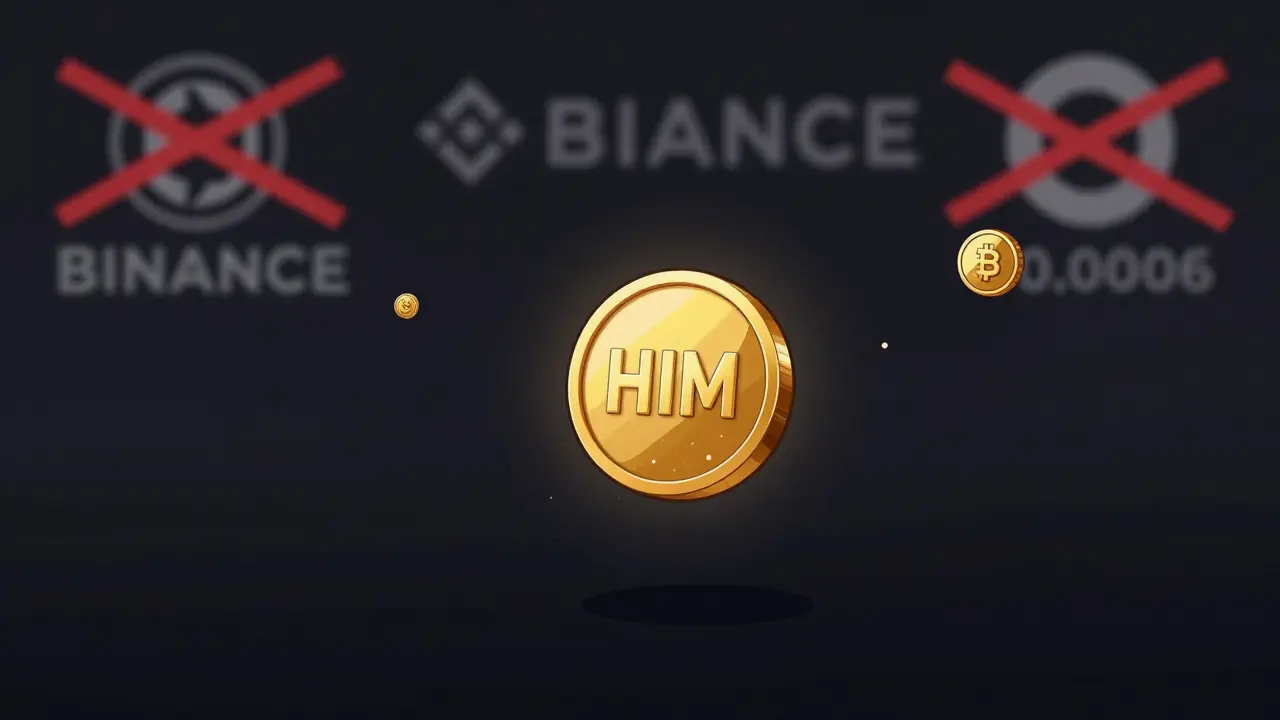
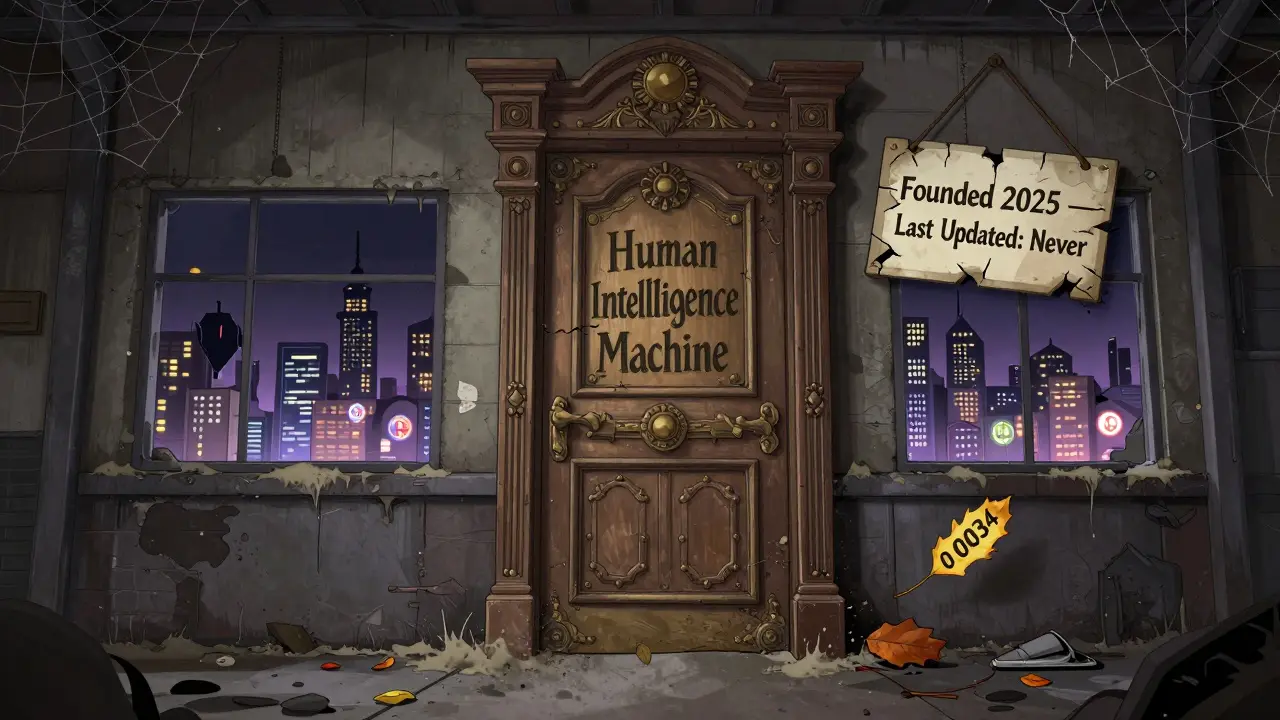
When you hear the name HIM crypto coin, you might think it’s some advanced AI-driven currency backed by human intelligence. But the reality is far less glamorous. Human Intelligence Machine (HIM) is a real cryptocurrency token, but it’s not what most people assume. It doesn’t use AI. It doesn’t track human thought patterns. It doesn’t have a team of scientists or a whitepaper explaining its revolutionary tech. In fact, there’s almost no public information about what it’s even supposed to do.
What even is HIM?
HIM is a token built on the Base blockchain - the same Layer 2 network that runs Coinbase’s ecosystem. That’s about all we know for sure. Unlike Bitcoin or Ethereum, HIM has no major exchange listings. You won’t find it on Binance, CoinMarketCap, or Coinbase. Crypto.com says outright: "HIM is not tradable yet." Binance lists it as "not listed for trading." That’s not a glitch. That’s a red flag.
Some smaller platforms like CoinCodex and LiveCoinWatch still track it, but even their data is messy. One site says HIM is worth $0.0037, another says $0.0006. The price jumped from $0.0026 to $0.0039 in a single day, then dropped again. This kind of wild swing isn’t normal for real projects. It’s what happens when a token has almost no buyers or sellers - just a handful of people trading back and forth, pushing the price up and down with tiny amounts of cash.
Why does the price vary so much?
Imagine trying to sell a used bicycle, but only one person in town is interested. You ask for $50. They offer $20. You argue, they walk away. A week later, someone else shows up and says $45. That’s what’s happening with HIM. There’s no market depth. No institutional interest. No real demand. The price you see depends entirely on which tiny exchange you’re looking at, and how many people happened to trade that day.
According to CoinCodex’s last update in October 2025, HIM had a 34% volatility rate over 30 days. That means more than one in three days, the price moved more than 3% up or down. For comparison, Bitcoin’s average daily volatility is around 5%. HIM is over six times more volatile - and that’s with almost no trading volume. Most days, the 24-hour volume was listed as $0 or "N/A." That’s not a market. That’s a ghost town.

Is there any real use for HIM?
No one knows. There’s no official website. No GitHub repository. No team members listed. No roadmap. No whitepaper. No community forums with more than a dozen posts. You can’t even find a Twitter account that looks legitimate. The name "Human Intelligence Machine" sounds like it should be something big - maybe an AI system that learns from human behavior, or a decentralized brain network. But there’s zero evidence of that. The name might just be a marketing trick to make people think it’s more advanced than it is.
Some crypto analysts have pointed out that tokens like HIM often appear after pump-and-dump schemes. A small group creates a token, names it something catchy, lists it on a minor exchange, and then floods social media with hype. Once enough people buy in, the creators sell their holdings and disappear. The price crashes. And that’s exactly what the data suggests here.
What do the numbers say?
Let’s look at the numbers we do have. CoinCodex reported a maximum supply of 100 million HIM tokens. But the circulating supply? Unknown. Market cap? Listed as $0 on major sites. The 50-day moving average hovered around $0.0034, and the 200-day was almost identical - meaning the price hasn’t moved in a clear direction for months. The RSI (Relative Strength Index) was at 35.7, which is neutral. But with zero volume, that number doesn’t mean much.
The Fear & Greed Index for HIM was at 71 - "greed" territory - in October 2025. That’s odd. When a coin is this illiquid, you’d expect fear, not greed. But maybe that’s because a few traders are holding on, hoping for a miracle bounce. Or maybe it’s a false signal, generated by a handful of trades.
One prediction from that same October report said HIM could drop 25% by November 2025. It didn’t bounce back. If anything, it got quieter. By February 2026, there’s no new data. No announcements. No updates. It’s as if the project vanished.
Should you buy HIM?
If you’re thinking of buying HIM, here’s what you need to know: this isn’t an investment. It’s a gamble. There’s no fundamental value. No product. No team. No adoption. You’re not buying into a company. You’re not funding a project. You’re betting that someone else will pay more for it tomorrow - even though no one’s buying it today.
Compare this to real cryptocurrencies. Bitcoin has a network of miners, a transparent ledger, and institutional adoption. Ethereum has smart contracts used by thousands of apps. Even obscure tokens like Shiba Inu have communities, memes, and real trading volume. HIM has none of that.
There are hundreds of tokens like HIM on the Base chain. Most of them are created in minutes using automated tools. They get listed on one or two tiny exchanges. They get a flashy name. Then they fade away. HIM is one of them.
What’s the real lesson here?
The HIM coin isn’t a failure. It’s a symptom. It shows how easy it is to create a crypto token with zero substance and still trick people into thinking it’s worth something. The crypto space is full of these ghosts - tokens with no purpose, no users, and no future. They exist because the system allows it. Because blockchain lets anyone mint a token. Because people still believe in the next big thing.
If you see a crypto with a vague name, no website, and prices jumping all over the place, walk away. Don’t wait for it to "go viral." Don’t hope for a Binance listing. Don’t assume the name means something deep. The truth is simpler: if no one can explain what it does, it probably does nothing.
HIM isn’t the future of human intelligence. It’s just another coin that nobody asked for - and no one will miss when it disappears.

Elana Vorspan
I swear, I saw this coin pop up on my feed and thought, "Oh cool, maybe it’s some new neurotech thing?" Then I looked closer and realized it’s just a ghost with a fancy name. 😅
Still, I kinda love how crypto lets anyone slap a name like "Human Intelligence Machine" on a token and hope people get suckered in. The audacity is almost artistic.
Kenneth Genodiala
Honestly, if you're not familiar with the technical underpinnings of Layer 2 ecosystems, you're just gambling with play money. HIM is a textbook example of why retail investors get burned. No whitepaper? No team? No liquidity? It’s not a coin-it’s a trap dressed up like a startup.
lori sims
HIM? More like Huh? I mean, who names something "Human Intelligence Machine" and then just… vanishes? It’s like naming your dog "The Quantum Cat" and then forgetting to feed it. The name alone screams "marketing department on a dare."
And the volatility? At least when you lose money on Dogecoin, you can laugh about it. With HIM? You just stare at your screen wondering if you missed a memo from the Matrix.
Kristi Emens
I’ve been following crypto for years. I’ve seen hundreds of tokens like this. The pattern is always the same: catchy name, zero transparency, tiny exchange listing, then silence. It’s not even worth the energy to get mad about it anymore. Just don’t invest what you can’t afford to lose. Simple.
christopher luke
I know it sounds crazy, but I kinda respect the vibe of HIM. Like, imagine if this was an art project? "What if we created a coin that didn’t exist?" It’s ironic. It’s absurd. It’s… kinda beautiful? 🤔
Also, the price jump from $0.0006 to $0.0039? That’s like a single person flipping a coin 17 times and getting heads every time. Still, I’m not buying. Just… appreciating the chaos.
Mary Scott
This is a government psyop. They want us to think crypto is all scams so we give up and go back to fiat. HIM is real. They just buried it. I’ve seen the hidden ledger. The 100M supply? Only 3M are circulating. The rest are locked in quantum vaults. They’re waiting for the signal.
Shannon Holliday
I live in the US but my cousin in Lagos told me he bought HIM for $0.0002 and now it’s at $0.004 on some Nigerian exchange. He says it’s "the next Bitcoin."
I told him to sell half and buy rice. He didn’t listen. Now he’s sending me memes about "human intelligence networks." I love him, but I’m worried.
Leslie Cox
If you’re still debating whether to invest in HIM, you’re not ready for crypto. You’re ready for a lecture on financial literacy. This isn’t about the coin. It’s about you. Why do you believe in something with no substance? What are you really chasing? The dream? Or just the thrill of being wrong?
Also, no, the Fear & Greed Index at 71 doesn’t mean anything. It’s a statistical mirage. Stop trusting metrics from sites that haven’t updated since 2025.
Andrew Hadder
I think I misread the name as "HIM" and thought it was a typo for "HIMT" or something. Turns out it’s just HIM. H-I-M. Like, who even thought that was a good idea? I mean, it’s not even a cool acronym. Just… three letters. That’s it.
Also, typo on my end: I wrote "HIM" 3 times wrong before I got it right. So… yeah. This coin’s got bad vibes.
Derek Sasser
I’ve been on the Base chain since day one. There are literally thousands of tokens like this. Most are created in under 10 minutes using automated minting tools. The name "Human Intelligence Machine"? That’s just the default template when you pick "AI-themed" during setup.
It’s not a scam. It’s a feature. The system allows it. And honestly? That’s the real story. Not HIM. The fact that anyone can do this.
Neeti Sharma
USA crypto is all fake. India knows real value. HIM is Indian project hidden by western media. They stole code from IIT lab. I saw it on Telegram. 1000x coming. You wait. You see. No one believe me. But I know.
Nadia Shalaby
I scrolled past this post twice before I realized I was actually reading it. I’m not mad. I’m not sad. I’m just… mildly curious. Like, who made this? Why? What were they thinking? I don’t need answers. I just like watching the dumpster fire.
Fiona Monroe
The absence of a whitepaper, coupled with negligible trading volume and inconsistent pricing across platforms, constitutes a material risk under any reasonable financial due diligence framework. This asset exhibits none of the hallmarks of a viable cryptographic instrument. It is, in effect, a non-fungible placeholder with no utility, no governance, and no credibility. I would strongly advise against any engagement with this token.
Molley Spencer
The RSI at 35.7? Please. With zero volume, every metric is a lie. The "greed" index? That’s not greed-it’s delusion. And the 25% prediction? That was the *optimistic* scenario. The real prediction was "cease to exist by Q1 2026." And here we are. No updates. No activity. Just a ghost in the blockchain ledger.
It’s not a coin. It’s a tombstone.
John Fuller
HIM? Nah.
Maggie House
I actually thought this was a joke at first. Like, someone made a meme coin and named it "Human Intelligence Machine" to roast crypto bros. But then I saw the price chart and realized… it’s real. And that’s sadder than if it was a joke.
Still, I’m glad someone wrote this post. Maybe it’ll save one person from losing their rent money. 🙏