What is ICLighthouse DAO (ICL) Crypto Coin? A Real-World Look at the Internet Computer's DeFi Project
The ICLighthouse DAO (ICL) crypto coin isn’t another meme token or copycat DeFi project. It’s a niche, technically ambitious experiment built directly on the Internet Computer blockchain - a platform most people haven’t heard of, but one that’s quietly pushing boundaries in decentralized finance. If you’re wondering what ICL is and whether it’s worth paying attention to, here’s the real story: it’s a small, developer-led DAO trying to build the first fully on-chain order book DEX on a public blockchain. That sounds impressive - and it is. But the market doesn’t care yet.
What Exactly Is ICLighthouse DAO?
ICLighthouse DAO is a decentralized organization that governs a suite of tools built on the Internet Computer (ICP) blockchain. It’s not a company. It’s not even a typical startup. It’s a smart contract running on-chain, controlled by token holders who vote on upgrades, funding, and direction. The ICL token is the glue holding it all together - used for voting, paying fees, and accessing ecosystem services like ICDex and icRouter.
The project started in Singapore, emerged from the Singapore Blockchain Innovation Programme Hackathon in early 2023, and officially launched later that year. Its goal? To prove that complex DeFi features - like limit orders, stop-losses, and grid trading - can run entirely on-chain without relying on centralized intermediaries or Layer 2 solutions. That’s different from Uniswap or PancakeSwap, which use automated market makers (AMMs). ICLighthouse is betting on order books, the old-school way of trading.
The ICL Token: Supply, Circulation, and Value
As of February 2026, there are 210 million ICL tokens designed to exist in total. Of those, about 200.25 million were minted at launch. Only 34.63 million are currently in circulation - meaning most tokens are locked up in treasury, team wallets, or future incentives. That’s a common structure in DAOs, but it also means the real market is tiny.
Price data varies across exchanges. On CoinMarketCap, ICL trades around $0.01438 USD. On Crypto.com, it’s $0.01614. On LBank, it’s $0.019725. That kind of inconsistency is a red flag - it suggests low liquidity and minimal trading activity. The total market cap sits at roughly $498,060, ranking it #5983 out of all cryptocurrencies. For context, the top 100 coins each have market caps over $1 billion. ICL is in the bottom 5%.
The 24-hour trading volume? Just $6.07. That’s not a typo. For a token with a $500k market cap, you’d expect at least $5,000-$25,000 in daily volume to be considered liquid. ICL’s volume-to-market-cap ratio is 0.00122%. Healthy tokens are above 1%. This isn’t just illiquid - it’s nearly frozen.
ICDex: The Real Innovation
If ICL had a flagship product, it would be ICDex. This isn’t another AMM DEX. It’s the first 100% on-chain order book exchange on any Layer 1 blockchain. That means every buy and sell order is stored and matched on-chain - no off-chain matching engines, no centralized servers. You can place limit orders, market orders, fill-or-kill, iceberg orders, and even complex TWAP/VWAP strategies - all running directly on the Internet Computer.
It uses something called OAMM (Orderbook Automated Market Making), which blends traditional order book mechanics with liquidity pools. This lets users trade with deeper liquidity than a pure order book, while still keeping full transparency. Developers praise it. DFINITY Foundation even awarded it a grant in 2023, calling it "a significant advancement in DeFi architecture for the Internet Computer."
But here’s the catch: running order books on-chain is expensive. Each trade costs computational power. On Ethereum, you’d use Layer 2s like Arbitrum to handle this cheaply. On Internet Computer, you pay in cycles - the network’s internal fuel. While transaction costs are still under a cent in USD terms, they’re high enough to make high-frequency trading economically unviable. Blockchain analyst Marcus Thompson of Blockworks Research put it bluntly in January 2025: "ICDex’s order book model faces fundamental challenges on the IC network due to computational cost structures."
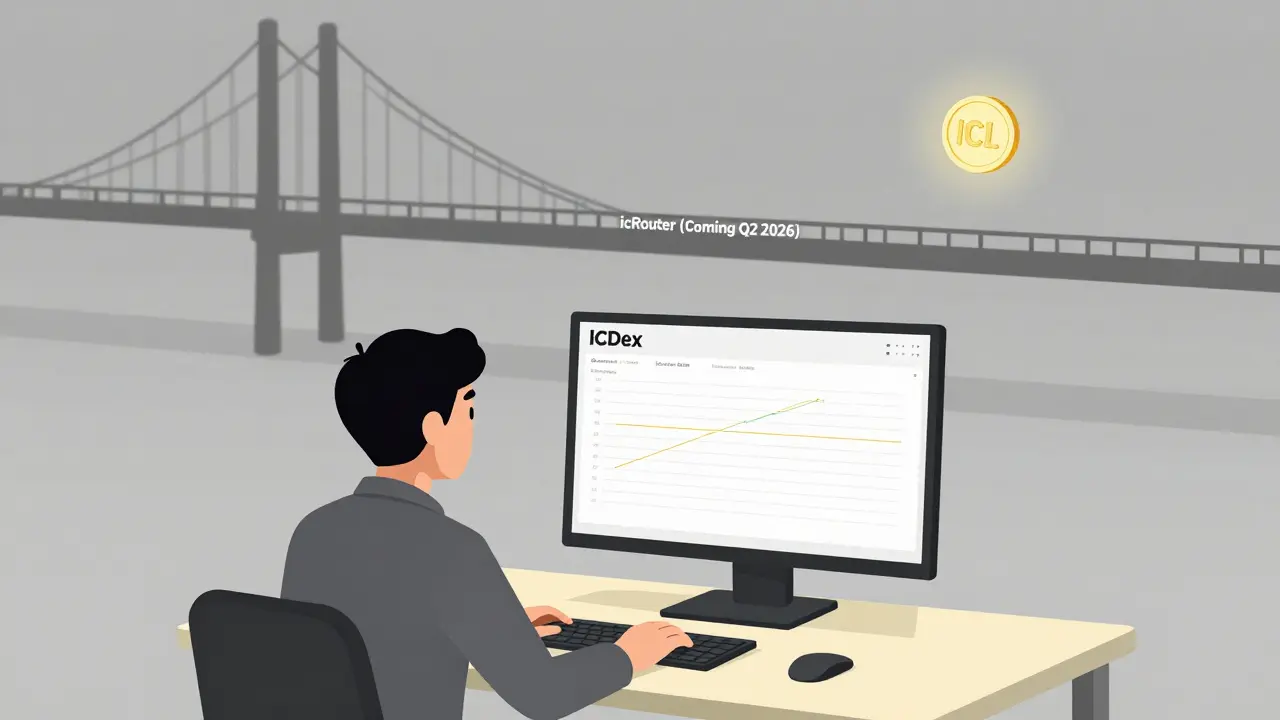
icRouter: The Missing Link
ICLighthouse isn’t just about trading. It’s also trying to solve one of crypto’s biggest problems: cross-chain asset movement. That’s where icRouter comes in. Unlike most bridges (which are centralized, hack-prone, and slow), icRouter uses threshold signature schemes (TSS) to move assets directly between Bitcoin, Ethereum, and the Internet Computer - without trusted third parties.
As of February 2026, icRouter is still in testing. No mainnet launch yet. That’s a problem. The whole ecosystem hinges on interoperability. If you can’t move your Bitcoin or ETH into ICDex easily, who’s going to trade there? The team says mainnet is coming in Q2 2026. But in crypto, promises don’t pay bills. And with trading volume at $6 a day, there’s little incentive for outsiders to wait.
Who’s Using ICL and Why?
The user base is small, but not insignificant. Most users are developers and early adopters of the Internet Computer ecosystem. On the IC Developer Forum, users report successfully using ICDex with gas costs around 0.0005 ICP per trade - that’s less than a penny. But liquidity is thin. One Reddit user said slippage hits 15% on trades over $50. That means if you try to buy $100 worth of ICL, you might end up paying $115 because there aren’t enough sellers.
Token holders are mostly retail. Blockchain explorer data shows 87% of ICL addresses hold under 10,000 tokens. That’s not institutions. That’s hobbyists. There’s no whale activity. No venture capital backing. No exchange listings beyond ICPSwap - the main DEX on Internet Computer. You won’t find ICL on Binance, Coinbase, or Kraken. It’s a hidden gem… if you know where to look.
The Bigger Picture: Internet Computer’s DeFi Ecosystem
ICLighthouse DAO exists inside a much larger, but still tiny, ecosystem. As of February 2026, the entire Internet Computer DeFi sector has a total value locked (TVL) of $187 million. That’s 0.12% of Ethereum’s $154 billion. ICL’s market cap of half a million dollars is just a drop in that bucket.
But the Internet Computer has one big advantage: speed and cost. Transactions settle in under two seconds, and fees are negligible compared to Ethereum. That’s why developers are still building here - even if nobody’s trading. The tech is real. The infrastructure works. It’s just not popular yet.

Is ICLighthouse DAO Worth It?
Here’s the honest answer: If you’re looking for a quick flip, walk away. ICL’s volume is too low. The price moves unpredictably. You could buy $100 worth and never find a buyer.
If you’re a blockchain developer who understands the Internet Computer, and you believe in on-chain order books as the future of DeFi - then ICL might be worth exploring. The team has delivered on their promises since 2023. They’ve won grants. They’ve shipped code. They’re not vaporware.
If icRouter launches successfully in Q2 2026 and brings real cross-chain liquidity to ICDex, everything could change. But that’s a big "if." Until then, ICL is a bet on a niche technology, not a mainstream asset. It’s not a coin you buy because it’s trending. It’s a coin you buy because you believe in the Internet Computer’s long-term vision - and you’re willing to wait years for it to matter.
How to Get Started with ICL
Getting ICL isn’t easy, and it’s not for beginners. Here’s what you need:
- Set up an Internet Identity - your on-chain identity on the IC network.
- Install the Internet Computer Wallet browser extension.
- Buy ICP tokens on a supported exchange (like Binance or OKX).
- Transfer ICP to your wallet and swap for ICL on ICDex.app - the only place it trades.
You’ll need to understand how cycles work, how canisters operate, and how to read Motoko code if you plan to interact with smart contracts. The learning curve is steep. Documentation exists, but it’s written for developers, not casual users. The Telegram group has about 1,200 members - most of them asking the same questions over and over.
What’s Next for ICLighthouse DAO?
The roadmap is clear: launch icRouter mainnet in Q2 2026, improve ICDex’s liquidity, and expand developer tooling. The team recently cut gas costs on ICDex by 37% in December 2025 - a sign they’re still iterating. But without volume, none of this matters.
Right now, ICLighthouse DAO is a quiet lab experiment. No headlines. No hype. No influencers. Just a small group of engineers trying to build something hard - and hoping the world catches up.

Michael Sullivan
This isn't a coin. It's a crypto art installation. 🤡
Shruti Sharma
why is everyone so into this? i thought icp was dead?? lol
Jacque Istok
The 24-hour volume is $6.07. That’s not illiquid. That’s a ghost town with a vending machine that only accepts Monopoly money. 🏚️💸
Mrs. Miller
So we're betting on a blockchain that nobody uses, to power a trading system that nobody trades on, because some devs think order books are "cool"? I miss when crypto was just dumb memes and free money.
But hey, if you wanna fund a PhD thesis with your life savings, go ahead. I'll be over here buying Dogecoin.
Brittany Novak
The Internet Computer is a Fed-backed project. They’re using ICL to quietly mint tokens for central bank digital currency testing. The low volume? That’s because the real trades are happening off-chain in black ops ledgers. Look at the grant from DFINITY-funded by DARPA. Wake up.
Taybah Jacobs
It's important to recognize that this project represents a thoughtful, technically rigorous attempt to solve a real problem in DeFi architecture. While the market conditions are currently unfavorable, the commitment to on-chain execution and cryptographic integrity is commendable. One should approach such endeavors with patience and intellectual humility.
Kyle Pearce-O'Brien
Order books on-chain? That’s like building a Ferrari with a horse engine and calling it "revolutionary." You’re not innovating-you’re just masochistically optimizing for the wrong paradigm. The IC’s cycle cost structure is a fundamental flaw. This isn’t DeFi. It’s a blockchain masochism experiment.
Freddie Palmer
I love how the team is actually shipping code, even if nobody’s trading. That’s rare. Most projects just tweet and airdrop. ICDex’s OAMM is legitimately clever-it’s not just AMM 2.0. And icRouter? If it works, it could be the first truly decentralized cross-chain bridge that doesn’t get hacked every other month. The tech is solid. The market just hasn’t caught up. I’m holding.
Nathaniel Okubule
If you don’t understand cycles or canisters, don’t touch this. It’s not for beginners. But if you’re a dev and you believe in the IC, this is one of the few real projects worth your time. No hype. Just code.
Reda Adaou
I’ve been watching ICL since launch. It’s quiet, but the devs reply to every comment on the forum. No fluff. No promises. Just updates. That’s rare. I don’t expect to get rich. But I believe in what they’re building. Sometimes, the quiet builders are the ones who change things.
laura mundy
This is why crypto is dead. You have a $500k market cap and $6 in volume and people are still pretending it’s a "hidden gem." It’s not hidden. It’s irrelevant. And you’re all just clinging to the corpse because you bought in at $0.03 and now you’re emotionally attached.
Alisha Arora
I tried to buy ICL. Took me 3 days to figure out how to get ICP. Then ICDex crashed my wallet. Then I had to learn what a canister was. Now I’m just waiting for the next update. I think I’m addicted to crypto trauma.
Brittany Coleman
Maybe it’s not about the price. Maybe it’s about the idea. What if order books on-chain are the future? What if we’re just too used to AMMs? Maybe we’re the ones who are lazy, not the devs.
Mendy H
The fact that this project exists at all is proof that crypto still attracts people who think "technical feasibility" is a substitute for market demand. Congrats. You built a beautiful, expensive, useless sculpture. The only thing more tragic than the volume is the comment section full of people calling it "visionary."
Matthew Ryan
I’m not bullish. I’m not bearish. I’m just watching. The team has delivered. The tech works. The market doesn’t care. That’s crypto. I’ll check back in 6 months.
Molly Andrejko
To everyone saying "this is dead"-remember that Ethereum was once a $20M project with 3 users. Sometimes the quiet ones grow the slowest. ICL isn’t a coin. It’s a seed. And seeds don’t shout.
sabeer ibrahim
India has better DeFi projects. This is just western tech bros playing with their toys. Why should I care about a blockchain that needs 1000 lines of code just to send $1?
Robin Ødis
The real scam isn't the token-it's the people who keep pretending this is a "real project" instead of a glorified sandbox. You're not an early adopter. You're a delusional martyr. And you're wasting your time. The ICP ecosystem is a sinking ship with a fancy paint job.
Michael Sullivan
icRouter launches in Q2 2026? Sure. And I’ll believe it when I see it. 🤖💸
Molly Andrejko
That’s fair. But if you look at the commit history, they’ve shipped every single milestone on time since 2023. That’s more than most projects can say. Maybe this time it’s different.