What is iCommunity Labs (ICOM) crypto coin? A practical breakdown of its use, value, and risks
When you hear about a new crypto coin, especially one with a name like ICOM, it’s easy to get excited. But not all tokens are created equal. Some are built to move money across borders. Others are meant to power real services inside a specific system. iCommunity Labs’ ICOM coin falls into the second group - and understanding that difference is key.
What ICOM actually does
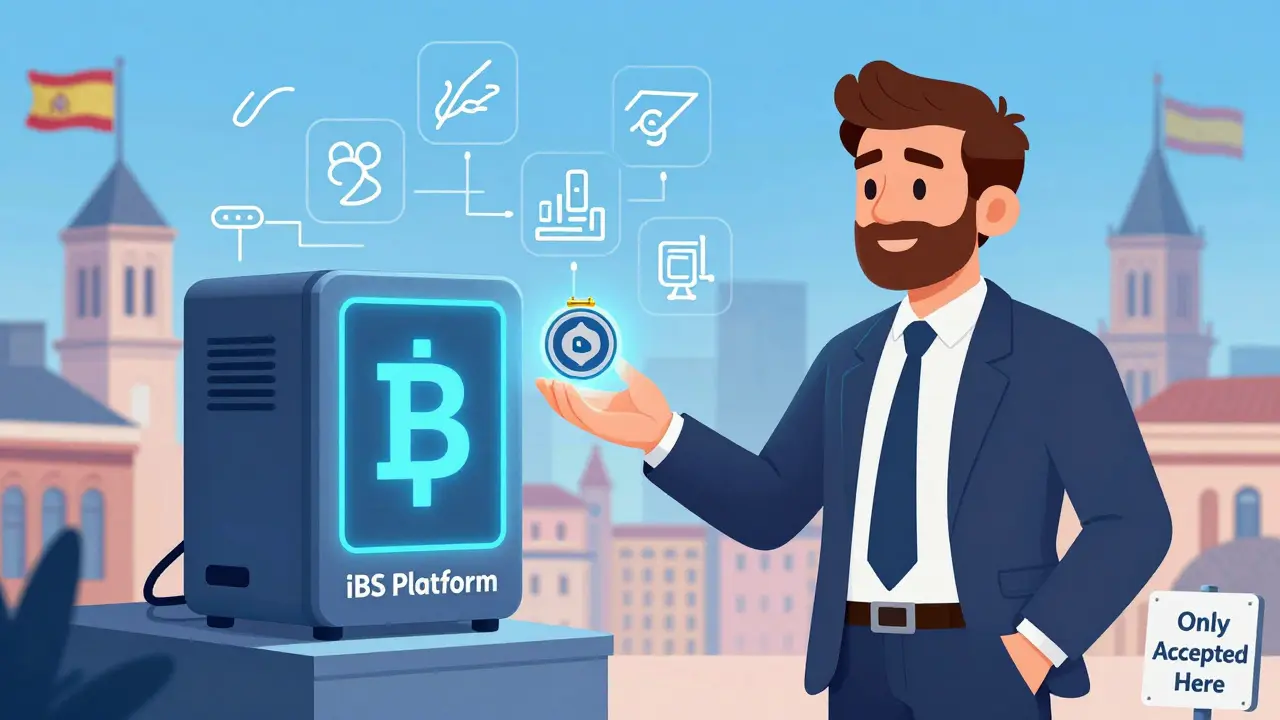
ICOM isn’t a currency you use to buy coffee or pay for a Netflix subscription. It’s a utility token - a digital key that unlocks services inside the iCommunity Blockchain Solution (iBS) platform. Think of it like a prepaid card for a single gym. You can’t use it at other gyms. You can’t cash it out. But if you’re a member of that one gym, it’s the only thing that lets you book classes, use the equipment, or access training sessions.
Inside the iCommunity ecosystem, ICOM is required to pay for services like electronic signatures, document notarization, supply chain tracking, and digital identity verification. If a Spanish company wants to use iCommunity’s blockchain tools to prove a product’s origin or sign a contract legally, they pay in ICOM. No credit cards. No bank transfers. Just ICOM.
This isn’t theoretical. Companies like Estrella Galicia, a major Spanish brewery, and AENOR, Spain’s official standardization body, already use this system. They don’t use ICOM to make money. They use it to do business - securely and without middlemen.
How ICOM works technically
ICOM runs on Ethereum as an ERC-20 token. That means it’s built on the same network as Ethereum itself, which gives it a solid technical foundation. The total supply is fixed at 99 million tokens. Right now, 85 million are in circulation. That leaves 14 million locked up for future releases or team incentives.
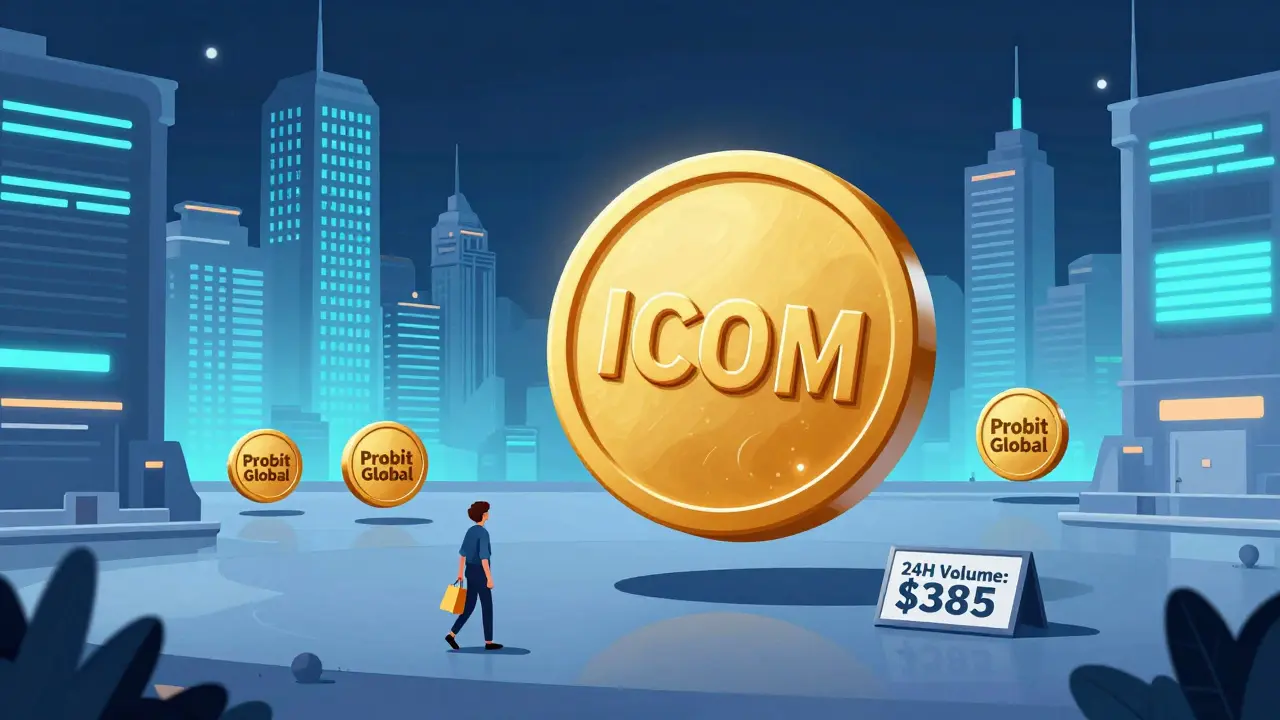
Here’s where things get tricky: ICOM doesn’t trade like Bitcoin or Ethereum. You won’t find it on Binance, Coinbase, or Kraken. It’s listed only on Probit Global and a few smaller exchanges. As of November 2025, its 24-hour trading volume was just $385.74. That’s less than what a single person might spend on a weekend shopping trip.
With a market cap of $283,020 and only 630 wallet addresses holding ICOM, this isn’t a liquid market. If you buy 10,000 ICOM today, you might not be able to sell them tomorrow unless you’re willing to take a huge loss. There’s almost no demand outside the iCommunity platform.
Who gets ICOM and how
ICOM isn’t mined. It’s distributed through sales and vesting schedules. Here’s how it breaks down:
- Pre-sale buyers: Get their tokens after a 5-month lock-up.
- Public sale phase 1 (via iCommunity’s own store): 3-month lock-up.
- Public sale phase 2 (via Probit): 20% released at launch, 80% after 60 days.
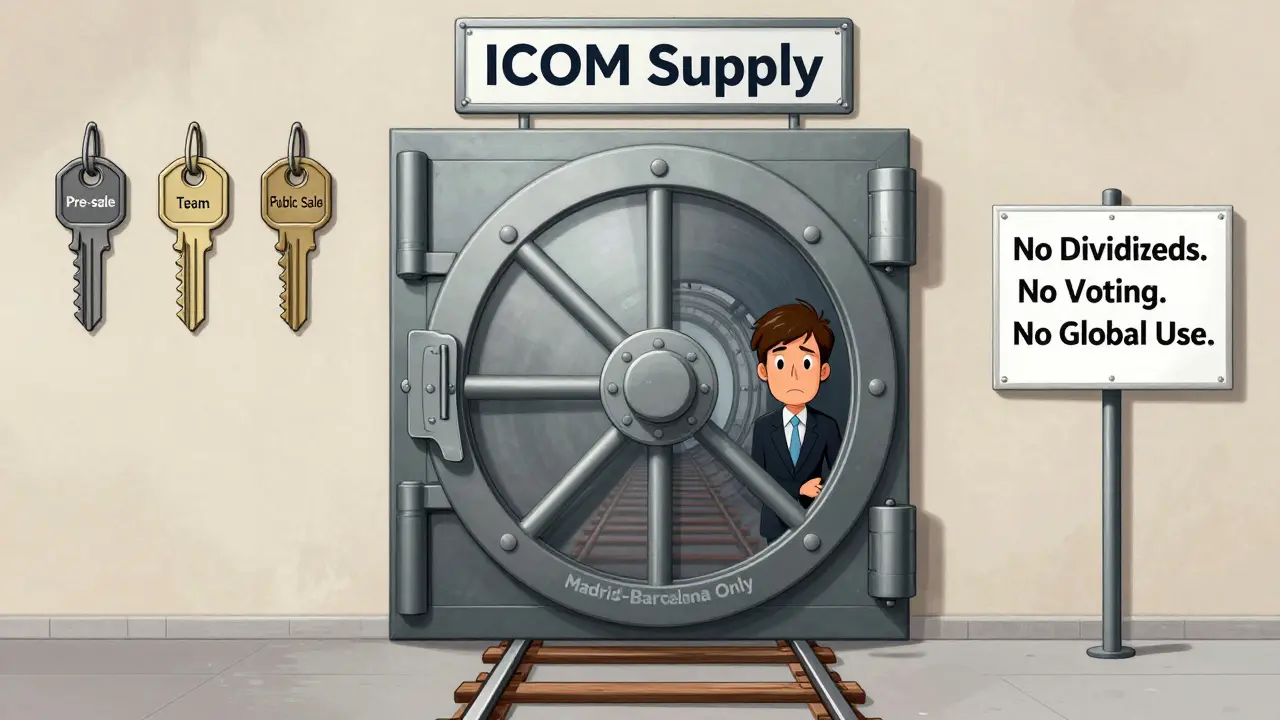
- Team and foundation tokens: Locked for 12 months, then released slowly over 36 months.
This structure is designed to prevent early investors from dumping their tokens and crashing the price. It also ensures that the people building the platform - the team, early backers, and investors - have a long-term stake in its success.
But here’s the catch: owning ICOM doesn’t mean you own part of iCommunity Labs. You don’t get dividends. You don’t get voting rights on company decisions. You can’t use it to claim equity. You only get access to services - and even those are limited to the iCommunity network.
Why ICOM is different from other blockchain tokens
Compare ICOM to Chainlink or Polygon. Those tokens power services across hundreds of apps, DeFi platforms, and enterprise systems. You can use Chainlink to get real-world data into a smart contract, whether you’re trading crypto, insuring a flight, or tracking a shipment.
ICOM does none of that. It’s a single-purpose tool. It only works inside iCommunity’s ecosystem. And that ecosystem is focused almost entirely on Spain. While iCommunity partners with global tech giants like AWS and IBM, the actual users are mostly Spanish businesses. The token even converts crypto payments to Euros using Coinbase’s daily average - a clear signal that it’s built for a specific national market.
This makes ICOM unique. Most blockchain projects try to go global. iCommunity Labs is trying to dominate a niche. It’s like building a high-speed train system - but only between Madrid and Barcelona. It might be the best system for that route. But if you need to go to Lisbon, it won’t help.
The risks of holding ICOM
Let’s be clear: ICOM is not a good investment if you’re looking for price growth. The numbers don’t lie.
- Market cap: $283,020
- Trading volume: $385/day
- Holders: 630 wallets
- Rank on CoinMarketCap: #5,797
That’s not a mistake. That’s the reality. For context, Ethereum has a market cap of over $400 billion. Even small tokens like Solana or Polygon have daily volumes in the hundreds of millions.
ICOM’s biggest risk? It’s entirely dependent on iCommunity Labs’ ability to grow its user base. If no new companies join the platform, demand for ICOM won’t increase. If the company fails to expand beyond Spain, its utility stays frozen.
There’s also no public roadmap beyond vague promises that “companies using the platform will grow, increasing demand for ICOM.” That’s not a plan. That’s a hope.
Who should consider ICOM?
There are only two groups who should care about ICOM:
- Spanish businesses who need blockchain-based notarization, traceability, or digital signatures - and who are already using iCommunity’s services.
- Speculators who are willing to risk money on a token with almost zero liquidity, hoping for a future surge in adoption.
For everyone else - investors looking for growth, crypto users wanting flexibility, or people trying to diversify their portfolio - ICOM offers no real value. You can’t spend it. You can’t trade it easily. And you can’t count on it to rise in price.
If you’re a business in Spain and you’re already using iCommunity’s tools, then ICOM makes sense. It’s the only way to pay. But if you’re just buying it because you saw it on a list of “next big coins,” you’re walking into a trap.
The bottom line
ICOM isn’t a cryptocurrency in the way most people think of it. It’s a service token - a digital voucher for a specific set of tools. It has a real purpose, but that purpose is narrow. It’s not designed to make you rich. It’s designed to help Spanish companies move paperwork onto blockchain.
Its value comes from utility, not speculation. And right now, that utility is limited to a handful of users in one country. Until iCommunity Labs expands its platform, attracts thousands of new clients, and opens up ICOM’s use beyond its own ecosystem, this token will remain a curiosity - not a cornerstone of the crypto world.

Freddie Palmer
This is one of the most balanced, clear-eyed takes on ICOM I've seen. Seriously. Most people either scream 'scam!' or 'next Bitcoin!'-but this? It’s a utility token with a hyper-localized use case. And that’s not bad. It’s just… not a global crypto play. I appreciate how you highlighted the Spanish business adoption. That’s the real story.
Taybah Jacobs
Thank you for this thoughtful analysis. It is refreshing to encounter a perspective that does not rely on hyperbole or fear-mongering. The distinction between a utility token and a speculative asset is indeed critical, and your analogy of the gym membership is both apt and accessible. I shall be sharing this with my colleagues in regulatory compliance.
Udit Pandey
India has real blockchain potential. Spain? They still use fax machines for legal docs. This ICOM thing is just another Western vanity project. If you want real utility, look at India’s CBDC pilot or the blockchain-based land registry in Telangana. This is just crypto tourism.
mahikshith reddy
Lmao. $385 daily volume? 630 wallets? Bro. This isn’t crypto. This is a spreadsheet with a blockchain sticker on it. If you’re holding ICOM hoping for moon, you’re already in the moon. Just sayin'.
Brendan Conway
so like… its not money. its like a gift card. for one store. that only one country uses. and no one else cares. and the price is like… $0.003? and you cant even sell it? huh. okay. cool. i guess if you live in spain and you do paperwork for a living… cool. otherwise… why are we talking about this?
Matt Smith
This is why crypto is dead. 🤡 Every time someone tries to make a "utility token" it’s just a fancy way to say "we’re trying to pump a coin nobody wants." ICOM? More like I-Cant-Offer-Much. 🚫💸
Alex Garnett
The author’s tone is disarmingly reasonable. But that’s the trap. This isn’t innovation-it’s regulatory arbitrage disguised as blockchain. A Spanish company using a token to avoid EU payment regulations? That’s not utility. That’s evasion. And the fact that it’s listed only on Probit? That’s not niche. That’s a graveyard.
Ryan Chandler
I’ve worked with blockchain systems in 12 countries. ICOM is the most fascinating case study I’ve seen in years. It’s not about global dominance. It’s about hyper-local trust infrastructure. Imagine if every country had its own utility token for official documents-secure, sovereign, frictionless. Spain’s just the first. This could be the blueprint for post-Brexit UK, or post-digital euro France. Don’t laugh. Watch.
Ajay Singh
If you need to notarize docs in Spain ICOM is legit. No drama. Just use it. Stop overthinking. The market will grow if the service is good. Simple.
Nathaniel Okubule
I appreciate the clarity of this breakdown. It is important to recognize that not every blockchain project needs to be a global phenomenon. Localized utility can be profoundly impactful. The structured vesting schedule also demonstrates thoughtful design. This is a model worth studying, even if it doesn’t appeal to speculators.
Brittany Novak
Wait. Let me get this straight. A company in Spain uses a token that only works on their platform, which is built on Ethereum, but they convert everything to Euros using Coinbase? So… they’re using crypto to avoid crypto? And you call this innovation? This is a Ponzi dressed in blockchain pajamas. I smell a SEC investigation coming. Mark my words.
Joshua Herder
Okay. Let’s go deep. The entire premise of ICOM hinges on the assumption that blockchain-based notarization is somehow superior to existing e-signature platforms like DocuSign or Adobe Sign. But here’s the thing: those platforms are already ISO-certified, GDPR-compliant, integrated with SAP, and used by 90% of Fortune 500 companies. Why would a Spanish brewery switch to a tokenized system with a $385 daily trading volume? What’s the actual cost-benefit? Where’s the white paper with the TCO analysis? Where’s the ROI projection? Where’s the user testing data? Nobody’s asking these questions. Because if they did, ICOM would collapse under the weight of its own irrelevance.
Brittany Coleman
I think this is actually kind of beautiful. It’s not trying to be everything. It’s trying to solve one real problem for one real group of people. That’s rare in crypto. Most projects are trying to replace banks, governments, and the internet all at once. ICOM just wants to help Spanish companies sign documents without paper. That’s humble. And honestly? That’s more valuable than another meme coin with a dog logo.
laura mundy
I’m from the UK and I’ve seen this before. A local tech startup with a cool idea. Gets funding. Builds a platform. Then realizes nobody outside their city gives a damn. So they make a token. Now they can say they’re ‘blockchain-enabled.’ Meanwhile, the actual product is just a fancy PDF validator. I’ve seen this cycle 3 times. It always ends the same. The token crashes. The team pivots. The investors vanish. ICOM? It’s already halfway there.
Jacque Istok
Oh wow. So ICOM is a token that only works if you’re a Spanish business that already uses their service? And you have to buy it to use it? And you can’t sell it? And it’s worth less than your coffee? And it’s ranked #5797? Honey. You didn’t find the next Bitcoin. You found the next prepaid phone card from 2007. Congrats.
Mendy H
The only thing more pathetic than the market cap is the tone of this post. "It’s not designed to make you rich." Who writes this? A crypto therapist? If you’re going to promote a token with $385 daily volume, at least have the decency to admit it’s a charity project. Or better yet-don’t write about it at all.
sabeer ibrahim
The entire ICOM model is a classic case of solutionism without problem validation. Blockchain for notarization? In Spain? Where notaries are legally mandated, state-regulated, and already digitized? You’re solving a problem that doesn’t exist. The only utility here is psychological: the illusion of innovation. The token is a placebo. The ecosystem is a mirage. The team? Probably raising funds for their next vanity project.
David Bain
The structural constraints of ICOM-fixed supply, non-transferable utility, minimal liquidity, and jurisdictional confinement-constitute a textbook example of a non-fungible economic artifact masquerading as a cryptocurrency. The ERC-20 designation is a red herring; it is not a token in the monetary sense, but rather a digital access key with zero extrinsic value. The market cap reflects not speculative fervor but institutional irrelevance. One might argue this is a deliberate anti-speculative design, yet the absence of a clear expansionary roadmap renders it a static artifact. In cryptographic economics, staticity is entropy. And entropy, as we know, leads to dissolution.