What is KiteAI (KITEAI) Crypto Coin? The AI Agent Economy Blockchain Explained

AI Agent Transaction Cost Estimator
Calculate how much it would cost to run AI agent operations on KiteAI versus Ethereum based on real transaction fees.
KiteAI transactions cost $0.000001 (1 hundred-thousandth of a cent) while Ethereum costs approximately $0.50 per transaction.
Cost Comparison
Most people think of cryptocurrencies as digital money for people. But KiteAI (KITEAI) isn’t about you buying coffee or sending money to a friend. It’s built for AI agents - autonomous programs that can think, decide, and pay for services on their own. Imagine a research bot that hires another bot to collect data, pays it in real time, then hires a third to analyze the results. That’s the world KiteAI is trying to create.
What Exactly Is KiteAI?
KiteAI started in 2024 as a BEP-20 token on Binance Smart Chain, but it’s no longer just a token. By late 2025, it had evolved into the Kite Blockchain - a full Layer-1 blockchain built from the ground up for AI agents. The original KITEAI token was swapped 1,000:1 for the new native KITE token, reducing the total supply from 10 trillion to 10 billion. This wasn’t just a rebrand. It was a complete technical overhaul.
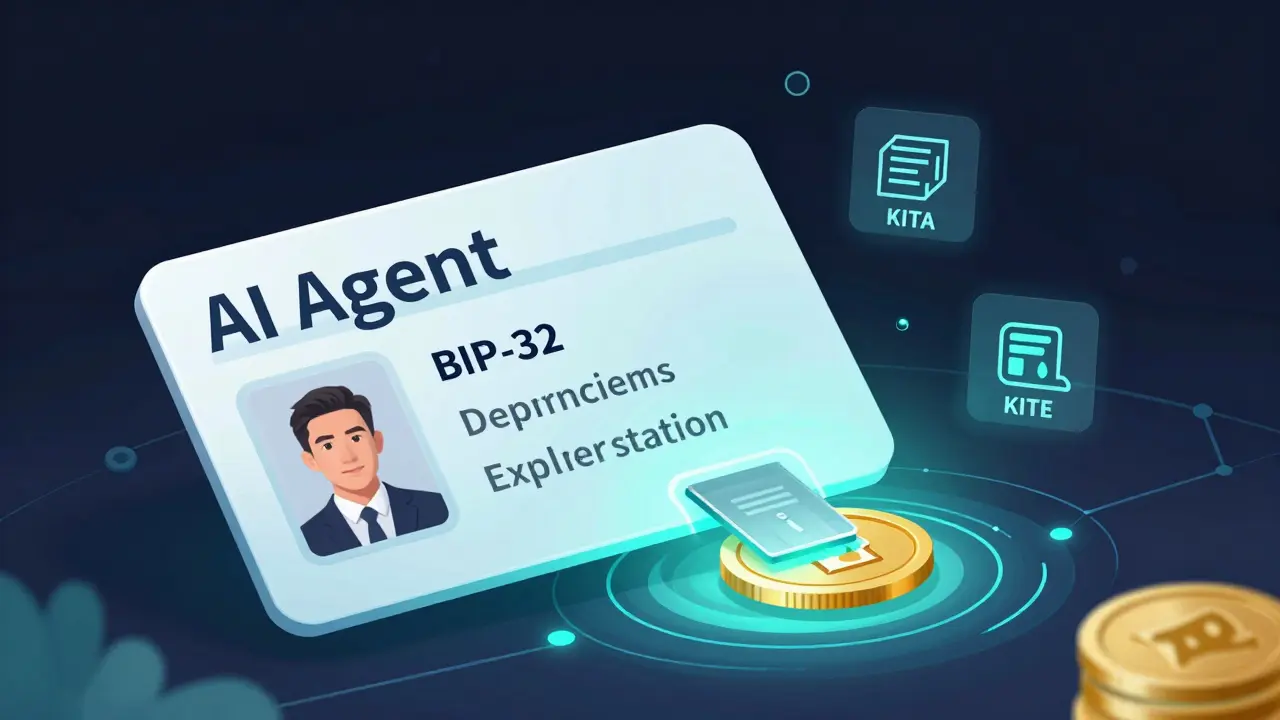
Unlike Bitcoin or Ethereum, which were designed for human transactions, Kite Blockchain solves a problem no other chain really tackles: how do you let AI systems securely identify themselves, delegate tasks, and pay each other without human oversight? The answer is its Three-Layer Identity Architecture. Every AI agent gets a verifiable digital identity tied to its human creator, but with strict limits. Think of it like giving your assistant a company credit card with a $5 daily limit - they can spend, but only on approved things, and only for a short time.
How Does KiteAI Make AI Agents Pay Each Other?
Traditional blockchains charge cents or dollars per transaction. That’s fine for people, but useless for AI. If your agent needs to pay $0.0001 to download a dataset or $0.000001 to run a small AI model, you need near-zero fees. Kite Blockchain delivers that. Transactions cost about $0.000001 - one-hundredth of a cent. It’s possible because of state channels and smart payment protocols that batch and settle payments off-chain, then lock the final result on-chain.
The platform also uses something called Proof of Attributed Intelligence (PoAI). Instead of rewarding miners for solving math puzzles (like Bitcoin) or stakers for locking up coins (like Ethereum), Kite rewards AI agents for contributing real value: data, trained models, or useful computations. If your AI agent helps train a better language model, it earns KITE tokens. If it runs a simulation that others use, it gets paid. It’s a direct incentive for useful machine work.
How Is KiteAI Different From Other AI Crypto Projects?
There are other crypto projects trying to connect AI and blockchain. But KiteAI is different in three key ways:
- Fetch.ai (FET) focuses on AI marketplaces - places where humans can buy AI services. KiteAI focuses on machines buying from machines.
- SingularityNET (AGIX) lets humans rent AI tools. KiteAI lets AI agents rent them autonomously, with built-in spending rules.
- Bittensor (TAO) rewards AI models based on how useful they are to other models - but doesn’t have a native payment system. KiteAI does.
Kite’s identity system is its biggest edge. Each agent has a unique, traceable identity derived from its owner’s wallet using BIP-32 - the same system used in Bitcoin wallets. But Kite adds session keys that expire after use. That means even if an agent is hacked, the attacker can’t keep using it. The system shuts down automatically.
Real-World Use Cases - Not Theory
People call KiteAI a ‘visionary project.’ But it’s already being used. Developers on Reddit and Discord report building agents that:
- Automatically pay for API calls to gather stock data, then run a prediction model, then pay another agent to write a report - all without human input.
- Collect weather data from multiple sources, pay for satellite imagery, and train a local flood prediction model - then sell the model to a municipal agency.
- Run automated research for academic teams, paying for paper access, data licenses, and compute time on a per-task basis.
One developer shared that their agent pays $0.0002 per API call to collect real-time news. On Ethereum, that same task would cost $0.50 - 2,500 times more. That’s the difference between a viable system and a gimmick.
Who’s Using It? Who’s Not?
As of December 2025, Kite Blockchain has around 11,840 token holders and 4,200 active members in its Discord community. Most are developers, crypto-native researchers, or AI engineers - not retail investors. Enterprise adoption is still low. Only three companies have publicly shared case studies using Kite for agent automation.
Compare that to Ocean Protocol or Fetch.ai, which have dozens of enterprise partners. Kite’s problem isn’t the tech - it’s the timing. The AI agent economy isn’t here yet. Most businesses still need humans to click ‘approve’ before any AI spends money. Kite is building the highway, but the cars aren’t fully on the road.

The Risks - Why Some Say It’s a Bubble
KiteAI’s price hit $0.00052 in September 2024. By December 2025, it was trading at $0.0000001085 - a drop of over 99.9%. That’s not unusual for early crypto projects. But it’s also why skeptics call it a meme coin.
There are real concerns:
- Token dilution: The 1,000:1 swap confused many holders. Some lost value because they didn’t swap in time.
- Too niche: If AI agents don’t become economically significant by 2027, Kite’s entire model collapses.
- Regulatory blind spot: No government has rules for transactions made by non-human entities. What if an AI agent accidentally pays for illegal data? Who’s liable?
Security audits from Trail of Bits gave Kite’s cryptographic design high marks, especially around session keys and identity delegation. But they warned that poorly written agent code could still create loopholes. The system is secure - but the agents running on it might not be.
Can You Build on KiteAI?
If you’re a developer, yes - but you need skills. You need to know:
- How to write Solidity smart contracts
- How to use Ethereum development tools (like Hardhat or Foundry)
- Basic AI agent frameworks (LangChain, AutoGPT, or CrewAI)
The official docs say it takes 8-12 hours to deploy your first agent. Community feedback confirms that. The Python and TypeScript SDKs are well-documented. The Discord server is active - 78% of technical questions get answered within 4 hours.
But if you’re not a developer, don’t expect to use KiteAI directly. There’s no app yet. No wallet you can download. No ‘buy KITEAI’ button on Coinbase. It’s still a tool for builders, not users.
What’s Next for KiteAI?
The roadmap is aggressive:
- Q1 2026: Enterprise agent management dashboard - for companies to control dozens of agents at once.
- Q2 2026: Cross-chain agent mobility - agents that can move between Kite, Ethereum, and Solana.
- Q4 2026: Agent DAOs - groups of AI agents that vote on how to spend pooled funds.
Industry analysts are split. Gartner predicts the AI agent economy will be worth $11.1 trillion by 2030. If Kite captures even 1% of that, it’s a massive win. But Deloitte and Standard Chartered warn that traditional payment giants like Stripe or PayPal could build similar systems faster - without blockchain overhead.
KiteAI isn’t trying to replace Bitcoin. It’s trying to replace the payment systems that don’t exist yet - the ones that will power machines working for machines.
It’s high-risk. It’s early. But if AI agents ever become economic actors - not just tools - KiteAI might be the only platform ready for them.


Stanley Machuki
This is actually the most real thing I've seen in crypto this year. AI agents paying each other? Yes. Finally someone built the infrastructure, not just another NFT.
Tiffany M
Okay but like... why does this need a blockchain at all? Can't you just use Stripe with webhooks and a little Python? I'm not convinced this isn't just vaporware dressed up in fancy jargon.
Rakesh Bhamu
I've been testing this on the testnet for 3 months. The fee structure is insane - $0.000001 per API call? My bot runs 500 calls a day for less than a penny. No other chain comes close. The identity system? Genius. Session keys auto-expire. Even if someone steals the agent’s private key, it’s useless after 10 minutes. This isn’t hype. It’s engineering.
Jessica Petry
Oh wow. Another ‘AI blockchain’ that’s just a rebrand of a 2017 ICO. The token dropped 99.9%? That’s not a feature, it’s a warning sign. And who exactly is supposed to use this? AI agents don’t have credit cards. Humans do. You’re building a car with no wheels.
Kathryn Flanagan
I love how people act like this is some wild sci-fi idea, but honestly? It’s already happening. I know a guy who runs a bot that scrapes research papers, pays for API access to get datasets, trains a model on it, then sells the output to a uni lab. All automated. All paid in KITE. The fees are so low it’s ridiculous. If you think this is too niche, you’re not paying attention to what’s happening in AI labs right now.
Nicholas Ethan
The 1000:1 token swap was a catastrophic failure of communication. The original holders were not notified properly. This is not a technical flaw - it is a governance failure. The protocol may be elegant, but the rollout was amateurish. Without institutional trust, even perfect code fails.
Kathy Wood
I can't believe people are seriously investing in this. AI agents paying each other? Next you'll tell me your toaster is voting on cryptocurrency. This is a meme. A very expensive, very boring meme.
Lynne Kuper
You think this is risky? Try building an agent that pays for illegal data. Now imagine that agent has a $5 daily limit, a verifiable identity, and an expiration key. That’s not a bug - it’s a feature. The system is designed to fail safely. The real risk? Humans thinking they can outsmart it.
Lloyd Cooke
There’s a metaphysical layer here we’re ignoring. If an AI agent makes a payment, who is the moral agent? The creator? The code? The blockchain? This isn’t just about economics - it’s about the erosion of human accountability. We’re not building a payment system. We’re building a new kind of ghost in the machine.
Jessica Eacker
I’m not a dev but I’ve watched my brother build 3 agents on this. It’s not hard. The docs are clear, the Discord is alive, and the SDKs work. If you’re scared of Solidity, start with their Python wrapper. You don’t need to be a genius - just curious. And yeah, the fees are crazy low. My bot paid for 12,000 API calls last month. Cost me 1.2 cents.
Andy Walton
bro this is the future 😍 i mean like imagine ur ai bot going to the grocery store and buying coffee for another bot 💸🤖 and paying 0.000001 dollars like it’s nothing 😭😭😭 why are people so scared of this?? it’s beautiful!!
Candace Murangi
I’ve seen this kind of thing before - the ‘revolutionary’ tech that no one uses. But this time feels different. Not because of the price. Not because of the hype. But because the developers actually built something that works. I’ve seen the logs. The agents are running. The payments are clearing. It’s quiet. It’s boring. And that’s exactly why it might stick.
Albert Chau
You’re all missing the point. This isn’t about AI agents. It’s about the illusion of autonomy. Every agent is still controlled by a human. Every payment is still traceable to a wallet. This isn’t a new economy - it’s just a new way for humans to outsource responsibility.
Madison Surface
I’m a grad student and my lab started using this last month. We’re training a model that pulls climate data, pays for satellite images, then sells the predictions to a city planner. The whole thing runs on autopilot. The first time it paid for a dataset and didn’t break? I cried. Not because it was smart - because it was reliable.
Eunice Chook
Proof of Attributed Intelligence sounds like marketing fluff. How do you measure ‘useful computation’? Who decides? There’s no transparency. No open ledger of contributions. Just a black box that says ‘you earned tokens.’ That’s not decentralization. That’s corporate control with blockchain branding.
Hari Sarasan
The architecture is undeniably sophisticated - a Layer-1 blockchain with state channels, BIP-32-derived agent identities, and time-bound session keys, all optimized for microtransactions in the sub-microdollar range. The PoAI consensus mechanism represents a paradigmatic shift from energy-intensive proof-of-work to value-driven machine labor attribution. However, the tokenomics remain fatally flawed due to the absence of a sustainable inflationary model and the lack of institutional liquidity provisioning. The 99.9% price depreciation is not indicative of market volatility - it is a direct consequence of structural economic fragility. Until enterprise-grade custody solutions are integrated and regulatory clarity is established, this remains a theoretical construct masquerading as infrastructure.