What is Layer2DAO (L2DAO)? Tokenomics, History, and Current Status
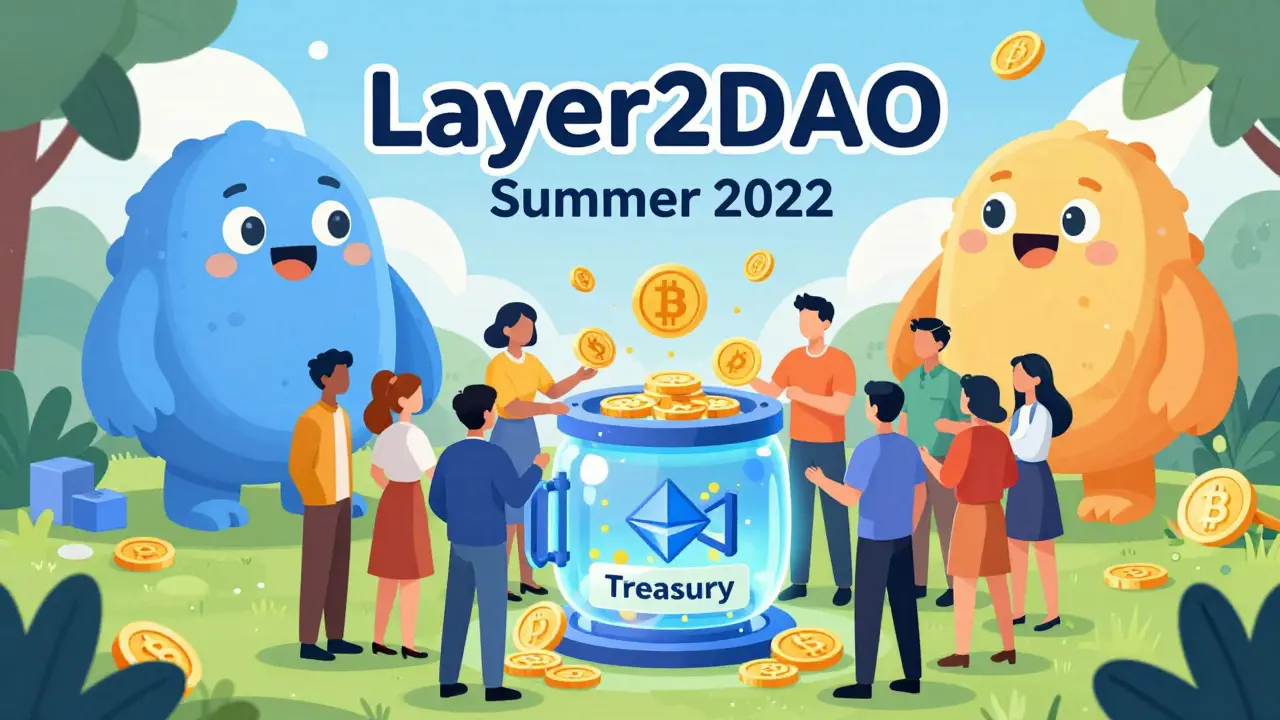
Remember the summer of 2022? The crypto world was buzzing about Ethereum Layer 2 scaling solutions. Projects like Arbitrum and Optimism were stealing the spotlight, promising faster transactions and lower fees on top of the congested Ethereum mainnet. In that fever dream of innovation, a new player emerged with a bold idea: what if the community itself governed the investment strategy for these Layer 2 protocols?
That project was Layer2DAO (L2DAO). It wasn't just another token; it was designed as a decentralized venture fund. The concept was simple yet powerful: pool capital from community members to invest in high-impact Layer 2 projects, provide liquidity, and incentivize users to move off the expensive Ethereum mainnet. But three years later, where does this experiment stand? Is it still driving adoption, or has it faded into the background of crypto history?
The Core Concept: A Decentralized Venture Fund
To understand Layer2DAO, you have to look past the ticker symbol. At its heart, Layer2DAO is a decentralized autonomous organization (DAO) focused on accelerating the growth of the Ethereum Layer 2 ecosystem. Unlike traditional venture capital firms where a small group of partners decides where money goes, Layer2DAO relied on community governance. Holders of the native token could vote on treasury allocations, partnership decisions, and strategic initiatives.
The model operated similarly to a mutual fund but with full transparency on-chain. Instead of buying stocks, the DAO’s treasury invested in tokens from other Layer 2 protocols, provided liquidity in automated market makers (AMMs), and staked assets to earn yield. The goal was compounding. By reinvesting profits back into the DAO, the treasury would grow, theoretically increasing the value of every L2DAO token held by a member. This created a feedback loop: better investments led to a larger treasury, which attracted more investors, allowing for even bigger bets on the Layer 2 narrative.
This approach addressed a specific pain point for retail investors. Picking the right Layer 2 chain is hard. Some succeed; many fail. Layer2DAO offered a diversified basket. If you believed in the future of Ethereum scaling but didn't know which specific protocol would win, L2DAO allowed you to bet on the entire sector through a single governance token.
Tokenomics: L2DAO vs. xL2DAO
The economic structure of Layer2DAO revolves around two distinct entities: the liquid token and the governance token. Understanding the difference between them is crucial for anyone analyzing the project's mechanics.
| Feature | L2DAO (Native Token) | xL2DAO (Governance Token) |
|---|---|---|
| Function | Medium of exchange, tradable asset | Governance voting, revenue sharing |
| Liquidity | High (can be traded freely) | Low (requires locking/staking) |
| Voting Power | None | Direct influence over DAO treasury |
| Revenue Share | Indirect (via price appreciation) | Direct (from protocol fees/yield) |
| Total Supply Context | Part of the 1 billion total supply | Derived from locked L2DAO tokens |
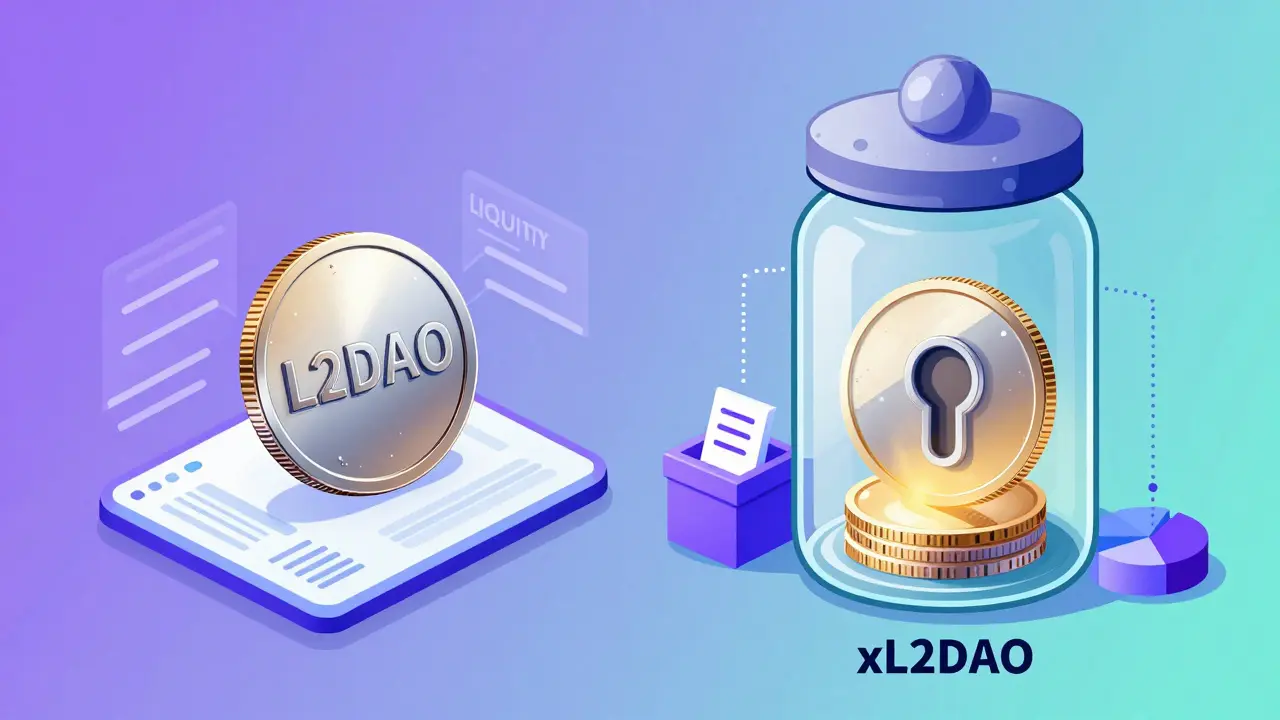
You start with L2DAO. This is the token you buy on exchanges. It represents your ownership stake in the organization. However, holding L2DAO alone doesn't give you a voice in how the money is spent. To participate in governance, you must lock your tokens. When you do, they convert into xL2DAO.
This mechanism is common in DeFi (Decentralized Finance). It aligns incentives. If you want to vote on risky investments or change protocol parameters, you need to show skin in the game by locking up your assets. This prevents short-term traders from manipulating governance votes without any long-term commitment. The xL2DAO token became the key to unlocking the DAO's true utility, granting holders the power to guide the strategic direction of the Ethereum Layer 2 ecosystem.
Key Initiatives: L2D4 and L2StateOfMind
A DAO is only as good as its actions. Layer2DAO didn't just sit on its hands; it launched several concrete initiatives to build infrastructure and community engagement. Two projects stand out in their history: L2D4 and L2StateOfMind.
In January 2023, the DAO deployed L2D4. This was a community liquidity pool built on Saddle Finance, an automated market maker known for efficient stablecoin swaps. The pool combined four major stablecoin protocols: Frax Finance, Alchemix, Sperax, and Forcenet. Why did this matter? Stablecoins are the lifeblood of DeFi. By creating a dedicated pool for these assets within the Layer 2 space, Layer2DAO aimed to reduce slippage and improve trading efficiency for users moving funds across different ecosystems. The fees generated from these trades flowed back into the DAO treasury, supporting the compounding growth model mentioned earlier.
Then there was the cultural play: L2StateOfMind, also known as L222. This was a collection of 2,022 profile picture (PFP) non-fungible tokens (NFTs). In the crypto world, NFTs often serve as membership cards. Holding an L2StateOfMind NFT gave you significant perks. Most notably, holders received double the revenue share allocation compared to standard token holders. They also gained access to weekly Ethereum airdrops. Initially minted for 0.1 ETH, these NFTs created an exclusive tier within the community. However, the minting process ended after a successful governance proposal, signaling a shift in focus or a conclusion to that particular phase of community building.
Market Performance and Current Status
Here is where the story takes a sharp turn. While the concepts behind Layer2DAO were innovative, the market reality has been harsh. Let’s look at the numbers, because they tell a clear story about investor sentiment.
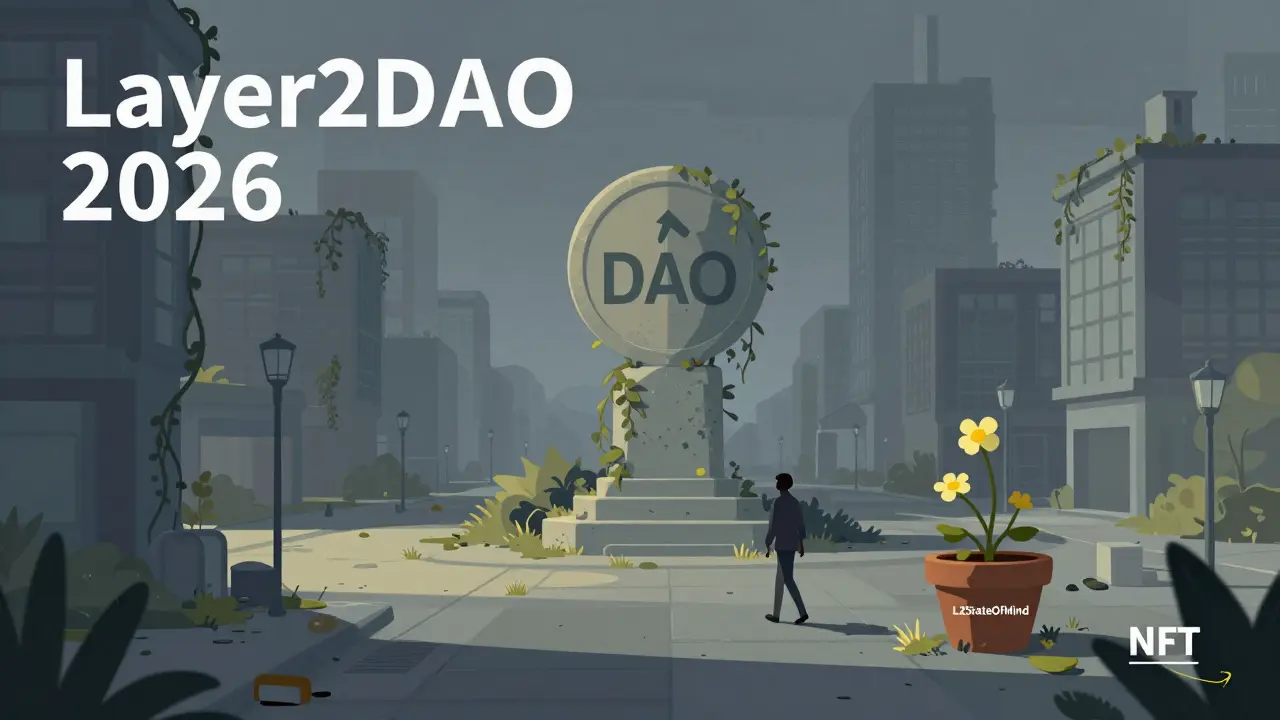
As of mid-2026, the L2DAO token trades at approximately $0.000125 USD. Compare that to its all-time high of $0.02549 USD, reached on August 6, 2022. That is a decline of roughly 99.5%. The market capitalization sits at a mere $30,180 USD, with a fully diluted valuation of $124,840 USD. Perhaps most telling is the 24-hour trading volume, which often registers at zero. This indicates a near-total lack of active trading interest.
Why the collapse? Several factors likely contributed. First, the broader crypto market experienced a severe bear cycle following the 2022 peak. Many speculative tokens, especially those tied to specific narratives like "Layer 2 governance," suffered massive drawdowns. Second, the complexity of DAO governance can lead to voter apathy. If the community fails to engage actively, the venture fund aspect stagnates. Third, competition intensified. Major Layer 2 protocols began launching their own native governance tokens and incentive programs, reducing the need for a third-party DAO like Layer2DAO to act as an intermediary.
The holder base remains at around 14,140 addresses. While not insignificant, this number suggests a concentrated group of early adopters who may have held onto their tokens despite the price drop, rather than a growing influx of new participants. The circulating supply stands at approximately 241.79 million L2DAO tokens, representing about 24% of the total 1 billion supply. The rest remains locked, unclaimed, or reserved for future development, though public updates on these reserves have become scarce.
Risks and Considerations for Investors
If you are considering interacting with Layer2DAO today, whether to buy the token or participate in governance, you need to weigh the risks carefully. The project illustrates both the potential and the pitfalls of niche DAO structures.
- Liquidity Risk: With near-zero daily volume, selling large amounts of L2DAO could significantly impact the price, or you might not find a buyer at all. Slippage would be extreme.
- Governance Stagnation: Without active proposals and voting, the DAO ceases to function as a dynamic entity. Check recent governance forums to see if the community is still alive.
- Smart Contract Risk: Like any DeFi protocol, Layer2DAO relies on code. While audits are standard, vulnerabilities can exist. The integration with multiple protocols (Frax, Alchemix, etc.) increases the attack surface.
- Narrative Shift: The hype around Layer 2 solutions has evolved. Users now interact directly with chains like Arbitrum, Base, and zkSync. The intermediary role of a meta-DAO like Layer2DAO may no longer be seen as necessary by the average user.
However, for those interested in the history of DeFi experimentation, Layer2DAO remains a case study in community-driven investment. It showed how token holders could collectively manage a treasury and deploy capital into emerging sectors. Even if the financial returns have not met expectations, the structural lessons learned by the team and the community contribute to the broader knowledge base of decentralized organizations.
Conclusion: What Remains of Layer2DAO?
Layer2DAO started with a vision to democratize access to the Ethereum Layer 2 boom. It built infrastructure like the L2D4 pool and engaged its community through the L2StateOfMind NFTs. Yet, the dramatic price depreciation and low trading activity suggest that the initial enthusiasm has cooled considerably. The project serves as a reminder that while technology and governance models can be sound, market dynamics and sustained community engagement are equally critical for survival.
For the casual observer, L2DAO is largely a relic of the 2022 bull run. For the dedicated holder, it remains a position in a diversified Layer 2 basket, albeit one that has lost most of its value. As Ethereum continues to scale, the question isn't just whether Layer 2 will win-it already has-but whether specialized DAOs like Layer2DAO will find a renewed purpose in a maturing ecosystem. Until then, the token remains a quiet footnote in the complex history of decentralized finance.
Is Layer2DAO still active in 2026?
While the smart contracts remain deployed, public activity and trading volume are extremely low. There have been no major announcements or significant governance actions reported recently, suggesting the project is in a dormant state.
What is the difference between L2DAO and xL2DAO?
L2DAO is the tradable native token. xL2DAO is the governance token obtained by locking L2DAO. Only xL2DAO holders can vote on proposals and receive direct revenue shares from the DAO's treasury activities.
How much has the L2DAO token dropped from its all-time high?
The token has dropped approximately 99.5% from its all-time high of $0.02549 in August 2022, currently trading around $0.000125.
What was the L2StateOfMind NFT collection?
L2StateOfMind (L222) was a collection of 2,022 NFTs that provided holders with double revenue shares and access to weekly airdrops. Minting has ended, and it served as a membership tool for the DAO community.
Can I still invest in Layer2DAO?
Technically yes, but liquidity is very poor. You should exercise extreme caution due to the risk of being unable to sell your tokens easily and the lack of recent development activity.