What is Parrot USD (PAI) Crypto Coin? A Real-World Look at a Dying DeFi Experiment
Parrot USD (PAI) isn’t a stablecoin you’ll find in your wallet because you chose it. It’s not on Coinbase, Binance’s main trading pairs, or even in most DeFi dashboards. It’s a quiet experiment that started on Solana in 2022, promising to unlock trapped liquidity - but today, it barely functions.
What PAI Claims to Do
Parrot USD (PAI) was built to solve a real problem: when you add liquidity to a DeFi pool - say, ETH/USDC on a DEX - your tokens get locked up. You can’t use them elsewhere without pulling them out, which means losing yield or paying high fees to exit. PAI wanted to fix that. Instead of holding cash or USDC as collateral, it let users lock up their LP (liquidity provider) tokens and mint PAI, a token meant to be worth exactly $1.
The idea was clever. If you own LP tokens from five different pools, PAI would act as a common unit of account. You could trade PAI for other assets, lend it, or use it in margin trades - all without touching your original liquidity position. It sounded like a way to make idle DeFi assets work harder.
The Reality: A Stablecoin That Can’t Stay Stable
Here’s the problem: LP tokens are volatile. They’re not cash. They’re shares in pools that can lose value fast if the underlying assets swing - like when SOL drops 30% in a day. PAI’s entire model relied on these unstable assets backing a supposedly stable coin.
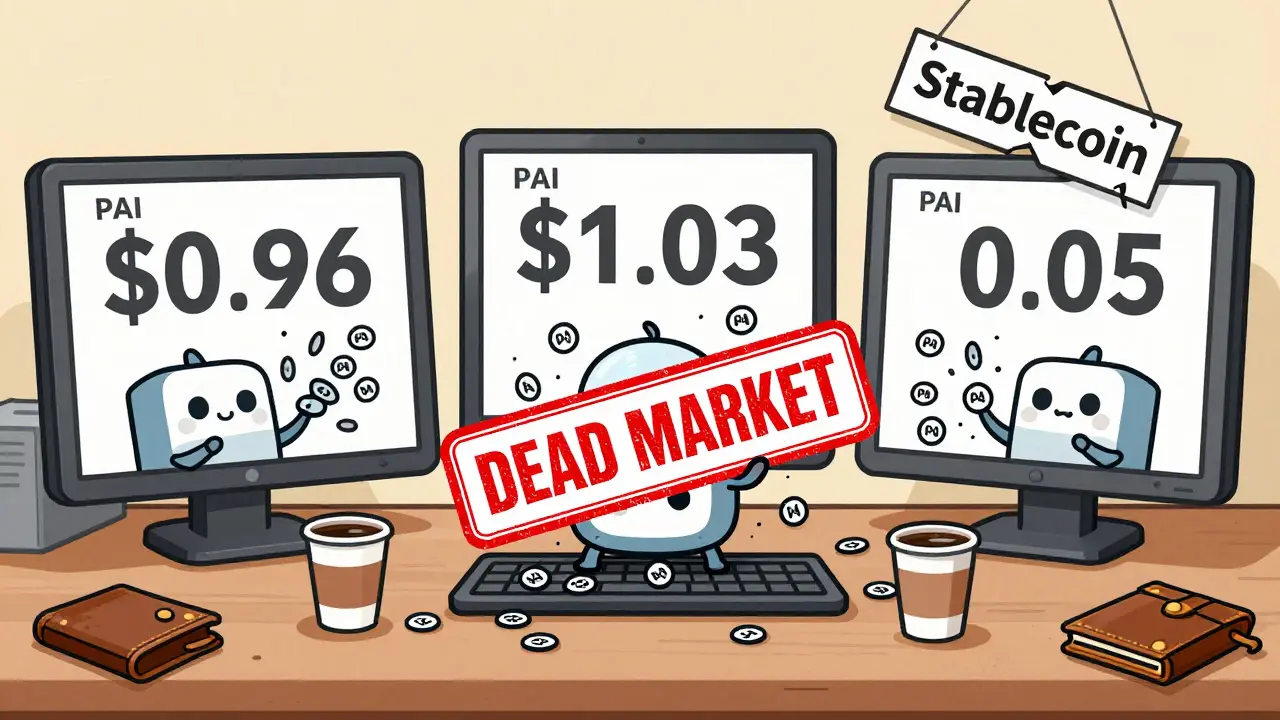
And it shows in the numbers. As of December 2025, PAI’s price swings wildly across exchanges. Binance says $0.96. LiveCoinWatch says $1.03. LBank? $0.05. That’s not a stablecoin. That’s a data glitch or a dead market.
Its all-time high was $2.19. Today, it trades around $1.00 - but only because a few bots are still spinning. The 24-hour trading volume? Around $200 on CoinGecko. That’s less than a single trade on USDT. You can’t buy groceries with PAI. You can’t pay for a coffee. You can’t even reliably swap 10,000 PAI without 15% slippage, as one user reported.
Who’s Using It? Almost No One
There are 5,760 token holders, according to CoinMarketCap. That’s less than the number of people who bought a single NFT on a random Tuesday in 2021. Reddit has three mentions in a year. Bitcointalk has two old threads. No one’s writing tutorials. No YouTube videos explain how to use it. No DeFi aggregator lists it as a supported asset.
The Parrot Protocol website hasn’t updated since mid-2023. Its GitHub repo stopped getting commits in August 2022. The team behind it? Anonymous. No roadmap. No team page. No Twitter account with more than 500 followers. This isn’t a project in maintenance - it’s a project in abandonment.
Why It Failed Where Others Didn’t
Compare PAI to DAI. DAI is backed by ETH, real estate tokens, USDC, and even cash. It’s overcollateralized. It has a decentralized governance system. It’s been audited. It’s used by institutions. DAI’s market cap? Over $5 billion.
PAI? Backed by LP tokens. No overcollateralization. No audits. No governance. No liquidity. No team activity. It’s a theoretical model that never got past the whitepaper.
Even other algorithmic stablecoins like FRAX or LUSD have more traction. They use hybrid models - part collateral, part algorithm. PAI tried to go all-in on the most volatile form of collateral possible and called it stable. It was doomed from the start.
Regulatory Risks Are Real
The EU’s MiCA regulations, effective in 2025, require stablecoins to be backed 1:1 by high-quality, liquid assets. LP tokens? Not liquid. Not stable. Not regulated. PAI doesn’t meet the bar. No exchange in Europe would list it. No institutional investor would touch it. Even if it worked technically, it’s legally risky.
After TerraUSD collapsed in 2022, regulators cracked down. Projects that claimed to be stablecoins without real reserves got shut down. PAI didn’t even have the resources to fight for survival - let alone compliance.
Can You Still Use PAI Today?
Technically, yes. You can connect a Solana wallet, deposit LP tokens, and mint PAI - if the smart contract still works. But you’d be risking your LP tokens for a token that:
- Has no real exchange liquidity
- Can’t be reliably swapped
- Has no community support
- Is likely unresponsive if something goes wrong
There’s no help desk. No Discord. No FAQ. If your transaction fails, you’re on your own. And if you try to redeem PAI back for LP tokens, you might find the protocol has frozen withdrawals - a common fate for abandoned DeFi projects.
What PAI Is Today
PAI isn’t a cryptocurrency you invest in. It’s not a tool you use. It’s a relic. A footnote. A proof-of-concept that ran out of steam.
It’s like finding a prototype of a flying car from 2010 in a garage. The idea was cool. The engineering was ambitious. But no one built it right. No one kept it running. And now, it’s just dust.
If you’re looking for a stablecoin on Solana, use USDC. It’s backed by real dollars. It’s audited. It’s used everywhere. If you want to unlock liquidity, use Solana’s native DeFi protocols like Raydium or Orca - they let you stake LP tokens for yield without turning them into a broken stablecoin.
PAI’s only real value today? As a case study. It shows how even clever ideas fail when they ignore liquidity, community, and real-world stability. Don’t chase it. Don’t invest in it. Don’t even waste your time trying to mint it.
The Parrot Protocol didn’t fly. It just fell silent.

Callan Burdett
Man, PAI is like that one friend who swore they’d start going to the gym every day… showed up once, took a selfie, and then vanished. I remember when I tried minting it-thought I was being clever, turning my LP tokens into ‘stable’ cash. Turns out I just turned my crypto into digital confetti. 😅
Haley Hebert
I know it sounds harsh, but honestly, PAI was never meant to last. It was built on the idea that LP tokens could be stable, which is like trying to build a house out of Jell-O-fun to watch collapse, but don’t expect it to hold your stuff. I’ve been in DeFi since 2020, and I’ve seen a hundred ‘innovative’ stablecoins die this way. The real winners? The ones that respect liquidity, transparency, and actual collateral. PAI? It didn’t even respect its own whitepaper. 🤷♀️
Pat G
Of course it failed. You let some anonymous devs on Solana create a ‘stablecoin’ backed by garbage? That’s not innovation-that’s treason against financial logic. America built the dollar on gold, not some random DeFi pool token. This is why the West is falling behind. We let these crypto clowns run wild. PAI isn’t dead-it was murdered by incompetence.
Rod Petrik
PAI was a fed shill all along bro 🤫 they wanted us to waste time on fake stablecoins so we wouldn't notice the real ones getting bought up by black ops hedge funds. i saw a guy in a hoodie whispering to a solana node last year he said PAI was just a honeypot. 0.05 on lbank? that's not a price that's a warning sign. they're watching us. 🕵️♂️
Pramod Sharma
Every great idea dies before it learns to walk. PAI didn’t fail because it was dumb-it failed because it skipped the hard work: trust, community, and patience. Real value takes years. This was a sprint in a marathon.
Liza Tait-Bailey
i mean… i tried it once. thought it was cool. then i tried to swap 500 PAI and got like 40 bucks worth of sol. my wallet felt sad. also the website looks like it was made in 2018 on wix. no offense to wix but… yeah. 🙃
nathan yeung
Same thing happened with a lot of DeFi projects. Everyone chases the shiny new thing, nobody checks if the foundation is solid. PAI’s just a reminder: if it’s not backed by something real, it’s just a meme with a smart contract.
Bharat Kunduri
lol i thought this was a joke at first. then i checked the contract and realized it was real. someone actually spent gas on this. i feel bad for them. like… i hope they got a good laugh out of it.
Chris O'Carroll
Okay but imagine being the dev who had to tell their partner: ‘Honey, I built a stablecoin… and now it’s worth 5 cents and no one talks to me.’ I’d be crying in the shower. This is the saddest crypto story since Terra. I need a tissue.
Christina Shrader
It’s heartbreaking when a project dies quietly like this. Not with a bang, not with a scam-just… silence. I wish more people would write obituaries for failed DeFi projects. They teach us more than the winners ever will.
Andre Suico
While the narrative around PAI is largely accurate, it's worth noting that many early DeFi experiments faced similar fates due to structural fragility and lack of governance. The real lesson lies not in its failure, but in the broader pattern: sustainable protocols require institutional-grade security, active community oversight, and regulatory foresight. PAI lacked all three. USDC remains the prudent choice for any serious user.
Chidimma Okafor
What a poignant allegory for the human condition: ambition without accountability, innovation without integrity. PAI was a phoenix built on sand, its wings forged from the dreams of those who believed in the magic of decentralization-yet forgot that magic needs roots. May it rest in peace, not as a failure, but as a lesson written in blockchain ink.
Bill Sloan
Wait so if PAI is worth $0.05 on LBank… does that mean someone’s buying it? Who? Why? Is this a rug pull in reverse? Are we the rug? 🤔 I need to know more. Can someone screenshot the order book? I’m not mad, I’m just… confused.
ASHISH SINGH
They told us crypto was the future… but PAI? That’s the future we got. A ghost in the machine. A whisper in the blockchain. No one’s coming to save it. No one’s even checking on it. We didn’t fail PAI… PAI failed us. And now it’s just another ghost in the graveyard of Web3 dreams.
Vinod Dalavai
Been there, seen that. I used to mint PAI just to see if the contract still worked. It did… once. Then I stopped. Now I just use USDC on Raydium. Life’s too short for dead stablecoins. 🤙
Anthony Ventresque
Actually, I think PAI’s quiet death is kind of beautiful. No drama. No panic. No rug pull. Just… fading out. Like a candle in a windless room. Maybe that’s the most honest way for a failed project to go. No one’s screaming. No one’s suing. Just silence. And maybe… that’s the real lesson.