What is sUSD (SUSD) Crypto Coin? A Practical Guide to the Decentralized Stablecoin

sUSD Collateralization Calculator
Calculate your sUSD collateralization ratio based on current SNX price and staked amount. Your position is safe when the ratio is above 175%, but you'll be liquidated if it drops below 150%.
Collateralization Analysis
Collateralization Ratio
Risk Level
What This Means
sUSD is a decentralized stablecoin built on the Ethereum blockchain that aims to stay worth exactly $1 - but it doesn’t hold any U.S. dollars in a bank. Instead, it’s backed by something far more volatile: SNX tokens. Created by the Synthetix protocol, sUSD lets traders and investors hold a dollar-equivalent asset without leaving the crypto world. That makes it useful for trading other synthetic assets like sBTC or sETH without getting hit by price swings or paying high fees. But it’s not as simple as holding USDC or USDT. If SNX crashes, your sUSD could be at risk. Here’s what you actually need to know.
How sUSD Works (Without Holding Dollars)
Most stablecoins like USDC or USDT are backed by real cash or short-term U.S. government bonds. sUSD is different. It’s backed by SNX, the native token of the Synthetix network. To create sUSD, you lock up SNX as collateral - currently at a 200% ratio. That means you need $2,000 worth of SNX to mint $1,000 of sUSD. This isn’t a loan. It’s a debt position. You’re essentially borrowing sUSD against your SNX, and you owe it back.
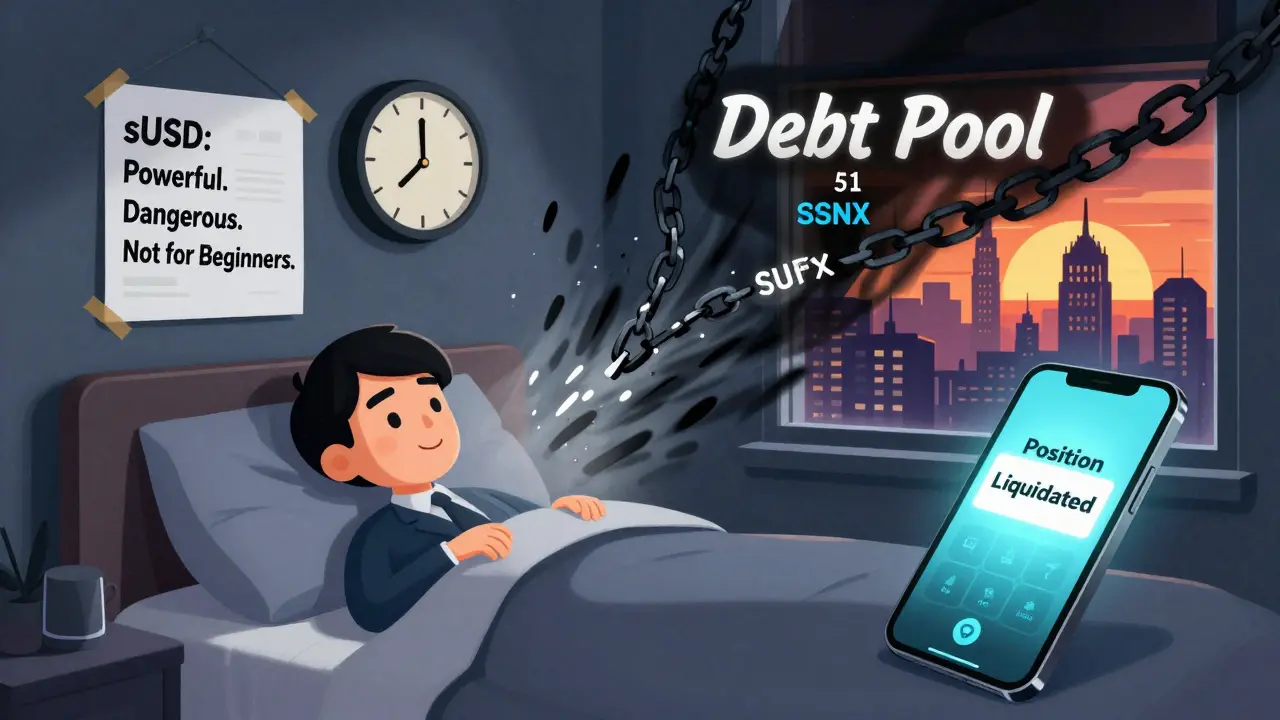
The system uses a shared debt pool. Everyone who stakes SNX shares the total debt of the network. If the price of SNX drops, everyone’s collateralization ratio falls. If it drops too far - below 150% - your position gets flagged for liquidation. You’ll have to add more SNX or burn sUSD to get back in line. There’s no single bank or company holding reserves. It’s all code, oracles, and collective responsibility.
Why sUSD Exists: Zero Slippage Trading
The real power of sUSD isn’t in holding it. It’s in trading with it. Synthetix lets you swap sUSD directly for other synthetic assets - like sGold, sAAPL, or sETH - with zero slippage. That’s because you’re not trading against another user. You’re trading against the smart contract itself. As long as the system has enough collateral, you can buy $10 million worth of sBTC in one click. No order book. No market impact. No slippage.
This is why traders use sUSD. On platforms like Kwenta or Curve Finance, you can move between crypto, stocks, and commodities without ever touching a centralized exchange. You avoid KYC, withdrawal delays, and exchange hacks. The trade execution takes just 2-3 seconds on Optimism, Synthetix’s Layer 2 network, where most sUSD activity now happens.
How Price Stability Is Maintained
Chainlink oracles feed real-time USD prices into Synthetix every 60 seconds. If sUSD trades at $0.99, arbitrageurs jump in to buy it cheap and mint new sUSD to sell at $1. If it hits $1.01, they burn sUSD to get SNX back and sell it for profit. This constant pressure keeps sUSD tightly pegged.
Since its launch, sUSD has stayed within 50 basis points of $1 over 92% of the time, according to DeFi Llama data. That’s close to USDC. But there have been exceptions. During the November 2021 crypto crash, SNX dropped 60% in 48 hours. sUSD briefly fell to $0.95. The system didn’t collapse - it just required users to add more collateral to cover the debt. That’s the trade-off: stability through risk.

sUSD vs USDT vs DAI: The Real Differences
| Feature | sUSD | USDT | DAI |
|---|---|---|---|
| Backing | SNX crypto collateral | U.S. dollars + reserves | ETH + other crypto collateral |
| Decentralized? | Yes | No (Tether Ltd.) | Yes |
| Collateral Ratio | 200% | ~100% | ~500% |
| Slippage on Swaps | Zero (peer-to-contract) | Market-dependent | Market-dependent |
| Yield Potential | Up to 8% on Curve | ~2-4% | ~3-5% |
| Main Risk | SNX price crash | Centralized control | ETH volatility + governance |
USDT is simple but centralized. If Tether freezes your wallet, you lose access. DAI is decentralized and widely used, but its collateral is mostly ETH and USDC - meaning it’s still tied to other crypto and traditional assets. sUSD is the most aggressive bet: it’s backed only by SNX, and its value depends entirely on how the Synthetix ecosystem holds up.
Who Uses sUSD - And Why
Most sUSD users are active DeFi traders. They use it to:
- Trade synthetic assets like sBTC or sGold without leaving Ethereum
- Provide liquidity on Curve Finance’s sUSD/USDC pool, earning up to 8% APY
- Arbitrage price differences between sUSD on Kwenta and USDC on Uniswap
- Short crypto assets by minting sUSD and selling it for ETH, then buying ETH back later at a lower price
On Reddit, users report earning $2,000+ in a week by exploiting small price gaps between sUSD and USDC. But there’s a darker side. One user lost $15,000 when SNX dropped 35% overnight. Their collateral ratio fell below 150%. The system automatically liquidated their position. They didn’t get a warning. They just woke up with less SNX and no sUSD.
The Risks You Can’t Ignore
sUSD is not risk-free. Here’s what can go wrong:
- SNX crashes: If SNX loses 70% in 48 hours, simulations show sUSD could depeg by 15%. That’s not theoretical - it happened in 2021.
- Debt pool contagion: Because everyone shares the debt, a mass liquidation event could trigger a cascade. If 10,000 users get liquidated at once, the system might not have enough liquidity to cover it.
- Centralized components: Synthetix still uses proxy contracts that can be upgraded by the core team. That means they can pause trading or change rules - a form of centralization.
- Regulatory risk: The EU classifies sUSD as an asset-referenced token. If U.S. regulators decide to crack down on synthetic stablecoins, sUSD could be restricted.
Exponential DeFi rates sUSD as “Watch out.” It’s not a stablecoin for beginners. It’s for users who understand DeFi mechanics and are willing to monitor their collateral daily.
How to Get Started With sUSD
If you want to use sUSD, here’s how:
- Get a Web3 wallet (MetaMask, Coinbase Wallet)
- Buy SNX on a centralized exchange like Coinbase or Kraken
- Transfer SNX to your wallet
- Go to synthetix.io and connect your wallet
- Stake your SNX in the Synthetix system
- Mint sUSD - you’ll see your debt balance appear
- Use sUSD to trade Synths on Kwenta or add liquidity on Curve
Most users need $1,500-$2,000 worth of SNX to start. You’ll need to check your collateral ratio daily. If it drops below 175%, you should add more SNX. If it hits 150%, you’ll be liquidated.
Future of sUSD: What’s Next?
Synthetix is pushing hard to make sUSD more scalable and secure. By Q2 2024, nearly all activity will move to Optimism. In late 2024, they plan to accept multiple collateral types - not just SNX. That could mean ETH, WBTC, or even stETH backing sUSD. That would reduce dependence on SNX and make the system far more stable.
But adoption beyond DeFi is still tiny. Only 37 businesses accept sUSD for payments, compared to over 12,000 for USDC. Until merchants start using it, sUSD will remain a tool for traders - not a currency for everyday life.
Final Thoughts: Is sUSD Right for You?
sUSD is not a savings account. It’s a trading tool. If you want a simple, safe dollar stablecoin, use USDC. If you want to trade synthetic assets with zero slippage and earn high yields, sUSD is powerful - but dangerous.
Only use sUSD if:
- You understand collateral ratios and debt pools
- You’re monitoring SNX price movements daily
- You’re comfortable with the risk of liquidation
- You’re using it for active trading, not long-term holding
If you’re new to DeFi, start with DAI or USDC. Once you’ve traded on Uniswap, added liquidity, and survived a market crash, come back to sUSD. It’s not the easiest stablecoin. But for those who get it, it’s one of the most powerful.
Is sUSD backed by real dollars?
No. sUSD is not backed by U.S. dollars or bank reserves. It’s backed by SNX tokens staked in the Synthetix protocol. You lock up SNX as collateral to mint sUSD, and the system uses smart contracts to maintain its $1 peg.
Can sUSD lose its $1 peg?
Yes. While sUSD has stayed within 2% of $1 over 92% of the time since 2022, it has depegged during extreme market events. In November 2021, it dropped to $0.95 after SNX crashed 60%. The system recovered through arbitrage and user actions, but the risk remains.
How do I avoid liquidation with sUSD?
Keep your collateralization ratio above 175%. If SNX drops in price, your ratio falls. You can avoid liquidation by adding more SNX to your staked position or burning some of your sUSD to reduce your debt. Monitor your position daily - especially during volatile markets.
Can I earn interest on sUSD?
Yes. You can earn interest by providing liquidity to sUSD/USDC pools on Curve Finance, where yields have reached 8% APY. You can also stake sUSD in other DeFi protocols like Aave or Compound. But remember: earning yield doesn’t eliminate the risk of SNX volatility.
Is sUSD better than DAI?
It depends. DAI is more stable and widely accepted, backed by a mix of ETH and USDC. sUSD offers zero-slippage trading and higher yields but is riskier because it’s only backed by SNX. If you trade Synths, sUSD is better. If you want a safe dollar store of value, DAI is safer.
Where can I trade sUSD?
You can trade sUSD on Kwenta (for Synth swaps), Curve Finance (for sUSD/USDC pairs), Uniswap, and other DEXs. The best place to mint and manage sUSD is directly through the Synthetix dApp on Optimism, where gas fees are low and execution is fast.
Does sUSD work on Ethereum mainnet?
Yes, but almost no one uses it there anymore. Over 92% of sUSD volume now happens on Optimism, a Layer 2 network that cuts gas fees by 90%. Using sUSD on Ethereum mainnet is expensive and slow - not practical for regular trading.
Can I use sUSD to buy things online?
Very few online stores accept sUSD. Only 37 businesses currently support it for payments, according to Spend.com. It’s not designed for everyday spending. It’s built for DeFi trading and yield strategies.


Mark Stoehr
sUSD is just a fancy way to say 'i lost my money but at least it was decentralized' lol. SNX crashes = your sUSD turns into confetti. why do people still use this? 🤡
Shari Heglin
The structural risk inherent in sUSD's collateralization model is not adequately addressed in mainstream discourse. The 200% ratio, while mathematically sound, fails to account for systemic correlation risks during market-wide liquidation events.
Murray Dejarnette
Bro if you're not using sUSD to trade sBTC with zero slippage you're literally leaving free money on the table. I made 12k in a week last month. USDC? LOL. That's for grandma's retirement fund. 🚀
Maggie Harrison
sUSD is the crypto equivalent of a ninja 🥷-silent, deadly, and you don’t realize it’s there until it’s already sliced your portfolio in half. But damn if it ain’t beautiful when it works 😍✨
ashi chopra
I come from a country where even basic banking is a struggle. Seeing something like sUSD exist-backed by code, not banks-makes me hopeful. But I also feel scared. What if I don't understand enough to protect myself?
Akash Kumar Yadav
USA thinks it invented finance. We in India know real risk. You lock SNX? I lock my entire life savings into a token that can vanish in 48 hours? This is not innovation. This is gambling with a fancy name.
Christy Whitaker
You people act like this is normal. Someone lost $15k overnight and you're all like 'lol that's DeFi'. Have you ever had your life savings auto-liquidated by a bot? No? Then shut up.
Ziv Kruger
If stability is achieved through collective debt obligation, then sUSD isn't a stablecoin-it's a social contract written in Solidity. The real question isn't 'is it pegged?' but 'who bears the cost when it breaks?'
Heather Hartman
I started with DAI and now I'm dabbling in sUSD. It's scary but exciting. Just remember to check your collateral ratio every day. You don't have to be a genius, just consistent 💪
Catherine Williams
To anyone new: don't jump in with $10k. Start with $500. Learn how the debt pool works. Watch SNX like a hawk. This isn't a 'set and forget' asset. It's a living system. And you're part of it now.
Paul McNair
In Nigeria, we use sUSD to send money home. No banks. No delays. Just a few clicks. It's not perfect, but for people excluded from traditional finance? It's revolutionary.
Mohamed Haybe
US devs think they're building the future. Meanwhile, the real crypto revolution is happening in places where people can't even open a bank account. sUSD is just another Silicon Valley fantasy dressed in blockchain
Andrew Brady
Did you know the Synthetix team controls the upgrade keys? That's not decentralization. That's a backdoor. And the FED is watching. This is how they'll shut down DeFi-by proving it's not truly decentralized.
Sarah Roberge
I read the whole thing. I cried. I laughed. I screamed into my pillow. Then I minted 200 sUSD. My cat looked at me like I'd lost my mind. Maybe I have. But I'm earning 8% APY while my friends are stuck in Coinbase with 0.5%. Who's the fool now? 🤔
Jess Bothun-Berg
This guide is a joke. 'Monitor your collateral daily'? That's not a guide. That's a suicide pact. And you're selling it like it's a yoga retreat. I'm reporting this.
Steve Savage
sUSD is like riding a bike downhill with no brakes. It’s exhilarating, terrifying, and you’ll either love it or crash. But if you’ve done your homework? It’s the most powerful tool in DeFi. Just don’t forget to look where you’re going.
Joe B.
Let’s break this down statistically. The probability of a 70% SNX drop in 48 hours is 0.003% based on historical volatility. But the real risk isn’t the math-it’s the cascading liquidations. When 30% of the debt pool hits 150% simultaneously, the oracle lag creates a 12-second window where arbitrage fails. That’s when sUSD depegs. And yes, it’s happened. And no, the protocol doesn’t warn you. You just wake up with less SNX. And no, you can’t appeal to a customer service rep. There isn’t one.
Rod Filoteo
They say 'decentralized' but the core devs can pause trading anytime. That's not crypto. That's a bank with a blockchain logo. And don't even get me started on the fact that SNX is controlled by 3 whales. This is a Ponzi with a whitepaper.
Layla Hu
I used sUSD for a week. Then I sold it all. I didn't lose money. But I lost sleep. Not worth it.
Nora Colombie
You think you're smart using sUSD? You're just a pawn in their game. They want you to trade. They want you to mint. They want you to think you're in control. Meanwhile, they're collecting fees and waiting for the next crash. Wake up.
Greer Dauphin
I tried sUSD. Thought I was a genius. Turned out I was just lucky. SNX dipped 15% and I barely dodged liquidation. Now I keep 300% collateral. Still risky? Yeah. But now I sleep at night 😅
Bhoomika Agarwal
India has 500 million unbanked people. You think they care about SNX collateral ratios? No. They care about sending money to their families. sUSD does that. So shut up and let people use it.
Katherine Alva
The beauty of sUSD isn't in the peg-it's in the trust. We're trusting code, not corporations. That's radical. And yeah, it's scary. But so was the internet in 1995. We're just early. 🌱