What is TriumphX (TRIX) crypto coin? A deep look at the NFT trading platform and its utility token

TriumphX (TRIX) isn’t just another crypto coin. It’s the backbone of a platform built to fix a real problem: illiquid NFT markets. While most crypto projects chase hype or speculative price spikes, TriumphX focuses on one thing - making it easy for gamers, artists, and creators to trade digital items across blockchains without middlemen, fees, or confusion.
If you’ve ever tried to sell an in-game skin or digital artwork and hit a wall because the buyer uses a different blockchain, you get why TriumphX exists. Most NFT marketplaces lock you into one chain - Ethereum, Solana, or Klaytn. But what if your NFT is on Klaytn and your buyer only uses Ethereum? TriumphX says: Why should that matter?
What is the TRIX token?
TRIX is the utility token powering the TriumphX ecosystem. It’s not meant to be a store of value like Bitcoin. Instead, it’s the fuel that keeps the platform running. With a total supply of over 9.9 billion tokens and around 5.1 billion in circulation, TRIX is designed to be abundant - not scarce. As of March 2026, its price hovers near $0.00094355, but the real value isn’t in the number on your screen. It’s in what you can do with it.
Here’s how TRIX works in practice:
- You stake TRIX to earn a share of platform fees from NFT trades.
- You use TRIX to pay for listing fees, auction bids, or cross-chain swaps.
- You can stake your NFTs on Sole-X to earn new NFTs as rewards - and those new NFTs can be sold or traded.
Unlike coins that rely on speculation, TRIX’s value comes from usage. The more people trade NFTs on TriumphX, the more TRIX holders earn. It’s a simple feedback loop: more trading → more fees → more rewards → more participation.
How TriumphX solves the NFT liquidity problem
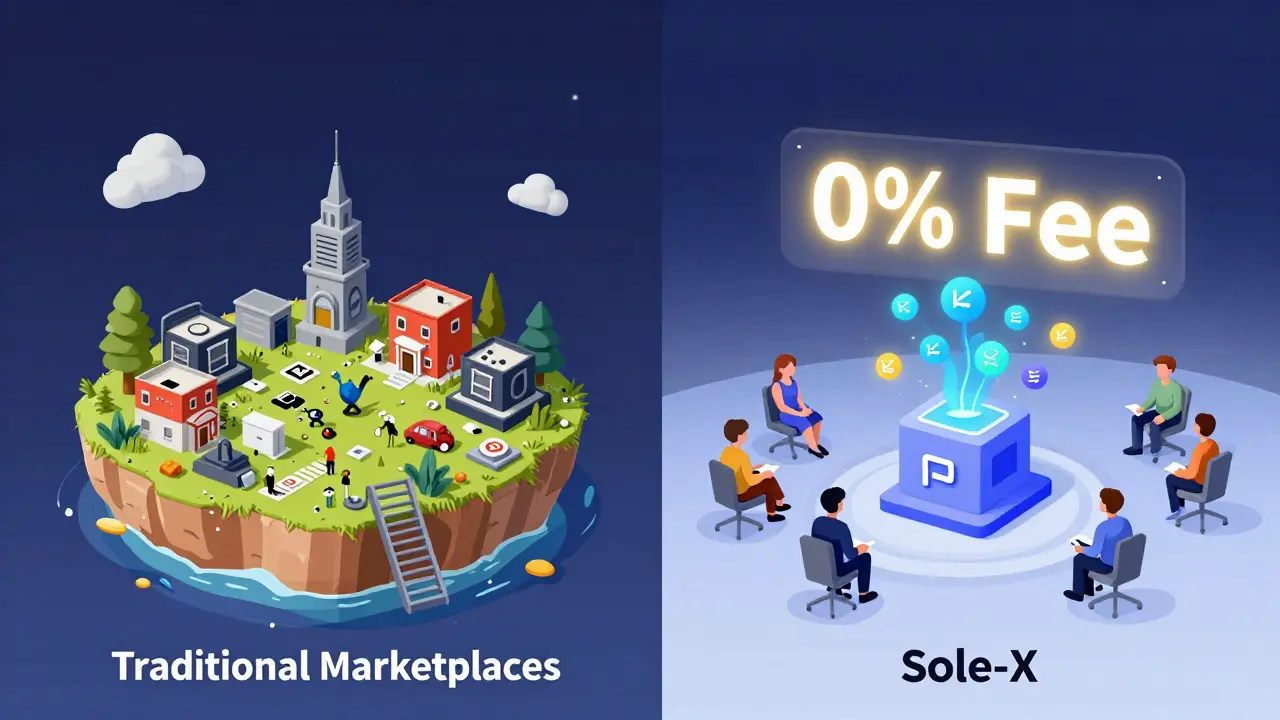
Most NFT marketplaces are like isolated islands. You can’t take your Klaytn-based NFT and sell it on an Ethereum-based platform. That’s a huge problem. Gamers own items on one chain. Artists mint on another. Collectors prefer a third. Fragmentation kills liquidity.
TriumphX breaks that barrier using two key technologies:
- Orbit Chain: A decentralized bridge that connects different blockchains. It’s the first open IBC (Inter-Blockchain Communication) platform built for NFTs. Think of it as a universal translator for digital assets.
- Polkadot integration: This lets TriumphX tap into Polkadot’s cross-chain network, expanding the range of blockchains it can support beyond just Ethereum and Klaytn.
The result? A single marketplace where you can buy an NFT from Solana, pay with Ethereum, and store it in your Klaytn wallet - all without switching platforms or wallets.
The two platforms: ENFTEE and Sole-X
TriumphX doesn’t run one marketplace - it runs two, each serving a different purpose.
ENFTEE.com: For creators and publishers
If you’re an artist, game developer, or content creator who wants to turn digital work into NFTs, ENFTEE is your launchpad. It’s a one-stop shop that helps you:
- Discover how to turn your content into NFTs
- Develop your NFT collection with tools and templates
- Market it to buyers across multiple chains
- Sell directly without paying high platform commissions
ENFTEE removes the guesswork. You don’t need to understand smart contracts or gas fees. Just upload your art, set your price, and let ENFTEE handle the rest - including listing it on Sole-X for global exposure.
Sole-X.io: For buyers and traders
Sole-X is where the actual trading happens. It’s the public marketplace where users buy, sell, and swap NFTs across blockchains. Here’s what makes it different:
- One wallet, many chains: Use MetaMask, Kaikas, or KLIP - no need to juggle multiple wallets.
- Zero intermediary fees: Trades happen peer-to-peer using smart contracts. No platform takes a cut.
- Escrow on auctions: When an auction ends, the buyer’s payment is automatically released. No trust needed.
- Stake NFTs to earn more NFTs: Lock your digital items into the platform and get rewarded with new ones over time.
That last feature is key. It turns passive NFT ownership into an active economy. Instead of just holding an NFT, you can use it to earn more - and those new NFTs can be sold, traded, or used in games.
Supported blockchains and wallets
TriumphX isn’t stuck on one chain. It’s built to work across several:
- Ethereum: The original home of NFTs. TRIX is an ERC-20 token on Ethereum.
- Klaytn: The backbone of Sole-X 1.0. Developed by Kakao, Klaytn offers fast, low-cost transactions ideal for gaming NFTs.
- Polkadot: Used for cross-chain expansion beyond Ethereum and Klaytn.
Supported wallets:
- MetaMask (Ethereum)
- Kaikas (Klaytn)
- KLIP (Klaytn, mobile-friendly)
You can trade using TRIX, ETH, KLAY, or USDT. That flexibility matters. Not everyone wants to hold crypto. Some prefer stablecoins. TriumphX lets you choose.
Who uses TriumphX?
The platform targets three groups:
- Game developers: Who want to tokenize in-game items and let players trade them outside the game.
- Digital artists: Who want to sell their work globally without relying on centralized galleries.
- Collectors and traders: Who want to buy NFTs from any chain without switching wallets or paying high fees.
TriumphX has partnered with the Korea Blockchain Content Association and several gaming platforms to build out its ecosystem. Its NFTs are already integrated into The Sandbox’s metaverse, where users can view and use them as voxel-based assets.

Current market status: Is TriumphX dead?
Here’s the hard truth: as of March 2026, TriumphX shows up as having zero active trading pairs on CoinMarketCap and CoinPaprika. The 24-hour volume is $0. The market cap is $0. No ranking.
Does that mean it’s dead? Not necessarily.
Many successful crypto projects started with low visibility. What matters isn’t whether it’s listed on Binance - it’s whether the platform is being used. TriumphX’s website (triumphx.io) is still live. ENFTEE and Sole-X are still operational. Developers are still building. The technology works. The problem is adoption.
Unlike projects that raised millions and launched on major exchanges, TriumphX took a slower, more technical route. It focused on building the infrastructure first - the bridges, the smart contracts, the wallet integrations. Now, it’s waiting for users to catch up.
If you’re a gamer who wants to sell your rare skins, or an artist tired of paying 15% fees to OpenSea, TriumphX is a real alternative. It just hasn’t gotten the marketing push of bigger names.
Why TRIX could grow
Three reasons TRIX might gain traction:
- Real utility: It’s not a meme coin. It’s needed to earn rewards, pay fees, and access the platform.
- Expanding chains: As TriumphX adds support for Solana, Polygon, and others, more users will need TRIX to trade.
- Creator economy shift: More artists and developers are leaving centralized platforms. TriumphX offers a decentralized, fee-free alternative.
The biggest barrier? Lack of exchange listings. Without major exchanges, retail buyers can’t easily buy TRIX. Until that changes, growth will be slow - but steady.
Final thoughts
TriumphX (TRIX) isn’t trying to be the next Bitcoin. It’s trying to be the plumbing behind the next generation of NFT trading. It’s not flashy. It doesn’t have celebrity endorsements. But it solves a real problem: fragmented NFT markets.
If you care about owning digital assets that you can actually trade - not just hold - then TriumphX is worth watching. The tech works. The model is sound. The question isn’t whether it’s valuable now. It’s whether enough people will use it to make it matter.



Cheri Farnsworth
TriumphX is the most underappreciated infrastructure project in crypto right now.
Most people don’t get it because they’re looking for a quick flip.
The real value is in the bridge between chains.
Not the token price.
Not the hype.
The plumbing.
And that’s why it will win.
Slowly.
But surely.
Mark my words.
Gene Inoue
Lmao this is a ghost project.
Zero volume, zero listings, zero credibility.
They built a fancy bridge to nowhere.
Stop pretending this isn’t dead.
Ricky Fairlamb
You’re all missing the fundamental flaw: if TriumphX were truly revolutionary, it would have been adopted by Ethereum’s core devs or Polkadot’s foundation.
Instead, it’s a fringe project with no institutional backing.
Their ‘Orbit Chain’ is just a rebranded wrapped asset bridge.
And calling it ‘IBC’? That’s not even technically accurate.
They’re exploiting terminology to sound more sophisticated than they are.
Real cross-chain interoperability requires consensus-level integration.
Not smart contract wrappers.
And don’t get me started on their tokenomics - 9.9 billion supply with no burn mechanism?
That’s not utility, that’s inflationary garbage.
This isn’t innovation.
This is a poorly constructed Ponzi dressed in blockchain jargon.
Lauren J. Walter
…I read the whole thing.
And I’m just… sitting here.
Like a ghost at a party.
Waiting for someone to say something real.
But nope.
Just… more blockchain poetry.
Beautiful.
Meaningless.
Carol Lueneburg
This is actually kind of beautiful 🥹
Like someone built a library no one’s visited yet…
but the books are all real.
And the shelves are solid.
And the lights are still on.
Don’t give up on it yet.
The world needs more builders like this.
Not more hype-chasers.
Keep going, TriumphX 💪✨
Manali Sovani
TRIX has no value.
Zero.
It is not money.
It is not utility.
It is noise.
Do not invest.
Do not believe.
Do not engage.
It is a distraction.
Konakuze Christopher
They’re waiting for users.
Meanwhile, the devs are still coding.
While the world moves on.
That’s not patience.
That’s delusion.
Build it and they will come?
That’s a fairy tale for losers.
S F
USA built the internet.
China is building Web3.
And we’re over here cheering for some Korean side project with a 9-billion supply token?
Wake up.
This isn’t innovation.
This is surrender.
Angelica Stovall
Zero volume.
Zero listings.
Zero legitimacy.
They’re not building.
They’re just waiting.
Waiting for suckers.
Waiting for the next wave.
It’s a trap.
Run.
Taylor Holloman.
There’s something quietly heroic about this project.
Not loud.
Not flashy.
Just… there.
Like a lighthouse that nobody’s noticed yet.
It doesn’t need a crowd.
It just needs one person to try it.
And then another.
And then someone who actually needs it.
Maybe that’s us.
Maybe we’re the ones who should’ve been here all along.
Bryan Roth
I’ve seen a lot of crypto projects.
Most of them? Built for greed.
This one? Built for friction.
The kind of friction that happens when artists can’t sell to gamers because of chain lock-in.
When devs lose 15% to middlemen.
When collectors are forced into wallets they don’t trust.
TriumphX doesn’t care about your portfolio.
It cares about your art.
And your game.
And your right to own what you bought.
That’s worth more than any chart.
And if you’re still here reading this?
You already get it.
Keep going.
sai nikhil
Good concept.
But needs marketing.
People don’t understand blockchain bridges.
They want simple.
Fast.
Easy.
TriumphX is complex.
That’s the problem.
Not the tech.
The message.
Sahithi Reddy
TRIX isn’t dead.
It’s sleeping.
And when the right artist or gamer finds it?
It will wake up.
And change everything.
George Hutchings
As someone who’s traded NFTs across three chains this year - I’ve been waiting for this.
Not the token.
Not the price.
But the bridge.
And I’ve tried every other solution.
None work as cleanly.
TriumphX is the only one that doesn’t make me juggle six wallets.
So yeah.
I use it.
And I’ll keep using it.
Until the world catches up.
Henrique Lyma
Let’s be honest - this entire project reads like a whitepaper written by someone who confused technical ambition with market viability.
Orbit Chain? That’s not even a real term in blockchain architecture.
Polkadot integration? You mean a parachain bridge that’s still in testnet?
And claiming zero intermediary fees while relying on a token with 9.9 billion supply? That’s not a utility model - that’s a liquidity trap dressed as a solution.
They’re not solving fragmentation.
They’re just creating another layer of complexity.
And now they’re asking us to believe in a token that’s worth less than a penny because… it’s ‘needed’?
That’s not innovation.
That’s a financial engineering exercise with zero real-world traction.
And if you’re still holding out hope?
You’re not a believer.
You’re a victim of narrative.