What is Usual USD (USD0)? A Deep Dive into the RWA-Backed Stablecoin
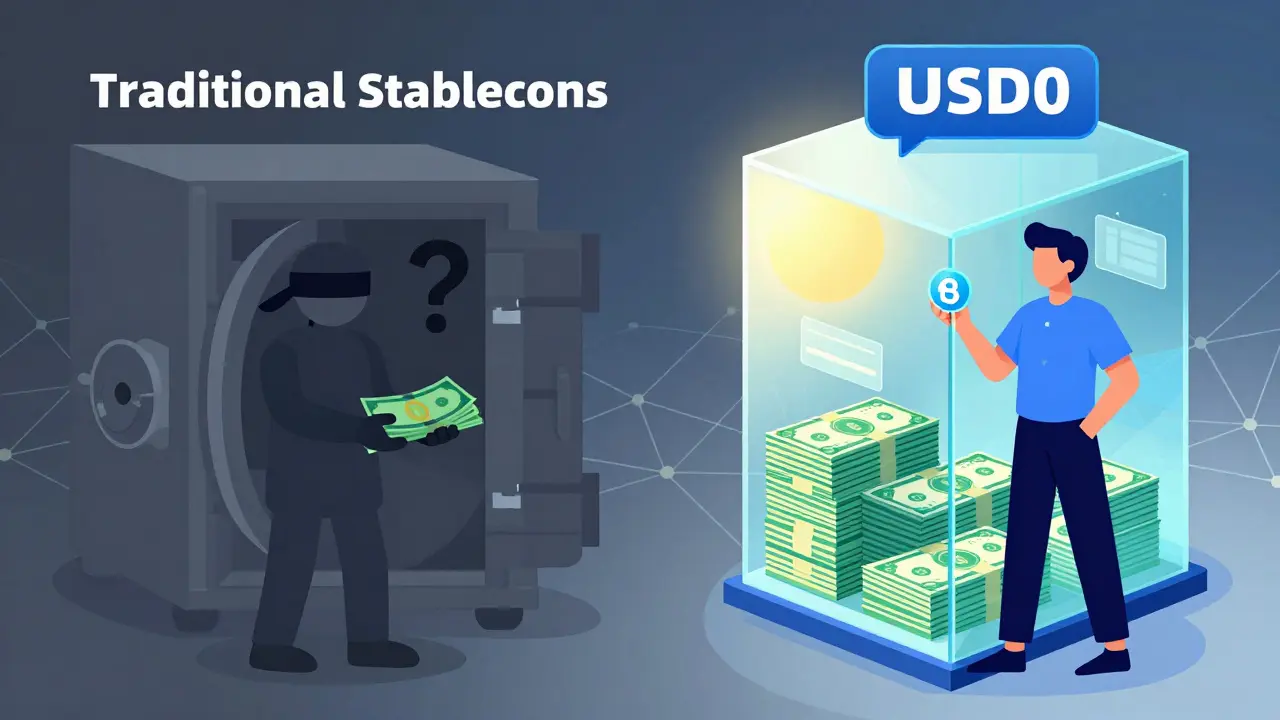
You’ve probably heard of USDT or USDC. They are the giants of the stablecoin world. But there is a new player in town that claims to fix the biggest problem with those giants: trust. That player is Usual USD (USD0).
If you have been following the crypto space for a while, you know that "stable" doesn’t always mean "safe." We’ve seen banks freeze accounts, we’ve seen reserves get questioned, and we’ve seen pegs break. USD0 tries to solve this by doing something different. Instead of relying on a company’s promise that they have enough cash in a bank, it relies on Real-World Assets (RWA), specifically short-term US Treasury Bills.
This isn’t just another copycat token. It represents a shift in how we think about digital dollars. So, what exactly is USD0, why does it matter, and should you care? Let’s break it down without the jargon.
The Core Problem: Trust vs. Transparency
To understand USD0, you first need to understand why it exists. Traditional fiat-backed stablecoins like USDT and USDC work on a fractional reserve model or at least an opaque one. You send them your dollars, they give you tokens. You assume they actually hold those dollars. But you can’t see the bank account. You have to trust their quarterly attestations.
Usual USD (USD0) flips this script. It is designed to be fully collateralized by Short-Term US Treasury Bills. These are government debt securities with maturities of less than one year. They are considered one of the safest assets in the global financial system. By backing every single USD0 token with these T-Bills, the protocol aims to eliminate the risk of insolvency that plagues traditional banks and some stablecoin issuers.
Think of it like this. With USDC, you hope the issuer hasn’t lent out your money. With USD0, the asset backing your token is publicly verifiable on-chain. It brings the transparency of blockchain to the safety of government bonds.
How USD0 Works: The Mechanics
So, how do you actually get USD0? And where does it live?
USD0 operates on multiple blockchains, making it accessible across the decentralized finance (DeFi) ecosystem. When you want to buy USD0, you typically deposit USDC or other supported assets into the protocol’s smart contracts. In return, you receive USD0. The key here is that the deposited assets are immediately used to purchase short-term T-Bills.
The process looks like this:
- You deposit USDC (or similar) into the Usual protocol.
- The protocol uses these funds to buy short-term US Treasury Bills.
- You receive USD0 tokens minted against that collateral.
- You can now use USD0 anywhere in DeFi-lending, borrowing, trading.
Because the backing asset is a T-Bill, which pays interest, the protocol generates revenue. This revenue is crucial. It doesn’t just sit there; it fuels the entire ecosystem, including rewards for users and protection for the network.
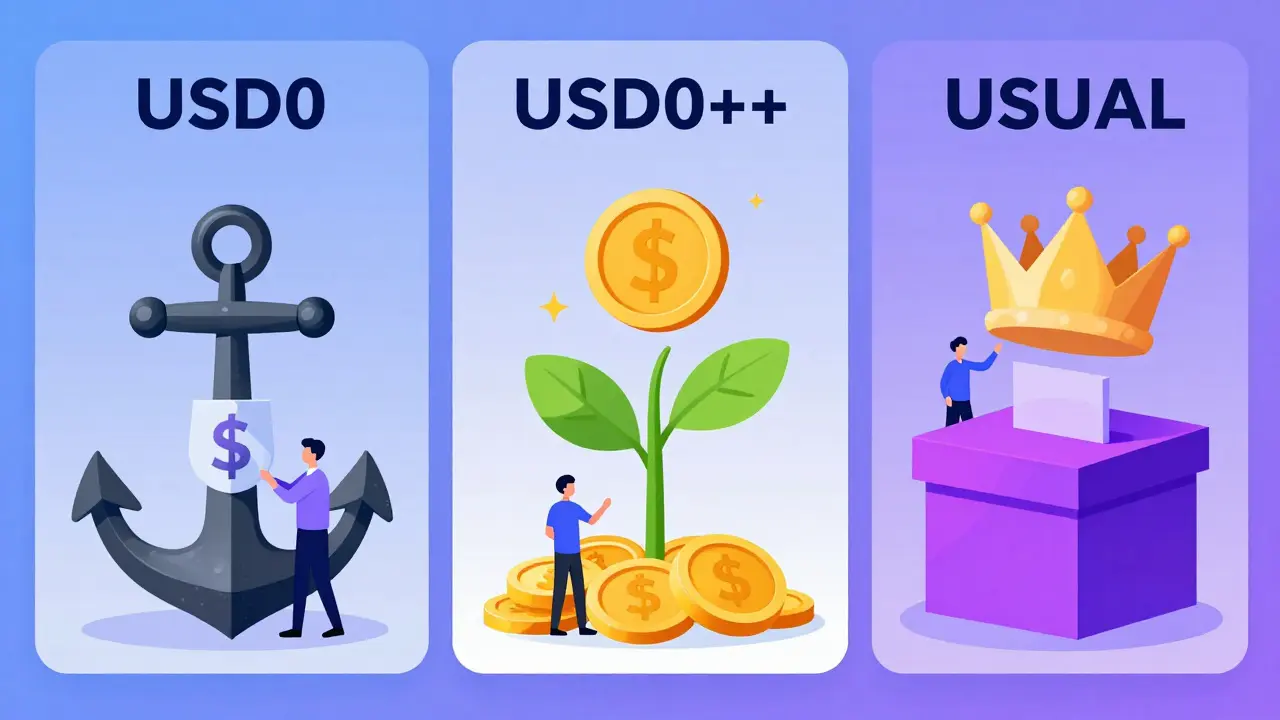
The Three Pillars: USD0, USD0++, and USUAL
Usual isn’t just one token. It’s a trio. Understanding the difference between them is critical if you want to participate effectively.
| Token | Type | Purpose | Risk Profile |
|---|---|---|---|
| USD0 | Stablecoin | Medium of exchange, store of value backed by T-Bills | Low (Pegged to $1) |
| USD0++ | Liquid Staking Token | Earn yield and governance rights by staking USD0 | Low-Medium (Smart contract risk) |
| USUAL | Governance Token | Voting, fee sharing, protocol control | High (Volatile crypto asset) |
USD0 is the stable part. It stays close to $1. USD0++ is what you get when you stake your USD0. It acts as a receipt proving you have locked up your stablecoin, and it earns you rewards. Finally, USUAL is the volatile governance token. It gives you a say in how the protocol runs and a share of the profits.
Why Stake? The Power of USD0++
Holding USD0 is safe, but it doesn’t make you much money directly. That’s where USD0++ comes in. When you stake USD0, you lock it up in the protocol’s smart contracts. In return, you receive USD0++.
Why would you do this? Two reasons:
1. Yield Generation: The underlying T-Bills pay interest. This interest flows back into the protocol. A portion of this yield is distributed to stakers. As of early 2026, yields have been competitive compared to traditional savings accounts, often ranging between 3% to 5% APY depending on market conditions and total value locked (TVL).
2. Governance and Rewards: Holding USD0++ often grants you voting power or eligibility for additional rewards in the form of USUAL tokens. This aligns your incentives with the health of the protocol. If the protocol grows, your governance influence and potential rewards grow.

The Role of USUAL: More Than Just Voting
Most governance tokens in DeFi are speculative assets with little intrinsic value. USUAL is different because its issuance is tied to the protocol’s revenue.
Here is the unique mechanic: USUAL operates on a disinflationary model. New tokens are issued based on the Total Value Locked (TVL) in staked USD0 (i.e., USD0++). As more people stake USD0, the supply growth of USUAL slows down relative to demand. Furthermore, the protocol captures revenue from the spread between the yield earned on T-Bills and the yield paid to stakers. This revenue can be used to buy back USUAL or distribute it to holders.
This creates a feedback loop. More adoption → More TVL → Higher revenue → Increased scarcity/value of USUAL. It’s a clever design that attempts to solve the "dump pressure" issue common in many DeFi projects.
Safety First: The Insurance Fund
No discussion of crypto is complete without talking about risk. What happens if the smart contract gets hacked? What if the T-Bills default (highly unlikely, but possible)?
Usual has built an Insurance Fund to address this. This fund is capitalized by protocol revenue. Its purpose is to cover losses in the event of a systemic crisis or a smart contract exploit. This adds a layer of security that goes beyond just having good code. It provides a financial backstop for users.
However, remember that no system is 100% immune. Smart contract risks still exist. Always do your own research and never invest more than you can afford to lose.
USD0 vs. USDC vs. USDT: The Showdown
Let’s put USD0 side-by-side with the incumbents. Why switch?
- Transparency: USDT and USDC rely on periodic audits. USD0 offers real-time on-chain verification of its T-Bill holdings. You can see the collateral anytime.
- Censorship Resistance: USDC can be frozen by the issuer if they receive legal pressure. USD0, being a decentralized protocol, is harder to censor. Your keys, your coins.
- Yield: Holding USDC or USDT in a wallet earns you nothing. Holding USD0++ earns you yield from T-Bills plus potential USUAL rewards.
- Accessibility: USD0 integrates seamlessly into DeFi platforms like Aave, Uniswap, and others, allowing you to use it as collateral for loans or liquidity provision.
That said, USDT and USDC have higher liquidity and wider acceptance in centralized exchanges. If you need to cash out instantly on Binance, USDT might still be easier. For DeFi-native activities, USD0 is gaining ground fast.
Current Market Context (May 2026)
As of May 2026, USD0 has established itself as a serious contender in the RWA stablecoin sector. The price remains tightly pegged to $1, typically fluctuating within a narrow band of $0.99 to $1.01 due to minor transaction fees and arbitrage activity.
The Total Value Locked (TVL) in the Usual protocol has grown significantly, driven by institutional interest in RWA products and retail users seeking safer alternatives to algorithmic stablecoins. The USUAL token has also seen increased trading volume as more participants engage with the governance and reward mechanisms.
Regulatory clarity around RWAs in the US and Europe has also boosted confidence in protocols like Usual. Unlike previous cycles where regulation was a wildcard, 2026 has seen more defined frameworks for tokenized treasuries, giving USD0 a regulatory tailwind.
Who Should Use USD0?
Not everyone needs USD0. Here is who benefits most:
- DeFi Degens: If you are already lending, borrowing, or providing liquidity, USD0 offers a safer, yield-generating alternative to USDC.
- Conservative Investors: If you want exposure to crypto infrastructure without the volatility of Bitcoin or Ethereum, USD0++ provides a low-risk yield play.
- Privacy Advocates: If you worry about centralized issuers freezing your funds, USD0’s decentralized nature offers peace of mind.
If you primarily trade on centralized exchanges and rarely touch DeFi, sticking with USDT or USDC might still be simpler for now.
Getting Started with USD0
Ready to try it out? Here is a simple path:
- Set Up a Wallet: Use a non-custodial wallet like Metamask or Rabby.
- Buy ETH or USDC: You’ll need gas fees to interact with the protocol.
- Connect to Usual: Go to the official Usual website and connect your wallet.
- Swap for USD0: Deposit your USDC to mint USD0.
- Stake for USD0++: Lock your USD0 to start earning yield and governance rights.
Always double-check URLs to avoid phishing sites. Bookmark the official site before you begin.
Final Thoughts
Usual USD (USD0) represents a maturation of the stablecoin market. It moves us away from blind trust in companies toward verifiable trust in assets. By combining the stability of US Treasuries with the flexibility of blockchain, it offers a compelling case for both conservative investors and active DeFi users.
The crypto landscape is changing. The days of "trust me bro" stablecoins are fading. Protocols like Usual are building the infrastructure for a more transparent, secure, and profitable future. Whether you choose to stake, govern, or simply hold, USD0 is worth keeping an eye on.
Is USD0 a safe investment?
USD0 is considered low-risk because it is backed 1:1 by short-term US Treasury Bills. However, it carries smart contract risks and regulatory risks inherent to all DeFi protocols. It is not insured by the FDIC like a traditional bank account.
What is the difference between USD0 and USDC?
USDC is issued by a centralized company and backed by cash and equivalents held in banks. USD0 is a decentralized protocol backed by tokenized US Treasury Bills. USD0 offers greater transparency and censorship resistance, while USDC has higher liquidity on centralized exchanges.
How do I earn yield with USD0?
You earn yield by staking USD0 to receive USD0++. This locks your stablecoin in the protocol, allowing you to earn interest generated by the underlying T-Bills and potentially receive USUAL governance tokens as rewards.
Can I lose money holding USD0?
While the peg is stable, you can lose money through smart contract hacks, extreme market events causing de-pegs, or impermanent loss if you provide liquidity. Always use reputable platforms and diversify your holdings.
What is the USUAL token used for?
USUAL is the governance token of the Usual protocol. Holders can vote on proposals, influence protocol parameters, and receive a share of the protocol's revenue. Its supply is disinflationary, tied to the TVL of staked USD0.

Jimmy vasquez
Hey folks, Jimmy here. I've been tracking Usual USD for a few months now and the T-Bill backing is genuinely interesting. Most people just look at the APY but the real win is the on-chain transparency. You can actually verify the collateral isn't being lent out to some shady hedge fund like with USDC. It's a small step but it matters for trust.
Andrew Todd
This is typical American over-engineering. We have banks. They work. Why do we need another layer of tech bro nonsense? Just keep your money in a bank where it belongs. This crypto stuff is for losers who don't understand how finance actually works.
Ryan Nakielny
Oh sure, because nothing says 'safe' like a smart contract that hasn't been around for decades. But hey, if you want to gamble on code instead of FDIC insurance, go ahead. I'll be here watching from the sidelines with my coffee. ☕
Sri Astuti
I have to say that while the concept of using treasury bills as collateral seems sound on paper, the execution risks are significant and often overlooked by retail investors who simply chase yield without understanding the underlying mechanics of the protocol or the potential for smart contract vulnerabilities which could lead to total loss of funds despite the theoretical safety of the assets themselves :(
Elle Kharitou
The beauty of this system lies in its ability to bridge traditional finance with decentralized autonomy 🌍✨ By staking USD0 into USD0++, users aren't just parking cash; they're participating in a new financial paradigm that rewards patience and governance participation rather than speculative frenzy 💰📈
Nitin Gupta
Nitin here. I think it's important to note that the yield comes from the spread on T-bills. It's not magic money. If interest rates drop, the yield drops. It's still better than holding USDT though since you get some return. Just manage expectations.
AP Fisher
I'm curious about the tax implications. Since you're earning yield from T-bills through a DeFi protocol, does the IRS view this differently than standard bond interest? Seems like a gray area that could get messy.
Wayne Gillis
Bro, I just swapped all my USDC to USD0 yesterday. The UI is smooth and I love that I can see the T-bills on chain. No more trusting Circle's PDFs. Let's gooooo 🚀🔥
Noel Mandotah
Please. Another stablecoin wrapper. Boring. The market doesn't need another 'trustless' dollar. It needs innovation, not re-skinned treasuries. Yawn.
edie rosa
You people are so naive to think that moving your money to a blockchain makes it safe. It just moves the risk from a regulated entity to an unregulated code base. And when it fails, who do you blame? The developers? The community? It's morally bankrupt to promote this as 'safer'.
Michael Repak
Michael here! I really appreciate the detailed breakdown in the post!! It helps clarify the distinction between USD0 and USD0++!! Many people confuse the two!! Remember to stake if you want the yield!! Cheers!!
Livvy Cooper
Sounds like a scam waiting to happen. All these fancy words and tables but it's still just gambling. I'd rather keep my cash under the mattress. At least I know where it is.
Rain Richardsson
I hear what you're saying about the risks. It's valid to be cautious. For me, diversifying a small portion into RWA-backed assets feels like a logical next step in DeFi. Not all-in, just exposure.
Iestyn Lloyd
In the UK, we are seeing similar trends with tokenized bonds. Usual is pioneering this in the US market effectively. The regulatory clarity mentioned in May 2026 is indeed a key driver. It legitimizes the space significantly.
April D Thompson
What strikes me most is the philosophical shift from 'trust me bro' to 'verify everything'. It's not just about finance; it's about reclaiming agency over our own value storage. In a world of increasing surveillance and censorship, having a neutral, transparent store of value is revolutionary. 🌟
Tracy McBurney
Tracy here. I've analyzed the smart contract code briefly. It's clean but the reliance on oracles for T-bill pricing introduces a single point of failure that isn't adequately addressed in the whitepaper. Typical oversight.