What is Woman Yelling At Cat (WYAC) Crypto? A Complete Guide to the Memecoin

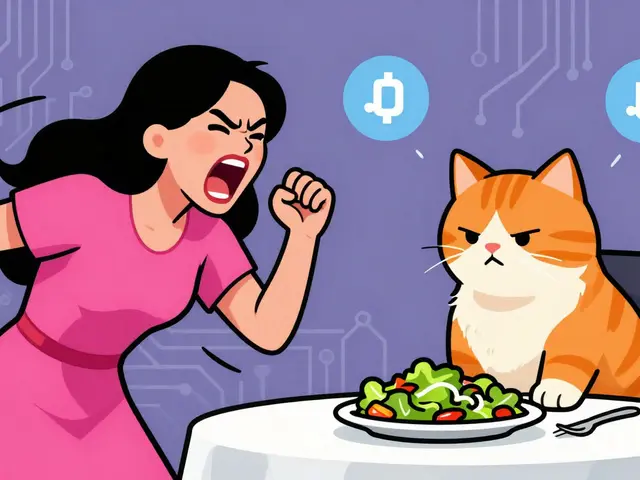
Have you ever scrolled through social media and seen that iconic image of a woman screaming at a confused-looking cat sitting at a dinner table? If so, you’ve encountered one of the internet’s most enduring memes. Now, thanks to the world of cryptocurrency, that joke has its own digital asset. Woman Yelling At Cat (WYAC) is a speculative memecoin built on the Solana blockchain that derives its value entirely from community sentiment and viral internet culture rather than technological utility. It is not a tool for payments, nor does it offer governance rights or staking rewards. Instead, it exists purely as a cultural artifact turned financial instrument.
If you are reading this, you likely want to know what this token actually is, why it fluctuates so wildly, and whether it makes sense to buy in. This guide breaks down the origins, mechanics, risks, and current market status of WYAC as of May 2026. We will look at the data without the hype, giving you a clear picture of what you are dealing with when you consider this highly volatile asset.
The Origin Story: From TV Drama to Digital Token
To understand WYAC, you first have to understand the meme itself. The original image went viral on Twitter (now X) on May 1, 2019. It was created by user @MISSINGEGIRL, who combined two unrelated photos into a single comic strip format. On the left, you see Taylor Armstrong from The Real Housewives of Beverly Hills, specifically from the episode "Malibu Beach Party from Hell." She is mid-shout, being restrained by fellow cast member Kyle Richards. On the right sits Smudge, a domestic shorthair cat, staring blankly at a plate of salad with an expression of utter bewilderment.
The juxtaposition worked because it captured a universal feeling: intense frustration meeting complete indifference. Over the years, the meme evolved. People added captions to represent arguments, debates, or misunderstandings. By 2023 and 2024, as memecoins began dominating headlines, developers saw an opportunity. They launched the WYAC token on the Solana blockchain. Solana was chosen because it offers high transaction speeds-capable of handling approximately 65,000 transactions per second-and low fees compared to Ethereum. This made it easy for thousands of small traders to buy and sell the token without paying exorbitant gas fees.
The launch wasn’t about building a new technology. It was about immortalizing a piece of internet history. There is no whitepaper detailing a revolutionary protocol. There is no team promising decentralized finance applications. The entire value proposition rests on one thing: people still find the meme funny enough to trade.
How WYAC Works on the Solana Blockchain
Technically, WYAC is a standard SPL token on the Solana network. This means it functions like any other fungible token on the platform. You can hold it in a compatible wallet, such as Phantom or Solflare, and transfer it between addresses. However, unlike utility tokens that grant access to services, WYAC has no inherent function outside of speculation.
The supply dynamics are crucial to understanding its price behavior. The maximum total supply is capped at 1 billion tokens. As of May 2026, approximately 989.98 million tokens are in circulation. This massive circulating supply relative to its market capitalization is why the price per token remains fractions of a cent. When you see a price like $0.0003, do not mistake it for "cheap" in the way a stock at $5 might be cheap. With nearly 1 billion tokens already out there, even a small increase in price requires significant capital inflow.
The Fully Diluted Valuation (FDV) is currently almost identical to the market cap, suggesting that very few tokens remain locked or unissued. This lack of future issuance pressure means the price movement is driven entirely by buying and selling pressure in the open market, not by new tokens entering the supply.
Current Market Status and Price Volatility
One of the most striking features of WYAC is its extreme volatility and the discrepancies in pricing across different exchanges. Because liquidity is fragmented, the price you see on one platform may differ significantly from another. Here is a snapshot of the data as of May 9, 2026:
| Exchange / Platform | Price (USD) | 24h Volume (USD) | Market Cap (USD) |
|---|---|---|---|
| Coinbase | $0.0003125 | $14,770 | $1.30M |
| CoinMarketCap | $0.0002967 | N/A | $334,400 |
| Binance (Off-exchange data) | $0.000423 | $3,662 | $418,633 |
| Crypto.com | $0.0002863 | N/A | N/A |
| Bitget | $0.0002907 | $1,570 | $287,760 |
Notice the wide variance. Coinbase lists the market cap at $1.3 million, while CoinMarketCap shows it closer to $334,000. This discrepancy highlights a critical risk: low liquidity. The Liquidity-to-Market Cap ratio is around 27.92%, meaning only about 28% of the market cap is available in liquid funds for immediate trading. For large trades, this results in significant slippage-you might buy at one price but end up executing orders at much higher prices as you eat through the order book.
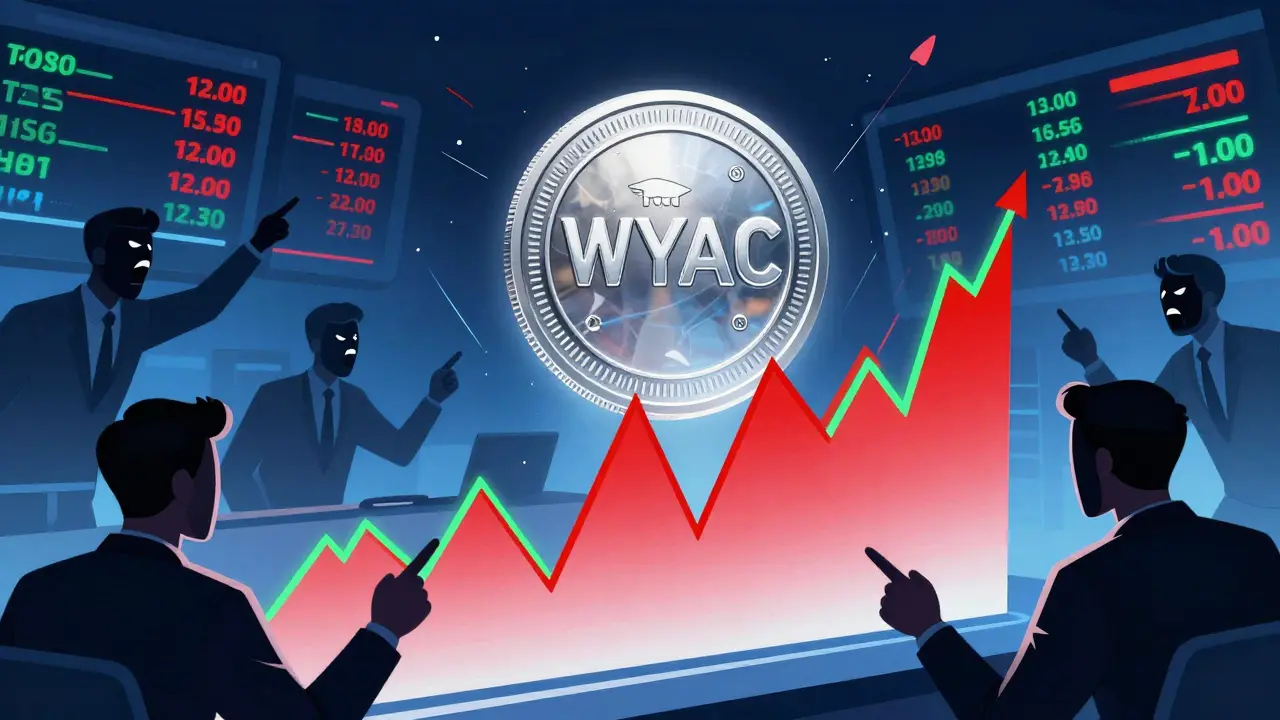
Performance metrics also tell a story of erratic movement. In the last 24 hours, CoinGecko reported an 11.70% price increase, followed by a 1,059% spike in trading volume. Yet, over the past seven days, the token declined by 9.20%, underperforming both the broader cryptocurrency market (which was up 0.10%) and the Solana ecosystem average. This indicates that WYAC does not move in lockstep with major trends; it moves based on its own niche community cycles.
Understanding the Risks of Investing in WYAC
If you are considering buying WYAC, you must go in with your eyes wide open. This is not an investment in a company with revenue, employees, or products. It is a bet on attention. Here are the specific risks you need to weigh:
- Lack of Utility: WYAC has no announced roadmap, no development team updates, and no technological innovation. Its value is purely sentimental. If the meme stops trending, the demand could evaporate.
- Low Liquidity and Slippage: As noted, the trading volumes are thin. Selling a large position could crash the price temporarily, causing you to lose more money than expected.
- Exchange Accessibility: Binance explicitly states that WYAC is not listed for trading on their platform. The data shown on Binance is aggregated off-exchange information. This limits mainstream access and forces traders to use smaller exchanges or decentralized swaps, which often have higher fees and less security oversight.
- Extreme Volatility: The token has traded between an all-time low of $0.000071 and highs varying by source ($0.0014 on Coinbase vs $0.058 on Binance). These swings mean you could double your money or lose 90% of it in a matter of days.
- Dilution Risk: With nearly 1 billion tokens in circulation, ownership is heavily diluted. There is no scarcity premium driving the price up, only speculative FOMO (Fear Of Missing Out).
Regulatory scrutiny on memecoins is also increasing globally. While WYAC operates on a public blockchain, the lack of transparency regarding who controls the largest wallets adds another layer of uncertainty. If a "whale" (a holder with a massive amount of tokens) decides to dump their holdings, the price could collapse instantly.
Why Do People Still Trade WYAC?
Given the risks, why does trading continue? The answer lies in the psychology of memecoin markets. Traders are not looking for steady growth; they are looking for explosive, short-term gains. The low entry price-fractions of a cent-makes it psychologically accessible. Retail investors can buy thousands of tokens for just a few dollars, creating the illusion of owning a "large" amount.
Additionally, the Solana ecosystem has become a hub for memecoin culture. Platforms like Raydium and Jupiter facilitate quick swaps, allowing traders to jump in and out rapidly. The community aspect is vital too. Discord servers and Telegram groups dedicated to WYAC keep the narrative alive, sharing screenshots of gains and coordinating "buy walls." This social proof creates a feedback loop where increased attention drives volume, which drives price spikes, which attracts more attention.
However, this cycle is fragile. Unlike established cryptocurrencies like Bitcoin or Ethereum, which have network effects and institutional adoption, WYAC relies solely on viral moments. When the meme ages out of relevance, the community may disperse, leaving the token with little to no support.

How to Buy WYAC Safely
If you decide to proceed despite the risks, follow these steps to minimize operational errors:
- Set Up a Solana Wallet: Download a reputable non-custodial wallet like Phantom or Solflare. Secure your seed phrase offline. Never share it with anyone.
- Acquire SOL: Buy Solana (SOL) on a major exchange like Coinbase or Kraken. Transfer it to your self-custody wallet. You cannot buy WYAC directly with USD on most platforms; you need SOL to swap.
- Use a Decentralized Exchange (DEX): Connect your wallet to a Solana-based DEX like Raydium or Jupiter. Search for the WYAC token contract address to ensure you are buying the correct token. Fake tokens with similar names are common.
- Check Liquidity Pools: Before swapping, look at the depth of the liquidity pool. If the pool is shallow, expect high slippage. Set your slippage tolerance appropriately (often 1-5% for memecoins) to ensure the transaction goes through.
- Verify the Contract: Always cross-reference the token contract address with trusted aggregators like CoinGecko or CoinMarketCap to avoid scams.
Remember, once you swap your SOL for WYAC, you are responsible for managing those assets. There is no customer service to call if something goes wrong.
The Future Outlook for WYAC
Predicting the future of a memecoin is nearly impossible, but we can look at historical patterns. Most memecoins follow a lifecycle: initial hype, peak valuation, gradual decline, and eventual dormancy. Some, like Dogecoin, have achieved cultural immortality and survived multiple cycles. Others fade into obscurity within months.
As of May 2026, WYAC appears to be in a phase of sustained but low-level interest. It is ranked #3123 on CoinGecko, placing it firmly in the lower tier of the cryptocurrency market. Without a catalyst-such as a major celebrity endorsement, a listing on a top-tier exchange, or a resurgence in meme popularity-it is unlikely to see massive appreciation. Conversely, if the Solana network faces congestion or regulatory headwinds, WYAC could suffer alongside other altcoins.
The key takeaway is that WYAC is a lottery ticket, not an investment. Treat it as entertainment spending. Only allocate funds you are prepared to lose entirely. The joy of participating in internet culture should not outweigh the potential financial pain of a bad trade.
Is Woman Yelling At Cat (WYAC) a scam?
WYAC is not inherently a scam in the sense that it is a legitimate token on the Solana blockchain with verifiable transaction history. However, it is a high-risk speculative asset with no fundamental utility. The lack of transparency regarding developer wallets and the potential for rug pulls (where developers abandon the project and drain liquidity) are common risks in the memecoin space. Always verify the contract address and be aware that you could lose your entire investment.
Can I buy WYAC on Binance?
No, Binance explicitly states that WYAC is not listed for trading on their platform. Any price data you see on Binance for WYAC is aggregated from off-exchange sources and does not represent active trading pairs on Binance itself. To buy WYAC, you must use decentralized exchanges (DEXs) on the Solana network or other smaller centralized exchanges that list the token.
Why is the price of WYAC different on different exchanges?
The price differences are due to low liquidity and fragmented trading pools. WYAC is not traded on major, high-volume exchanges with deep order books. Instead, it trades on smaller platforms and DEXs where supply and demand can vary significantly. This lack of a unified price discovery mechanism leads to arbitrage opportunities and wide price discrepancies between platforms like Coinbase, CoinMarketCap, and Bitget.
What is the total supply of WYAC tokens?
The maximum total supply of WYAC is 1 billion tokens. As of May 2026, approximately 989.98 million tokens are in circulation. This high circulating supply contributes to the low per-token price, as the market cap is divided among nearly a billion units.
Does WYAC have any utility or real-world use case?
No, WYAC has no announced utility, technological innovation, or real-world application. It is a pure memecoin, meaning its value is derived entirely from community sentiment, meme virality, and speculative trading. It does not offer staking rewards, governance rights, or payment processing capabilities.