CoinBene Crypto Exchange Review: Is It Safe in 2026?

Imagine you’ve just bought your first Bitcoin. You want to swap it for Ethereum or Solana, but every time you click 'trade,' a chunk of your profit vanishes into trading fees. That frustration is exactly why platforms like CoinBene emerged. Founded in 2017 and based in Singapore, this exchange promised one thing above all else: rock-bottom fees. But in the world of crypto, low prices often come with hidden costs-like poor security, bad support, or worse. So, is CoinBene actually worth your trust in 2026?
The Low-Fee Promise vs. Reality
The main reason people still talk about CoinBene is its fee structure. Most major exchanges charge between 0.1% and 0.5% per trade. If you’re an active trader, those percentages add up fast. CoinBene cuts through that noise by charging only 0.01% for both makers and takers. To put that in perspective, if you trade $10,000 worth of crypto, you’d pay just $1 in fees on CoinBene, compared to $10-$50 on bigger platforms.
They also advertise zero withdrawal fees. Now, don’t get too excited yet-you still have to pay the standard blockchain network fees (gas fees) to move coins off the platform. But CoinBene doesn’t slap an extra service charge on top of that. For someone moving large amounts of altcoins frequently, this can save real money.
| Exchange | Trading Fee | Withdrawal Fees | Fiat Support |
|---|---|---|---|
| CoinBene | 0.01% | Network fees only | No |
| Binance | 0.1% - 0.75% | Variable | Yes |
| Coinbase | 0.4% - 1.5% | High | Yes |
However, there’s a catch. Because CoinBene doesn’t accept fiat currencies like USD, EUR, or NZD, you can’t buy crypto directly with a bank card. You already need to own some cryptocurrency to deposit into your account. This makes it a secondary trading hub rather than a starting point for beginners.
Safety and Transparency Concerns
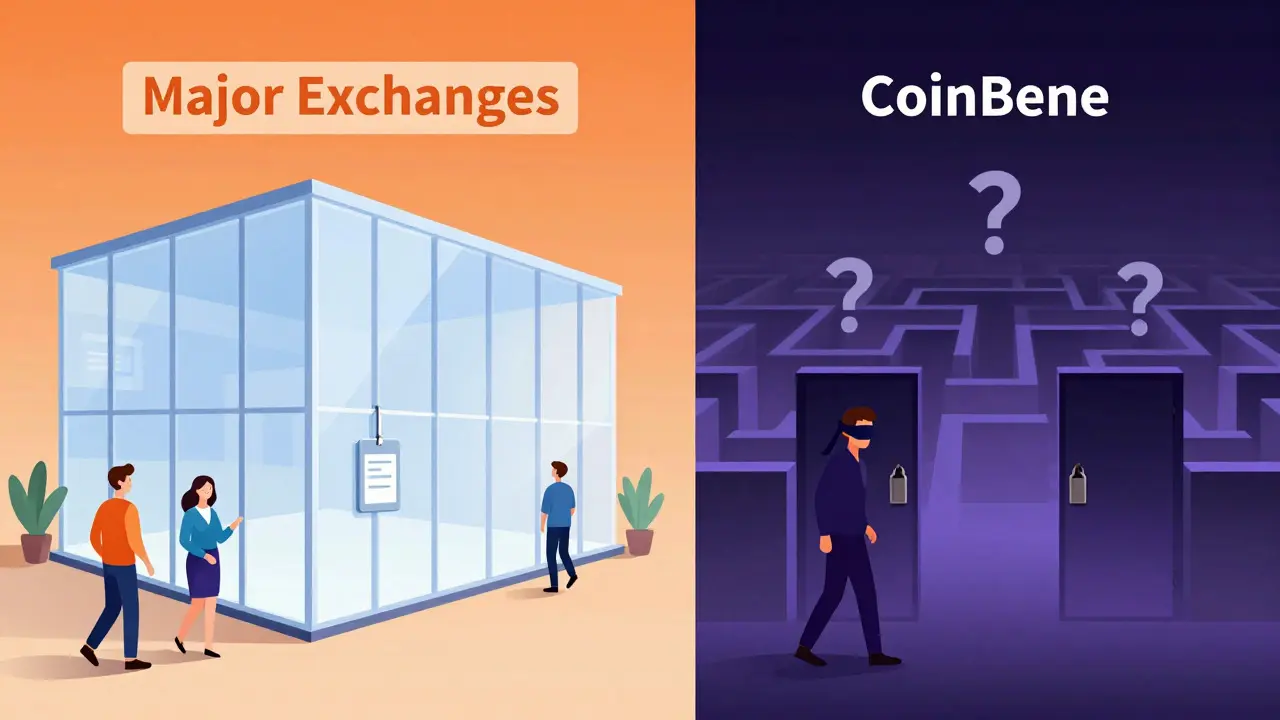
Here’s where things get tricky. In crypto, "cheap" shouldn’t mean "risky." Yet, when we look at CoinBene’s track record, red flags appear. The biggest issue? A lack of transparency. Unlike Coinbase or Kraken, which publish regular proof-of-reserves audits and have clear leadership teams, CoinBene keeps its operations behind closed doors.
Who runs the company? Where are the servers located? How much of user funds are kept in cold storage? These questions remain largely unanswered. CaptainAltcoin, a well-known crypto reviewer, noted in their 2025 analysis that this opacity could lead to "serious problems in the future." In an industry shaken by collapses like FTX and Celsius, trusting an opaque platform feels like walking blindfolded across a tightrope.
User sentiment backs up these concerns. As of late 2025, CoinBene holds a dismal 1.5 out of 5 stars rating on Trustpilot based on dozens of reviews. Common complaints include frozen accounts, unresponsive customer support, and delayed withdrawals. One user described trying to contact support for three weeks without a reply. Another claimed their funds were stuck during a routine maintenance window that lasted days longer than expected.
Features and User Experience
If you do decide to give CoinBene a shot, what kind of experience should you expect? The platform supports over 170 cryptocurrencies, including major names like Bitcoin (BTC), Ethereum (ETH), and various altcoins. They offer spot trading pairs and even have a native utility token called CONI. Holding CONI tokens gives you additional discounts on trading fees, which might appeal to high-volume traders looking to squeeze out every last bit of savings.
The interface itself is described as "simple and clean" by some reviewers, but others find it clunky and outdated. There’s no leverage trading available, meaning advanced traders who rely on margin positions won’t find what they need here. If you’re used to the sophisticated tools on Binance or Bybit, CoinBene will feel barebones.
On the mobile front, CoinBene offers apps for both iOS and Android. They’re free to download and allow basic functions like checking balances and executing trades. However, users report occasional bugs and slower load times compared to competitors. Security-wise, the platform offers two-factor authentication (2FA), which is essential. But beyond that, there’s little information about anti-phishing codes, IP whitelisting, or other advanced protections.

Who Should Use CoinBene?
Let’s be honest: CoinBene isn’t for everyone. Here’s how to decide if it fits your needs:
- Use CoinBene if: You already hold crypto, want to trade small-cap altcoins not listed on major exchanges, and prioritize ultra-low fees above all else.
- Avoid CoinBene if: You’re new to crypto and need to buy with fiat currency, you value top-tier customer support, or you’re paranoid about exchange solvency and transparency.
For most retail investors, especially those in regulated markets like New Zealand or the US, sticking to established giants like Coinbase, Kraken, or Binance remains the safer bet. Yes, you’ll pay higher fees, but you’re paying for insurance, regulation, and peace of mind.
Alternatives Worth Considering
If CoinBene’s lack of fiat support or transparency worries you, consider these alternatives:
- Kraken: Known for strong security, transparent audits, and excellent customer service. Fees are slightly higher but fair.
- Binance: Offers the widest range of coins and lowest fees among top-tier exchanges, though regulatory scrutiny varies by region.
- Coinbase Advanced Trade: Great for beginners wanting fiat on-ramps, with competitive fees if you use their advanced interface.
Each of these platforms has faced its own controversies, but they operate with significantly more visibility and accountability than CoinBene.
Is CoinBene legit in 2026?
While CoinBene has operated since 2017 without a major collapse, its legitimacy is questioned due to low user ratings (1.5/5 on Trustpilot) and lack of operational transparency. It hasn’t been shut down, but caution is advised.
Does CoinBene accept USD or NZD deposits?
No. CoinBene does not support fiat currencies. You must deposit existing cryptocurrency from another wallet or exchange to start trading.
What are the trading fees on CoinBene?
CoinBene charges a flat 0.01% fee for both makers and takers, which is significantly lower than industry averages of 0.1% to 0.5%.
Is my money safe on CoinBene?
Safety is uncertain. While they offer 2FA, there is no public proof-of-reserves data or clear cold storage policy. The low Trustpilot rating suggests many users have had negative experiences with fund access.
Can I trade leveraged positions on CoinBene?
No. CoinBene currently only offers spot trading. There are no futures, options, or margin trading features available.



Jack Delasquez
bro this is insane lol. who actually uses this place in 2026?? i mean the fees are low but like... is it worth losing your life savings to a ghost company? seems sketchy af.
Harman Singh
why does everyone keep posting about these dead exchanges its so annoying. nobody cares about coinbene anymore. just use binance or whatever and stop wasting our time with this garbage content. ugh.
Qolbina Islami
THIS IS A SCAM!!! ;; Everyone needs to stay away from CoinBene!!! They are stealing from American wallets!!! Why is the SEC not shutting them down right now??? It is an outrage that they are still operating in 2026!!! Protect your assets at all costs!!!
SUBHAM CHOUDHURY
I think you should look at the bigger picture here. While the transparency is lacking, maybe they are just trying to survive in a tough market. Don't be too hard on them. Just take small steps and verify everything yourself. You got this!
Joy Kwant
It is absolutely disgusting how people trust these unregulated entities. Where is the morality in trusting a platform with no proof of reserves? It feels like we are going back to the dark ages of finance. Shameful really.
amy miranda
The audacity of this exchange to claim legitimacy while hiding behind closed doors is truly staggering. One would expect basic accountability by now, yet they continue to operate with such blatant disregard for user safety. It is a testament to human gullibility that anyone even considers using this service. The lack of fiat support is merely a convenient excuse for their lack of regulatory compliance. Truly pathetic.
Pernelia Wahkan
Here's the thing, folks. The 0.01% fee sounds like a sweet deal until you realize liquidity is probably thin as hell. I dug into their order books last year and the spread was wider than the Grand Canyon. You save on fees but lose on slippage. Also, no fiat means you're playing hot potato with crypto deposits. Not exactly a beginner-friendly setup, is it?
Subhash Kashyap Dm
obviously the deep state wants you to use binance because they track every transaction. coinbene is offshore for a reason. they know something we dont. wake up sheeple. the feds are watching your wallet balances through quantum decryption algorithms already implemented in 2024. stay off the grid.
Billy Cunningham
lol yeah right 😂😂😂 nobody believes that conspiracy stuff anyway. just stick to kraken if you want to sleep at night. 🙄🙄🙄
Ed Wallace
One must ponder the philosophical implications of value storage in a digital void. If an exchange collapses and no one hears the crash, did the funds ever truly exist? CoinBene represents the existential dread of modern finance. We trade trust for convenience, only to find the foundation is made of sand. A cautionary tale for our times.
Joshua Hofford
Hey there! Look, every platform has its quirks. CoinBene might not be perfect, but hey, they've been around since 2017! That's some serious staying power. Maybe give them a chance with a tiny amount first? No harm in exploring different options, right? Stay positive and keep learning!
Marcia Albert
I just sit back and watch the drama unfold. People get so worked up over fees when the real game is holding your own keys. CoinBene is just another character in the wild west of crypto. Let them burn if they have to. I'm just here for the memes and the occasional altcoin gem.
Emma Smith
the matrix is trying to control your financial freedom through regulated exchanges. coinbene offers a loophole in the systemic oppression. why do you let fear dictate your portfolio choices. break free from the chains of traditional banking norms and embrace the chaos of decentralized trading platforms that question authority.
Ed Mitchell
IT IS OBVIOUS THAT THIS PLATFORM IS PART OF A LARGER GLOBALIST PLOT TO DESTROY NATIONAL SOVEREIGNTY THROUGH CURRENCY MANIPULATION. THE LACK OF TRANSPARENCY IS NOT AN OVERSIGHT BUT A DELIBERATE STRATEGY TO HIDE ILLEGAL ACTIVITIES FROM THE PUBLIC EYE. WE MUST DEMAND IMMEDIATE INVESTIGATION BY ALL RELEVANT AUTHORITIES BEFORE IT IS TOO LATE FOR OUR ECONOMY.
Michael Mostyn
Upon careful consideration of the available data, it appears that the risk-reward ratio is heavily skewed towards risk. The absence of proof-of-reserves is a critical failure in governance. One might argue that the low fees are a compensatory mechanism for higher counterparty risk. Prudence dictates avoiding such opaque institutions.
Erica Johnson
Well, obviously you need to check the whitepaper first. But seriously, who runs this place? It's like the Wild West out there. I always say, if it sounds too good to be true, it probably is. Keep your eyes peeled and don't put all your eggs in one basket. 😉
Ken G
these elites want us to believe that cheap fees are good. they are lying to you. the rich don't pay fees they manipulate the market. coinbene is a trap for the poor masses who think they can beat the system. stay away from this garbage and hold gold instead. simple is best.
Lorraine Surringer
oh honey please. you really think they care about your money? its so sad watching people fall for these scams again and again. i feel for you but you need to grow a backbone and do your own research. dont let them walk all over you. its embarrassing honestly.
Alex Di Mango
Let's try to see both sides here. On one hand, the fees are incredibly attractive for high-volume traders. On the other hand, the security concerns are valid. Perhaps it's best to use it only for specific altcoins not found elsewhere and keep the majority of your funds on more established platforms. Balance is key!
Amor Jordan
I hear your concerns loud and clear. It is terrifying to think about where our money goes. Please take care of yourself and prioritize your peace of mind over saving a few dollars. Your mental health is worth more than any potential profit. Stay safe out there.
Nick Darring
You know what? Everyone says Kraken is safe but remember when they had that outage? And Coinbase charges a fortune. So really, CoinBene isn't that bad compared to the giants that fail spectacularly every other week. Maybe the haters are just jealous of the low fees. I've been using it for years and haven't lost a dime. Sure, the UI looks like it's from 2010, but it works. Stop listening to the FUD merchants and start trading. It's not rocket science.
Eden Tadesse
i just wanted to say that the table in the post is really helpful thanks for sharing this info. it makes it easier to compare the options without getting overwhelmed by all the technical jargon. good job on the write up!
Eric Zehr
Great points raised in this review. It is crucial to understand that low fees often correlate with lower liquidity and higher risk. For most users, especially those new to the space, the additional cost of using a regulated exchange is essentially an insurance premium. Do not skimp on security for the sake of marginal savings.
Namrata Mapgaonkar
in india we have similar issues with local exchanges being shut down randomly. so global platforms seem safer sometimes even if they are weird. but yeah coinbene support is terrible i tried once and never heard back. maybe try koinpark or something else? :)
Rita Dutta
the metaphysical nature of cryptocurrency requires a certain level of faith which coinbene lacks in its communication strategy. it is not just about fees but about the narrative they project. if they cannot tell their story clearly how can they manage your assets? it is a reflection of internal chaos projected outwardly onto the user experience.