PancakeSwap V2 Review: Fees, Features & BSC vs Ethereum
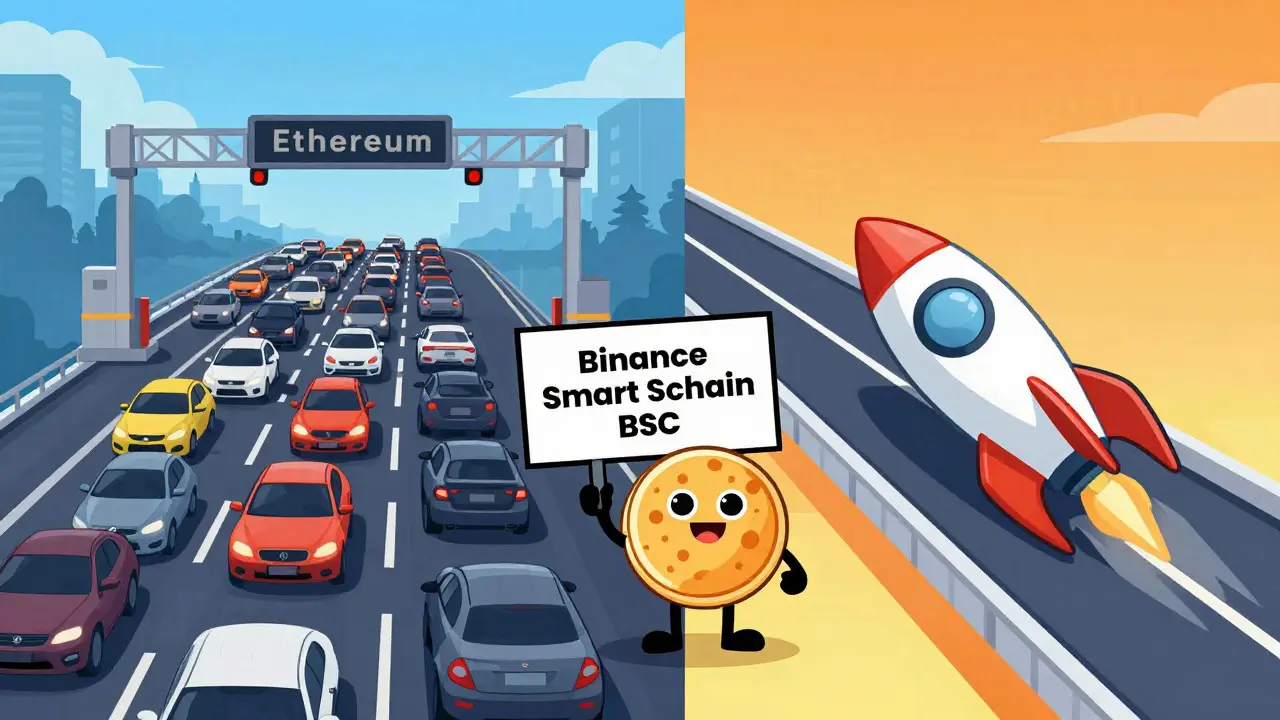
There is a common misconception floating around the crypto forums: that PancakeSwap is a major player on the Ethereum mainnet. It isn’t. If you are searching for "PancakeSwap v2 (Ethereum)," you might be about to waste money on high gas fees or get confused by the wrong network selection. The reality is that PancakeSwap was built specifically for the Binance Smart Chain (BSC), leveraging its fast blocks and low costs. While it has expanded to other chains via routing, its core identity-and where its V2 pools shine-is firmly rooted in BSC infrastructure.
This review breaks down what PancakeSwap V2 actually offers in 2026, how its fee structure compares to Ethereum-based rivals, and whether it fits your trading style. We will look at the real-world performance, the risks involved, and who should actually use this platform versus those who should stick to centralized exchanges or Ethereum-native DEXs like Uniswap.
The Core Truth: BSC, Not Ethereum
Before diving into features, let’s clear up the biggest hurdle for new users. PancakeSwap operates as an Automated Market Maker (AMM) on the Binance Smart Chain. This means it trades BEP-20 tokens, not ERC-20 tokens directly on the Ethereum mainnet. Why does this matter? Because BSC processes blocks every 3 seconds, compared to Ethereum’s variable but often slower finality, and transaction costs are measured in cents rather than dollars.
If you try to access PancakeSwap while your wallet is connected to the Ethereum mainnet, you won’t see the liquidity pools you expect. You need to switch your MetaMask or Trust Wallet to the BSC network. For those who hold assets on Ethereum, you have two options: bridge your funds to BSC first, or use PancakeSwap’s multi-chain router if available for specific pairs, though the deepest liquidity and lowest fees remain on BSC.
V2 vs. V3: Understanding the Fee Structure
PancakeSwap currently runs two main versions of its pool technology. Most users familiar with the "V2" label are referring to the classic constant product formula pools. Here is how the economics work:
- V2 Pools: These charge a fixed 0.25% trading fee. This applies to all standard swaps. It is simple, predictable, and significantly lower than the typical 1%+ fees found on many centralized exchanges when you factor in spreads and withdrawal costs.
- V3 Pools: Introduced later, these use concentrated liquidity. They offer four fee tiers: 0.01%, 0.05%, 0.25%, and 1%. Traders can choose the tier that best matches the volatility of the pair they are trading. Low-volatility stablecoin pairs often sit in the 0.01% or 0.05% tiers, offering ultra-cheap execution.
For the average retail trader making frequent small trades, the V2 0.25% flat rate is often sufficient and easier to manage. However, if you are a power user looking to minimize costs on stablecoin swaps, checking the V3 pools for the lowest applicable fee tier is a smart move. There are no minimum deposit requirements; you can trade starting from just $1, which is great for testing the waters without risking significant capital.
Feature Set: More Than Just Swaps
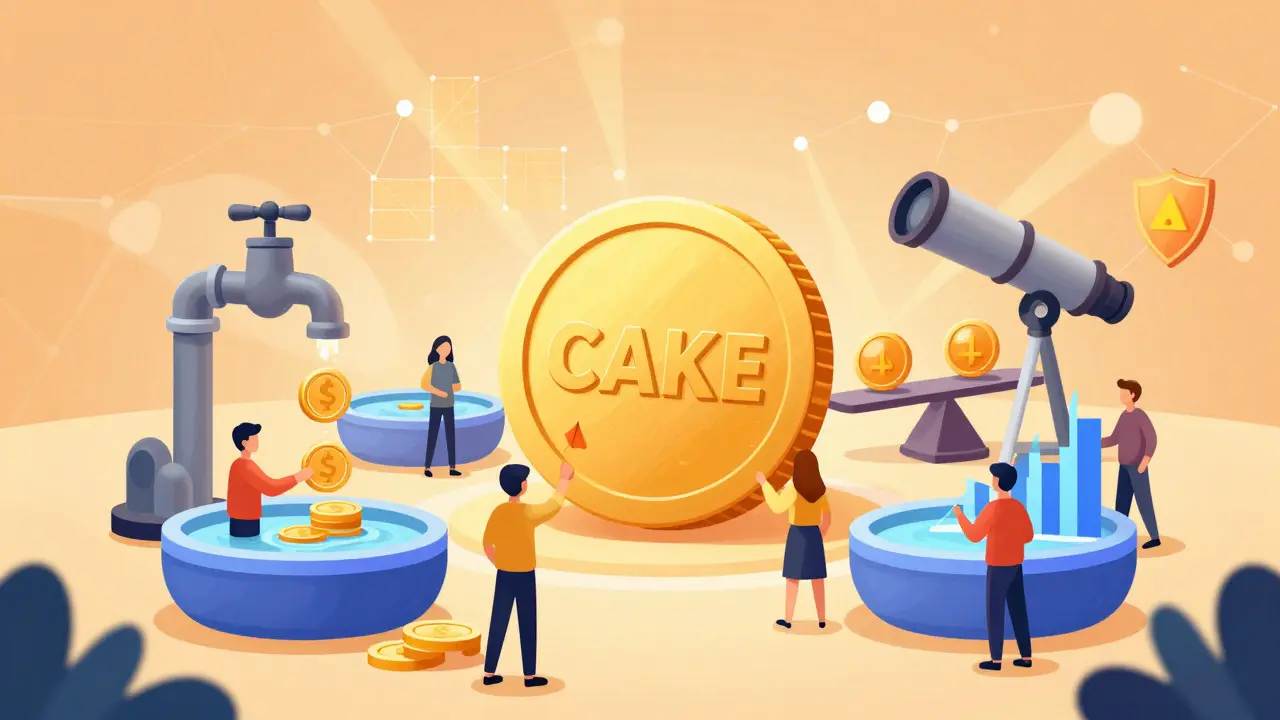
PancakeSwap positions itself as an "all-in-one" DeFi hub. It is not just a place to swap tokens; it is a suite of financial tools bundled together. Here is what you get beyond basic spot trading:
| Feature Category | Description & Impact | User Benefit |
|---|---|---|
| Spot Swaps | Instant exchange of BEP-20 tokens via AMM pools. | Low latency, no intermediaries, 0.25% base fee. |
| Yield Farming | Deposit tokens into liquidity pools to earn trading fees and CAKE rewards. | Potential for higher yields than staking, but carries impermanent loss risk. |
| Perpetual Futures | Leveraged trading powered by ApolloX/Aster infrastructure. | Access to leverage without moving funds to a separate CEX. |
| Prediction Markets | Bet on price movements of specific assets over set timeframes. | Speculative tool for experienced traders. |
| Smart Router | Aggregates liquidity across multiple chains for optimal pricing. | Best execution prices even if the token isn't natively on BSC. |
The inclusion of perpetual futures and prediction markets makes PancakeSwap attractive to traders who want a single interface for both spot and derivatives. However, these advanced features come with complexity. If you are new to DeFi, stick to the Swap tab initially. The farming and perps interfaces require a solid understanding of liquidity ranges and leverage mechanics to avoid costly mistakes.
Risks and Limitations to Consider
No DeFi platform is without risk, and PancakeSwap is no exception. As of 2026, the platform carries a "higher-than-average risk" profile in independent assessments. Here is why:
- Self-Custody Responsibility: You hold the keys. If you lose your seed phrase, there is no customer support team to call. No one can reverse a transaction if you send funds to the wrong address or approve a malicious contract.
- Smart Contract Risk: Like all DEXs, PancakeSwap relies on code. Bugs or exploits in the contracts could lead to fund loss. While audits are performed, history shows that even audited protocols can face vulnerabilities.
- Asset Limitations: PancakeSwap supports around 164 cryptocurrencies. This is a solid number for a DEX, but it pales in comparison to centralized exchanges like Binance or Coinbase, which list thousands of pairs. You won’t find native Bitcoin or Litecoin here; you’ll be trading their wrapped BEP-20 versions.
- Regulatory Uncertainty: Being unregulated offers freedom but also lacks consumer protections. Regulatory shifts in major jurisdictions could impact accessibility or tax treatment.
For beginners, the learning curve is steep. The interface is intuitive once you know what you’re doing, but navigating slippage settings, wallet approvals, and network switches can be overwhelming. Start with tiny trades-$10 or $20-to get comfortable with the flow before committing larger sums.

Who Should Use PancakeSwap?
PancakeSwap is ideal for specific types of users. If you fall into these categories, it’s worth setting up a wallet and connecting to the platform:
- Cost-Conscious Traders: If you make frequent small trades, the low BSC gas fees and 0.25% swap fee save you significant money compared to Ethereum-based alternatives.
- DeFi Enthusiasts: Users who want to farm yield, stake CAKE, and explore prediction markets in one place will appreciate the integrated ecosystem.
- Privacy-Focused Individuals: No KYC (Know Your Customer) required. Trade purely with your wallet, keeping your identity private.
- Multi-Chain Users: Those who operate across BSC and Ethereum Layer 2s can benefit from the Smart Router’s aggregation capabilities.
On the other hand, avoid PancakeSwap if you are an absolute beginner who needs hand-holding, if you rely on fiat on-ramps (you’ll need to buy crypto elsewhere first), or if you demand deep liquidity in obscure non-BSC tokens. For those purposes, a centralized exchange or a specialized Ethereum DEX might serve you better.
Final Verdict
PancakeSwap V2 remains a powerhouse in the DeFi space, primarily because of its efficiency on the Binance Smart Chain. It delivers on its promise of low-cost, fast trading with a feature set that goes far beyond simple swapping. The key takeaway is to respect the network: ensure you are on BSC for the best experience. If you are comfortable with self-custody and understand the risks of smart contracts, PancakeSwap offers a robust, cost-effective alternative to traditional exchanges. Just remember, it’s a tool for active participants, not a passive savings account.
Is PancakeSwap available on Ethereum Mainnet?
Primarily, no. PancakeSwap is built for Binance Smart Chain (BSC). While it has multi-chain routing capabilities, its core liquidity and lowest fees are on BSC. To use it effectively, you should connect your wallet to the BSC network.
What is the trading fee on PancakeSwap V2?
The standard trading fee for V2 pools is 0.25%. Additionally, you will pay a small network gas fee on BSC, which typically costs only a few cents.
Do I need to do KYC to trade on PancakeSwap?
No. PancakeSwap is a decentralized exchange, so there is no account creation or identity verification process. You only need a compatible crypto wallet like MetaMask or Trust Wallet.
Can I trade Bitcoin on PancakeSwap?
You cannot trade native Bitcoin directly. However, you can trade wrapped versions of Bitcoin (like BTCB) that exist on the Binance Smart Chain as BEP-20 tokens.
Is PancakeSwap safe to use?
It is generally considered safe due to its established track record and audits, but it carries inherent DeFi risks such as smart contract bugs and self-custody responsibility. Always verify contract addresses and start with small amounts if you are new.

Hicham Mounir
It is truly a tragedy that so many people still confuse the networks. I have seen friends lose half their portfolio just because they forgot to switch MetaMask from Ethereum to BSC before swapping. The gas fees alone are enough to make you cry, but the confusion? That is what breaks your spirit. Please, for the love of all things holy, check your network selection twice. It is not rocket science, yet we act like it is. We are all just trying to save a few cents here and there, aren't we?
Linda Leeuwesteijn
Such a helpful breakdown! 🌟 I was actually thinking about moving some stablecoins over to try out those V3 pools with the 0.01% fee tier. It sounds incredibly efficient compared to what I'm used to on other chains. Does anyone have experience with the slippage settings on BSC? I always feel a bit nervous about setting them too high and getting a bad deal, but too low and the transaction fails 😅
Sarah Hafner
Hey! (:) For slippage, if you are trading major pairs like CAKE/BUSD or ETH/BNB, you can usually keep it pretty low, maybe around 0.5% or even less. But if you are dipping into smaller cap tokens, bump it up to 1-2% to ensure the trade goes through. Also, remember that BSC blocks are fast, so if it fails, it usually reverts quickly without costing you much in gas. Just double-check the contract address first though!
Patrick Quairoli
wait so u r saying its not on eth?? thats a lie right?? i saw a tweet yesterday where some guy said pancake swap is coming to mainnet soon and its gonna be huge. this article is just trying to scare us away from the real alpha. i bet they are hiding something. why else would they emphasize bsc so much? its gotta be a trap. the whales know something we dont. #conspiracy #truthseeker
Walker Perry
Another one who thinks the government is hiding the truth about blockchain infrastructure. If it's not on Ethereum, it's probably being suppressed by the SEC anyway. Why do we trust Binance Smart Chain more than our own native chains? Because they're cheap and fast, sure, but at what cost to our financial sovereignty? We need to stop relying on foreign-coded protocols and build our own American DEXs. Wake up people.
Zothana Pachuau
Oh, give it a rest. If you want to trade cheaply, use PancakeSwap. If you want to pay $50 in gas fees to feel superior, go ahead and use Uniswap. There is no conspiracy, just math. The block time is 3 seconds vs 12+ on L1. Do the math, then judge. :)
Gary Straiton
Drama much? You think 'math' is a conspiracy theory now? How quaint. The only thing being suppressed is your ability to read a basic technical review. Enjoy your expensive gas fees while the rest of us actually move capital efficiently. It's not about nationality, it's about utility. Grow up.
Shawn Schaerer
One must consider the philosophical implications of such network fragmentation. Is the value of a token truly intrinsic, or is it merely a function of the liquidity depth provided by its host chain? When we migrate assets across bridges, do we preserve their essence, or do we merely create a shadow copy? The question remains: in a decentralized world, who defines the 'real' asset? Perhaps we are all just ghosts in the machine, chasing numbers that mean nothing without consensus. Yet, here we are, debating fees.
michelle aguilar
How... charming. Truly, how very profound of you to ask such a... basic question. Most people, however, simply accept the market as it is presented to them, without needing to deconstruct the ontological status of every single BEP-20 token. It is, after all, rather exhausting to maintain such a level of intellectual rigor when one could simply... click the button. But I suppose not everyone has the capacity for such deep thought. Or perhaps they just prefer their money safe in a CEX. Who knows?
manish jha
You speak with great confidence but little substance. The 'essence' of an asset is its utility and adoption, not its chain location. If BTCB works for your trade, it is valid. Stop overthinking and start executing. The market does not care about your philosophy, it cares about your entry price.
Ami Elizabeth
lol yall arguing about philosophy while i am just trying to buy some sushi with my crypto. keep it simple folks. bsc is cheap. end of story. 🍣
Dina Lazarova
It is somewhat tedious to witness the sheer volume of misinformation circulating regarding DeFi platforms. One assumes that by 2026, the distinction between L1 and L2 ecosystems would be common knowledge among any self-proclaimed 'investor.' Yet, here we are, debating whether PancakeSwap is on Ethereum. A fundamental error, indeed. It suggests a lack of due diligence that is frankly embarrassing for the sector. One should really educate oneself before posting public opinions. It saves everyone the trouble of having to correct them.
Ashley Snyder
I don't think it's embarrassing at all! Learning curves are normal. I made the same mistake last year and lost about $20 in gas fees trying to bridge back. Now I just keep a small amount of BNB on BSC specifically for this. It's a nice reminder to stay humble. We were all beginners once, right? 😊
Susan Kiley
Ah, the classic beginner's tax! 💸 So delightful to see someone learn the hard way. It builds character, doesn't it? Though, I suppose if you had done your research, you wouldn't have needed to 'learn the hard way.' But then again, where is the fun in that? At least you learned! Now, do tell, did you also forget to approve the token properly? That is another common pitfall for the uninitiated. One must be so careful with these things. It's a minefield, really. But you survived! Bravo! 👏
alex fordy
Honestly, the approval issue is a big one. I always revoke unused approvals using Revoke.cash or similar tools. It gives me peace of mind knowing I haven't left infinite access to random contracts. Highly recommend making it a habit if you're active on DeFi. It’s a small step that prevents big headaches later. 🛡️✨
Lance Konig
The narrative surrounding PancakeSwap V2 is largely overstated in terms of innovation. It is, fundamentally, a derivative of Uniswap V2 logic, adapted for a different chain. To claim it offers a unique 'feature set' beyond swaps is to ignore the fact that most of these features-farming, perps, predictions-are now standard fare across the DeFi landscape. The true value proposition is purely economic: lower fees. Anything else is marketing fluff designed to distract from the fact that it is a second-tier protocol riding on the coattails of Binance's user base. Do not be fooled by the shiny interface.
Evelyn Kula
Oh, please. Another 'second-tier' comment from someone who probably hasn't touched a DEX since 2021. PancakeSwap's TVL speaks for itself. And let's not forget, 'second-tier' is still infinitely better than the bloated, slow mess that is Ethereum L1 for retail traders. If you want to be elitist, go farm LP on Uniswap V3 and enjoy your impermanent loss. The rest of us are here to actually make trades. #RealTalk #BSCSupremacy
Nia Franklin
Y'all are both kinda right, innit? It's a tool, not a religion. I use PancakeSwap for quick swaps because it's fast and cheap, but I keep my long-term holds on Eth or Sol depending on what feels right that week. It's all about vibes and utility, not brand loyalty. Don't get too attached to one chain, life's too short for gas fee drama!! ✨🚀💖
Alexander Scheel
It is quite amusing to observe the tribalism that arises in online forums. On one side, the purists who believe in the sanctity of the Ethereum mainnet; on the other, the pragmatists who simply wish to transact without paying exorbitant fees. Both camps are equally wrong in their absolutism. The future of finance is multi-chain, and the winners will be those who are flexible enough to utilize the best tool for each specific task. Moral superiority has no place in economics. Only efficiency matters.
Mohamed Shoaeb
Efficiency is key. I agree with the pragmatic approach. In India, we often say 'Jugaad' - finding a smart, resourceful solution to a problem. Using BSC for cheap trades and bridging when necessary is exactly that kind of smart approach. No need for drama, just results. Keep it chill and keep trading. 🇮🇳📈
Phelan Deihl
Just wanted to add a quiet note about the risks mentioned in the post. I lost a small amount to a rug pull on a BSC pair last month. It wasn't PancakeSwap's fault, but the platform's speed means you can get in and out fast, which is good, but also means scams move fast. Always check the token contract on BscScan before buying anything obscure. Stay safe out there.
Rod Sidoroff
You are clearly a novice. Rug pulls are not the platform's fault; they are the result of poor due diligence. If you cannot read a contract audit or check holder distribution, you do not belong in DeFi. You are a liability to the ecosystem. Go back to your savings account where it is safe and boring. The market will eat the weak. It always has. Do not expect hand-holding. Earn your profits.